


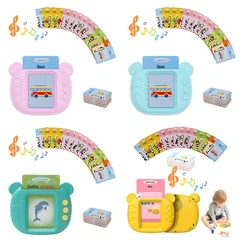
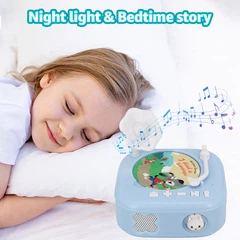
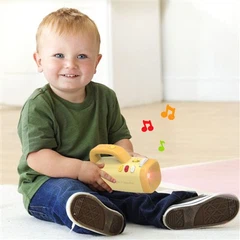
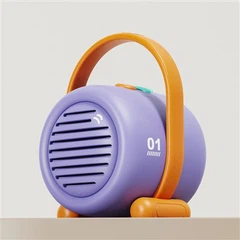




What Is a Screen-Free Audio Player?

A screen-free audio player is a children's listening device built without a display. A child chooses a story by placing a card on the unit, by setting a figure onto its seat, or by pressing a single key, and the unit plays the audio from local storage. There is no application to install, no account to create, and no network path in the standard configuration. Buyers should read this definition less as a feature list than as a cost structure: the display is usually the most volatile line in an electronic toy bill of materials, and removing it removes the line and its price movement together.
What most programmes are actually buying is three things: a wider age band, fewer after-sales failure modes, and content as a second line of business. Story libraries update over USB or SD, storage is specified from 4GB to 16GB, and narration is recorded with native voices in English, Chinese, Spanish, Arabic, French and Japanese. We build this category as an OEM/ODM manufacturer rather than as a catalogue reseller, which means the enclosure, the board, the acoustic path, the scripts and the carton are specified in one conversation and frozen in one controlled document set.
Before comparing specifications, answer three questions inside your own team. Who presses the control, and with how much force: a three-year-old alone in a bedroom, or a teacher managing twenty units at once? Where does the unit sit at two in the morning, and does it need to stop by itself? When something fails, does your team ship a replacement or answer a review? Those three answers decide the enclosure geometry, the firmware behaviour and the spare-unit plan for a screen-free audio player, and every one of them is cheaper to answer now than after steel is cut.
How a Screen-Free Audio Player Programme Moves from Brief to Mass Production

Almost every delayed project in this category is not an engineering failure; it is a sequence failure. The five decisions below are the ones that actually move your launch date, and each of them sits next to a lead time we publish openly, because buyers plan calendars rather than quotations.
Step A → Freeze the trigger and the listening path before anything cosmetic: card slot, figure seat or a single key - the choice belongs to your channel and your age band, not to styling. Recognition depends on two tolerances: how the card sits in the slot and how its artwork registers on the face. Trigger geometry is drawn into the STP file, which our engineers issue within three days of a signed brief.
Step B → Draw the enclosure around the acoustics and the trigger: rear-cavity volume, grille open area, key travel and the battery door are one drawing set, not four styling rounds. Verifying them costs one printed part: our three-dimensional prints are delivered within three days, and a tolerance discovered here costs a print file, while the same discovery in steel costs a tool modification and a season.
Step C → Write the behaviour down: start-up sequence, story order, timer default, what the unit remembers when it is switched off again, and how it behaves at the volume ceiling. This becomes the programme white paper, prepared within three days, and it is the document your firmware, your test house and your retail buyer all read.
Step D → Freeze electronics, power and storage in one pass: speaker specification, storage step against your twelve-month language plan rather than your first market, AAA tray or rechargeable lithium, and the compartment layout that belongs to the approval route you intend to follow. Our electronics team delivers a PCBA sample within five days, and the configuration that goes to your laboratory must be the configuration that ships.
Step E → Cut steel, then run: thirty days to a dedicated tool and thirty days to mass production for a screen-free audio player. Tooling ownership, amortisation terms and expected volume over twelve months belong in writing before steel is ordered, because those three lines are commercial decisions recorded in engineering language.
Key Features of a Screen-Free Audio Player

1. Trigger Geometry Before Cosmetics
Feature: The trigger - a card slot, a figure seat or a key with defined travel - is drawn into the STP file before the silhouette is styled, together with the card tolerance it depends on.
Advantage: A tolerance problem found on a printed part costs one print file. The same problem found in steel costs a tool modification, a re-test where applicable, and a launch window.
Benefit: What you are buying here is the right to change your mind cheaply and early. In this category a one-week slip at the drawing stage becomes a one-season slip once a tool exists, and that is the difference between landing a promotion and missing it.
Evidence: Three structural and design engineers issue the STP file within three days, and the first physical check is a printed part delivered within another three days.
2. No Display in the Bill of Materials
Feature: The standard configuration carries no display, no application, no account and no network path. Selection happens through a physical object and playback runs from local storage.
Advantage: That removes three of the most common return reasons in connected children's electronics - a cracked screen, an application that stops being supported, and an account that cannot be created - and it removes the component whose price moves most between quotation seasons.
Benefit: Fewer returns protect your review score and your listing position, and a fixed bill of materials lets you hold a price across a twelve-month forecast instead of re-quoting every quarter.
Evidence: Every unit passes 100% function test under an AQL 1.0 regime, in a plant running more than twenty thousand units a day.
3. Content That Lives Outside the Board
Feature: The story library sits outside the board and updates over USB or SD, with storage specified from 4GB to 16GB and narration recorded by native speakers.
Key functions include:
• Version numbers attached to every script release, so a batch can be identified after shipment.
• Language codes burned into firmware and mirrored onto the carton.
• Supplementary card packs that can be printed without touching the tooled parts.
• Six-language recording in English, Chinese, Spanish, Arabic, French and Japanese.
Advantage: A new language becomes a content project rather than a development project, which turns a small-language commitment into a small-language pilot.
Benefit: Refill packs are the highest-margin re-order in this category - no tooling, no electronic material, no certification round and no firmware change. If a pilot fails, what you hold is printed cards and audio files rather than populated boards, which is usually why a screen-free audio player range is renewed for its content rather than for its hardware.
Evidence: More than one million units manufactured since 2010, with content and packaging sourced from one controlled release process.
4. Sleep Behaviour Written Into Firmware
Feature: What happens at power-up, at the end of a story, at the volume ceiling and when the timer expires is specified in the programme white paper before firmware freeze.
Advantage: The two most expensive complaints in bedtime listening - a unit that runs all night and a flat battery in the morning - are firmware behaviours, not hardware defects, and neither can be corrected after shipment.
Benefit: Behaviour you can document is review protection and listing protection, and it is also your strongest argument in the next replacement-cost conversation with a retail buyer.
Evidence: Behaviour is fixed in the three-day programme white paper, and two quality engineers together with ten inspectors hold the line between that document and the units that leave the factory.


5. One Platform, Three Price Tiers
Feature: Good, better and best versions share one audio platform. The differences sit in enclosure finish, bundled cards, storage step and carton specification.
Advantage: Because the electronics stay common, your slow-moving inventory is plastic and printed material rather than finished boards.
Benefit: You can change the mix inside the season without re-testing a new board, and tooling cost is amortised over a twelve-month forecast rather than over the first order.
Evidence: Ten injection machines and an in-house tool room support thirty days to a dedicated tool and thirty days to mass production.
6. One Unit, One Document Pack
Feature: Every configuration ships with a single indexed document pack rather than a folder assembled in the week the vessel is booked.
Advantage: What a retail buyer purchases is not compliance as an idea; it is the ability to prove that the unit on the shelf is the unit that was tested.
Benefit: Document delay is calendar delay. A pack that already exists before the container sails is frequently the difference between shipping this season and shipping next season.
Evidence: ISO9001, BSCI and SEDEX audits, CE (EN71) covering EN71-1/2/3, EN 62115 for the electrical part, FCC Part 15 where a radio feature is added, RoHS, UKCA, and CPSIA together with CPC supporting files, all delivered with AQL 1.0 reports and 100% function-test records.
B2B Applications: Where Screen-Free Audio Players Fit

The same screen-free audio player sells into six different rooms. What changes is not the product but the recommended configuration, and each recommendation below carries one trade-off you should accept consciously rather than discover later.
1. Brand owners and education publishers - Take the private-mould route with your own content sequence, and plan the first four card packs now: adding them later means a separate print quantity rather than a firmware update. Recommended configuration: own enclosure, one shared board, six-language narration. Trade-off: you fund tooling, amortised over a twelve-month forecast; in exchange nothing in your programme appears in anyone else's catalogue.
2. Large supermarket and chain retail buyers - Ask for the file, not the promise. Specify the full set up front: BSCI and SEDEX social audits, ISO9001, CE (EN71) with EN71-1/2/3, EN 62115 for the electrical part, FCC Part 15 where a radio feature is present, RoHS, UKCA, and CPSIA with CPC supporting documents, plus AQL 1.0 and 100% function test records. Recommended configuration: existing platform model with two colourways in an open-window carton that shows a card in the slot. Trade-off: less differentiation, faster listing.
3. Import distributors and promotional buyers - Take the fixed-bill-of-materials platform version: no service fee per unit, no subscription, no backend to maintain, so landed cost can be quoted twelve months ahead. Quote refill packs separately, because their minimum quantity is a print quantity rather than an electronics quantity. Trade-off: you compete on availability and price, not on novelty.
4. Amazon and marketplace sellers - Two lines decide your margin: dimensional weight and review score. Specify a compact enclosure, put the moment a card drops onto the unit into your main image, and test two colourways from one tool. Trade-off: a second colourway doubles your listing work before it doubles your sales.
5. Nursery groups and education chains - Buy in sets rather than in single units: one content version per site, a volume ceiling written into the specification, and a one-page staff guide instead of a training session. The absence of an application is a feature in this room, not a compromise. Trade-off: minimal packaging, so this configuration will not cross into gift retail without a second carton.
6. IP licensors and gift channels - Character voices and a planned series of cards turn one tool into a family. Book the approval slot before you book the tooling: licensors approve objects rather than renderings, so budget for a sample produced from production tooling. Trade-off: the approval calendar, not our lead time, is usually the longest line in this route. We do not reproduce a character whose rights chain has not been shown to us.
OEM/ODM Customization Services for Screen-Free Audio Players

Product Design Customization
Design work starts with the trigger and the acoustic path, not with a picture of a finished toy.
• Trigger type - card slot, figure seat or key - selected against your channel and your age band.
• Slot and seat geometry drawn into the STP file, then verified on a printed part.
• Enclosure styled around rear-cavity volume and grille open area rather than the reverse.
• One shell family planned together with its colourways, finishes and second-tier variant.
Every design output lands in one controlled drawing set, because the version you approve is the version we quote and later build.
Hardware Customization
Hardware is specified once, as one configuration, for one reason: the screen-free audio player sent to your laboratory must be the unit that ships.
• Recognition path matched to card artwork print tolerance.
• Speaker, rear cavity and grille specified as a single acoustic package.
• Storage of 4GB to 16GB chosen against your twelve-month language plan.
• Power options - AAA tray or rechargeable lithium - with the compartment laid out for the route you intend to follow.
• Switches, key travel and the volume ceiling written into the specification rather than left to firmware.
Software & AI Content Customization
Content and firmware are one deliverable here: the behaviour your buyer will read about in reviews is written before the board is frozen.
• Scripts, narration and music produced with native voices across six languages.
• A programme white paper covering start-up, story order, timer behaviour, volume default and low-battery behaviour.
• Content version number and language code burned into firmware and mirrored onto the carton, so a mismatch is caught at goods-in rather than in reviews.
• Optional open conversation delivered as an LLM-driven upgrade with a documented persona sheet and a one-page data map. We claim no privacy certification we do not hold, and which route applies to that feature set should be confirmed with your own notified body or laboratory against the current text.
A character that exists as a document can be approved; a character that exists as a consensus in a meeting cannot.
Packaging & Compliance Customization
Packaging is a structural and documentary deliverable, chosen together with the drop programme your channel uses.
• Window carton, insert tray and display carton designed around that programme.
• Barcode placement, multi-language manuals and age labelling handled as version-controlled files.
• Market-specific text zones so one carton size serves several destinations.
• Document pack assembled per configuration rather than per shipment.
• AQL 1.0 inspection reports and function-test records attached to the batch.

Why Choose XINDITAI as Your Screen-Free Audio Player Partner
Factory-Direct Manufacturing
You work with the plant that cuts the tool, populates the board and runs the line, so the answer you receive about geometry, lead time or a defect is given by the people who own the decision.
• Five thousand square metres, with an in-house tool room and ten injection machines.
• More than twenty thousand units of daily capacity for peak-season orders.
• Three days to STP files, three days to printed parts, three days to the programme white paper and five days to a PCBA sample.
• AQL 1.0 inspection with 100% function test on every unit.
Global Export Experience
Most delays in this category are documentary rather than physical, so export work starts at the brief and finishes at the file pack, not at the port.
• Shipped to more than one hundred and twenty countries and regions.
• Twenty thousand customers served and one million units manufactured since 2010.
• ISO9001, BSCI and SEDEX documentation prepared in advance rather than on request.
• Seven by twenty-four sales response, with OEM and ODM each about half of our business.

Frequently Asked Questions About Screen-Free Audio Players
Q1: What is the minimum order quantity for a screen-free audio player programme?
We quote three thresholds rather than one number, because the honest answer depends on three choices you have not made yet. Existing platform models carry the lowest quantity, since the tool exists. A private-mould programme carries tooling cost, which we amortise across a twelve-month volume forecast rather than across your first order. Refill packs carry a print quantity, which is why we quote them separately from the main unit. Tell us which combination you expect to run and we will return three figures in one sheet.
Q2: Which compliance files should I request before presenting this to a supermarket buyer?
Ask for the complete set in one request: BSCI and SEDEX social audits, ISO9001, CE (EN71) covering EN71-1/2/3, EN 62115 for the electrical part, FCC Part 15 where a radio feature is present, RoHS, UKCA, and CPSIA with CPC supporting documents, together with AQL 1.0 reports and 100% function-test records. Note where the responsibility sits: the children's product certificate is issued by the importer, not by the factory, and what we supply are the test reports, material declarations and production records that support it. Which items your specific channel requires should be confirmed with your own laboratory or notified body.
Q3: Does the unit collect or upload anything?
In the standard configuration there is no camera, no network path and no cloud account, and the audio plays from local storage. Optional open conversation is an LLM-driven upgrade that we document: a persona sheet defining permitted and prohibited statements for the character, and a one-page data map describing what is captured, where it is processed, how long it is retained and how it is deleted. We claim no privacy certification we do not hold, and the applicable route should be confirmed with your own notified body.
Q4: How long does development actually take?
Three days to STP files, three days to printed parts, three days to the programme white paper, five days to a PCBA sample, thirty days to a dedicated tool and thirty days to mass production. In practice the longest line is rarely ours: it is the approval sequence on your side, especially where a screen-free audio player carries a licensed character or goes in front of a retailer committee, so we recommend booking that calendar before ordering steel.
Q5: Can I have my own enclosure and my own packaging?
Yes, and both should be agreed in writing before tooling starts. Tooling ownership and amortisation terms belong in the contract rather than in an email thread. Packaging has three different freeze points: the die-line locks when the plates are made, the manuals lock at translation sign-off, and marketplace dimension fields lock when your listing is built. A version number on each of those files is what keeps a good carton from being printed against an old drawing.
Q6: What happens if a batch has problems?
Warranty terms are fixed in the purchase contract rather than in a brochure, so both sides know what they are arguing from. Beyond that we keep batch traceability linking units to their inspection records and function-test results, we hold a seven-by-twenty-four response line during your selling season, and we agree the treatment of cosmetically imperfect but functionally sound goods before the first shipment rather than after it.
Future Trends in Screen-Free Audio Players
1. Content ownership becomes the margin line - Hardware margin in this category keeps thinning, and the economics that decide whether a channel renews now sit in the refill packs. Plan the second, third and fourth pack at the same time as the first unit.
2. Firmware behaviour becomes a listed specification - Timer memory, default volume and bedtime sequence are moving out of engineering notes and into listing copy, because reviewers describe exactly those behaviours. Specifying them early turns a source of complaints into a source of differentiation.
3. Bedtime becomes a family of models rather than one model - Once timer behaviour and storage structure are specified and tested, your next bedtime model inherits them instead of re-developing them, which shortens the second launch by more than the launch you are running now.
4. The voice path becomes a per-SKU decision made in the brief - A fixed command set carries a one-off bill-of-materials cost you can lock; open conversation carries a service cost that recurs per unit. Both fit the same enclosure, but the microphone, board and battery freeze at the PCBA stage and again at tooling, so the decision belongs in the brief and nowhere else.
Conclusion: Start Your Screen-Free Audio Player Project Today
A screen-free audio player is a straightforward product to specify and an expensive one to specify late. The decisions that decide your launch date - which trigger, which tolerance, which timer behaviour, which power path, which files - all live in the first three weeks, when changing them costs a drawing revision, and none of them can be recovered cheaply once steel is cut.
Bring us a channel, an approximate volume over twelve months and the languages you intend to sell, and we will return a configuration, a document list and a dated plan. If the fit is wrong for your channel, we will say so before you spend anything on tooling.
Contact Us
Contact: Zoey
WhatsApp: +86 13342950150
Email: xdt06@dtdianzi.com
Company: SHENZHEN XINDITAI ELECTRONIC CO., LTD | Website: www.kidsoundbook.com
Hot Tags: screen-free audio player, China, suppliers, manufacturers, factory, customized, wholesale, bulk, quotation, made in China


