







Introduction
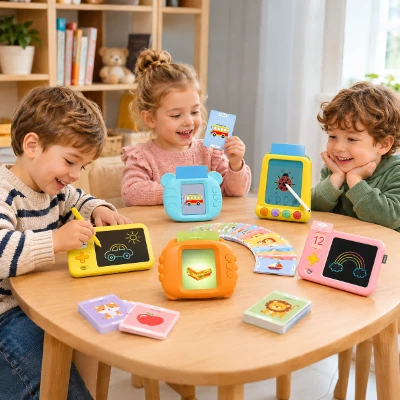
A talking flash card reader is 95 mm wide, 78 mm tall, and looks like a toy radio that lost its dial. The card goes in the top, the machine says the word, the child pulls the card out and reaches for the next one. That is the whole product. 🎴
Which is why the mechanical design matters more than the electronics. The reader identifies a card and plays a file, and both of those are solved problems costing a few cents. The unsolved problem is a hand that arrives at the slot with enthusiasm, at an angle, at speed, sometimes holding two cards.
This article is about the slot: what it has to do, the four dimensions that decide whether it works, and the tests that show the difference between a slot that survives a classroom and one that survives a photo shoot.
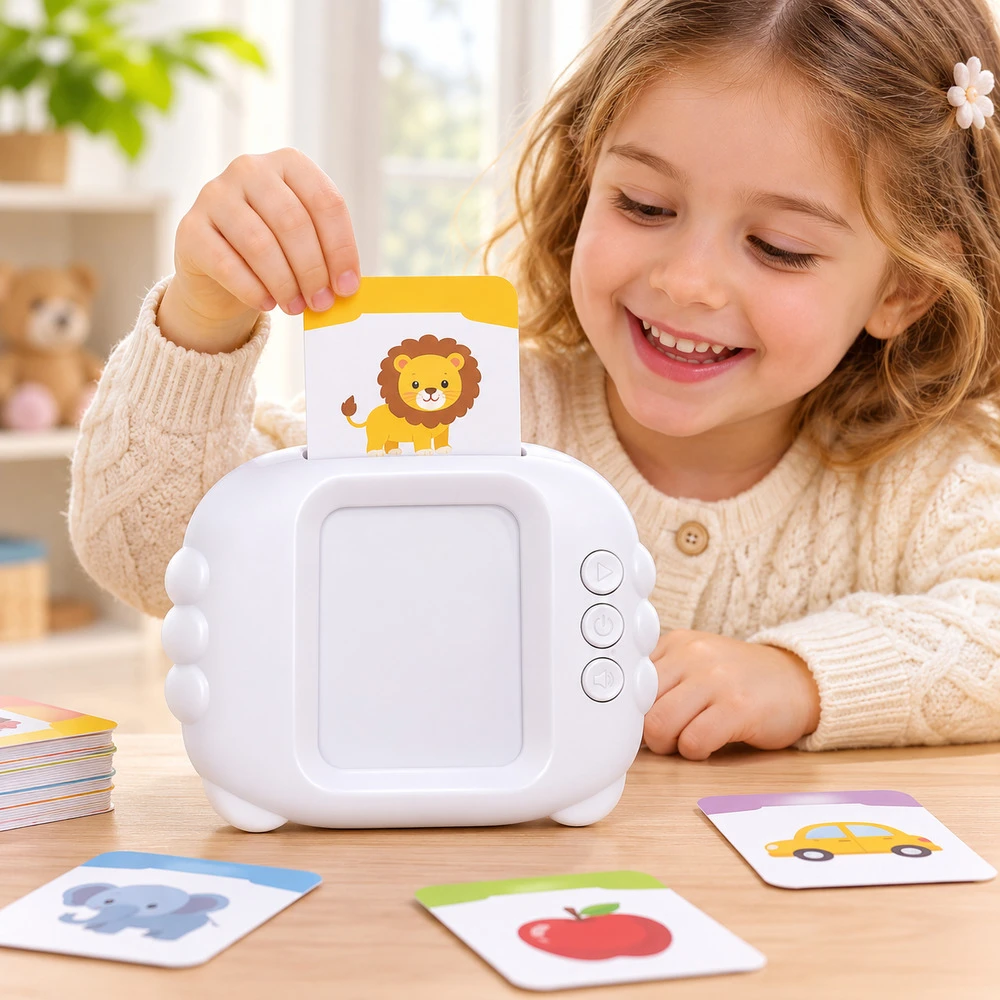
A child inserts a card into the top slot with one hand; the card has to find a 1.4 mm aperture on the first try
Five jobs in twenty millimetres of plastic
The slot is not a hole. It is a mechanism with five sequential jobs, and the design fails if any one of them is solved at the expense of another.
Lead in. The card arrives off-axis most of the time. A chamfer at the mouth converts a 15 degree approach into a straight insertion within the first 3 mm.
Guide. Two rails or a channel hold the card plane so it cannot rotate once the leading edge is inside. Without this, the card corners dig into the plastic.
Hard stop. The card has to reach a repeatable depth, because whatever senses the card sits at the end of travel. A card that stops 1 mm short is a card that reads intermittently.
Retention. Once seated, the card must not fall out when the toy is turned over, shaken, or dropped on a wooden floor.
Extraction. A child must be able to pull it out with two fingers without tearing the card or lifting the product off the table.
The fifth job and the fourth fight each other. Every gram of retention is a gram of extraction force, and the two constraints meet somewhere around one newton.
The 1.4 mm that decides everything
Cards for this category are printed on 300 to 350 gsm board and laminated both sides with 50 to 80 micron film. The finished card is 0.55 to 0.65 mm thick, and it varies by plus or minus 0.05 mm across a print run because lamination pressure varies.
A slot aperture of 1.4 mm leaves roughly 0.4 mm per side. That sounds generous until the tolerance stack is added up: card thickness variation, card warp of up to 0.3 mm across 60 mm, slot draft from the mold, and the flash line at the parting surface.
At 1.6 mm the card tilts easily and the leading edge can miss the guide rails. At 1.1 mm a warped card jams, and a jammed card is worse than a loose one, because a child resolves a jam by pushing harder.
The number that matters on the drawing is not the aperture. It is the guidance length, the distance over which the rails hold the card flat. Under 6 mm and the card still has enough angular freedom to catch a corner. Above 12 mm and friction starts to fight the child's hand. 📏
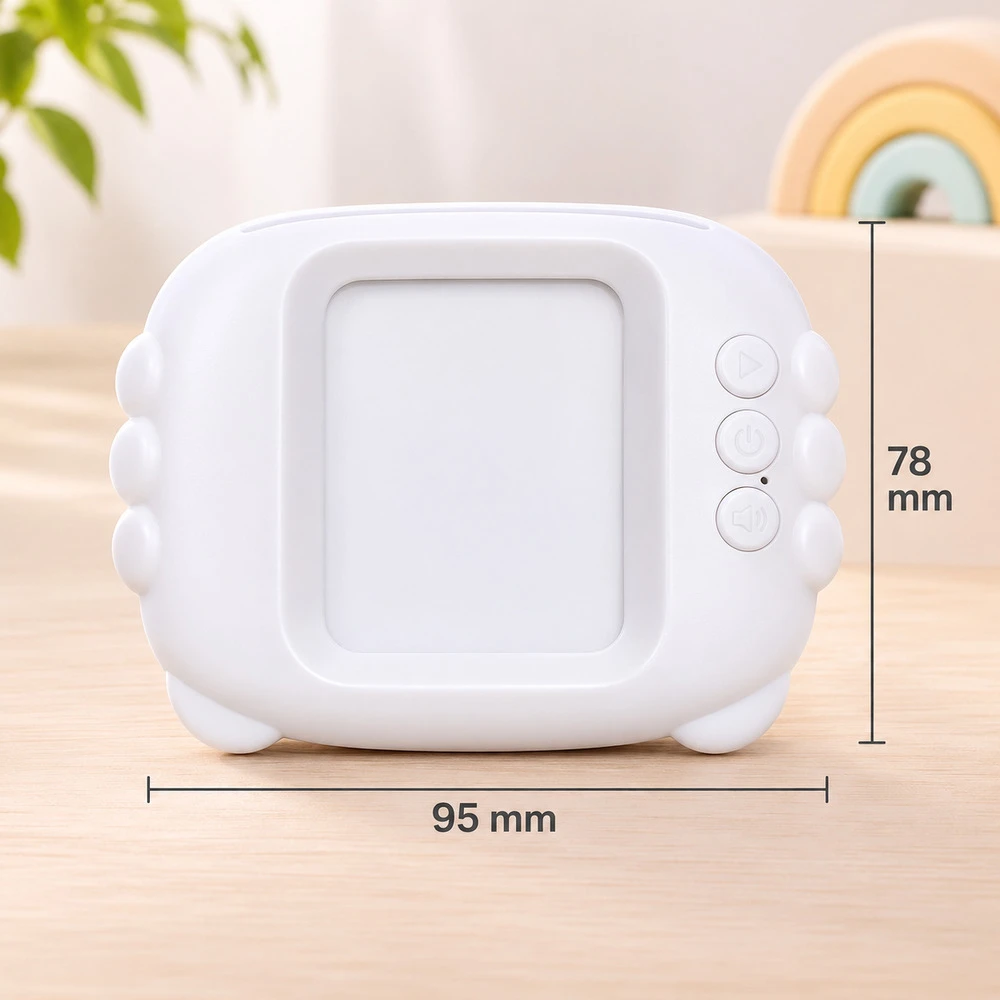
95 mm by 78 mm: the slot runs the full width of the top edge, so the case height sets the guide length
Why the mouth has to be a funnel
A straight-edged slot will accept a card that arrives perfectly aligned and reject everything else. The chamfer is what makes the product usable, and its angle is a compromise.
A 30 degree chamfer, 0.8 mm deep, catches a card arriving within about 12 degrees of the slot axis and steers it in. A 45 degree chamfer widens that window but eats into the wall thickness at the top edge, which is the thinnest part of the case. A 20 degree chamfer is gentler on the card edge but rejects more attempts.
The chamfer also determines what happens to the card edge. A sharp transition scrapes the laminate and starts the delamination that shows up three months later as a white fringe. A radiused transition, 0.3 mm, burnishes the edge instead of cutting it.
Insertion force should land between 2 and 4 newtons. Under 2 N the card does not feel seated and children keep pushing. Above 4 N a small hand cannot overcome the friction at the angle it naturally holds the card. 🖐️
The fifteen degree case
Watch a child insert a card and the angle is not vertical. It is fifteen to twenty degrees off, because that is where the wrist is comfortable when the toy sits on a table.
At that angle the leading edge contacts the slot mouth on one side first. If the chamfer catches it, the card rotates into alignment. If it does not, the corner digs in and two things happen in sequence: the card stops, and the child pushes harder.
That is the load case the slot actually has to survive, not the clean vertical one in the drawing. It is worth building a fixture that inserts cards at 15 degrees, off-centre by 10 mm, and running it a few thousand times. Most slot problems appear in that fixture and not in a straight-line one. ⚠️
Retention without tearing
Once the card is seated, it has to stay. Turn the toy upside down and shake it, and a card held by friction alone will slide out.
The usual answer is a spring finger molded into the slot wall, or a pair of small ribs that pinch the card within the last 2 mm of travel. Target holding force is 0.8 to 1.5 N. Below that the card falls out in a bag. Above 2 N the child cannot start the extraction, and the natural response is to pull sideways, which tears the card at the slot mouth.
Extraction is also a two-finger operation. A card standing 25 mm out of the slot gives enough grip. A card standing 12 mm out does not, and children end up pinching the toy and the card together.
One more detail that is easy to miss: the retention ribs wear. Molded POM or a stiffener in ABS holds up; a soft rib on a thin wall polishes smooth after a few thousand cycles and stops holding. 🔒
Five thousand insertions and the card edge
The slot outlives hundreds of cards, so the test that means something is a card cycle test with real laminated cards, not a steel gauge.
Run 5,000 insertions with the same card and inspect the leading edge every 500 cycles. What appears first is laminate lift at the two corners, then paper fuzz, then a slight thickening that makes the card drag. The dust that comes off stays inside the case, and on a design where the sensing element sits behind the slot, that dust lands exactly where it hurts.
Worth adding: 200 insertions with slightly damp hands, and 50 with a card deliberately inserted corner-first. Neither is in the standard. Both happen in a kitchen. 🧰 🧪
The card that goes in backwards
Cards are printed on both faces, which removes one error mode and introduces another: the card can be inserted with either face forward, and the child has no way of knowing which one the machine expects.
Two design responses work. Make the card electrically identical in both orientations, so the reader does not care. Or make it mechanically impossible, with a notch and a matching key in the slot, which costs a die cut on the card and a steel detail in the mold.
What does not work is a printed arrow. In our forty-attempt video, no child under four looked at the card before inserting it, and only two of the parents did. 🎯 🔄
What to settle in the drawing
Aperture and card thickness together. Specify the card first, including laminate, then derive the slot. A slot dimension without a card specification is a guess.
Guidance length. Between 6 and 12 mm. Below 6 the card can still rotate; above 12 friction climbs.
Chamfer angle and radius. 30 degrees, 0.8 mm deep, 0.3 mm edge radius. It is the cheapest usability feature on the product.
Retention force. 0.8 to 1.5 N, measured with a pull test on a production card, not a steel strip.
Dust path. Where the paper dust goes when it leaves the card, and whether it can reach the sensor window. ✅
Why does the card sometimes not read?
Three causes, in order. The card is not fully seated, so it stops short of the sensing position. The card is warped and enters at an angle that the guide rails do not correct. Or paper dust has collected on the sensor window after several months of use. The first two are tooling and geometry, the third is a cleaning instruction that should be in the box. 🔍
Can we tighten the slot so the card is held better?
Up to a point. Retention is better solved with a spring finger or pinch ribs than with a smaller aperture, because the aperture also has to accept a warped card. Closing the slot to 1.1 mm buys holding force and loses first-try insertion rate, which is the number parents actually notice.
What card thickness should we specify?
300 to 350 gsm with 50 to 80 micron matte lamination both sides, giving 0.55 to 0.65 mm finished. Thinner cards warp more and feel cheap; thicker cards raise insertion force and cost. Ask for a thickness tolerance of plus or minus 0.05 mm, and check it on the delivered lot, not on the sample. 📦
What this product actually is
A talking flash card reader is a mechanical product with a speaker attached. The card slot decides whether it feels like a toy or a jammed machine, and it is decided in four numbers: aperture, guidance length, chamfer and retention force. 🚀
Every one of those numbers is cheap to change before the mold is cut and expensive to change afterwards. That is the conversation worth having with a buyer in the sample stage, while the drawing is still a drawing.
SHENZHEN XINDITAI ELECTRONIC CO., LTD.
Official Website: www.kidsoundbook.com | www.xinditai.com
Email: happy@xinditai.com WhatsApp: +86 138 2434 3309
LinkedIn: https://www.linkedin.com/in/happy-gao-education-toy-oem-odm/
YouTube: https://www.youtube.com/@XDTHappy