








Introduction
The product is 95 mm wide, 78 mm tall, and small enough to hold in one hand. The front is a face with three buttons. The back is a circular grille, about 45 mm across, with four screws in the corners.
That layout decides almost everything about how the toy sounds. Not the driver, not the amplifier, not the codec. The layout.
This article is about what happens to a small voice in a small box with its only opening aimed at a table. 📐
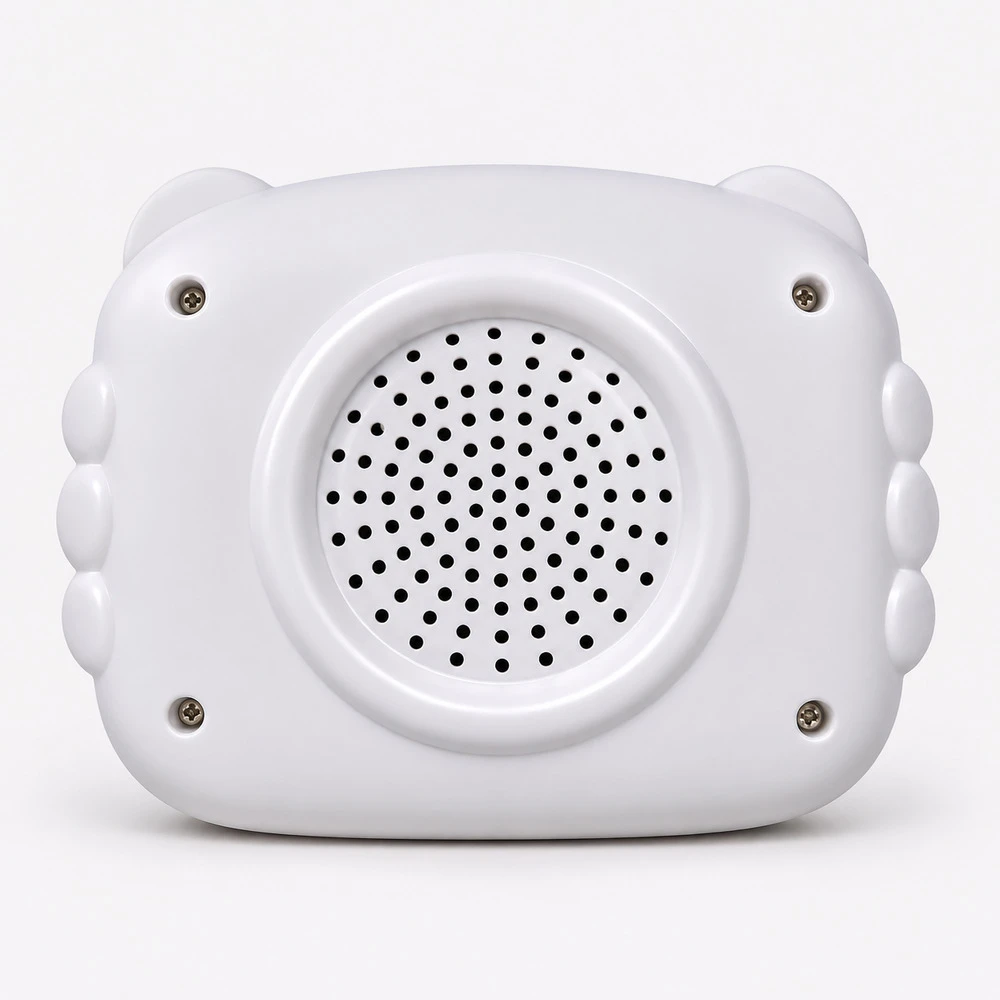
The back cover: one circular grille, four screws, and no other acoustic opening
Why the driver faces backward
Put a speaker on the front of a hand-held toy and the first thing that happens is a thumb.
A child holds the case with the palm across the bottom and the thumb near the buttons, which is exactly where a front grille would be. Press a palm over a 45 mm grille and the output drops by 10 to 15 dB and the tonal balance collapses into a muffled thump. Parents call it "broken", not "covered".
Turning the driver around solves that and raises the next question. Sound now leaves through the back, into whatever the toy is standing on. On a hard table the reflection adds a few dB in the 500 Hz to 2 kHz range and the voice gains body. On a bed, a carpet or a lap, the same sound is absorbed and the toy sounds quiet again.
The design has to work in both. That is a grille question and an equalization question, and it is decided before the first sample. 🎤 🪑
110 cubic centimeters and almost no bass
The internal volume of a case this size, after the board, the cell and the card guide, is roughly 110 cubic centimeters. That is a sealed box the size of a small yoghurt pot.
A 36 to 40 mm driver with a free-air resonance around 180 Hz, dropped into that volume, sees the air spring as a stiff additional suspension. Box resonance moves up, and the low end rolls off early. In practice the useful output begins around 350 to 450 Hz, and everything below is gone.
That is not a defect to design out. A child's voice and the phonemes that carry meaning sit between 300 Hz and 4 kHz, and the toy is a word machine. Chasing bass in 110 cubic centimeters costs a passive radiator, a bigger box, or 30 percent more amplifier power, and buys a warmer thump that masks the consonants the product exists to teach. 📉 🥁
The grille is a low-pass filter
Look closely at the hole pattern: small holes, evenly spaced, roughly 1.2 mm across, through a wall about 2 mm thick. Total open area is around 12 to 14 percent of the circle.
That geometry is an acoustic mass. Each hole plus the air behind it forms a small resonator, and the array behaves as a low-pass element with a corner somewhere between 4 and 6 kHz. It softens sibilance, which is flattering on speech. It also means the high end you hear is a product of the hole pattern, not only of the driver.
Two consequences are worth knowing. Change the hole diameter to 1.5 mm for a cleaner mold and the sound gets brighter and harsher. Reduce the count to make the pattern stronger and the high end drops while the airflow noise rises.
The third consequence is not acoustic at all. A 1.2 mm hole passes crumbs, sand and juice. Every grille in this category needs a mesh or a felt disc behind it, and the felt costs 0.5 to 1 dB of output. 🔈 🍪
Four screws, one gasket, no leaks
The four screws in the photograph are not only there to hold the cover on. They clamp the back cover against a seal, and that seal is what makes the box sealed.
A leak the size of a pin hole in a 110 cubic centimeter box cancels low-frequency output before it ever reaches the room, because the air escapes instead of compressing. The symptom is a toy that sounds acceptable at low volume and gets thinner as it gets louder, which is exactly the range a child uses.
Specify a foam or TPE gasket with about 30 percent compression, torque the screws to a fixed value, and check the seal on the line by listening to a 300 Hz tone at maximum volume. A hiss or a rattle at that frequency is a leak or a loose screw, and both are two-second failures to catch. 🧰 🔧
80 dB(A) at 50 cm and what the test measures
Toys that are held at arm's length are measured at 50 cm, and the limit for this category is 80 dB(A). Toys intended to be held against the ear are measured at 25 cm against a much lower limit, which is why a card reader is not a near-ear product.
Three details decide whether a report is meaningful.
The measurement is made in a free field or a defined test arrangement, not on a wooden desk in a workshop. The signal is typically a warble tone or a defined noise, not a narrated word, because speech has peaks and gaps. And the volume control has to be at maximum, because a report at 70 percent volume proves nothing about the setting a child will find.
For the US market the comparable limit under ASTM F963 is 85 dB(A) at 25 cm for hand-held toys, so a design that passes the European test at 50 cm will normally have room on the American one. 🔍
Clear is not the same as loud
The temptation with a small box is to raise the output until the word is audible across a room. That is the wrong target, and it is audible as distortion.
A driver this size produces about 80 dB at 1 kHz from one watt at one metre, and the compliant ceiling of 80 dB(A) at 50 cm is reached long before the amplifier is working hard. So the design has almost no headroom to spend on loudness, and all of its remaining freedom is in the frequency response.
The useful moves are a high-pass filter around 300 Hz to stop the driver wasting excursion on frequencies it cannot reproduce, and a gentle lift between 1 and 4 kHz where speech consonants live. Both are firmware, both cost nothing, and both make the product sound more expensive than it is. 🌬 🎚️
What an acoustic sample report should contain
Test distance and standard. 50 cm, free field, and which clause the report is claiming.
Volume setting. Maximum, stated explicitly, with the firmware build number.
Frequency response. One third octave, 100 Hz to 10 kHz, on a table and in free air, so the buyer sees both conditions.
Distortion at 1 kHz. At the maximum compliant level, not at a comfortable one.
Rattle and leak check. A sweep at maximum volume, listening for the case resonating.
Without those five, an "80 dB" claim is a number on a page. ✅
Why does it sound different on a bed than on a table?
The grille is on the back, so the surface under the toy is part of the acoustic system. A hard table reflects mid frequencies back toward the listener and adds body. Fabric absorbs them, and the toy sounds thinner. This is normal for a back-firing design and is the reason the equalization is set slightly bright.
Can we move the grille to the front?
You can, and you will lose 10 to 15 dB every time a child covers it with a thumb or a palm. If the front is the only option, the grille needs to sit off-centre, away from the natural grip, and the buttons need to move with it.
Is one speaker enough for a word toy?
Yes. The content is monophonic speech in the 300 Hz to 4 kHz band, and a second driver in a 110 cubic centimeter box would need its own volume and its own crossover. The money is better spent on the driver quality and on the seal.
What this product actually is
A card reader is a small sealed box with one opening pointed at the table. The driver, the grille pattern, the gasket and the four screws are one system, and the frequency response is what a family hears, not the datasheet. 🚀
Get the seal right and the box sounds bigger than it is. Get the grille wrong and the same box sounds like a phone in a cup.
SHENZHEN XINDITAI ELECTRONIC CO., LTD.
Official Website: www.kidsoundbook.com | www.xinditai.com
Email: happy@xinditai.com WhatsApp: +86 138 2434 3309
LinkedIn: https://www.linkedin.com/in/happy-gao-education-toy-oem-odm/
YouTube: https://www.youtube.com/@XDTHappy