











Introduction
The range is six colors: pink, blue, yellow, white, orange and red. One housing tool, six masterbatch recipes, one assembly line.
From a purchasing view that looks like a simple multiplier. In practice, each color has its own process window, its own scrap rate and its own failure mode, and the white one sets the standard for the whole range.
This article is about what decides whether six colors look like one product family, and why the white sample is the one that comes back wrong. 🎨
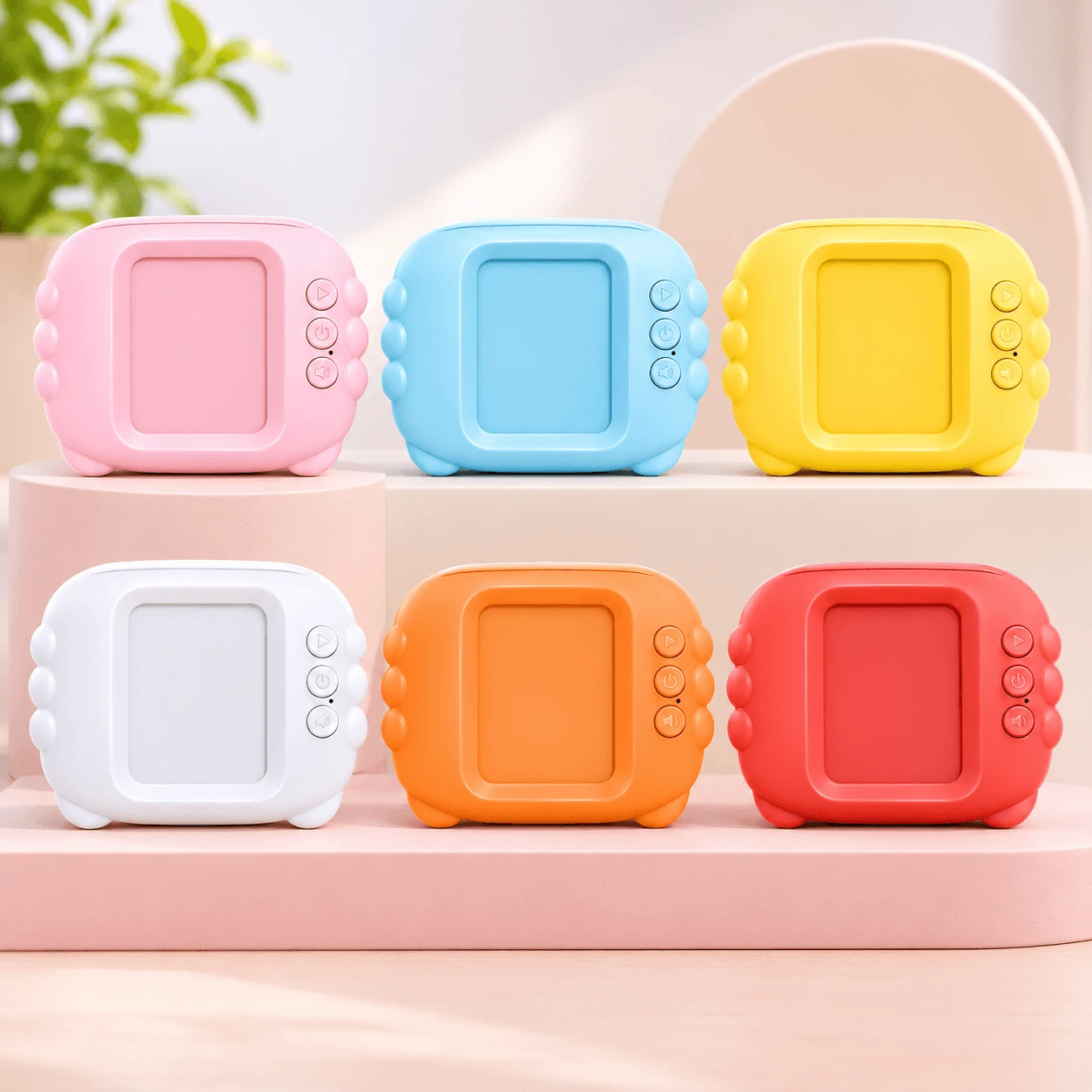
Six colors, one tool: the same housing with six masterbatch recipes
Six colors from one tool
One tool means one flow path, one gate position, one weld line location and one set of shrinkage values. That is good for consistency and hard on color, because every color shows the same mold defects differently.
Dark colors hide flow marks. Yellow and white show everything. A weld line that is invisible on the red housing reads as a thin pale seam on the white one, and a weld line on a toy face is a visible defect at arm's length.
Color changeover is the other cost that never appears in a quotation. Going from red to white on the same machine takes 30 to 60 minutes of purging, plus a scrap ramp until the parts are clean. Sequencing the run from light to dark cuts that in half, and it is free to plan. 📊
The practical rule is to run white first in every shift, not last. 🌡 🏭
Why white is the hardest
White is not an absence of color. It is a pigment system, usually titanium dioxide at 4 to 8 percent loading, and every percent does something to the plastic.
More titanium dioxide means better hiding and a whiter part. It also means lower impact strength, because the particles act as stress concentrators, and higher viscosity, because the filler changes flow. On a housing with a thin wall at the top edge, the difference between 4 and 8 percent is the difference between surviving a drop and cracking at the slot.
The second issue is tone. A pure titanium white under daylight reads slightly yellow, and formulators add a trace of blue or violet to neutralize it. That trace is what makes a white part look clean in a showroom and slightly blue in a warm-lit kitchen.
The third issue is that white has nowhere to hide. Any flow line, any sink, any dust speck in the melt is visible, and no dark color has that problem. 🧪 ⚪
Yellowing is a chemistry clock
ABS yellows because of its butadiene content. The rubber phase that gives the plastic its toughness contains double bonds, and those bonds react with ultraviolet light, heat and nitrogen oxides in the air.
The result is a gradual shift toward yellow that is invisible for months and then obvious in a comparison. Around ΔE 2 is where an untrained eye starts to notice, and a white housing can reach that in a year of shop-window exposure.
Three levers control the clock. A UV stabilizer package, which adds cost per kilo. A light-stable grade of ABS, which costs more again. And the packaging, since a unit that spends its first year in a closed box with no light ages far more slowly than one on display.
For a white toy, the specification worth writing is a measured color shift after a defined exposure, not a claim of UV resistance. 300 hours of QUV against a retained master plaque is the usual target, and the number that matters is the ΔE, not the pass word. 🖼 ⏳
The big recess on the front is a flow problem
The front face of this housing is dominated by a large shallow recess with a wall around it. That geometry is a classic source of cosmetic defects and it interacts badly with white.
Where the melt flows around the recess and rejoins, it forms a weld line. Where a thick rib meets a thin wall, the thick section cools last and pulls a sink into the visible face. Where flow slows at the recess wall, the surface can show a faint matte patch that looks like a fingerprint.
All three are mold and process issues rather than color issues, but all three are only visible on light colors. The usual fixes are a gate position moved away from the visible face, a thicker recess floor, and a texture fine enough to scatter the light that would otherwise reveal the sink.
The worst outcome is discovering it after the tool is cut. A gate reposition on a finished tool is a weld repair and a re-polish, and on a textured face it means re-etching the whole cavity. ✨ 🔍
Texture is a mold decision, not a paint decision
The matte finish on this housing comes from the steel, not from a coating. That matters for cost, for durability and for how the six colors match.
Texture is specified by grade, from a fine matte to a coarse grain, and it is produced by bead blasting or chemical etching the cavity. Finer texture hides sink marks and flow lines better, and shows fingerprints more. Coarser texture hides handling marks and makes a thin wall look thicker.
Draft angle has to follow the texture. A textured wall needs one to two degrees more draft than a polished one, or the part drags and leaves a polished streak on ejection that no amount of cleaning fixes.
The one rule that saves a project: decide the texture before the steel is etched. Changing grain afterwards means stripping the cavity and starting the etch again, which is a week and a new risk of dimensional drift. 📏
Writing a color target that holds
A color target that says "white" is not a specification. Three things have to be written down.
The reference. A physical master plaque, signed and dated, kept by both sides, and measured under the same conditions.
The metric. ΔE00 of 1.5 or less against the master, which is tight enough to hold a family together and loose enough for a real process to hit.
The conditions. D65 illuminant, 45/0 geometry, and a stated surface: textured parts measured on the texture, not on a polished plaque, because texture changes the reading by more than the tolerance.
Batch approval follows the same logic. Three parts per batch, measured, recorded, and compared to the master, not to the previous batch. Comparing to the previous batch is how a color walks away from the target without anybody noticing until a reorder arrives next to a launch unit. 🎯
Four screws and the boss behind them
The four screws on the back cover are not only a fastening decision. Each one sits in a boss, and every boss is a sink mark waiting to appear on the opposite face.
A boss wall thickness around 60 percent of the nominal wall, a radius at the base, and a screw torque of 0.4 to 0.6 newton metres is the standard combination. Over-torque cracks the boss on the second assembly; under-torque leaves a gap that becomes an acoustic leak and a rattle.
Thread-forming screws into a molded boss are acceptable for a toy that is opened once at the factory. Metal inserts cost more and survive service. Either way the boss is where the appearance and the acoustics meet, because the back cover is also the speaker baffle. 🔧
Appearance QC under a lamp
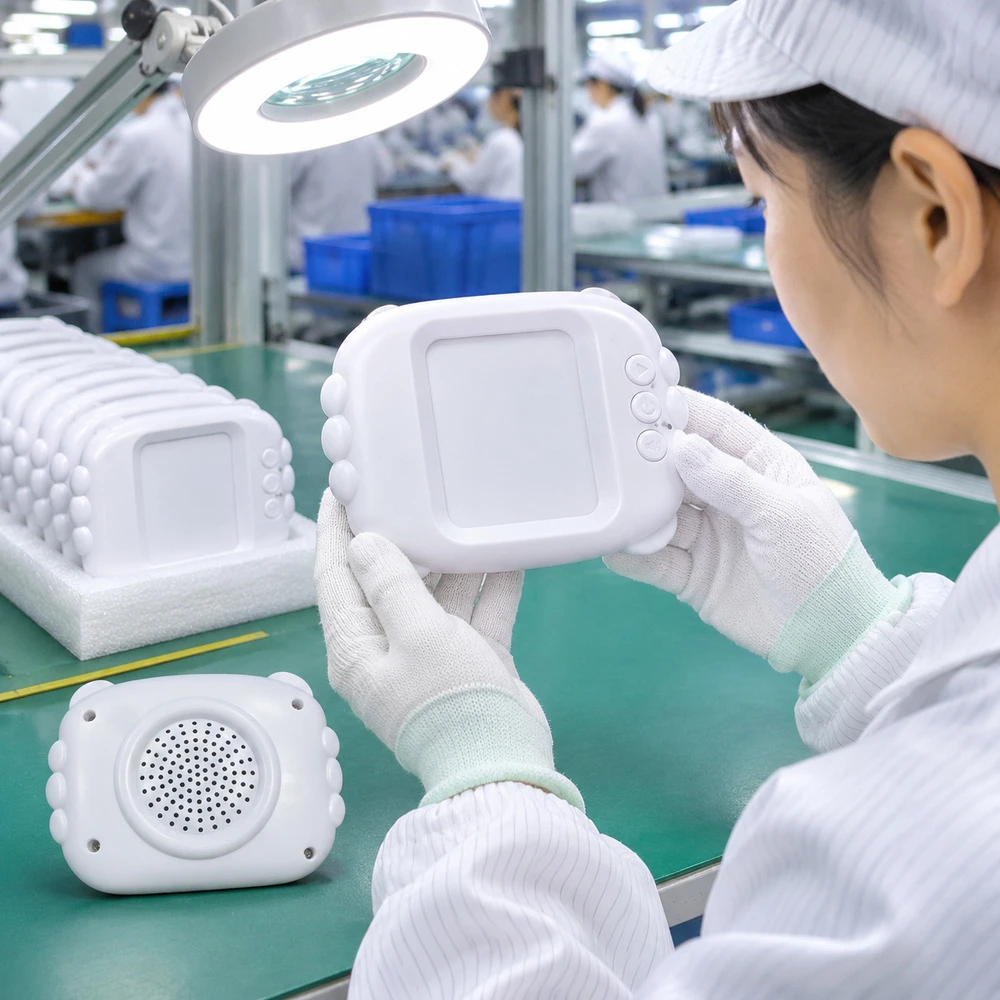
Appearance inspection under a defined lamp, with a signed limit sample beside the line
The photograph is the part of the process that decides whether the customer sees the defect or the child does.
Inspection happens under a defined lamp at roughly 1,000 lux, with the part held at about 45 degrees so reflections travel away from the eye, and with a signed limit sample for each defect type. Scratch, flow mark, sink, flash and color are judged against that sample, not against an opinion.
AQL 1.0 for major cosmetic defects is the usual level for this category, with a separate, stricter rule for the front face, because that is the surface a buyer photographs.
The two failures worth preventing are worth naming. Inspecting under whatever light is available, which makes a shipment pass in Guangzhou and fail in Hamburg. And accepting a limit sample that neither side signed, which turns every future batch into a negotiation. ✅
How much yellowing is acceptable on a white toy?
Around ΔE 1.5 at shipment, measured against the master plaque. Over a year in a shop window, a further 1 to 2 is realistic for a standard ABS grade and 0.5 or less for a light-stable one. What matters commercially is that the number is written into the specification before the first batch, not discovered at the reorder.
Can we paint the housing instead of coloring the plastic?
Yes, and it adds a process, a cure time, a scratch risk and a color-match problem between painted parts and molded parts in the same box. Molded-in color with a textured tool is cheaper at volume and does not chip. Painting makes sense for a small run or for a finish that cannot be molded.
Why do the six colors feel different in the hand?
Because pigment loading changes the surface. Titanium dioxide in white raises hardness and reduces the gloss slightly, while some organic pigments in red and orange leave a marginally softer surface. The difference is small, but on a textured wall it changes how the part catches light, which is why the six colors need one texture specification rather than six.
What this product actually is
A six-color range is one tool with six recipes, and the recipe is only half the product. The other half is texture, draft, gate position and a color target that survives a year of daylight. 🚀
The white unit is the one that will be photographed next to the launch sample, so it is the one worth specifying properly. The other five colors will follow whatever discipline the white one establishes.
SHENZHEN XINDITAI ELECTRONIC CO., LTD.
Official Website: www.kidsoundbook.com | www.xinditai.com
Email: happy@xinditai.com WhatsApp: +86 138 2434 3309
LinkedIn: https://www.linkedin.com/in/happy-gao-education-toy-oem-odm/
YouTube: https://www.youtube.com/@XDTHappy