






112 cards, 224 words. That ratio is the first design decision in the whole product, and it is usually made by accident.
Two words per card means one word on each face. It doubles the vocabulary without doubling the paper, the printing, the die cutting, the lamination or the box. It also means the card has no obvious "correct" side, which changes how the slot and the sensing have to behave.
The rest of the set is structure: how the words are grouped, how a child finds the next one, how 224 recordings stay in one voice, and how the whole thing survives being translated into a second language. 🗂️
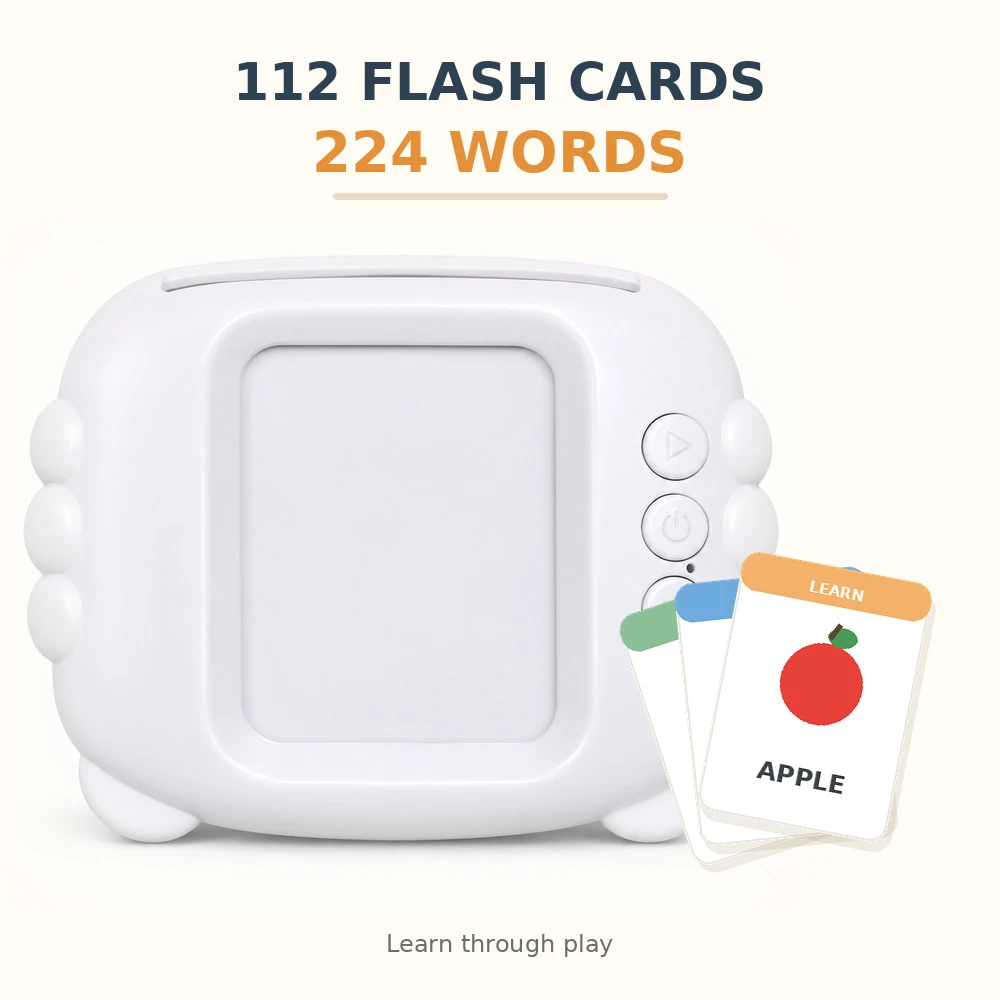
112 cards, 224 words, one bar-tabbed card face with the word and its picture
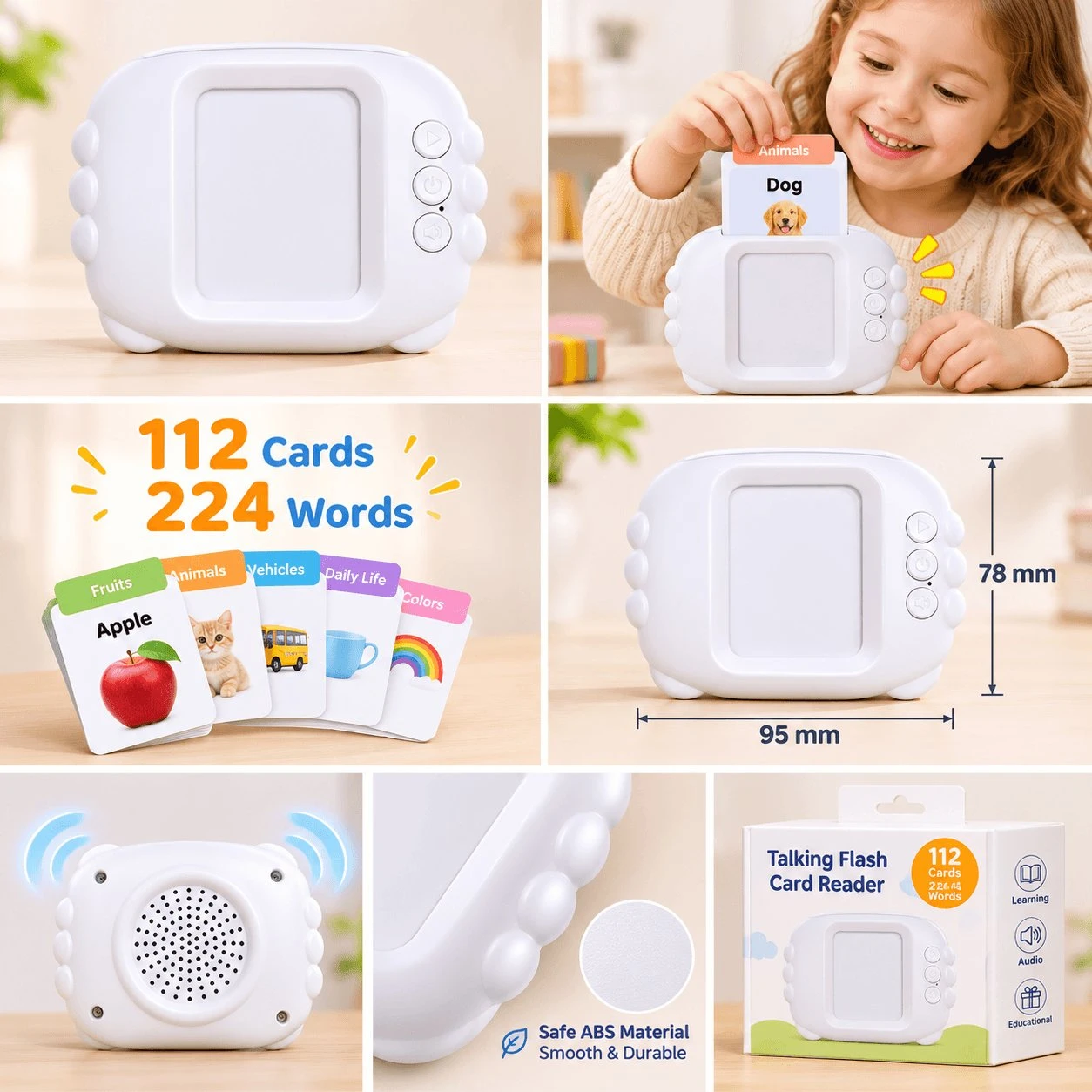
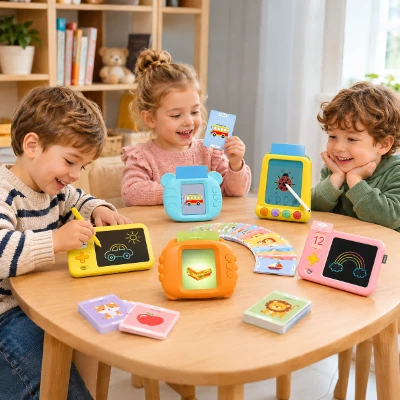
The set as a product: reader, cards, tab block and retail box in one frame
The arithmetic that decides everything
224 words is 224 audio clips before anything else is decided. At three to five seconds each, including the word, a short example and a natural pause, that is 11 to 19 minutes of finished audio.
Recording that takes two studio days with one narrator, plus a review pass. Not because 224 words is a lot of speaking, but because consistency is: the same word recorded on day one and day two will not match unless the narrator hears the first take, and intonation drifts when someone reads a list for six hours.
The card count then drives the print run. 112 cards at 300 to 350 gsm is a little over two kilos of board per set, and a gang run of 5,000 sets is 560,000 cards. That number is why the artwork is locked before the printer starts, and why a late addition is measured in sheets, not in words. 🏷 🖨️
Why the tab color is the real navigation
Look at the top edge of the cards in the photograph. Each category has a colored tab with its name printed on it: animals, fruits, vehicles, daily life, colors.
That is not decoration. A four-year-old cannot read the category names, but can match a color, and can see that the cards with the orange tabs belong together. The tab is the index of the product, and it works only if two rules hold.
The tab position must be identical on every card, because the stack is fanned by thumb and the tabs form a visible block. And the tab color must be reserved, one color per category, with enough separation that a deuteranopic parent can still sort them.
Five categories are visible in this set. Whatever the full list is, the structural rule is the same: the number of categories has to be decided before the artwork, because the tab block on the stack edge is a designed object. 🎨
What one "word" really is in audio
A word in a card set is not a word. It is a short audio object with three parts: the word spoken clearly, a pause, and a short phrase that uses it.
"The apple. A red apple."
That structure is what makes the card teach rather than label, and it triples the recording work. It also creates the first place where a set can fall apart: if some cards have an example sentence and some do not, the product feels unfinished after ten minutes of play.
Two more decisions belong here. Whether the narrator is an adult or a child, since a child voice is friendlier and an adult voice is clearer at the phoneme level. And whether each word gets one take or three, because three takes let the firmware randomize and stop a child memorizing the exact rhythm instead of the word. 🎙️
Printing 112 cards without color drift
The hardest print job in this product is keeping 112 cards looking like one set.
Cards are typically printed four-up or eight-up on a large sheet, then cut. That means card 7 and card 103 may come from different positions on the same sheet, and card 1 and card 112 may come from different sheets printed hours apart. Ink density drifts, and the drift shows up as a slightly different green between the frog card and the leaf card.
Three controls fix it. Print the whole set in one run, on one machine, with one ink batch. Hold each background color to a measured target with a tolerance of about two Delta E, checked on the printed sheet rather than the proof. And keep the tab colors out of the CMYK build, using a spot color, because a tab that shifts is a sorting error, not a cosmetic one.
Card faces also need to survive a two-year-old's thumb. Matte lamination both sides, 50 to 80 micron, with a corner radius of about 3 mm, is the standard combination that resists scuffing without glare under a lamp. 📐
The edge that fails first
Every worn card set fails at the same place: the edge, and specifically the corner nearest the hand.
Lamination that stops short of the trim edge leaves a paper edge exposed, and a paper edge absorbs moisture, swells, and fuzzes. Within a few hundred handlings the corner is soft, then it delaminates, then it delaminates into the slot and deposits paper dust on the sensing window.
Full-bleed laminate that wraps past the trim is more expensive and lasts several times longer. A rounded corner at 3 mm removes the sharp point where delamination starts. Neither is visible in a product photo, and both are the difference between a set that survives a school term and one that does not. ✂️
Fitting the audio into the flash
224 clips at 11 to 19 minutes total is a small audio problem, and it is worth doing the arithmetic before choosing a codec.
Speech at 64 kbps mono MP3 is about 480 kB per minute, so 15 minutes is roughly 7 MB. A 4-bit ADPCM stream at 32 kbps halves that to about 3.5 MB and decodes with almost no processor time, which matters on a low-cost controller. The trade is quality: ADPCM at 32 kbps is intelligible and slightly gritty, and on a 2 W speaker nobody hears the difference.
The other constraint is startup latency. A compressed format needs a decoder priming time before the first sample, and every format adds a different delay between the card seating and the first sound. Under 300 ms feels instant. Over 600 ms, children pull the card out and try again, and the machine then reads the same card twice. ⏱️
Localizing a set: eight languages, eight products
Here is the part that surprises brands new to the category. Translating a card set does not translate the product. It creates a new one.
For each language, 224 clips are re-recorded with a native narrator, and 112 cards are reprinted, because the word, the example sentence, the article and often the picture caption all change. The tooling is shared. The content is not. The box, the manual and the barcode change too.
That is why a card set is normally launched one language at a time, and why the audio should be stored as one file per card rather than one long file. A per-card file lets a distributor replace 30 clips for a regional variant without touching the rest. A single long file forces a full re-master. 🗣 🌍
Card ID and audio ID have to stay married
The last structural decision is the mapping. Every card carries some identifier, and every identifier points to a file. That mapping is the product's spine.
Keep it in one table, versioned, with the card artwork and the audio folder named from the same number. When a word is replaced, the table changes one row and the printer changes one position on one sheet. When the table lives in three places, a single change becomes a full reprint, because nobody can prove which cards in the warehouse are the old ones.
The test is simple: hand the table to someone who has never seen the project and ask them to find the audio for card 74. If it takes more than a minute, the set is not maintainable. 🔖 🗃️
How many words should go on one card?
Two, one per face, is the standard for this format and the reason 112 cards yield 224 words. One word per card halves the vocabulary for the same paper and printing cost. Four words per card saves board and loses the picture, which is the part that carries meaning for a child who cannot read yet.
Can we use our own word list and recordings?
Yes, and it is the normal OEM route. Send the word list with categories, the example sentence for each word, and either finished recordings or a script for our narrator. We return a timing sheet and a card layout proof before anything is printed.
How long does a new language take?
Six to eight weeks for a full set: two to three weeks for translation and script review, one week of recording and editing, two weeks of print, and the balance for sample approval. The tooling does not change, so a second language is faster than the first. 📅
What this product actually is
A talking flash card reader sells on 224 words and lives or dies on whether the set stays usable. The reader is a speaker with a slot. The card set is a database with a print run, a narrator and a version table. 🚀
Brands that treat the content as an afterthought end up with a good toy and a bad second edition. The structure costs a week to design and saves a reprint every time the range grows.
SHENZHEN XINDITAI ELECTRONIC CO., LTD.
Official Website: www.kidsoundbook.com | www.xinditai.com
Email: happy@xinditai.com WhatsApp: +86 138 2434 3309
LinkedIn: https://www.linkedin.com/in/happy-gao-education-toy-oem-odm/
YouTube: https://www.youtube.com/@XDTHappy
LinkedIn Hashtags
#FlashCards #EarlyLearning #ContentDesign #ProductDesign #ToyIndustry #OEM #ODM #Printing #Manufacturing #EdTech #SupplyChain #Innovation