

Screen-Free Story Machine: What It Is, Why Parents Choose It, and How to Pick One
What Is a Screen-Free Story Machine?
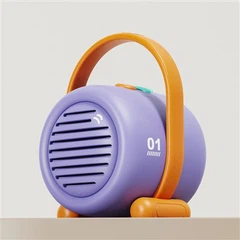
A screen-free story machine is an audio player built for children that tells stories, plays lullabies, and reads rhymes without any display, touchscreen, or on-screen menu. The child does not scroll, tap icons, or read a user interface. Instead, a physical object - a card, a character token, a figurine, or a small record - acts as the "remote control." Place it on or near the player, and the matching audio begins. Remove it, and the story stops or pauses. The screen that a tablet would use is replaced by a hand and a small plastic tile.
This single design choice changes everything about how the toy fits a household. There is no blue light in a dark bedroom, no autoplay algorithm deciding what comes next, and no login wall between a child and a story. The device is closer to a music box than to a computer, which is exactly why it has become a distinct category rather than a feature of a generic tablet. For a brand or importer, understanding that distinction is the first step in choosing the right product.

Why "Screen-Free" Matters More for a Story Device Than Other Toys
For many toys, removing a screen is a nice-to-have. For a device whose entire job is stories and listening, it is the defining feature. The reasons stack up. First, eye health: a listening toy used at bedtime never emits the blue light that screens do, so it does not suppress melatonin the way a phone beside the pillow can. Second, attention: without a feed, there is no infinite scroll and no autoplay spiral - the child hears one story, then decides what to do next. Third, sleep: a calm, predictable audio routine is far easier to end than a glowing screen that always offers "one more."
Fourth, parental control: what the child can hear is decided by which physical card or token is on the shelf, not by an algorithm learning the child faster than the family does. Fifth, independence: a two-year-old who cannot read a menu can still choose a story by grabbing a tile with a familiar face. These five points are why "screen-free" is not a marketing adjective here - it is the product's reason to exist, and the lens through which every other buying decision should be made.
The Formats That Deliver Screen-Free
Every screen-free story machine shares the same core - local audio playback triggered by a physical object - but the triggering object varies, and that variation defines the sub-types a buyer should know before choosing a platform. The four common formats below are not competitors; they are points on the same screen-free spectrum, each suited to a different brand asset and retail channel.

Card and Token Triggers
The two most common triggers are the card and the token, and they serve different strengths:
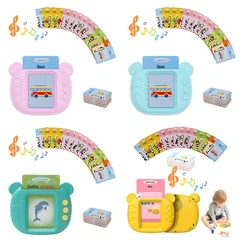
NFC card player (Yoto-style): the child inserts or taps a printed card; the player reads an NFC chip and streams the stored audio. Cards are cheap to print, easy to collect, and simple to localize.
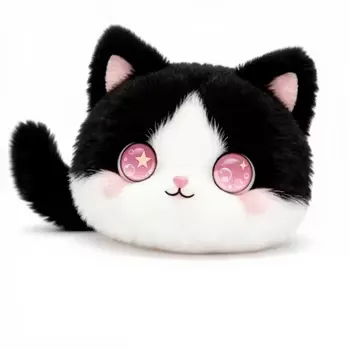
Character token player: a small figurine or disc with an embedded chip; placing the character starts its story. Strong for brands with their own IP, because the toy and the character are the same object.
Phonograph and Pure Audio
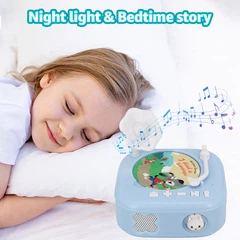
Phonograph story machine: a retro turntable aesthetic where a small disc or card stands in for a record. The vintage look sells in gift and museum-bookstore channels.
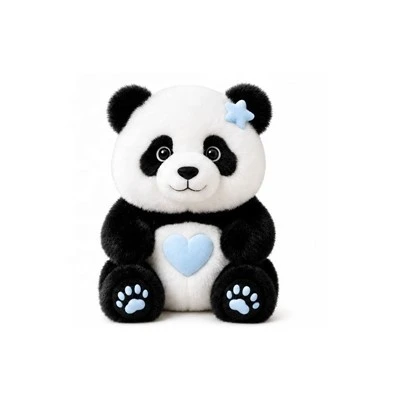
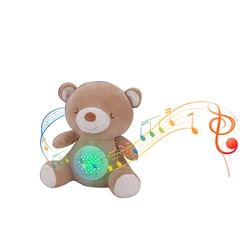
Pure audio module: a plush or block with a single button or squeeze sensor and fixed internal content, no external token at all. The simplest and often the most durable option for the youngest ages.
Screen-Free vs Screen: What Each Does Better
It helps a buyer to be honest about the trade. A tablet playing an audiobook app can show pictures, run hundreds of apps, and receive updates instantly. A screen-free story machine cannot do any of that - and that is the point. What it does instead is remove the distractions that make screens hard to put down. The comparison is not "which is more powerful" but "which is the right tool for a child settling into a story."
In practice, the screen-free device wins on calm, on battery life (no backlight to power), on robustness around toddlers, and on the absence of in-app purchases or surprise content. The screen wins on visual richness and versatility. Most families do not want to choose forever - they want a dedicated, peaceful story device for the bedroom and the car, and a tablet for other moments. Selling the screen-free machine as a complement to screens, not a rival, is the more honest and more effective pitch.
How a Child Actually Uses One
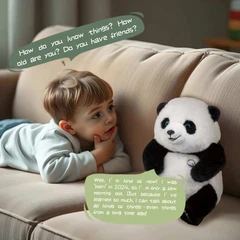
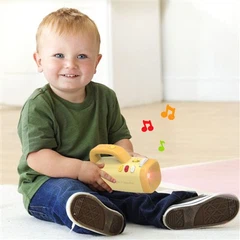
The interaction loop is the whole product, and it is deliberately tiny. A child picks a token or card - often by the picture, not the words - and places it on the player. Within a second or two the story begins. There is no home screen, no password, no "where is the Wi-Fi," and no adult needed to start playback. That independence is why the category works for ages as young as two, and why grandparents and babysitters can hand it over without a tutorial.
The Tap-and-Play Loop
What looks simple is a deliberate design: the physical object is the only interface a child ever meets. Grab, place, listen.
The Offline Bottom Line
Because the audio lives on the device or on the token itself, playback does not depend on a cloud connection. A parent is not negotiating with a router at bedtime; a traveler is not hunting for hotel Wi-Fi. The story is already inside, which means the toy works identically in Lisbon, Seoul, or a small bookstore in Ohio.


The Content Ecosystem Is the Real Product
Here is the part new buyers underestimate. Without a screen to browse, the content must be physical and curated. A screen-free story machine is only as good as the library of cards, tokens, or discs that surround it. That is a constraint and an opportunity. The constraint: you cannot ship an empty player and promise "thousands of titles in the app." The opportunity: every new card or character is a reason to come back, a giftable add-on, and a recurring purchase that keeps the hardware relevant long after the first unboxing.
For a brand, this means the content strategy is the product strategy. Questions to settle early: Who owns the audio rights? Can a retailer or publisher add their own titles (the "make your own" model)? How many languages ship at launch? Can content be updated without reprinting the token? A screen-free device with a thin content plan will sit on the shelf; one with a growing, owned library becomes a small ecosystem - and ecosystems are what defend a SKU against generics.
Sound Safety: Why 85 dB Matters
Removing the screen does not remove the responsibility for a child's hearing. A toy held close to the head can exceed safe limits without anyone noticing, so the audio side of a screen-free story machine deserves the same scrutiny as its outer shell. The good news is that the screen-free format makes safe listening easier to guarantee, because there is no video to distract from a volume cap.

Volume Cap Protects Young Ears
Young ears are fragile, and a toy held close to the head can exceed safe limits without anyone noticing. A responsible screen-free story machine caps output around 85 dB(A) - the common ceiling in children's audio standards - and keeps that cap regardless of what is playing. For the under-3 segment this is non-negotiable; for older children it is the difference between a trusted brand and a recall risk.
Offline Playback Protects the Routine
Limiting volume is only half the safety story. Because playback is local, there is no streaming of unknown content, no ad, and no autoplay into something a parent did not choose. The calm-by-default behavior is built into the hardware, not hoped for in a settings menu a child will never open.
What Makes a Good Screen-Free Story Machine for B2B Buyers
If you are importing or private-labeling, judge the category by criteria that protect your margin and your reputation. Offline reliability comes first: the core play must work with no Wi-Fi, every time, because that is the promise you are making to parents. Content ownership is second: confirm in writing who controls the audio and whether you can localize or expand it. Certifications - EN71-1, EN62115, ASTM F963, CPSIA, and the 2027 EU removable-battery rule - must be in place for your target markets before you order.
Then look at durability (drop-tested shell, washable or wipe-clean outer), no data collection (a selling point you can demonstrate), and token quality (cards and figures that survive a toddler and resist cloning). A supplier who hands you a tear-down sample, a wash-cycle report, and a content roadmap without being asked is showing you the maturity that separates a one-season novelty from a shelf staple.
Where Screen-Free Story Machines Sell
The product fits channels that a loud, lit-up gadget does not, because its selling point - calm, offline, parent-trusted - maps onto specific buyer worries. Understanding those channels helps a brand place the right format in the right store rather than competing on a generic toy aisle where screen-free is hard to explain at a glance.
Channels That Fit the Format
The product fits channels that a loud, lit-up gadget does not. Parents worried about screens are the largest and fastest-growing buyer group, followed by schools and libraries that want calm listening without device management. Gift remains strong, especially the character-token and phonograph styles with their unboxing ritual, and travel wins because offline playback needs no connectivity.
One Shelf, Three Stories
The same screen-free principle spans formats - card, token, phonograph - so a retailer can merchandise a coherent "calm corner" rather than three unrelated toys. For a brand, that coherence is a chance to own a shelf position instead of competing line by line.

Common Myths About Screen-Free Story Machines
Three myths slow buyers down. Myth one: screen-free means less capable. In reality the engineering is often harder - you must deliver a satisfying experience with no interface except a tile and a speaker. Myth two: screen-free means no technology. Under the shell sits NFC reading, offline audio decoding, battery management, and sometimes OTA content updates. It is just technology kept invisible. Myth three: it is only for babies. The format scales: simple for toddlers, richer character worlds for ages 4–8, and language-learning libraries for families. The screen-free principle is age-agnostic; only the content changes.
Sourcing One-Roof: OEM/ODM Platforms
Because the category combines hardware, audio content, safety certification, and token manufacturing, the sourcing decision matters as much as the product decision. A supplier who does only one piece - say, the plastic shell - leaves you to stitch the rest together across vendors, each with its own lead time, quality bar, and liability boundary. That fragmentation is where screen-free projects quietly go late.

One Supplier, Less Hand-off Risk
A one-roof OEM/ODM platform - handling the player, the tokens, the content pipeline, and the certifications together - shortens the path from concept to compliant shipment and keeps accountability in one place.
Start With a Pilot
The usual entry is a pilot: pick one hero format (card or token), one market, and a starter library of 10–20 titles, then validate sell-through before expanding the range. With MOQs often around 500 units for a custom run, a pilot is affordable insurance against guessing wrong about which character or language sells.
FAQ - Screen-Free Story Machine
Does a screen-free story machine need the internet? The core play does not. Cards, tokens, and internal memory hold the audio, so stories play offline. Wi-Fi, when present, is only for an adult to add content - never required for a child to listen.
Is it safe for a two-year-old? Yes, provided it meets under-3 standards: no small parts, a locked battery compartment, an 85 dB(A) volume cap, and an embroidered or enclosed face. Always request the test reports for your target market.
Can I add my own stories or languages? With the right platform, yes. Many screen-free systems support a "make your own" content path where a brand, publisher, or retailer loads their own audio onto tokens or cards.
How is it different from a tablet with audiobooks? A tablet shows pictures, runs apps, and can autoplay; a screen-free machine does none of that. It trades versatility for calm, robustness, and independence - the qualities that matter at bedtime.
Which format should I start with? If you have existing IP or characters, the token player extends your brand naturally. If you want the lowest cost per title and easy localization, the NFC card format is the safer first step. The phonograph style suits gift and heritage channels.
What is a realistic first order? A pilot of roughly 500 units of one format with a 10–20 title starter library lets you test a market before committing to a full range. Reorder the winners; retire the slow sellers.