













Not Only a Bedtime Toy – Seven Other Homes for the Square Phonograph, From Authors and Singers to Faith and Sleep
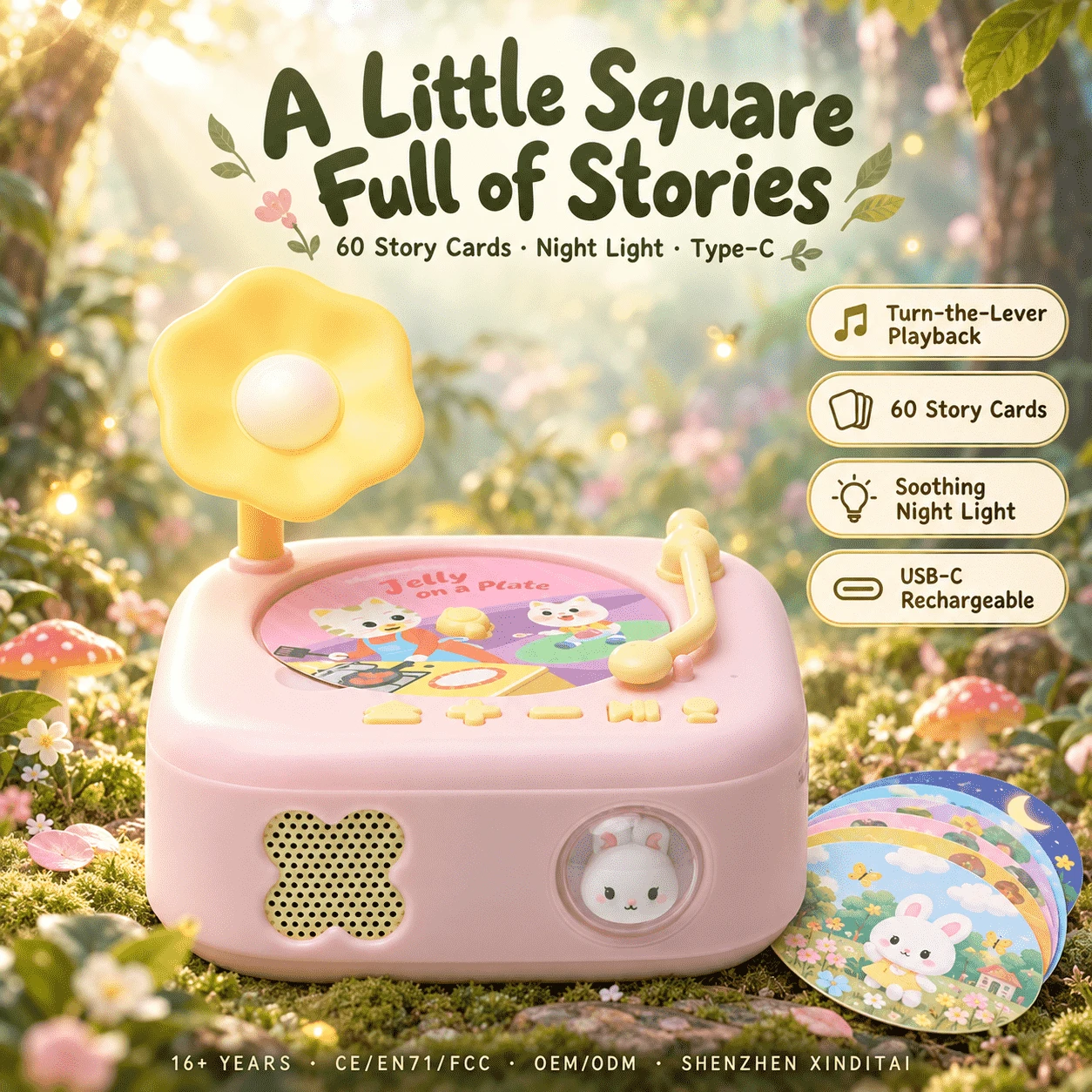
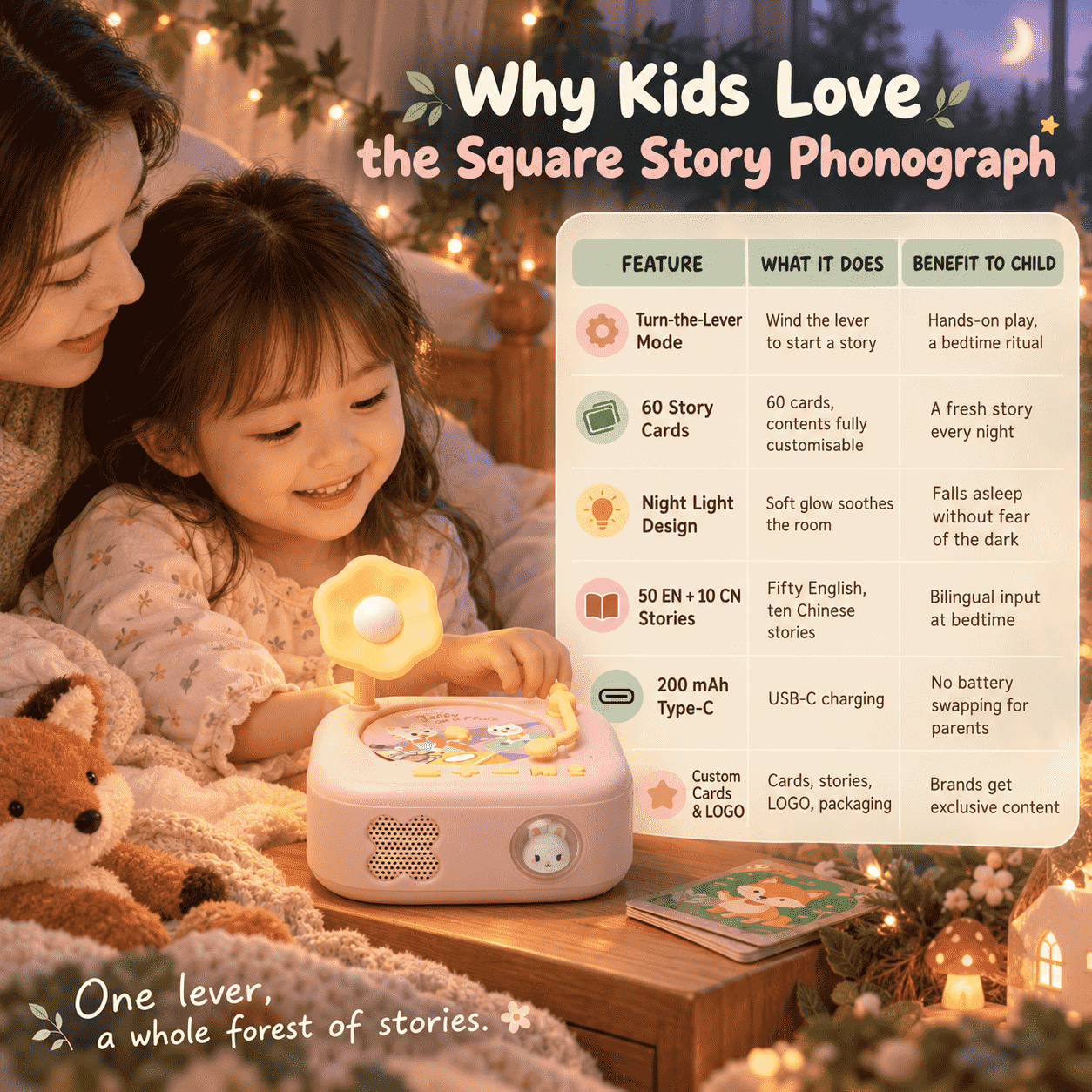
Details: The Square Children's Phonograph is a card player with a soft habit built into it. A story card is seated and the lever is turned, the tale plays through a voice-tuned speaker, and a gentle night light comes up to help a small child settle. Sixty cards ship as standard, fifty in English and ten in Chinese, and the cards, the stories, the logo and the packaging are all produced to order. That last point is what turns the idea of a bedtime toy upside down. Because the content lives on cards that a brand controls, the same square box can carry a publisher's backlist, a singer's voice, a family's faith material or a school's lessons – and the bedroom the product was built for is only its first home. Runs begin at 1,000 pcs, with trial quantities between 200 and 500 units available to test an audience first.
Key Product Selling Points
Details: The seven settings below are places the square phonograph already lives, once the content behind the card is chosen for the room rather than for the toy shelf. Each one is the same machine, the same lever and the same sixty-card format – only the deck changes.
The Author's Box
A publisher with a children's list can put a season of titles onto cards and sell a box that plays them. The card format suits an author's work because it is short, collectable and inexpensive to extend, and a well-known name gives the box a reason to be bought that a plain toy never has. New titles become new cards, which means a backlist can be reissued in audio form without a printing plant or a new device.
The Singer's Box
A recording artist, a choir or a label can use the same box to carry songs rather than stories, and the fan gets a physical object that plays a voice on demand. The square shape reads like a keepsake on a shelf, and a limited run tied to an album or a tour gives it the scarcity that makes music merchandise sell. For an artist, it is a new way to reach an audience that is too young for a phone and too old for a rattle.
The Faith Corner
Families that want their children to hear prayers, songs, scripture stories or devotional content at home need a device that is simple enough for a small hand and quiet enough for a room. A card player fits that need quietly and well, and it lets a faith publisher or a community reach families with the voices and texts it trusts. The night light adds a natural place for the box beside a bed or on a shelf where it is used at a fixed time each day.
The Learning Desk
Cards can carry lessons as easily as tales, which makes the box a quiet study aid for vocabulary, early numbers or a second language. A child returns to a subject because the box makes starting it a single gesture, and a teacher or a parent can lay out a sequence of cards for a week without printing anything. Because the deck is produced to order, a school can match the box to its own syllabus rather than to a catalogue.
The Language Table
A household raising a child in two languages can keep both decks beside the same box and let the child choose. The same tale can be produced in one language for one market and in two for the next, so a distributor ships a bilingual edition into a country where it matters and a single-language edition where it does not, without changing the hardware. For a family, it is one object that keeps both grandparents' voices in the room.
The Gift Table
A square box that makes a sound and carries a light is a natural present, and a personalised deck makes it a keepsake rather than a toy. A grandparent can record a message, a family can collect a season of stories, and a shop can build a gift set around a theme and a date. The gift market rewards exactly what this format does well: something that looks substantial, works on the first attempt and can be added to later.
The Waiting Room
Beyond the home, the box works anywhere a child has to wait and a screen is unwelcome: a clinic, a dentist, a family restaurant, a hotel that wants a quiet room. Each of those settings buys content rather than hardware, and each one can carry the venue's own branding on the deck or the box. It is the same machine a bedroom uses, doing a very different job, which is the whole argument of this page.
In short: one square box and one lever, carrying whatever a brand owns – a publisher's titles, a singer's songs, a family's faith material, a school's lessons, a shop's gift set or a waiting room's calm.
The Bedroom It Was Built For
Whatever else the box grows into, the bedroom is where it began, and that origin is worth understanding because it explains the whole design. A child who is settling at night needs less stimulation rather than more, and the small rituals around sleep – a story, a dim light, a familiar voice – do more for that than any feature. The square phonograph was shaped around exactly those three things, and the night light is the piece that keeps it in the room after the story has finished.
That is why bedtime routines have become a category of their own rather than a corner of the toy market. Parents who are trying to move the last hour of the day away from screens are looking for something that ends in darkness, and a card player that stops when the tale stops answers that need without an app or a network. The habit is also the strongest commercial pattern in the category: a product that is used every night is used for years, and one that is used every night by a tired parent is the one that gets recommended to other parents.
The night light is what turns a one-time listen into a nightly routine. It gives the child a reason to leave the box out on the shelf, and it gives the parent a reason to reach for it before reaching for anything with a screen. Once the routine exists, the content that fills it can come from anywhere – which is the bridge from this section to the next one.
Why the Screen-Free Moment Favours One Small Box
Screen-free audio for children has moved from a niche idea to one of the liveliest corners of the toy market, and the brands that lead it are the ones that made listening a physical act. A child who can start a story by touching an object is being given independence without a device to manage and a parent is being given an hour that does not end in a negotiation over a screen. That combination is the reason the format keeps appearing at the top of 2026 buying lists.
The trend has a second half that matters to a buyer: as the big names build awareness, they also train a whole market of parents to look for the format, and they leave plenty of room underneath them. A distributor or a brand with its own content does not need to compete with the funded giants on their ground; it needs a box that carries what they own. That is the gap the square phonograph fills, and it is why the same trend that drives sales of known players also drives demand for a customisable one.
There is a third thread worth naming, because it explains the buying mood rather than the technology. Quiet, single-purpose objects have become a small luxury in their own right, and a box that does one thing well reads as intentional next to a phone that does everything. That is a shift in taste as much as in parenting, and it is friendly to a product whose whole promise is that there is nothing to configure.
Product Parameter
| Square Children's Phonograph – Specification and Ordering (LMC 002) | |
| Item | Square Children's Phonograph / LMC 002 |
| Story Playback | A card is seated and the lever is turned to enter story mode; no buttons to hunt for and no screen |
| Card Deck | Sixty story cards as standard – fifty English, ten Chinese – fully replaceable and adaptable to other content |
| Night Light | A soft light that comes up with the story and helps a child settle |
| Customisation | Card and story content, logo and packaging all produced to the buyer's order |
| Power | 200 mAh lithium cell, recharged over Type-C |
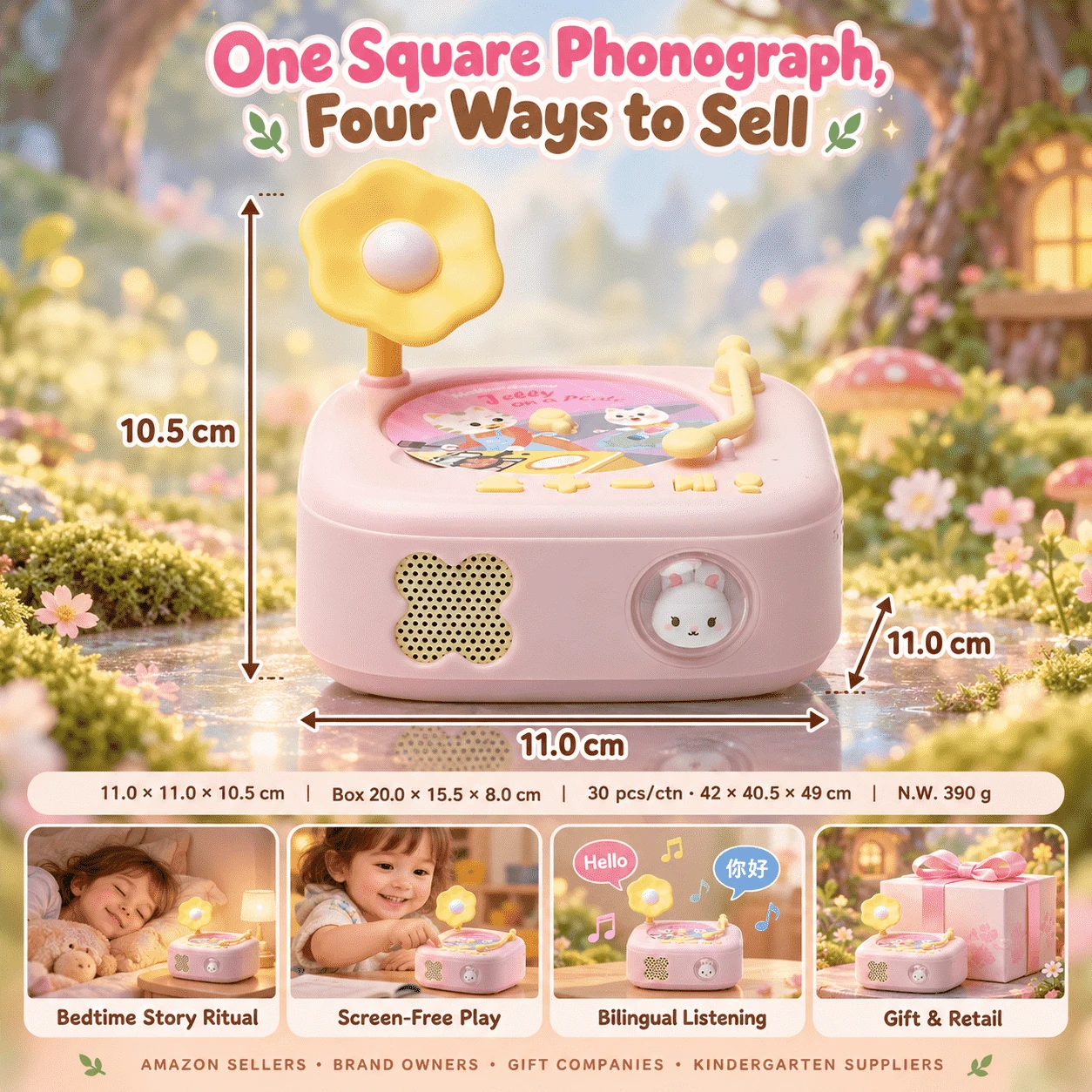
| Body Size | 110 × 110 × 105 mm |
| Gift Box | 200 × 155 × 80 mm |
| Unit Weight | 390 g |
| Export Carton | Thirty sets per carton – 42 × 40.5 × 49 cm, 13 kg gross |
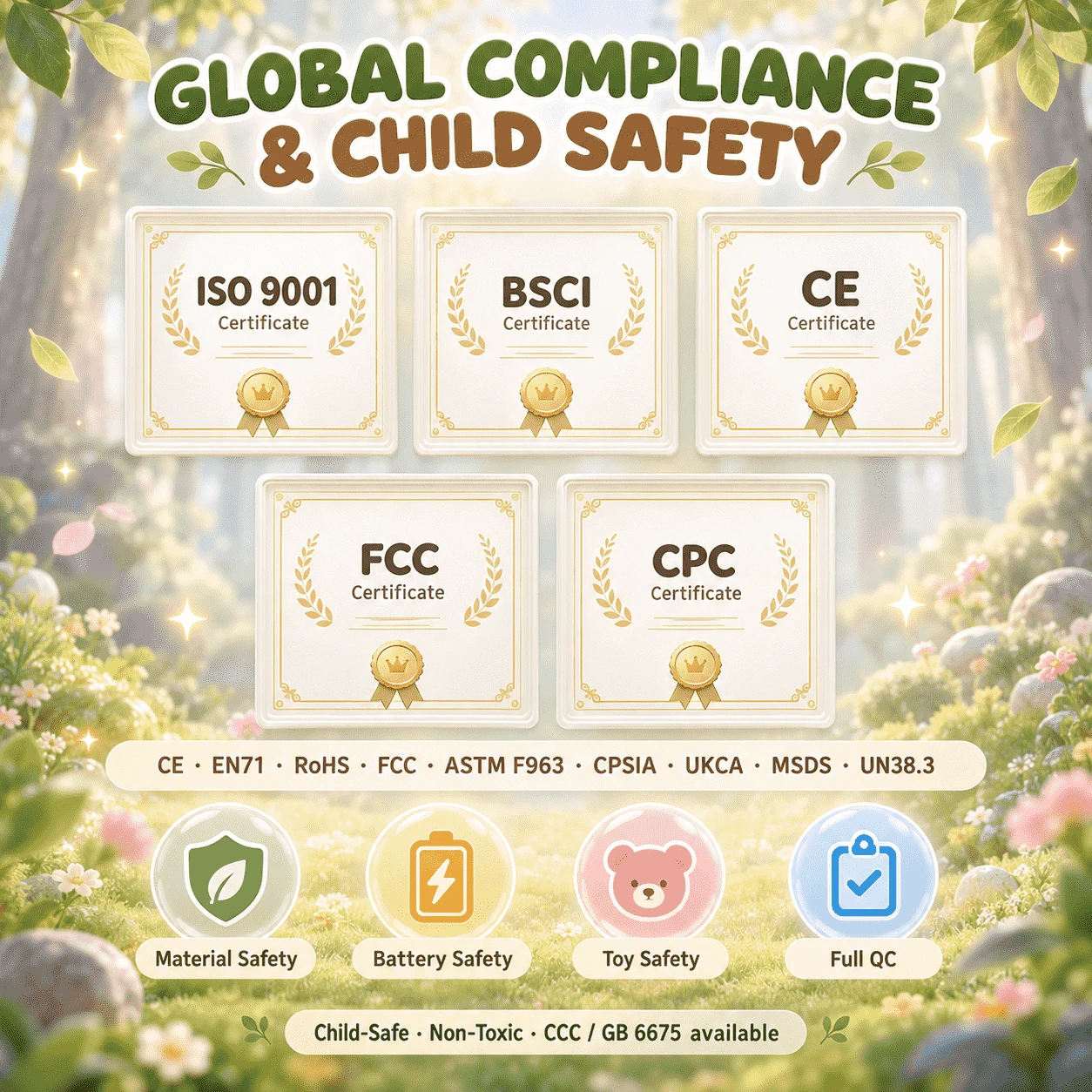
| Compliance | CE, UKCA, FCC and RoHS files with CPC; EN71 and ASTM F963 reports issued when a market requires them |
| Minimum Order | 1,000 pcs; a trial run between 200 and 500 units is possible |
Tell us which audience the box is for – readers, listeners, a faith community, a school or a gift line – and we will come back with the deck plan, the recording scope, sample terms and the production slot your date needs. Reach the export desk through the enquiry form or directly by email. Related phonograph, story and talking-card models are listed at: https://www.kidsoundbook.com/products
A Licensed Stage: Authors, Singers and the Rights Behind the Card
Half the value of a customisable card player is commercial rather than technical: it lets a brand put content it already owns onto a physical product without engineering anything. A publisher holds a backlist, a label holds recordings, a writer holds a body of work, and a community holds the texts and songs it wants passed on. What none of them usually holds is a factory, and that is precisely the gap a card box closes. The box becomes the stage; the rights holder supplies the play.
The licence still comes first, and it is worth being precise about it. A recording of a person's voice, a published story and a piece of music are each protected in most markets, and putting any of them onto cards normally needs a written permission that names the territory, the period, the channels and whether the use is exclusive. Where a well-known name is involved, the rights holder will usually want to approve the recording and the artwork before a run is committed. Planning that approval step early is what keeps a release on its date.
The other thing a licence decides is how far a deck can travel. A voice cleared for one market is not automatically cleared for the next, and a translation is a new recording rather than a printing change. A buyer who writes the deck down – how many cards, in which language, sold through which channel, for how long – finds that the product, the packaging and the paperwork all stay inside the agreement that was signed. That discipline is the difference between a one-off drop and a series that can be repeated every season.
Where It Still Surprises Buyers
The uses that raise eyebrows in a first meeting are the ones away from both the nursery and the shop. A hospital or a dental surgery wants something that occupies a waiting child without a screen and without a staff member supervising; a hotel or a holiday let wants a children's corner that is quiet and can be cleaned; a museum or a heritage site wants a way to give young visitors a story in the local language. Each of these buyers needs a small number of boxes and a specific deck, and each one is a market a general toy brand never reaches.
There is also a longer-life use that turns the box from a children's product into a household one. The same format works for older listeners who want spoken content, music or familiar material in a simple object, and the physical cards suit hands and habits that a phone does not. A care home, a library or a family buying for a grandparent can use the identical machine with a different deck, which widens a product line without widening the tooling.
| Beyond the Nursery – Four Buyers and What They Put on the Cards | ||
| Buyer | What the Deck Carries | Why the Box Fits |
| Publisher or author | Titles from a backlist, read aloud as cards | Turns owned content into a physical product without a device build |
| Label or recording artist | Songs, lullabies or a tour edition in the artist's voice | A keepsake that plays a voice on demand and sells in limited runs |
| Faith community | Prayers, songs, scripture stories and devotional material | Simple enough for a small hand and quiet enough for a room |
| Clinic, hotel or museum | Waiting-room stories, a local-language guide or a venue deck | A calm, clean object with no screen and no supervision needed |
Read together, the four rows make the same point in different ways: the buyer is not really shopping for a toy, but for a way to put content they care about into a form a child can use alone. The box is the part that is ready; the card is the part that is theirs.
Quality Inspection
Production Process
Our Service
The box rarely changes; the content behind it does. The route below is how a deck – and a licence, where one is needed – is turned into a finished set ready for a shelf or a bedside.
Requirement Communication
We agree first on the audience, the content, the languages, the licence terms and the packaging. Those points are written into a brief both sides sign before any recording is booked, so a release is built to a plan rather than corrected afterwards.
Content and Deck Development
The deck is mapped card by card, the scripts are written or supplied, and the voice or music is recorded and mastered. Where a licence applies, the recorded set is circulated for approval before the cards are printed, so the version that ships is the version that was cleared.
Sample Confirmation
You receive a working box with a loaded deck to judge the lever feel, the sound and the night light together, as a family or a class would meet them. Approval is recorded in writing, and the run does not start until it is given.
Pre-production Sample
The earliest units from the production run are set aside as the standard for the released deck. Later runs are measured against it on sound, card behaviour and finish, so a reprinted set matches the version that was already signed off.
Bulk Production
The boxes are assembled, the cards printed and encoded, and the sets packed for a retail carton or a classroom order. Output is logged and can be reported to you, which matters when a release is tied to a season or a date that cannot move.
Inspection, Documents and Dispatch
Finished sets clear a last check on sound, light, contents and carton marking, and the documents for each destination are prepared to match the batch. A buyer may inspect the line in person, or watch it over a live call, before the order ships.
Customization Information
The box is the fixed half of the product and the card is the half a buyer controls, so almost everything that makes a range distinctive can be built to order. Where a change touches a mould, a certificate or a new permission, it is raised before the order is confirmed rather than after.
FAQ – Frequently Asked Questions
Q1: What can the box be used for besides bedtime stories?
The machine plays a card, so the use is decided by the card. The same box carries songs and music, lessons and language practice, prayers and devotional material, gift messages, a venue's own stories or a backlist of titles read aloud. What stays constant is the way a child starts it – seat a card, turn the lever – so a buyer can aim a single product at several audiences simply by changing the deck.
Q2: Can we put licensed content onto the cards?
It can be, so long as the recording carries the right permission. A voice, a published story and a piece of music are each protected in most markets, and a commercial release of any of them normally needs written permission naming the territory, the period and the channels. We record and load the content to the terms you confirm; the permission runs between you and the person or company that controls the rights.
Q3: Who handles the licence and the approvals?
The licence is normally arranged by the buyer, since it runs between the buyer and the rights holder. Where a well-known name is involved, the rights holder will usually want to hear the recording and see the artwork before a run is committed, and some will ask to approve each card rather than the set as a whole. Building that approval into the schedule early is the most reliable way to keep a release on its date.
Q4: Is the box suited to religious or faith-based content?
It is a natural fit. Faith material is usually short, repeated and part of a daily or weekly routine, which is exactly the shape a card deck handles well. Prayers, songs, scripture stories and devotional readings can each sit on their own card, and the night light gives the box a settled place in the room. A publisher or a community can reach families with the voices and texts it trusts, on a device a young child can work alone.
Q5: Can a school or a publisher build its own deck?
Yes, and it is one of the most common reasons a buyer comes to the format. The deck can follow a syllabus, a reading scheme, a language programme or a publisher's list, with the titles, the wording and the voice all set by the buyer. A custom deck is a card list and a recording rather than a new machine, so a new unit or a new season can be added without starting again.
Q6: Can one order cover several languages or editions?
Yes, as long as the editions are kept apart at packing rather than mixed in one box. Each market normally takes its own deck and its own box wording, so a carton holding two language editions needs its contents divided and marked accordingly. Give us the split when you order and each carton is labelled to match, which lets a distributor or a school office hand out the right edition without opening a box.
Q7: What quantities can we start with, and how do samples work?
Production runs begin at 1,000 units, and a trial batch between 200 and 500 units can be arranged when a brand, a publisher or a pilot wants to test the format before a full order. A working box with a loaded deck is supplied for judgement first, and the sample cost is credited against the production order. The box itself needs no tooling; a new deck is a print and recording job.
Q8: Where is the box made, and can we visit the factory?
The box, its cards and its recordings are made at a single site in Shenzhen, which matters for a licensed or faith-based release because the voice, the deck and the unit have to arrive consistent and accounted for. Buyers are welcome to visit the plant, or to watch the lines over a live call, before a run is committed, and each carton can be traced to the batch it came from.
Company Introduction
for children
Xinditai Electronics is a Shenzhen manufacturer that has worked on OEM and ODM programmes for children's audio products since 2010 – phonograph and card players, talking cards, sound books, story players, projection toys and plush devices – for brands, publishers, schools, communities and distributors in many markets. Content-led card products are a regular part of that work, which is why the deck, the voice and the box are produced by one team rather than passed between suppliers.
A workshop of about 3,000 square metres holds the moulding, board assembly, card printing, voice recording, acoustic testing and packing lines, staffed by more than a hundred engineers and operators. Every stage signs off on its own check before the next begins, and each batch keeps a record that traces it from the line to the buyer's order. A plant visit, or a live walkthrough of the lines, can be arranged before a release is confirmed.

Certifications
Certificates
The box and its cards reach the buyer as one product, so the document pack is assembled around the unit and the deck in the order and prepared for the destinations named. Certificates are kept current and issued with the batch paperwork, and a full copy set can accompany any quotation.

CE

RoHS

FCC

SEMTA

EMC

ISO





