













What Is UN38.3 Toy Battery Compliance?
UN38.3 toy battery compliance is the transport test regime a lithium cell or battery has to pass before a carrier will move it by air, sea, road or rail. It comes out of the UN Manual of Tests and Criteria rather than out of a toy directive, and it answers one narrow question: will this cell survive the journey without becoming a fire risk. It is not a child-safety certificate, it does not replace EN 62115 or the EN71 series, and it is not a quality badge. It is a laboratory sequence covering altitude simulation, thermal cycling, vibration, shock, external short circuit and abuse behaviour, run on the cell or the pack in the condition it will actually be shipped, and it finishes in a report plus a summary document that a carrier, a forwarder or a marketplace can ask for at any point between the factory gate and the shelf.
Two facts turn a UN38.3 toy battery question from a shipping footnote into a buying decision. The first is that the report describes a specific cell from a specific maker at a specific rating: change the cell and you are holding a document that no longer describes the goods. The second is that the cell number is chosen on the board, the board is chosen before the enclosure is frozen, and the enclosure is frozen before steel is cut - so the decision that decides the file is made weeks before anyone thinks about freight.
A transport test is not a safety standard either. Alongside it, most channels now ask for a cell-level safety standard, with IEC 62133 the common reference, and for the toy's own electrical safety route on top. Three questions, three documents, three sets of weeks. Which combination applies in your destination, which edition of the transport manual is current, and which watt-hour or state-of-charge thresholds your carrier works to should be confirmed with your own laboratory, carrier or notified body; we design to the requirements you bring us and document what we built.
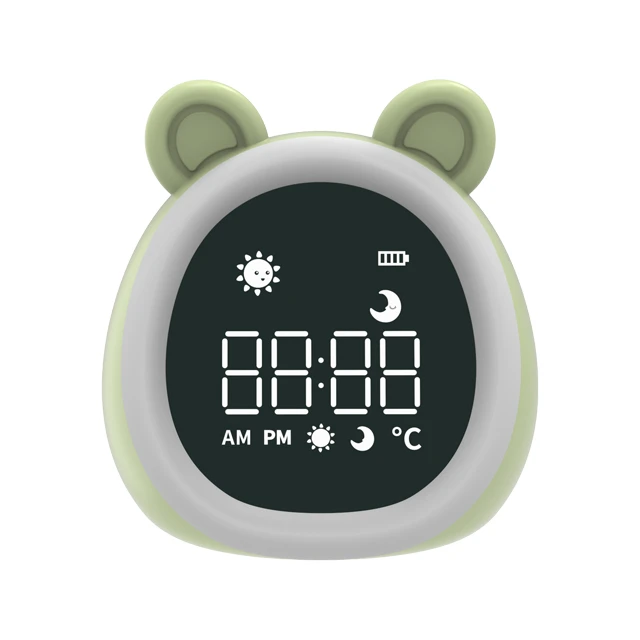
We are an OEM and ODM manufacturer of children's educational toys, founded in 2010, running a 5,000 square metre factory with our own mould shop and shipping to 120+ countries. This article follows one product through the whole question: the White Noise Night Light - a rechargeable bedside unit combining a dimmable light with a sound library of rain, waves, heartbeat and lullabies, on a timer that closes the night down. It is the clearest case in our range because the cell is large, the channel is nursery, and the freight is usually air. Read UN38.3 toy battery compliance as a schedule rather than as a certificate and the subject becomes manageable.
Five Dimensions That Decide Whether a UN38.3 Toy Battery Programme Holds
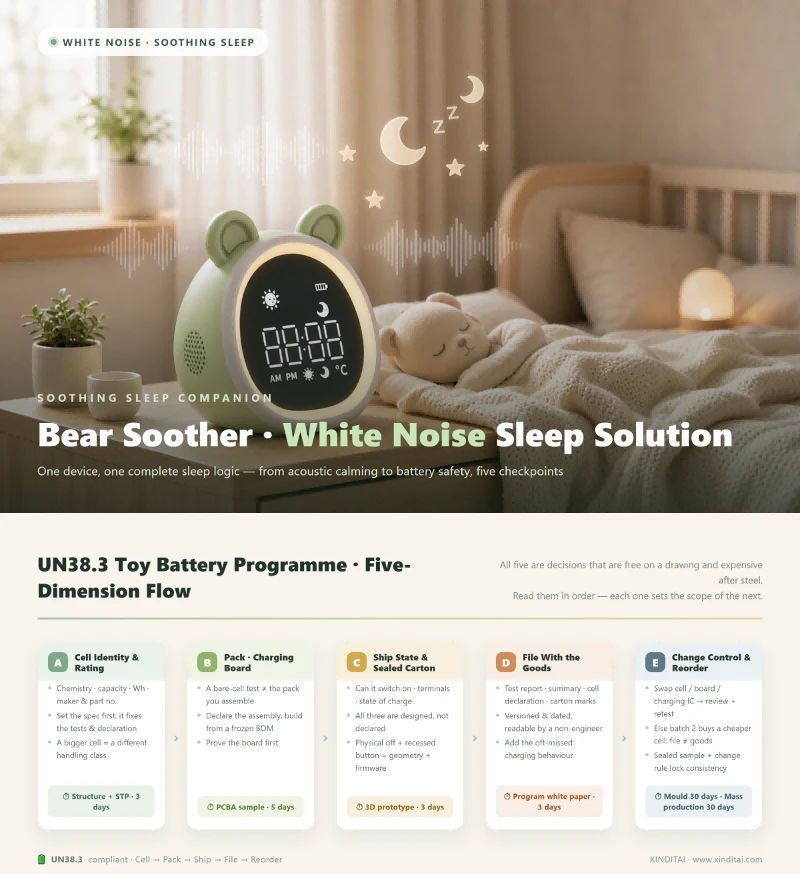
Five dimensions decide whether a UN38.3 toy battery programme holds at the booking, at the retailer's gate and on the listing. None of them is paperwork in the ordinary sense: all five are decisions that lock at a known point in the calendar, and each one is free on a drawing and expensive after steel. Read them in order, because every dimension sets the scope of the next.
Dimension A → Cell identity and rating, decided first: Chemistry, capacity, watt-hour rating, maker and part number belong on the specification before anything is drawn, because they set what has to be tested and how the consignment has to be declared. A bigger cell buys longer run time and pushes the unit into a different handling category; that is a product decision, not a freight decision. We put it into geometry early - structural drawings and an STP file in 3 days - so the electronics inventory exists on paper before anyone quotes a price.
Dimension B → The pack, the charging board and the declared scope: A test run on a bare cell does not automatically cover the pack your factory assembles from it, with its own protection board, wiring and connectors. Declare the assembly in writing, then build the plan from that list. We prove the board first: PCBA sample in 5 days. A plan written against a frozen bill of materials is the cheapest line in a UN38.3 toy battery programme.
Dimension C → Ship state and how the unit behaves in a sealed carton: Carriers care about the condition of the battery in the box: whether it can be switched on in transit, whether the terminals are protected, what state of charge it carries. All three are designed, not declared. A physical off position, a recessed button and a defined pack-out charge level are geometry and firmware decisions. We put a 3D printed prototype in your hands in 3 days so switch position and terminal protection are reviewed on an object rather than in an email.
Dimension D → The file that travels with the consignment: Test report, summary, cell declaration, carton marks and the handling information your forwarder asks for have to be one consistent set, versioned and dated, because the reviewer reading them is not the engineer who built the product. For a night light the charging behaviour is what most suppliers leave out - charge cut-off, thermal behaviour and what the unit does when it is plugged in for a week. We write that as a program white paper in 3 days, as a controlled document you can hand to a reviewer.
Dimension E → Change control and reorder consistency: This dimension decides whether the file still describes the goods twelve months later. Any swap of cell, protection board or charging IC should trigger a written review and, where tested items are touched, new tests. Without it the most common failure in this category arrives: a good design whose second batch bought a cheaper cell, so file and goods describe two products - something no first-sample test can catch. We lock it with a dedicated mould in 30 days and mass production in 30 days, against a sealed sample and a change rule.
Six Checkpoints in a UN38.3 Toy Battery File for White Noise Night Lights
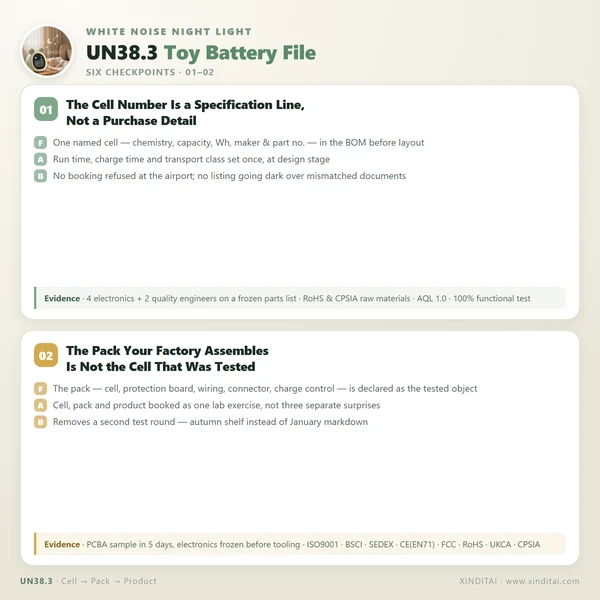
1. The Cell Number Is a Specification Line, Not a Purchase Detail
Feature: The White Noise Night Light is specified with one named cell - chemistry, capacity, watt-hour rating, maker and part number - recorded in the bill of materials before the board is laid out, and changed only through a written review.
Advantage: Run time, charge time and the transport classification are then decided once, at design stage, instead of being rediscovered by a purchasing clerk looking for a cheaper unit before Chinese New Year.
Benefit: Buyers protect the two things that actually cost money here - a booking refused at the airport, and a marketplace listing that goes dark because the documentation does not match the unit. Both are recovered with weeks, not with money.
Evidence: Four electronics engineers and two quality engineers work to a frozen parts list; raw materials are RoHS and CPSIA compliant; every shipment runs to AQL 1.0 with 100% functional testing before it leaves.
2. The Pack Your Factory Assembles Is Not the Cell That Was Tested
Feature: The assembled pack - cell, protection board, wiring, connector and charge management - is declared as the tested object, with the cell report carried alongside the pack-level evidence.
Advantage: Scope stops being a surprise. Cell-level, pack-level and product-level questions are booked as one exercise with one laboratory instead of surfacing one at a time, which is how programmes pay for two rounds of testing.
Benefit: Test weeks are the longest line in any nursery launch calendar; removing a second round is the difference between landing on the autumn shelf and landing in January markdown. A tidy UN38.3 toy battery scope is a margin decision.
Evidence: We take the board to PCBA sample in 5 days and freeze the electronics before tooling; our factory file includes ISO9001, BSCI, SEDEX, CE (EN71), FCC, RoHS, UKCA and CPSIA.
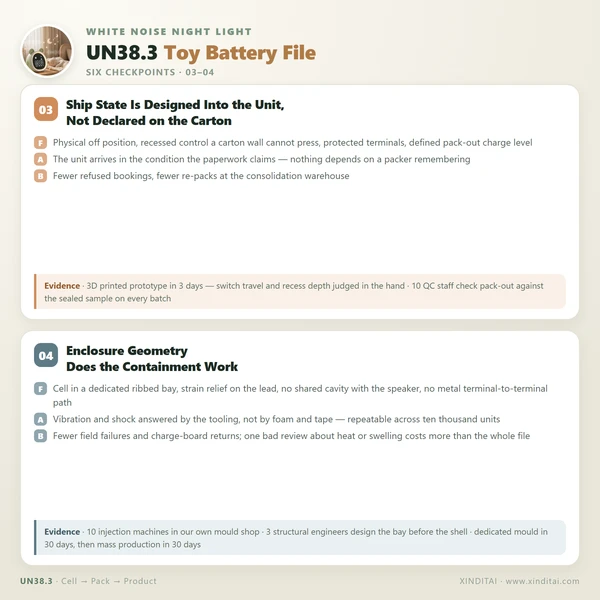
3. Ship State Is Designed Into the Unit, Not Declared on the Carton
Feature: A physical off position on the switch, a recessed control that cannot be pressed by a carton wall, protected terminals and a defined pack-out charge level.
Advantage: The unit arrives in the condition the paperwork claims. Nothing depends on a packer remembering an instruction, and the forwarder is not asked to accept a device that can wake up inside a sealed box.
Benefit: Fewer refused bookings and fewer re-packs at the consolidation warehouse - the two costs that never appear in the unit price and always appear in the launch date.
Evidence: A 3D printed prototype in 3 days lets switch travel and recess depth be judged in the hand; ten QC staff inspect the pack-out state against the sealed sample on every batch.
4. Enclosure Geometry Does the Containment Work
Feature: The cell sits in a dedicated, ribbed bay with strain relief on the lead, no shared cavity with the speaker, and no metal path from terminal to terminal through a fastener or a trim ring.
Advantage: Vibration and shock are answered by the tooling rather than by foam and tape, so the result is repeatable across ten thousand units rather than dependent on an assembly line habit.
Benefit: Fewer field failures and fewer charge-board returns, which is where nursery brands lose review scores - one bad review about heat or swelling costs more than the entire battery file.
Evidence: Ten injection machines in our own mould shop; three structural engineers design the bay before the shell; a dedicated mould in 30 days, then mass production in 30 days against the approved sample.
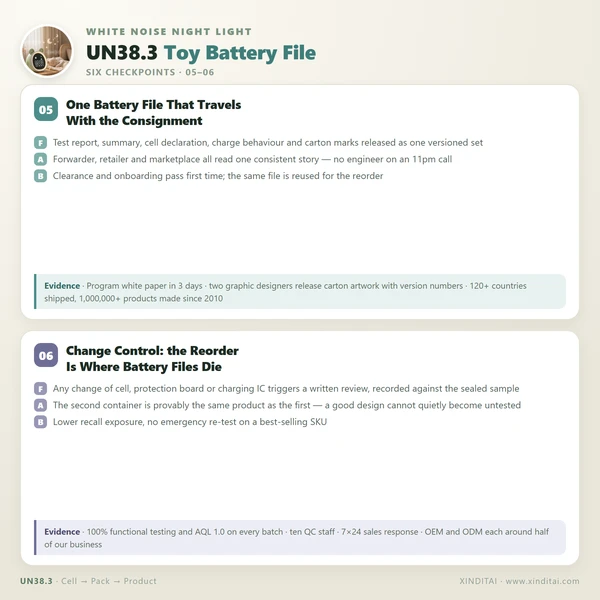
5. One Battery File That Travels With the Consignment
Feature: Test report, summary, cell declaration, charge-behaviour description and carton marks are released as one versioned set, with the same model code on the unit, the box and the document.
Advantage: Whoever reads it - forwarder, retailer, marketplace - reads one consistent story, and the answer does not need an engineer on a call at eleven at night in another timezone.
Benefit: Clearance and onboarding move on the first pass instead of the third, and the same file is reused for the reorder rather than rebuilt for every container. That is what a UN38.3 toy battery file is for.
Evidence: Program white paper in 3 days; two graphic designers release carton artwork with version numbers; 120+ countries shipped and 1,000,000+ products made since 2010.
6. Change Control: the Reorder Is Where Battery Files Die
Feature: Any change of cell, protection board or charging IC triggers a written review and a decision on whether tested items are touched, recorded against the sealed sample.
Advantage: The second container is provably the same product as the first. Without this rule a good design quietly becomes an untested one at the moment it starts selling well.
Benefit: Lower recall exposure and no emergency re-test on a best-selling SKU, which is the single most expensive way to spend a quarter's margin in this category.
Evidence: 100% functional testing and AQL 1.0 inspection on every batch, ten QC staff, 7x24 sales response, and OEM and ODM each around half of our business - we live on reorders, so batch consistency is our own risk too.
B2B Applications: Where UN38.3 Toy Battery Work Fits

A rechargeable night light travels through six very different buying processes, and a UN38.3 toy battery question lands differently in each. The unit is the same; what changes is who asks for the document and when.
1. Mother and baby brands (Brand Owners) - Building a first sleep product from zero, usually with a firm view on light temperature and sound library but no view at all on cell selection. This is the buyer who gains most from deciding the cell before the drawing: run time, charge time and the transport category are then one decision rather than three compromises made under a launch deadline.
2. Large supermarket and retail chains - Here the battery file is one item in a much longer list, and the list is non-negotiable. Expect to be asked for BSCI and SEDEX social audit reports, ISO9001, CE (EN71) covering EN71-1, EN71-2 and EN71-3, EN 62115 for the electrical side, FCC Part 15 where a radio is present, RoHS, UKCA, CPSIA with the supporting children's product certificate documentation, inspection to AQL 1.0 and 100% functional testing - with the battery transport report and the cell declaration added to the same pack. Missing one document in that list delays the whole delivery, not just the battery question.
3. B2B importers and distributors - Running standard SKUs on a reorder calendar, often mixing several SKUs in one container. Their exposure is batch-to-batch sameness: the first container was tested, the third one is the one that gets checked. Change control and a sealed sample are worth more to them than any single certificate.
4. Amazon and e-commerce sellers - Air freight and marketplace onboarding in the same week, with the calendar set by a promotional window. This is where a refused booking and a documentation request cost the most, because the goods are already paid for and the season is already booked. Cells declared early, carton marks right first time, and a file that can be uploaded rather than rewritten.
5. Gift, hotel and maternity-centre channels - Presentation-led buyers who want the unit in a gift box with a cable and a printed card, and who rarely think about what that does to the declared contents. Gift packaging adds volume, loose accessories add packing questions, and a spare cell in the box is a different consignment entirely. Keep accessories in the declaration, not in the surprise.
6. Education and nursery chains - Daily charge cycles, shared use, and a duty of care that shows up in procurement. They ask about run time per charge, charge-cycle life and what happens when twenty units are charged overnight on one rack - questions answered by the charging design and the thermal behaviour, both of which belong in the white paper rather than in a sales reply.
OEM/ODM Customization Services for White Noise Night Lights
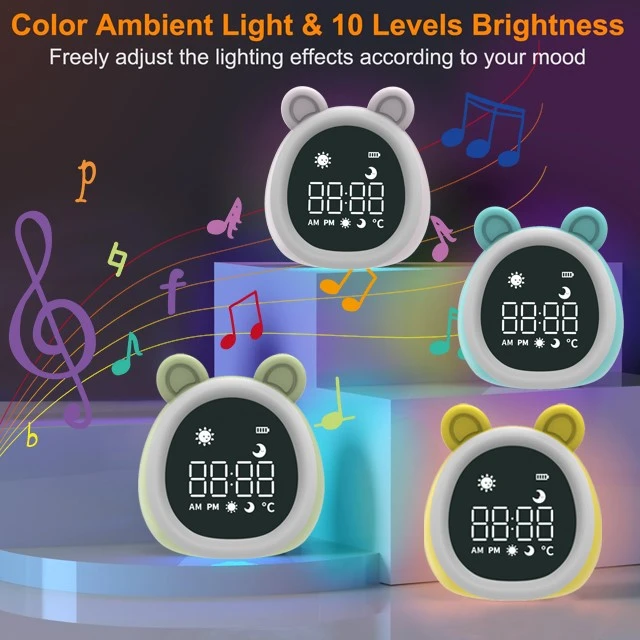
Product Design Customization
The cell bay is a design output, not a leftover space. Geometry, wall thickness and the position of the charging port are decided together, because the biggest cell you can fit is set by the tooling you are about to cut.
• Shell, dome and light-diffuser geometry drawn around a declared cell volume
• Dedicated ribbed battery bay with strain relief and no shared cavity with the speaker
• Switch travel and recess depth tuned so the unit cannot wake in a sealed carton
• Charger port position and cover chosen for bedside use and for terminal protection
• Structural drawings and an STP file in 3 days; a 3D printed prototype in 3 days
Every design output lands in a drawing set that is reviewed before steel, which is the only point at which a UN38.3 toy battery decision is still cheap.
Hardware Customization
Four electronics engineers take the board from specification to sample, and the cell decision sits on that board, not in a purchasing file.
• Cell chemistry, capacity and maker selected against your run-time target
• Charge management, cut-off behaviour and thermal monitoring defined in writing
• Audio hardware platform tuned to the enclosure: rain, waves, heartbeat and lullabies
• Dimmable light channel with adjustable colour temperature on a timer
PCBA sample in 5 days, so the declared configuration exists as hardware before tooling starts.
Software & Audio Content Customization
Content is what makes one night light different from another on a shelf of identical domes, and it is also part of the document a reviewer reads.
• Sound library built to your brief, with native-speaker narration where voice is used
• Six-language option - English, Chinese, Spanish, Arabic, French and Japanese
• Timer and dimming behaviour written down as firmware logic, reviewed before tooling
• An LLM-driven variant where a voice-led version is requested, with the persona written into a white paper and no model provider named
Program white paper in 3 days, covering wake method, charge behaviour and what the device does when nobody is touching it.
Packaging & Compliance Customization
The carton is where most battery programmes actually fail, because the marks, the manual and the declared contents have to agree with each other and with the file.
• One dieline with a market-specific text zone, so a new destination is a plate change
• Barcode and UPC placement, shelf-ready carton proportions and multilingual manuals
• Carton marks and handling information released from the same versioned artwork set
• Accessories - cable, printed card, gift sleeve - listed in the declaration, not added later
• Raw materials RoHS and CPSIA compliant; inspection to AQL 1.0 with 100% functional testing
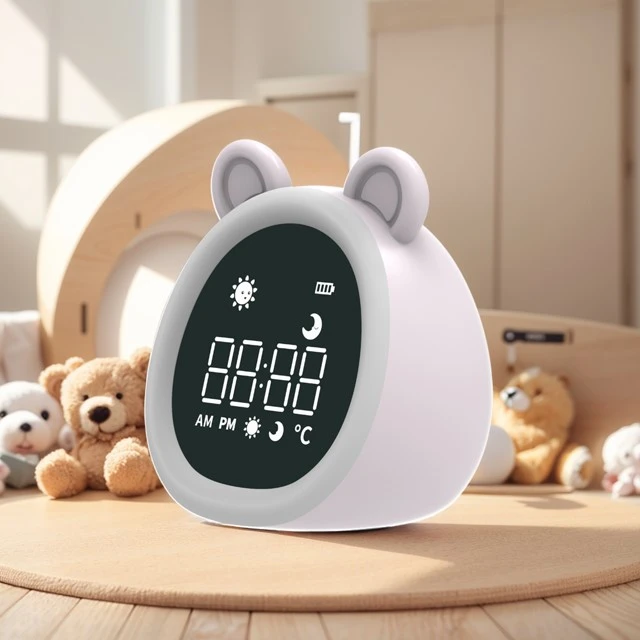
Why Choose XINDITAI as Your White Noise Night Light Partner
Factory-Direct Manufacturing
A battery decision made in a trading office has to be communicated to somebody else's factory. Ours is made in the room where the mould is cut, which is why we can answer a UN38.3 toy battery question with a drawing instead of a promise.
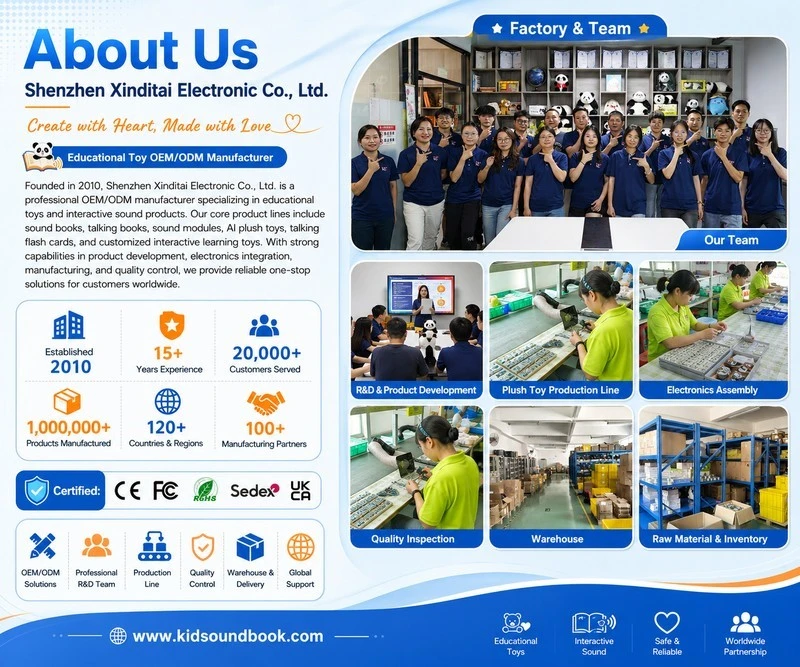
• 5,000 square metre factory with our own mould shop and ten injection machines
• 20,000+ units daily capacity, 1,000,000+ products made, 100+ manufacturing partners
• Three structural engineers, four electronics engineers, two quality engineers, ten QC
• National high-tech enterprise; ten new products developed every year
Global Export Experience
Rechargeable nursery units ship by air more often than by sea, and air is where documentation is read most closely. We have been shipping to 120+ countries since 2010 and have served 20,000+ customers.
• Factory certifications include ISO9001, BSCI, SEDEX, CE (EN71), FCC, RoHS, UKCA and CPSIA
• Inspection to AQL 1.0 with 100% functional testing on every batch
• 7x24 sales response, so a document request is answered in your working day
Frequently Asked Questions About UN38.3 Toy Battery Compliance
Q1: What is the MOQ for a custom white noise night light?
MOQ depends on whether you need a dedicated mould. Existing-shell OEM with your own colour, sound library and artwork carries the lower threshold; a new enclosure carries tooling and a higher one. Tell us your channel and first-year volume and we will quote both routes, because the mould decision should follow your forecast rather than the other way round.
Q2: Which documents does a retail chain ask for on a rechargeable night light?
Plan for the full set: BSCI and SEDEX social audit reports, ISO9001, CE (EN71) with EN71-1, EN71-2 and EN71-3, EN 62115, FCC Part 15 where a radio is fitted, RoHS, UKCA, CPSIA with the supporting children's product certificate documentation, inspection to AQL 1.0 with 100% functional testing - plus the battery transport report and cell declaration. Which items any given chain asks for, and which consolidated text is current in your market, should be confirmed with your own laboratory, notified body or local authority.
Q3: Does the night light record anything in the room?
The standard configuration has no camera and no microphone: it plays a sound library and dims on a timer. Where a voice-led version is requested, the platform is LLM-driven and the wake method, the boundary of the persona and whether anything leaves the unit are written into the white paper. We claim no privacy certification we do not hold.
Q4: How long does development take, and when is the cell decided?
Structural drawings and an STP file in 3 days, 3D printed prototype in 3 days, program white paper in 3 days, PCBA sample in 5 days, a dedicated mould in 30 days and mass production in 30 days. The cell is named at the specification stage and proven on the PCBA sample, which is roughly four weeks before tooling is cut - the last point at which a UN38.3 toy battery change is free.
Q5: Can you build a private-mould enclosure and our own packaging?
Yes. Ten injection machines run in our own mould shop, and a dedicated mould is delivered in 30 days. Packaging is developed in parallel: one dieline with a market-specific text zone, barcode and UPC placement, shelf-ready proportions and multilingual manuals, all released as versioned artwork so a second destination is a plate change rather than a new carton minimum.
Q6: What happens if something fails after delivery?
Warranty terms are fixed in the purchase contract rather than in a brochure, and spares are planned with the project rather than after it. Every batch is inspected to AQL 1.0 with 100% functional testing, and our sales team answers on a 7x24 basis, so a question raised in your morning is answered in your morning.
Future Trends in Rechargeable Nursery Night Lights
1. Rechargeable replaces disposable in the nursery aisle - Parents no longer accept a night light that eats batteries, so cells are growing. Bigger cells move the UN38.3 toy battery question from the shipping department into the specification meeting, which is exactly where it belongs.
2. Ship state becomes a written spec line - Off position, recessed control and pack-out charge level are starting to appear in buyer briefs next to lumen output and run time. Buyers who write them down stop paying for re-packs at the consolidation warehouse.
3. Battery documentation becomes an onboarding item - Retailers and marketplaces increasingly ask for the battery file before they list the product, not before they ship it. Treat a UN38.3 toy battery file as a listing asset and it stops being a freight problem.
4. Run-time claims push cell selection into tooling - A twelve-hour claim is a cell decision, and the cell is a volume decision. Brands that name the cell before the enclosure is drawn get the claim, the enclosure and the file in one pass instead of three.
Conclusion: Start Your Rechargeable Night Light Project Today
UN38.3 toy battery compliance is not a certificate you collect at the end of a project. It is a decision about which cell goes into your product, made while the decision is still a line on a drawing - and then protected by a change rule so the reorder stays the same product as the first container. Buyers who treat it as freight paperwork discover it in the week the cartons were meant to move; buyers who treat it as a specification line never think about it again.
We build rechargeable night lights for nursery brands, retail chains, importers, marketplace sellers, gift channels and education groups, with the cell named early, the board proven in 5 days and the enclosure cut after both are agreed. Send us your run-time target, your channel and your first-year volume, and we will come back with a cell proposal, a drawing set and a development calendar you can put in front of your own reviewer.
Contact Us
Contact: Zoey
WhatsApp: +86 13342950150
Email: xdt06@dtdianzi.com
Company: SHENZHEN XINDITAI ELECTRONIC CO., LTD | Website: www.kidsoundbook.com





