













The Square Phonograph in 2026: A Licensed-Content Carrier for Singers, Authors, Bedtime, Faith and Learning
The Square Phonograph in 2026: A Licensed-Content Carrier for Singers, Authors, Bedtime, Faith and Learning
A card-based square phonograph with a night light, built as a carrier for licensed content. OEM/ODM and content-partnership programmes by Shenzhen Xinditai Electronic Co., Ltd.
Table of Contents
02. What Is a Square Phonograph?
04. Square Phonograph vs. Streaming App and Bluetooth Speaker
05. Who Is the Square Phonograph For?
06. Why the 2026 Trends Favour It
08. Building a Licensed Content Line: Details, Quality and Safety
09. How to Choose a Square Phonograph
10. Recommended Products, Services and Content Partnerships
1. Introduction
Two things happened to the same audience in 2026, and together they made a small square phonograph unexpectedly relevant. Physical media kept coming back: sales of vinyl, CDs and cassettes rose again through the first half of the year, and commentators described a genuine nostalgia-driven return to objects you can hold, keep and hand to someone else. At the same time, parents kept looking for a bedtime routine that did not end with a screen in a child's bedroom, with the debate over sleep aids for children making a calm, non-drug, audio-and-night-light alternative more attractive than ever.
The commercial point is that the phonograph is not really a toy competing on novelty. It is a content carrier. Its cards are a physical format, like a record or a book, and that makes it useful to exactly the people who own content: an author with a story collection, a singer or label with a catalogue, a faith community with scripture and lessons, a school with a curriculum. Each of them can put their work onto a card that a child plays by turning a lever, and the machine becomes the distribution channel rather than the product.
This guide is written for the buyers, publishers and rights holders deciding whether to build on the format. It explains what a square phonograph is, how the card-and-lever mechanism works, how it compares with streaming apps and ordinary speakers, who it serves, why the late-2026 trend picture favours it, how a licensed content line is built, how to choose a configuration and how a custom programme runs. The reference platform throughout is model LMC 002 from Shenzhen Xinditai Electronic Co., Ltd.
2. What Is a Square Phonograph?
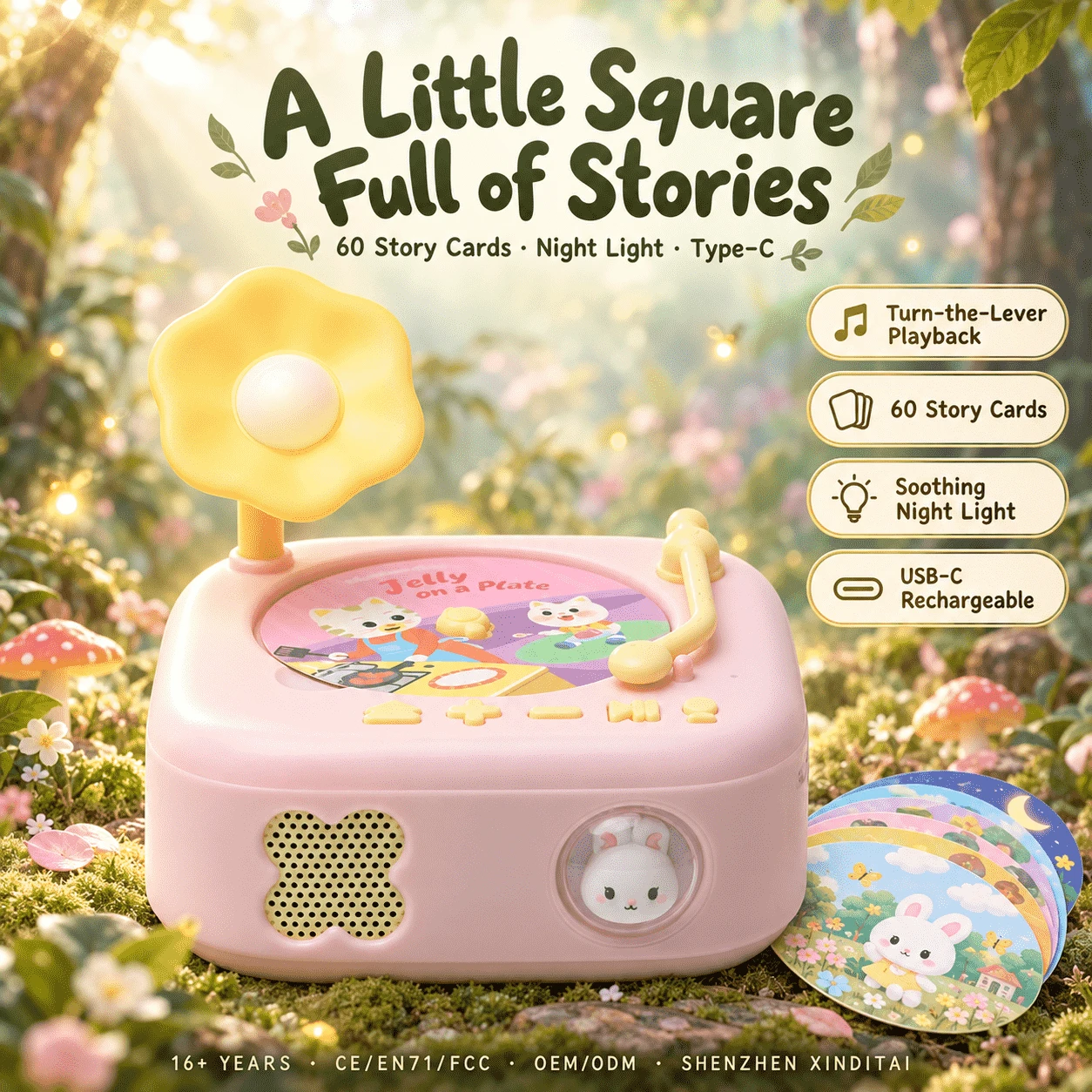
A square phonograph is a small audio player shaped like a classic horn phonograph, which plays cards instead of records. A child turns a lever to enter story mode, slides a card in, and the machine reads it and plays the story, song or lesson that belongs to that card, with a soft night light glowing while it runs. There is no screen, no app and no network: the content lives on the card and the card belongs to whoever created it, which is what turns the object into a licensed-content carrier rather than a generic speaker.
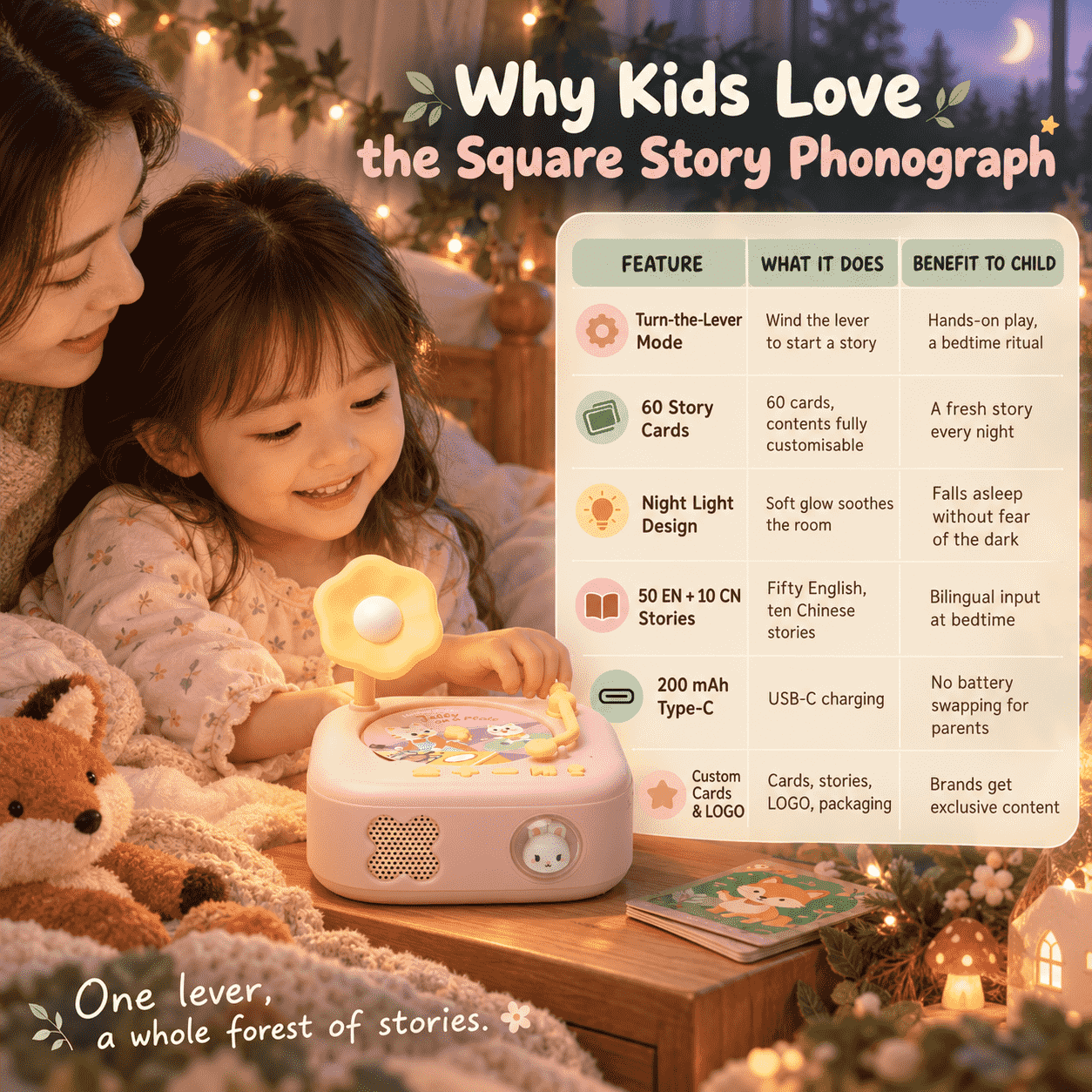
Model LMC 002 folds five capabilities into a 110 x 110 x 105 mm body that weighs 390 g:
- Card-based content library: the standard set ships with 60 story cards, and both the cards and their content are fully customisable, so a publisher, a label or a faith group can build the deck around its own work.
- Lever-operated story mode: turning the lever starts the machine and puts it into story mode, a physical gesture that children understand immediately and that no screen can replicate.
- Night light for bedtime: the night light design settles a child at bedtime and helps them sleep, which is what places the product in the evening routine rather than in the toy box.
- Spoken word and music together: the deck carries stories, songs and teaching content, so the same machine can serve a bedtime story, an album track or a lesson from a curriculum.
- Rechargeable and portable: a 200 mAh cell recharged over Type-C powers the audio and the light, and the small body moves from a bedside table to a car seat without cables or an outlet.
Typical B2B buyers include publishers and authors extending a book or a series into a physical format, music labels and independent artists looking for a child-safe way to release content, faith-based organisations and ministries building scripture and lesson libraries, educational companies packaging curricula, toy and gift distributors, and importers who want a private-label bedtime line. Because the cards, the story contents, the logo and the packaging can all be changed, one hardware platform can carry a library built by the buyer rather than by the factory.
3. How Does It Work?
The square phonograph runs on a short four-step routine: turn the lever, choose a card, listen, and let the night light close the day.
Step 1 - Turn the Lever to Wake It
Instead of a power button, the child turns the lever on the front and the machine enters story mode. The gesture is deliberate and satisfying, it needs no literacy, and it gives the child a sense of operating a real instrument rather than pressing an icon.
Step 3 - Listen and Switch Cards
The child listens to the story or song and, when they want something else, swaps in another card. Because each card is a self-contained piece of content, a session becomes a sequence of small choices and the deck can grow into a collection over time.
Step 2 - Insert a Card and Play
A card slides into the slot and the machine plays the audio linked to it, whether that is a bedtime story, a song or a lesson. Nothing has to be paired, downloaded or scrolled through, so the content starts in seconds and always starts at the beginning.
Step 4 - Settle Down With the Night Light
At bedtime the night light glows softly while the audio plays, so the machine becomes part of the wind-down routine rather than a screen to put away. The light and the story together are what let a child settle without an adult staying in the room.
4. Square Phonograph vs. Streaming App and Bluetooth Speaker
| Aspect | Square Phonograph | Streaming Story App | Bluetooth Speaker |
|---|---|---|---|
| Where the content lives | On a physical card that is owned outright and belongs to whoever produced it. | On a licensed platform the family rents access to, under someone else's terms. | On a phone, played through a speaker that owns nothing itself. |
| Screen involvement | None; a lever, a card and a soft light, which suits a dark bedroom. | A phone or tablet is in the room and in the child's hands. | None at playback, but a phone is still needed to choose content. |
| Content control for the owner | The rights holder decides exactly what ships, with its branding on the card, the box and the machine. | The platform sits between the creator and the audience and sets the terms. | The creator has almost no control over presentation or discovery. |
| Bedtime suitability | Purpose-built for it, with a night light and a routine a child repeats alone. | Designed for daytime use, with notifications and autoplay that wake a child up. | Neutral; nothing about it is made for a bedtime routine. |
| Offline use | Works with no network, on a flight, in a car or in a room without Wi-Fi. | Depends on a connection, an account and a subscription that can lapse. | Needs a paired phone, and the phone's battery has to last. |
| Gift and collection value | High; a card set is a collectible physical format and an easy gift. | Low; an app cannot be wrapped or handed down. | Low; it is a utility rather than a keepsake. |
- Children and the Bedtime Routine: The lever, the card and the night light give a child a short, repeatable ritual they can run alone, which is what a bedtime routine needs to be if it is going to hold night after night.
- Parents Wanting a Calmer Night: For households trying to keep screens out of the bedroom, the phonograph offers a self-contained alternative that plays content they have chosen and then stops, rather than a feed that keeps going.
- Authors, Publishers and Storytellers: A writer with a series, or a publisher with a list, can turn a catalogue into a card library and sell it as a physical, giftable format with its own branding on every card.
- Singers, Labels and Music Creators: The phonograph carries songs as naturally as stories, so an artist can release a lullaby album or a children's record in a format that is safe, tactile and impossible to pirate by copying a file.
- Faith Communities and Educators: Scripture, prayers, hymns and lessons fit the format exactly, and a school or a curriculum provider can ship its own teaching content on cards that a child plays at home without a screen.
6. Why the 2026 Trends Favour It
The format answers several shifts that matured through 2026, and a content owner reading the market will recognise more than one of them:
The Physical-Media Revival
Sales of records, CDs and cassettes rose again through the first half of 2026, and a nostalgia-driven return to objects you can hold has been widely reported. A card-based phonograph rides that mood: it is a physical format with artwork, a title and a place on a shelf, not a file in a library.
The Screen-Free Bedtime Shift
Screen-free sleep and bedtime products have been a visible growth area of the year, and parents increasingly search for them by name. A machine that is screen-free by construction, with a night light instead of a display, speaks directly to that demand without needing to be explained.
Caution Around Children's Sleep Aids
The debate over pharmacological sleep aids for children has grown louder, with clinicians urging caution about using them routinely. That debate pushes parents toward behavioural and environmental solutions instead, and a calm story with a soft night light is exactly the kind of non-drug night-time routine they are looking for.
The Growth of Faith-Based Children's Content
Faith-based children's media has been steadily expanding, from new curricula and lesson series to dedicated apps and creator communities. Those publishers own strong content and a committed audience, and they need a physical, screen-free way to put it in a child's hands, which is precisely the gap a card phonograph fills.
Licensing as the Engine of Kids Media
Franchise and IP strategy has dominated the children's media conversation through the year, and the autumn licensing calendar is when the year's deals are struck. A content carrier that can hold a partner's branding on the card, the box and the machine is an easy addition to a licensing programme, because it extends the property into a physical object without a new app.
Nostalgia and the Tactile Object
The physical-media return is driven by how an object feels and how it marks a moment, and the phonograph is designed around exactly that. Turning a lever, choosing a card and watching the light come up gives a child a tactile, deliberate experience that a tap on glass cannot match.
Night Light as Sleep-Routine Value
Night lights are one of the most consistently purchased children's sleep products, and combining one with audio makes the item do two jobs at once. That pairing also justifies a higher price than a plain speaker, because the parent is buying a bedtime solution rather than a device.
The Holiday and Gifting Window
As the toy calendar turns toward the year-end season, buyers shift from classroom stock to gift stock, and this product meets the gift criteria: a clear price point, a self-contained box, an instantly understandable benefit and a card set that can be expanded after the first purchase.
7. How It Is Used Day to Day
The machine earns its place by being used twice a day - once for learning or play, and once for the wind-down before sleep.
Step 1 - The Learning Hour
During the day a child plays a lesson card, a language card or a story that teaches something, and the machine reads it aloud in a clear voice. Because the content is chosen by the adult but operated by the child, it works as independent practice rather than instruction that needs supervision.
Step 3 - The Wind-Down
As the room darkens the night light comes on and the deck turns to quieter content - a lullaby, a prayer, a gentle story with a soft ending. The routine signals that the day is closing, which is what helps a child settle without negotiation.
Step 2 - Choosing a Card
The child picks the card from the pack and turns the lever, which hands them control of the session within limits the adult has already set. That balance - free choice inside a curated library - is what keeps the machine in use without turning the bedroom into a screen.
Step 4 - Growing the Library
New cards can be added at any time, so a family, a class or a faith group can build the library across the year. A publisher can release a new set of stories before a holiday, and the same machine plays the new deck without any change to the hardware.
8. Building a Licensed Content Line: Details, Quality and Safety
A content carrier is only as strong as the cards that travel with it, so the details below are the ones a rights holder should inspect on a sample before a run is committed.
Card Content and the Licence
Each card is a small, sealed object holding the audio that belongs to it, and the content can be a story, a song, a prayer or a lesson. Because the card is the unit of content, a rights holder controls exactly what ships and how it is labelled, with its own title, artwork and imprint on every piece, and additional cards can be added later without touching the machine.
The Lever and the Story Mode
The lever is the machine's signature gesture: turning it wakes the device and puts it into story mode, and its travel and click are tuned so that a small hand can work it and an adult finds it satisfying. Because it replaces a screen menu, the whole selection process happens through physical objects, which is what keeps the device screen-free in practice and not just in the specification sheet.
The Night Light
The night light is not an afterthought bolted on for marketing; it is the reason the machine belongs in the bedroom. It glows softly while the audio plays, settles a child at bedtime and helps them sleep, and the light level and colour are chosen to be restful rather than stimulating.
The 60-Card Content Library
The standard set ships with 60 cards, and the deck, the story contents, the logo and the packaging are all customisable. That combination means the library is built by the buyer rather than by the factory, so a publisher, a label, a ministry or a school can ship its own catalogue as a finished card collection with matching branding.
Size, Weight and Portability
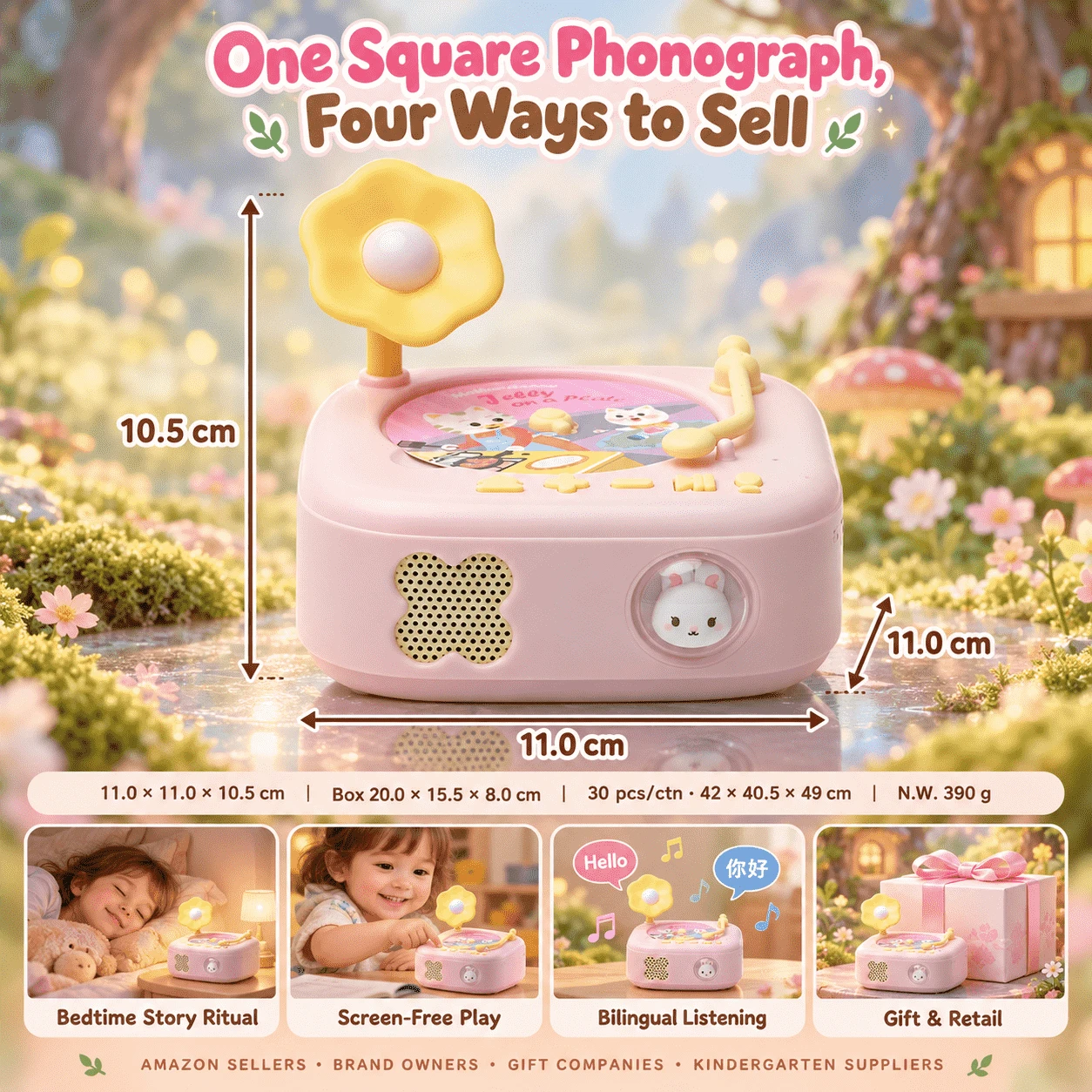
The body measures 110 x 110 x 105 mm and weighs 390 g, small enough to sit on a bedside table without crowding it and light enough for a child to carry. It runs on a 200 mAh cell recharged over a Type-C port and packs 30 units to a carton, with the whole unit self-contained and ready to play with no network.
Safety, Materials and Compliance
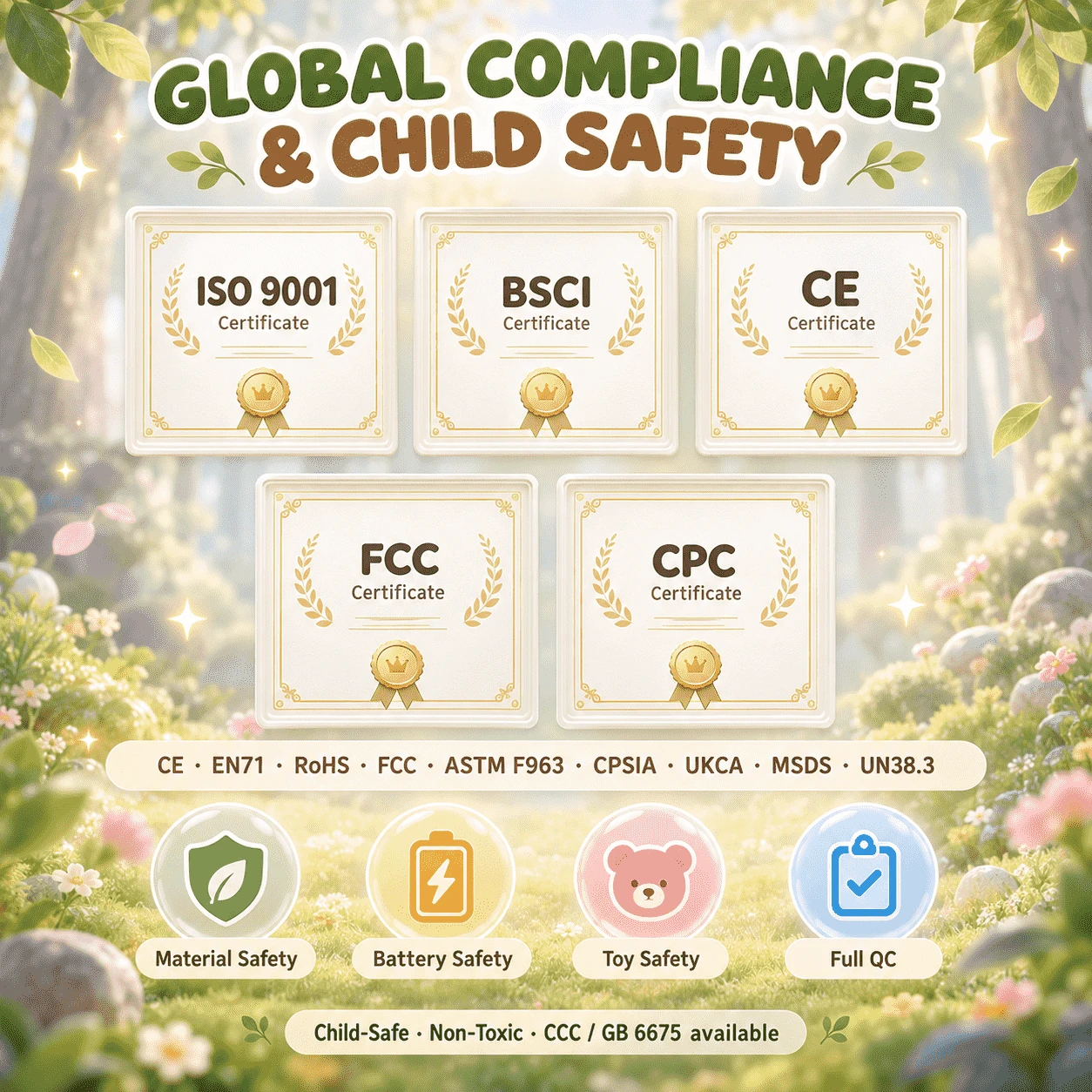
Because the product sits beside a child at night, the shell is built as a sealed body with the electronics kept away from the surface, the lever is finished with no sharp edge and the light is low enough to be restful. There is no screen and no small loose part in normal use, and compliance documents for the destination market - such as CE, EN71 and RoHS in Europe or CPC and ASTM F963 in the United States - are prepared for the batch that ships.
9. How to Choose a Square Phonograph
Two machines can look alike and serve very different content strategies, so the points below are worth settling on a sample before an order is placed:
The Content Library and Licensing Position
Decide first whose content will ship. A buyer distributing an existing catalogue needs the rights settled in writing before the decks are printed, while a content owner building its own library needs a supplier that can produce cards to its artwork and label. Both routes start from the same question, which is who owns what.
Card Count and Customisation
Confirm how many cards ship and how far the customisation reaches, including the story contents, the artwork, the logo and the packaging. A standard 60-card set is a starting point; what matters is whether the deck can be rebuilt around a specific series, season or curriculum.
Night Light Quality
See the light in a darkened room. It should be soft and restful rather than bright or cold, and it should stay on comfortably while the audio plays, since the light is the part of the product a child sees last before sleep.
Lever Feel and Playback Controls
Work the lever as a child would. It should move cleanly, return reliably and start playback every time, because it is the one control that has to survive years of enthusiastic use. Confirm the volume control and that the machine stops cleanly at the end of a card.
Battery, Charging and Speaker
Ask how long a charge lasts with the light on and how long a refill takes, and confirm the charging port is a common standard. The speaker should carry a voice clearly at a bedside volume without becoming harsh when the room is quiet.
Size, Weight and Portability
Check the footprint against a bedside table and the weight against a child's hands. The body should be stable enough not to be knocked over easily, and light enough that a child can move it without help.
Language and Content Style Range
Confirm which languages the supplier can produce and how wide a style range the deck can carry, from bedtime stories and lullabies to lessons and scripture. A library that covers more than one use keeps the machine in the routine rather than in the toy box.
The Manufacturer's OEM/ODM and Content Capability
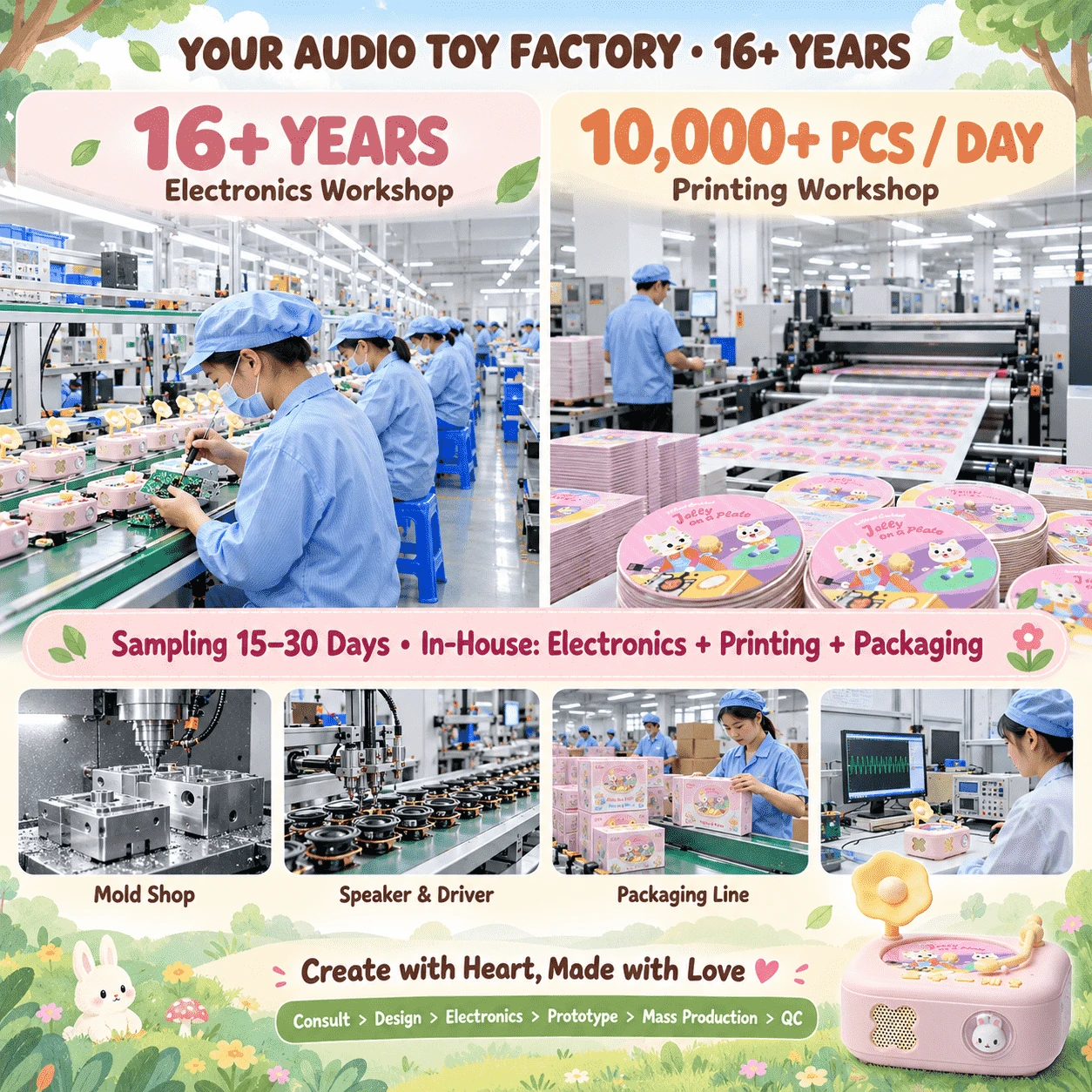
Finally, judge the partner behind the product. A supplier that can record the audio, print the cards, tool the shell and handle packaging on one site will move faster on a licensed project and keep a range consistent as it grows, which matters more over a season than a small unit-price difference.
10. Recommended Products, Services and Content Partnerships
Xinditai Square Children's Phonograph (LMC 002): a 110 x 110 x 105 mm card phonograph weighing 390 g, supplied with 60 story cards, a lever-operated story mode and a night light, running on a 200 mAh cell recharged over Type-C and packed 30 units to a carton. The standard deck carries stories in English and Chinese, and both the deck and its contents are produced to order.
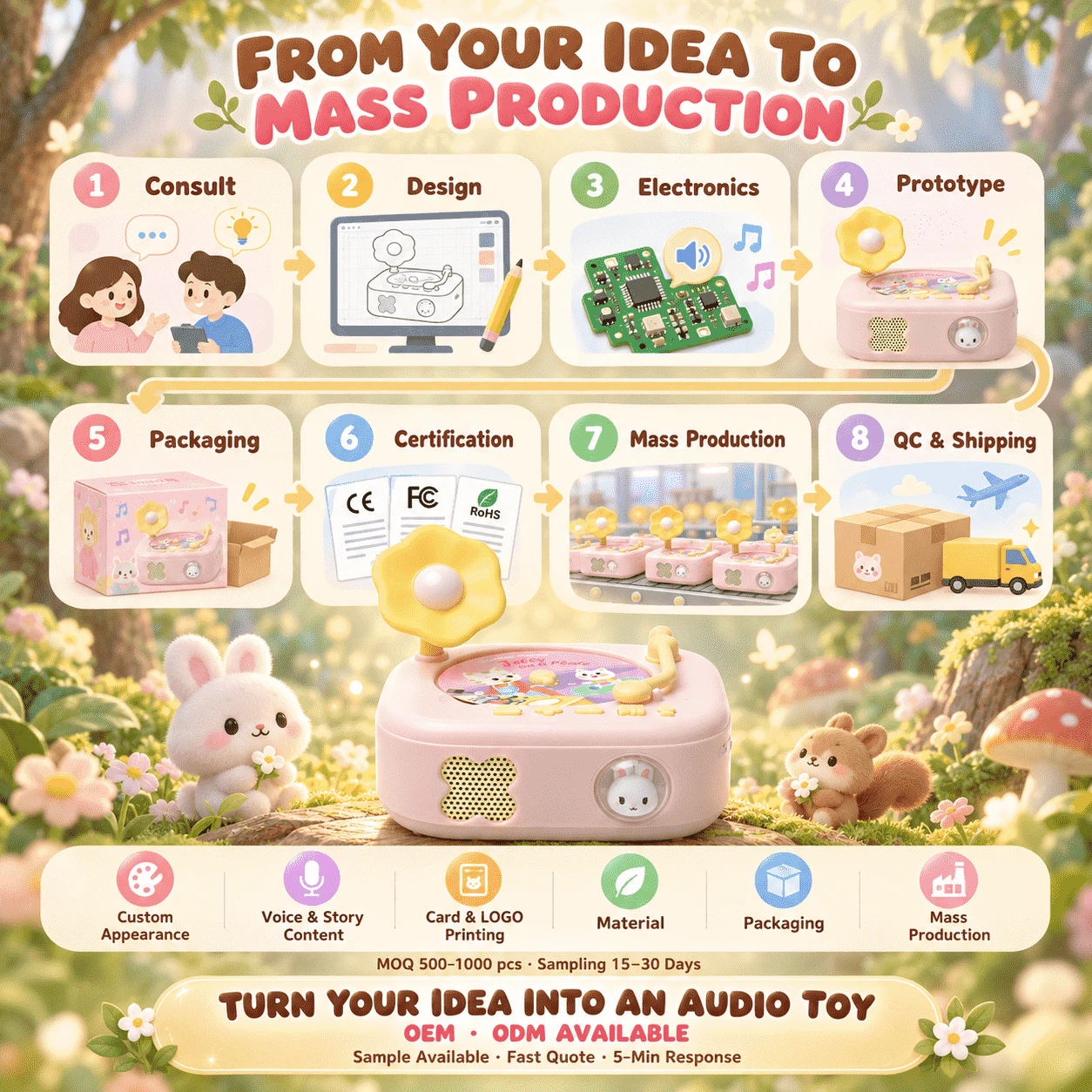
Content partnership service: the card artwork, the story contents, the logo and the packaging are all customisable, so a publisher, a music label, a faith organisation or a school can ship its own catalogue as a finished card library with matching branding on every card and on the box.
Audio production and card manufacturing: narration, music and lesson recording, editing and mastering, and the printing and encoding of the cards are handled alongside the hardware, which keeps a licensed range consistent from the first sample to the last carton.
Category experience: the same facility produces card phonographs, talking flash cards, drawing machines, sound books, AI plush companions and NFC story machines, so a partner can extend a catalogued content line across several physical formats with one supplier. The company was established in 2001 and holds ISO 9001, BSCI and SEDEX certification; design, engineering and assembly all take place on a single site, with OEM and ODM orders accepted from a flexible minimum of 1,000 pcs.
11. FAQ
Q: What age is the square phonograph suitable for?
A: It is aimed at young children, from around three years old. The lever needs no reading and no instructions, so a small child can operate it, while the content can be written for babies, preschoolers or early primary children, which lets one machine serve a family for several years.
Q: What kinds of content can go on the cards?
A: Stories, songs and lullabies, bedtime and wind-down audio, lessons, vocabulary and language practice, prayers, hymns and scripture, and guided routines. Because each card holds its own audio, a single deck can mix a bedtime story with a learning card and a song without any change to the machine.
Q: Can it be used without any network or app?
A: No. The machine reads a card and plays what is on it, offline. There is no app to install, no account to create and no signal to lose, which is why it works in a bedroom, a car or a place of worship without any setup, and why no screen ends up in a child's room.
Q: Can we use our own content and branding?
A: Yes, and this is the core of the format. The card contents, the storytelling, the artwork, the logo and the packaging are all customisable, so a rights holder can ship its own catalogue as a branded card library. Confirm the licensing position for any third-party content in writing before the decks are printed.
Q: Is it suitable as a sleep aid for children?
A: It is a night-time routine aid, not a medical one. The night light, the gentle audio and the soft ending help a child settle, and many parents prefer that to a medication-based approach, but the product is not a treatment for a sleep disorder and should not be presented as one. Persistent sleep problems belong with a paediatric professional.
Q: Why is now a good time to launch this format?
A: The demand is already visible. Physical media has been growing again, screen-free bedtime products are one of the year's clearest trends, the debate over children's sleep aids is pushing parents toward behavioural routines, and faith-based and educational content owners keep expanding. A licensed content carrier answers all of those at once, ahead of the year-end gifting season.
12. Contact Us
Tell us the content you hold, the language and the market you are building for, and our export desk will come back with a tailored proposal.
Email: xdt01@dtdianzi.com
Send a short note about your catalogue and the audience you serve, and the same team picks it up from there.
WhatsApp / Mobile: +86 139 2381 3463
Reaching out with a short message is enough, and you will receive a clear next step and sample options within a working day.





