

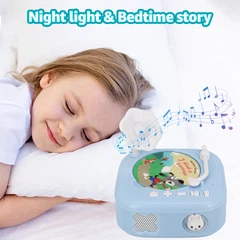


Baby Soothing Night Light Alarm Clock – How a Bear Shape Writes the Bedtime Routine Before Anyone Touches a Button
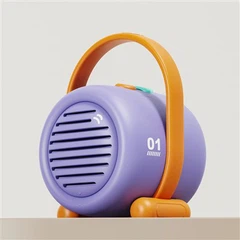
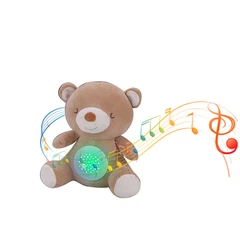
Details: On a nursery shelf, a shape does the talking long before a single feature is switched on. The rounded bear body of this unit tells a parent where to reach, and it tells a child that the object belongs to the night rather than to play. That is the commercial heart of this model: the silhouette is the first line of the routine, and the routine is what a retail buyer is really putting on a shelf. Underneath the soft curves sit four working features – a soothing night light, an alarm clock, a temperature display and voice recognition – powered by a 1500 mAh lithium cell that recharges over Type-C. The body measures 95 × 90 × 89 mm and weighs 200 g. Minimum order: 1,000 pcs.
The Shape Is the First Instruction
A bedtime product is handled by people who are already tired, so anything that has to be learned at ten at night will not be learned at all. Bear proportions solve that problem by making the object self-explanatory: a head that is plainly a head, ears that read as ears, and a rounded belly that invites a hand. Before a parent has finished opening the box, the form has answered the question of what this object is for.
That is why the mould came before the feature list in this design. The housing is a near-cube of 95 by 90 by 89 mm with softened corners, sized so a young hand can wrap around it and an adult hand can lift it between two fingers. Nothing in the outline suggests a laboratory instrument, and nothing in it suggests a toy that will be outgrown in a single season.
Buyers who sell into nurseries know that shelf presence is decided in the first second, and a recognisable animal silhouette wins that second far more reliably than a grey rectangle. The bear reads at three metres. It reads again on a phone screen in a marketplace listing. It also photographs well, which matters because most of a modern catalogue is seen as a thumbnail long before it is seen in a room.
There is a second, quieter argument for the animal form. A character shape gives a family something to call the object. Once a child has a name for the lamp, the lamp quietly becomes part of the evening. Object permanence turns into habit, and habit is the reason a household replaces this model with the same model rather than with a cheaper one next season.
For a brand, that naming habit is worth more than any single feature on the box. It is the difference between a product a family owns and a product a family talks about. It is also the reason a licensed version and a house-brand version can sit at different shelf positions without competing, because the silhouette carries the meaning while the artwork carries the identity.
Roundness as a Working Detail, Not a Style Choice
Softness on this unit is structural rather than cosmetic. The absence of sharp edges is the first thing a parent checks, and a rounded shell passes that check visually before a hand ever touches it. It is a small design decision with a large effect on how quickly trust is granted in an aisle.
The 200 g weight belongs to the same logic. Light enough for a child to move and heavy enough to stay where it is put, it lands between a toy and an appliance. A unit that can be carried from the cot to the bathroom without effort gets used more often, and the unit that gets used more often is the one a family recommends.
Wall thickness and corner radius also decide how the product survives a drop onto a wooden floor. A body with no stress-raising corners spreads an impact instead of concentrating it in one point. That is the difference between a scuff and a return, and returns are the cost line a buyer feels first.
The proportions are deliberately chunky rather than slim. A narrow, tall lamp topples when a sleepy hand brushes past it; a low, wide bear stays exactly where it was placed. Stability is not a word a buyer prints on a carton, yet it is a quality a user notices within the first week of ownership.
The surface finish is chosen to hide fingerprints as well. A nursery device is handled with sticky fingers, and a high-gloss shell shows every mark under a bedside lamp. A matte or soft-touch treatment keeps the object looking new for longer, which quietly protects the reputation of the brand printed on it.
The Face as the Control Panel
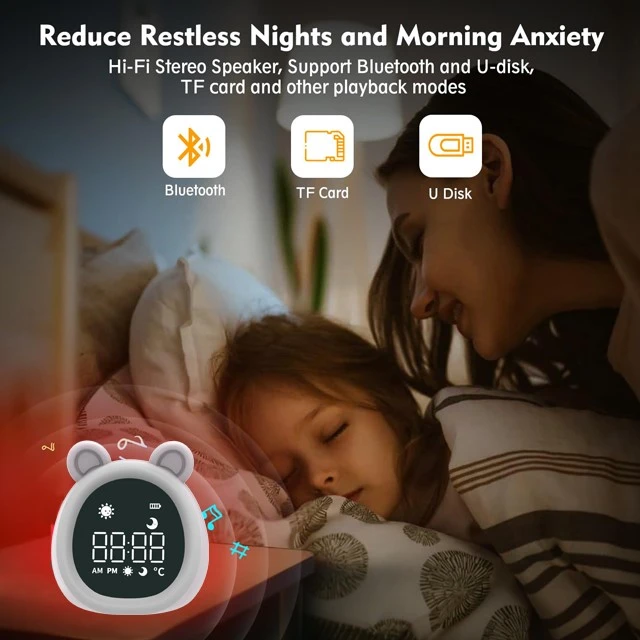
Four features need four places to live, and this model resolves that by letting the face do the work. The readout sits where a face would sit, so a child absorbs the screen as an expression rather than as an instrument. The result is a control layout that needs almost no printed labels.
That matters for export. A panel that depends on words has to be re-printed for every language a buyer sells into, and each version is a fresh chance for a mistake. A panel that depends on position and shape is language-neutral, and a language-neutral interface travels between markets without a single reprint.
The same reasoning applies to the temperature display. Read out on a face, it becomes a piece of room information rather than a technical measurement. A parent glancing across a dark room takes it in within a moment, and that moment is often enough to decide whether a sleeping child is warm enough.
Voice recognition adds the final layer. Spoken control removes the need to hunt for a switch in the dark, which is precisely the situation a night light exists to serve. Whether a buyer positions voice control as a headline feature or as a quiet convenience depends on the market, but the capability is already present in every unit that leaves the line.
For a B2B buyer, the useful point is that these interface decisions are already made and already coherent. A face that reads as a face, a readout placed where a readout belongs, and a microphone listening from the top of the head form one system. Re-specifying a single part of it tends to weaken the other parts.
How the Shape Sequences the Evening
Form turns into ritual because it creates an order. A bear with ears at the top and light in the middle invites the hand upwards and then inwards, and that movement is the opening of a routine. The product is arranged so the whole sequence feels like one gesture instead of four separate commands.
First the lamp, which is dim and warm enough to be left running. Then the room reading, taken from the face without pressing anything at all. Then the alarm, set once and trusted to repeat. Finally the voice, used for the small interventions that would otherwise require a light and a search.
That order matters commercially because a ritual is repeatable. A parent who performs the same sequence every evening becomes fluent in the product, and a fluent user rarely returns it. Simplicity at the point of use is a retention strategy rather than a courtesy.
It also changes how the product is demonstrated. A salesperson holding a bear can mime the entire evening in fifteen seconds, because the shape makes the sequence visible. A feature list cannot be mimed, and live demonstration is one place where a physical shelf still beats a screen.
Retailers should treat that mime as training material. Teach the staff the gesture once and the same sequence appears in every store that carries the line. Consistency of demonstration is one of the cheapest ways to lift sell-through on a product that depends on being understood quickly.
Light, Sound and the Small Hours
A night light is judged at its dimmest setting rather than at its brightest, and the bear form helps here as well. Because the light source sits behind a rounded front, the glow spreads softly instead of projecting a hard circle onto the wall. A gentler pool of light is far less likely to be perceived as a device that somebody switched on.
The alarm side of the product is judged in the morning, which is the opposite test. A wake-up that escalates gradually is kinder than one that arrives at full volume, and a chime pitched in a warm register is easier to accept than a sharp electronic tone. Both are configuration choices a buyer can settle before production begins.
Between those two moments lies the whole night. Voice recognition covers the interruptions, and the rechargeable cell covers the schedule. A 1500 mAh lithium battery charged over Type-C means the unit can travel without a cable hunt, because the connector it needs is the common one.
Together the three behaviours form a service that runs from dusk to dawn. Light at the start, reassurance in the middle, sound at the end. A product that covers all three earns its shelf space in a different way from a lamp that covers only the first.
Why the Ritual Is an Operations Argument
Ritual is often treated as a marketing word, but in this category it is an operations word. A household that folds a product into a fixed routine uses it every single day, and daily use drives both satisfaction and word of mouth. Those are the numbers a distributor actually measures after the first container clears customs.
There is a packaging benefit too. A product whose purpose is obvious from its shape needs fewer words on the box, and fewer words mean more room for brand storytelling and less risk of a translation slip in a market the buyer does not speak.
For an own-brand order, the bear form provides a stable visual anchor. Colourways can change, artwork can change, the language printed on the carton can change, and the recognisable silhouette still holds the range together across several markets. That continuity is difficult to buy with graphics alone.
The last argument is timing. Sleep products sell in predictable windows, and a design that can be specified quickly fits those windows more easily. Because the form and the mechanism are already settled, a first order becomes a matter of choosing colours and packaging rather than commissioning a new shape.
Baby Soothing Night Light Alarm Clock – Model AC-003 Data Sheet
| Baby Soothing Night Light Alarm Clock – Specification Summary (AC-003) | |
| Item | Baby Soothing Night Light Alarm Clock / AC-003 |
| Functions | Baby soothing night light, alarm clock, temperature display and voice recognition |
| Battery & Charging | 1500 mAh lithium battery, Type-C rechargeable |
| Unit Size | 95 × 90 × 89 mm |
| Gift Box | 120 × 115 × 96 mm |
| Unit Weight | 200 g |
| Carton Size | 50.5 × 48.5 × 35.5 cm |
| Carton Weight | 13 kg |
| Compliance | CE, UKCA, FCC and RoHS marks, with CPC documentation and ASTM F963 / EN71 reports supplied on request |
| Order Quantity | 1,000 pieces (trial orders negotiable) |
For an enquiry on this model we send a working pack rather than a brochure: the current colourways, the sample terms, the artwork template for the gift box, the carton dieline and the 3D data of the housing. Send the requirement list through the enquiry form and it arrives within one working day. The full range sits here: https://www.kidsoundbook.com/products
Seven Things the Bear Form Decides for a Buyer
Details: When a silhouette is settled, a large part of the buying decision is settled with it. What remains is a short, familiar list. These are the seven items that change from one order to the next, and each one is easier to answer because the shape already points in a direction.
The Bear Itself
Whether the line sells the character as a warm family figure, as a licensed property or as a plain house mascot. The same housing carries all three, because the identity rides on colour and small cosmetic details rather than on the outline. Deciding which of the three a brand wants is the first answer, since packaging copy follows it.
The Dimmest Light Setting
How far the soothing light drops before it goes out completely, and whether the range leans warm. A nursery usually needs a low, amber-toned floor; a reading corner wants more headroom. This is the setting that decides whether the unit sleeps beside a cot or sits across the room, so it belongs in the first sample review.
The Face Layout
Where the temperature readout sits, how bright the digits run and how much of the face stays dark at night. A readout that glows too strongly undoes the work of a dim lamp, so brightness control on the display is part of the specification rather than an afterthought. Buyers with a strong packaging concept often want the digits styled to match it.
How Voice Recognition Behaves
Which commands are accepted, how far the microphone listens and how the unit confirms that it heard. A product used by a sleepy adult should be forgiving of a quiet voice, while a product aimed at older children can be firmer about confirmation. These are firmware settings, so they can be adjusted per order without touching tooling.
The Alarm Character
The tone, the volume ramp and the way a wake-up is silenced. A gradual climb suits a child learning to wake independently, while a firmer single tone suits a shared bedroom. Because the alarm is the last thing a user hears each morning, its character shapes the memory of the product as much as its light does.
Colourway and Finish
Whether the bear ships in a soft neutral, a pastel or a saturated tone, and whether the surface is matte or lightly textured. Colour is applied at the moulding stage, so it is one of the few decisions that touches the production calendar. It is also the decision a retailer notices first on a shelf test.
Territory and Identity
Whether the order is a general edition or tied to a channel, a country or a single retail group. This is a commercial decision rather than a technical one, but it has to be answered beside the specification, because it determines whether the artwork and packaging can be reused for another buyer later.
Who Orders a Character Sleep Product in Volume
A shape-led sleep product attracts a particular kind of buyer: someone who already owns a market position and a brand, but who has no wish to develop a rechargeable, voice-aware night light from an empty page.
When Character Sleep Products Move
| Selling Windows – Baby Soothing Night Light Alarm Clock | ||
| Window | What Buyers Do | What to Have Ready |
| Late summer to early autumn | Nursery category resets and back-to-routine promotions are planned | Confirmed colours, gift box artwork and carton markings |
| Autumn to early winter | Gift assortment orders are placed for the year end | A display-ready pack and a short demonstration script for staff |
| Winter | Sleep-focused campaigns run while daylight hours are short | Marketing images and the light behaviour at its dimmest |
| Spring | Reorders are placed against what sold in the previous season | An unchanged specification so the repeat run matches the first |
| Early summer | New listings are prepared for the next year of trading | Sample units for photography and marketplace copy |
Two habits keep a character product moving through these windows. The first is to place the gift assortment order against a finished specification rather than a draft, because a colour decision made in October is worth less than the same decision made in July. The second is to keep one approved sample on the buyer's side, so a reorder can be checked against the original rather than against memory.
The Commercial Case for a Settled Form
Ordering against a finished form behaves very differently from commissioning a new one, and the difference shows up in time, in risk and in what a buyer has to fund before anything can be sold.
| What a Buyer Is Choosing Between | ||
| Baby Soothing Night Light Alarm Clock (AC-003) | A sleep device drawn from scratch | |
| Design work before the first sellable unit | Complete, with the bear form already in production | Months of form study, surfacing and prototype rounds |
| Tooling | Existing mould for the character housing | New moulds cut, paid for and amortised |
| Time to a reviewable sample | Weeks | A season or longer |
| Where the money goes | Specification, packaging and stock | Form development, tooling, testing and stock |
| What can change without a redesign | Colour, light floor, display style, alarm character, branding | Very little once the mould is cut |
| Behaviour of a repeat order | Decision stages skipped | Re-approval and re-testing each cycle |
The trade-off deserves to be stated plainly. Buying a settled form gives up absolute freedom of shape: the bear outline and the four-function set are fixed, and a buyer who needs a different silhouette is looking at a development project rather than an order. For brands whose advantage sits in market access, distribution and packaging, that trade is usually the right one.
There is also a quieter benefit that appears in the second year. Because the housing is shared, spare parts remain available long after an opening order ships, and a replacement unit can be built from the same specification without a fresh approval cycle. Buyers planning to support a line across several seasons should weigh that continuity beside the cost of the first container.
From Enquiry to Container – the Eight Stages
Buyers who have not ordered from a Chinese toy factory before usually ask what happens once an enquiry is sent. The sequence below is the one this model follows, and knowing it in advance is what keeps a project inside its window.
| Order Flow – Stage by Stage | ||
| Stage | What Happens | What Is Needed From the Buyer |
| 1. Requirement brief | The market, the intended shelf position and the function emphasis are mapped onto the existing form | Destination markets, channel, and which of the four functions leads the message |
| 2. Specification sheet | Light floor, display behaviour, alarm character and voice settings are written down and confirmed | A decision on each configurable behaviour |
| 3. Appearance and artwork | Colourway, finish and branding are agreed against the current housing | Colour reference plus logo files |
| 4. Sample round | A working unit is built to the agreed specification and shipped for review | Sign-off, or one written list of changes |
| 5. Packaging | Gift box artwork, carton wording and manual language versions are laid out | Artwork, wording and the manual languages required |
| 6. Testing and documents | The destination test programme runs and the document set is prepared | Confirmation of markets and labelling needs |
| 7. Pilot and mass production | A pilot batch is checked against the approved sample, then the full run is built with line inspection | Pilot approval, final quantity and delivery window |
| 8. Packing and export | Units are boxed to the agreed carton, markings applied and export documents prepared | Carton markings and shipping instructions |
Two stages carry most of the risk. The specification sheet decides how much rework appears at the sample stage, and the packaging artwork decides whether the run can ship on time. Both are documents the buyer produces rather than the factory, which is why a project that finishes early is usually one where the buyer was organised rather than one where the line was fast.
For a buyer new to this process, one piece of advice outweighs everything else: treat the specification as the product. Every hour spent defining it before sampling saves several hours of correction afterwards, and that document is what the factory builds to, what the sample is judged against and what a reorder is reproduced from. A clear brief is the largest saving available on an order like this, and it costs nothing but attention.
What Buyers Ask Before Placing a First Order
Q1: Can we change the character, or is the bear fixed?
The housing outline is fixed because it is already tooled, but the character it reads as is not. Colourway, surface finish, the expression printed or moulded on the face and the artwork on the box can all be adjusted to suit a brand, and a licensed release is handled the same way. What we cannot do within this model is produce a different animal or a different silhouette, because that requires a new mould and a development schedule.
Q2: How does the temperature display behave at night?
The readout is part of the specification, so its brightness and its style are agreed before production rather than left at a default. For a nursery we usually recommend a subdued setting that can still be read across a dark room without the digits competing with the night light. A buyer serving older children or a reading corner can choose a more visible display. Whichever way it is set, the display and the lamp are tuned together so the two do not fight each other in a dark room.
Q3: What does voice recognition actually control?
It gives the user a way to act without finding a control in the dark, which is exactly the moment a night light is meant to serve. The command set, the listening range and the way the unit confirms it heard are firmware matters, so they can be tuned per order without touching the housing. Buyers positioning this as a convenience feature usually keep the phrasing simple, while buyers building it into a wider smart-home story tend to ask for a fuller command list and clearer confirmation.
Q4: How is the unit charged, and how long does a charge last?
Charging is done over Type-C, which is the connector most households already own several of, so the product travels without a dedicated cable hunt. The cell is a 1500 mAh lithium battery, and the usable run time depends on how the light and the alarm are configured, because the lamp is the largest consumer of power. We confirm the expected behaviour for a specific configuration during the sample stage, so a buyer can state a realistic expectation in their own marketing copy.
Q5: What quantity does a first order need to be?
Production runs start at 1,000 units, and shorter trial quantities between 200 and 500 units can be arranged for a market test on terms we confirm with the quotation. A working sample can be sent ahead of any commitment, and its cost is credited once the bulk run is placed. Buyers entering a new channel often begin with a trial quantity and a single specification, then move to a full run once the shelf has proved itself.
Q6: How can an own-brand order be packed?
Gift box artwork, carton wording, the manual language and the brand printed on the product all belong to the order. The gift box measures 120 × 115 × 96 mm, and the export carton measures 50.5 × 48.5 × 35.5 cm at 13 kg, so a retail-ready pack and a distribution pack can both come off the same run. Artwork has to be approved before the first carton is closed, which puts it near the start of the schedule rather than at the finish.
Q7: Which certificates accompany an order?
We run the test programme for the markets an order is shipping to and prepare the document set alongside production. The base work covers the electrical and safety requirements common to the destinations we serve, and market-specific requirements are added when a new country is involved. CE, UKCA, FCC and RoHS marks are standard for the relevant regions, with CPC documentation and ASTM F963 or EN71 reports supplied on request.
Q8: Can we visit the factory and watch our order being built?
Yes, and we welcome it. Buyers are free to come on site, or to join a live video walkthrough of the line while their batch is running. Because tooling, electronics, assembly, testing and packing all sit on one site, an order can be followed from the components that arrived to the carton that shipped without a gap in between. Buyers who have not travelled before often find that one visit answers more questions than a month of email.
The Site Where the Routine Is Built
for children
Xinditai Electronics is a Shenzhen manufacturer that has worked on children's audio and interactive products since 2010. The business runs on OEM and ODM programmes for children's audio products – sound players, talking cards, audio books, drawing tablets, projection toys, sleep aids and musical devices – for brands and distributors in many countries.
From a 3,000-square-metre site with more than 100 engineers and operators, the whole chain stays under one roof: audio engineering, moulding, electronics, assembly, testing and packing. The working rule is captured in one line – Create with heart, ship with pride – and inspection sits at every stage rather than only on the finished pallet, so any unit can be traced back to the parts it was built from.

Compliance and Certificates
Certificates
Documents are prepared for the markets an order is shipping to and reviewed as standards change, so what accompanies a quotation belongs to that order rather than to a previous run.

CE

RoHS

FCC

SEMTA

EMC

ISO