

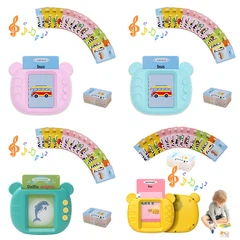
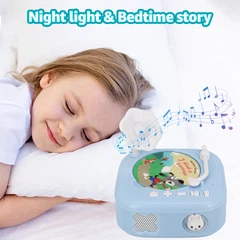
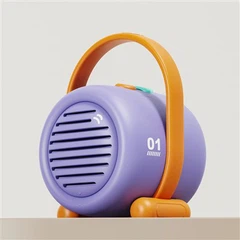


Europe is where the category was invented, not just where it sells
If you want to understand the children's phonograph and story machine category, you do not start in a trade fair hall. You start with a bedtime routine in a German household.
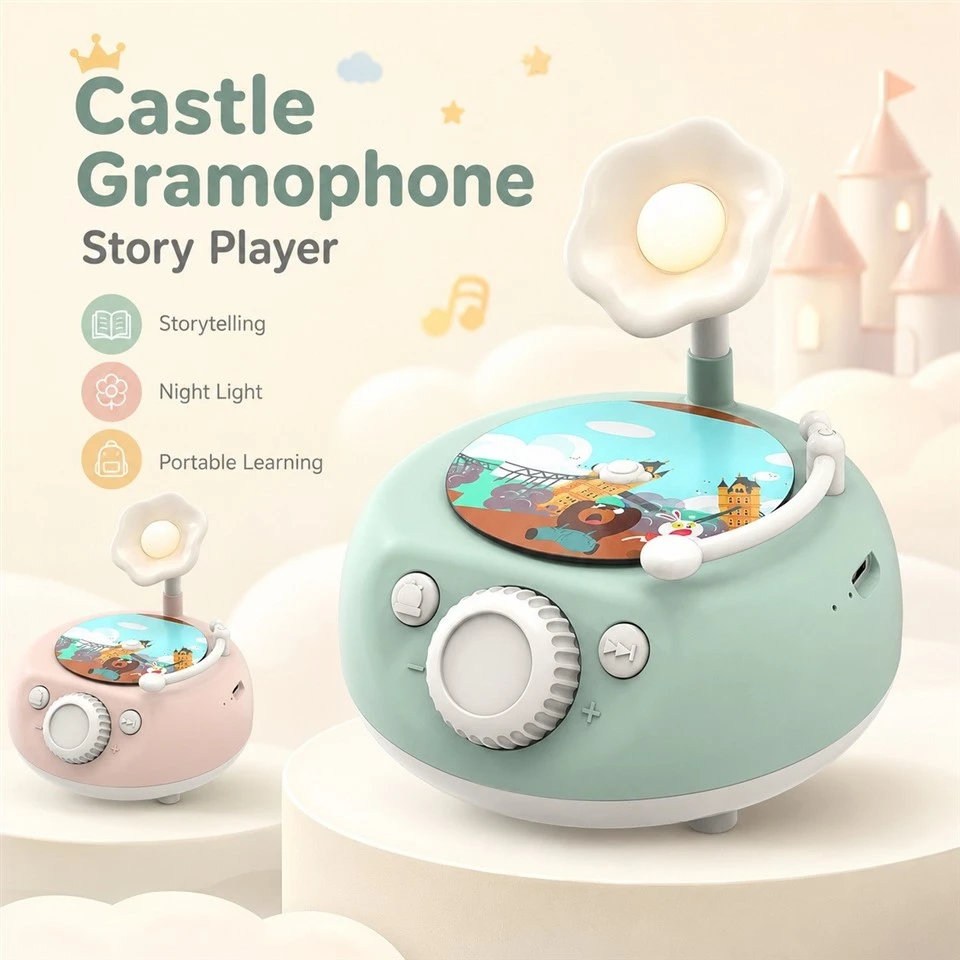
Europe is the category's home market, its largest market and its most demanding one. The leading device, the Toniebox, comes from a German-founded company publicly listed on the Frankfurt Stock Exchange since 2021, and it has since grown into a family of devices with a second-generation flagship and a smaller companion model rolling out across Europe and other English-speaking markets. The other major player, Yoto, built a library of more than a thousand card titles, struck partnerships with broadcasters, children's authors and science publishers, and pushed into schools and libraries across the UK and US.
Those two names define the category; they do not define the market. Demand is broader than any single brand - licensed toy sales across the five largest European toy markets grew while the wider toy industry declined. The category is being carried by a cultural shift, not one product cycle.
What drives it is a set of pressures stronger in Europe than almost anywhere: anxiety about young children's screen time; an early-learning culture that treats listening, not reading, as the first literacy skill; a bedtime routine where a device earns its place by ending a day rather than filling it; and nurseries and libraries buying audio equipment by the carton for group use.
So the question for a European buyer is not whether screen-free audio sells - it clearly does. It is who can build the specific version your market needs: your language mix, your age grading, your artwork, your brand on the carton, and the right paperwork for your country. That is what we can speak to from experience rather than theory.
What European buyers actually ask for
The same requirements come up in almost every European brief - and each one is something a general-purpose toy factory will miss.
A language split, not a translation. A German buyer rarely wants a straight English deck. They want the deck designed for their market: how many stories, how long each runs, the play order and who narrates. A voice that sounds right to a British buyer can sound wrong to a French one.
No app, no account, no network. Non-negotiable. The category works in Europe precisely because nothing depends on a phone being awake or a parent remembering a password.
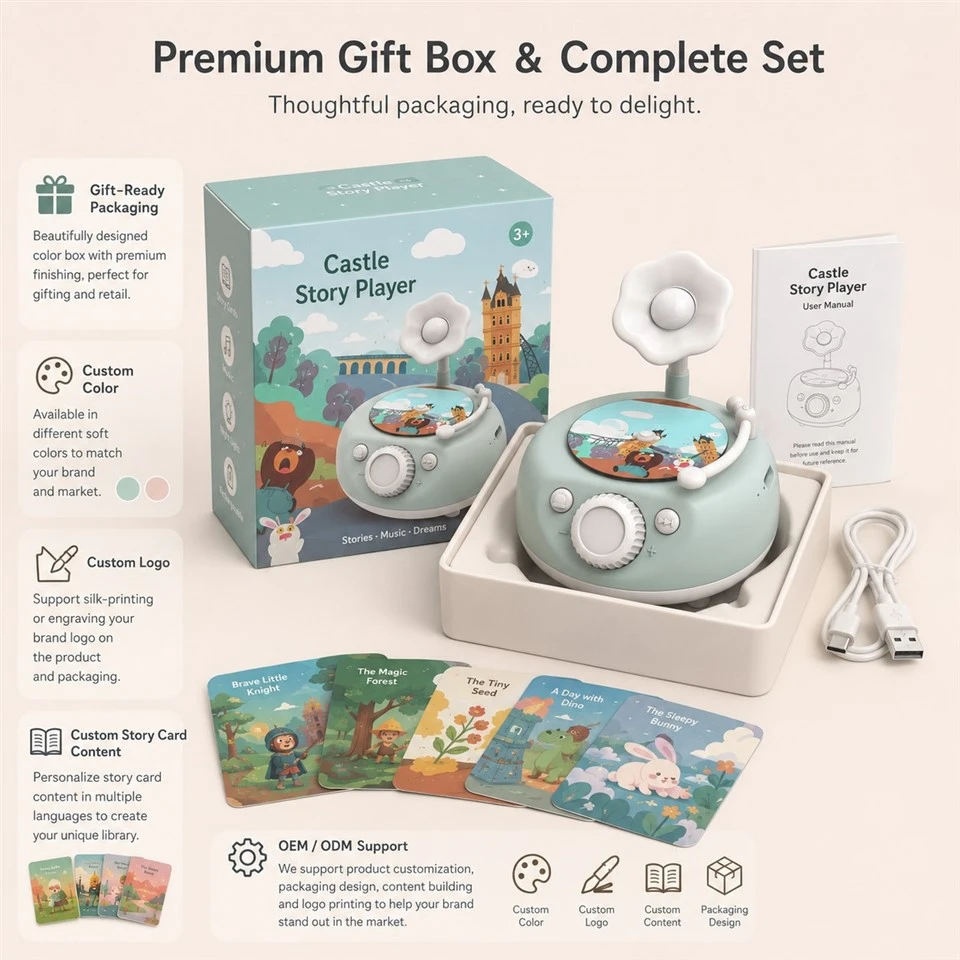
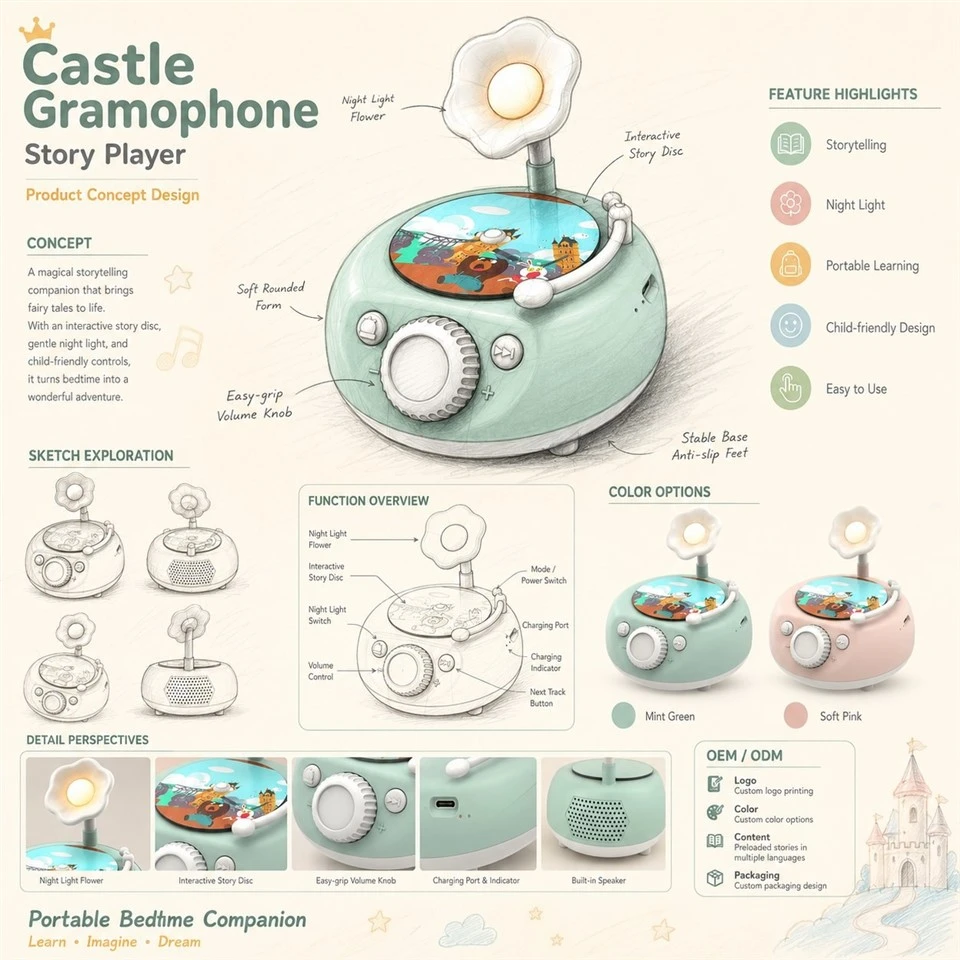
An interface a pre-reader can operate alone. A lever, a knob, one tactile action. If a three-year-old cannot start a story unaided, the product never gets handed over at bedtime - and a product that is not handed over does not become a habit.
Content that extends without new hardware. European buyers think in decks, not devices. A seasonal library, a second language, a longer edit or a licensed property should be a reprint and a re-recording, not a new product line.
Battery behaviour that matches real use. A small lithium cell on a standard Type-C port, sized for a story or two at a time. No proprietary cable, no disposable cell to keep buying.
A night light that behaves. The light is not decoration; it is why the device stays on the bedside table instead of in a toy crate, and why its level must not creep upward between batches.
Where a factory's customization experience shows
Any supplier can print a logo. These eight areas separate an order-taking factory from a development partner, and each tells you what it costs in time and tooling.
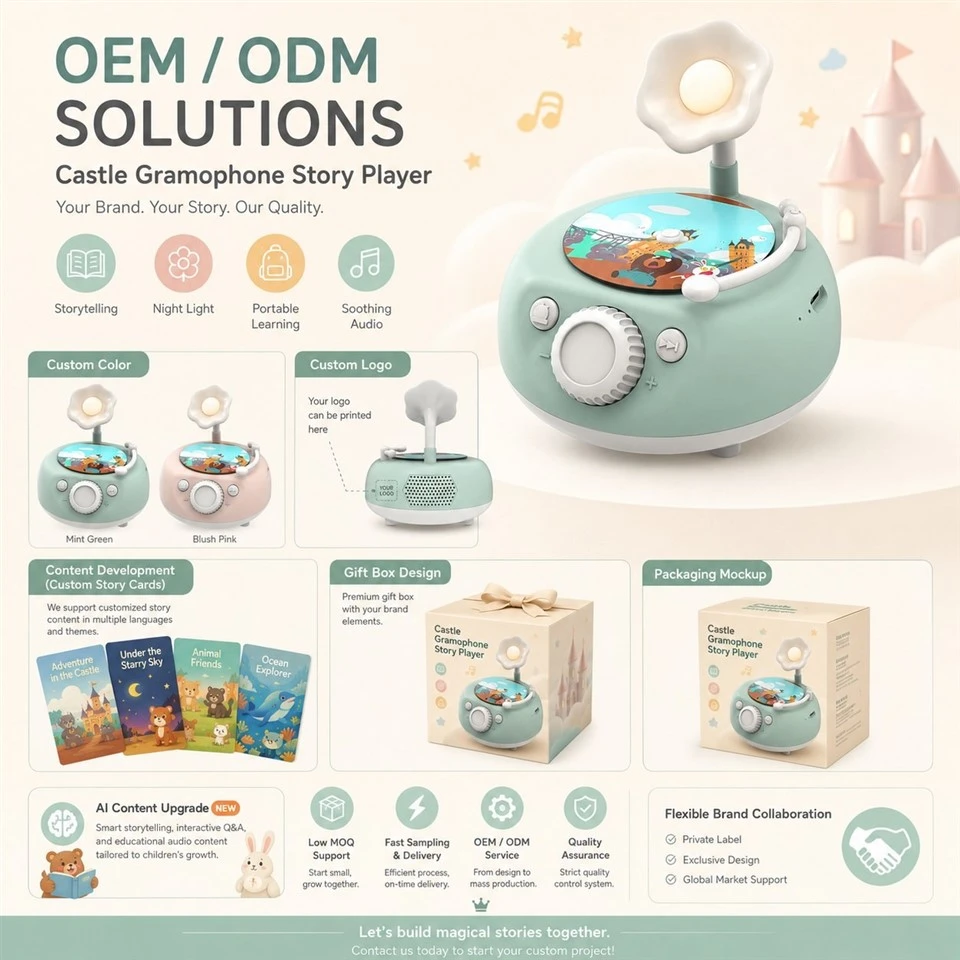
Story library and running order - you set the deck: folk tales, a reading band, a holiday collection, a licensed property. This touches the recording and the print, never the machine.
Voice talent and languages - narrator, pace, language and regional accent. Approve one spoken spread before the full session; it locks voice and pace while they are still cheap to change.
Card artwork - drawn to match the words, not chosen afterwards, and reviewed beside the vocabulary before printing, because a pre-reader picks a story by its picture.
Shell colour and front face - one colour decision per batch, planned with the run; the wide front face carries a character, a licensed property or a plain pattern.
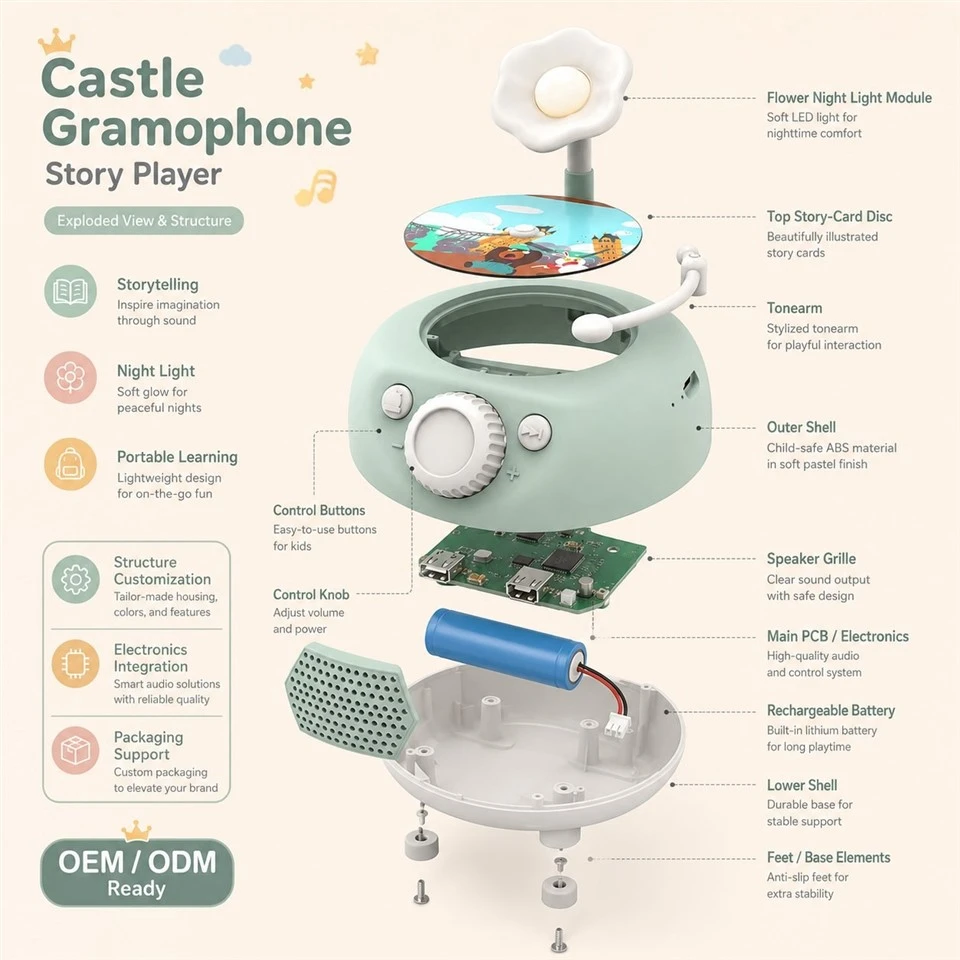
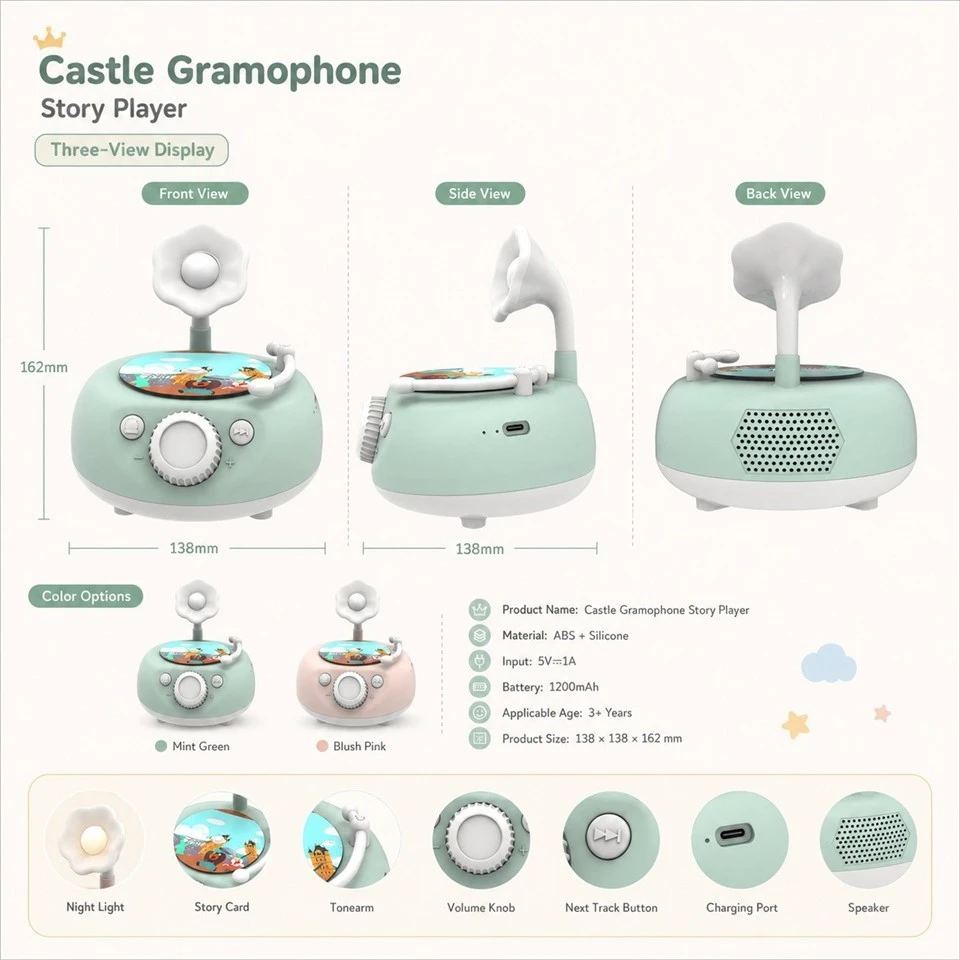
Packaging and gift box - colour, window or keepsake box printed for the destination market. A printed sleeve over the standard carton is the cheapest way to give one hardware line two price points.
Additional card packs - the deck is printed per order, so a follow-up set sells to existing customers with no new hardware.
Accessory bundles - carry pouch, extra deck or gift insert in one outer carton. Anything that changes the mould or electronics becomes a separately quoted development project.
The pattern worth noticing: items 1, 2, 3, 5, 6 and 7 change the content and the print, not the tooling - which is why a European buyer can test three markets from one hardware platform.
The working process behind a custom run
A well-run OEM/ODM programme follows ten stages, and the order matters more than most buyers expect.
Requirements briefing - market, age range, language mix, story themes, branding, packaging, volume - with feasibility, minimum and schedule confirmed up front, and a plain statement of which requests touch the tooling.
Library planning - how many stories, how long each runs, play order, artwork style. This fixes everything downstream: the story list is what the recording and the print file are built from.
Script and voice recording - written for the target age, then performed, edited and level-matched, with one spread approved before the full session.
Card artwork and packaging design - illustration, front face, carton dieline and market wording produced as one job.
Sample production - a working unit with your deck, colourway and carton, sent for hands-on review.
Feedback and revision - notes on story order, pace, artwork, lever feel, light level and wording, resolved before tooling and printing are locked.
Golden sample approval - a production-materials unit sealed as the run reference, judged against an object rather than a drawing.
Mass production - moulding, board assembly, mechanism fitting, card printing, voice loading and packing under one roof.
Quality inspection - each batch checked against a signed sheet: card-to-audio match across the deck, lever action, light level in a darkened room, charging, print against proof.
Shipping - packing marked per destination and released with the documents belonging to that batch.
Two stages are where European orders most often go wrong. Buyers compress stage 6, approving a sample after one round of notes and then finding the lever or light behaves differently because the comment was never tied to a version. And they treat stage 3 as a formality, listening properly only to the finished product - by which point a re-record is a schedule risk instead of an edit.