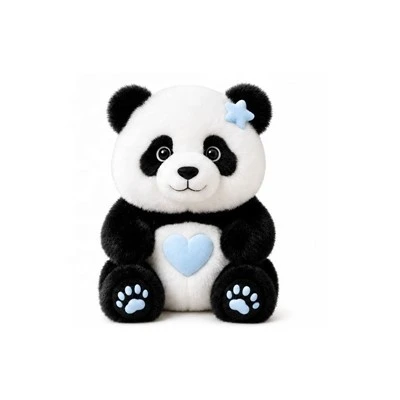

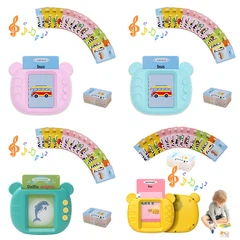
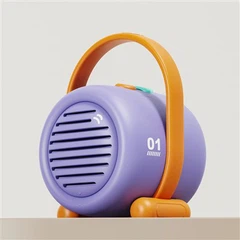
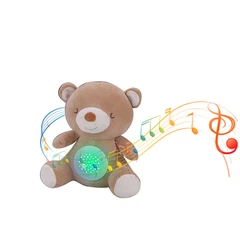
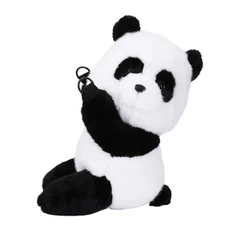
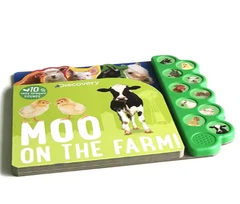

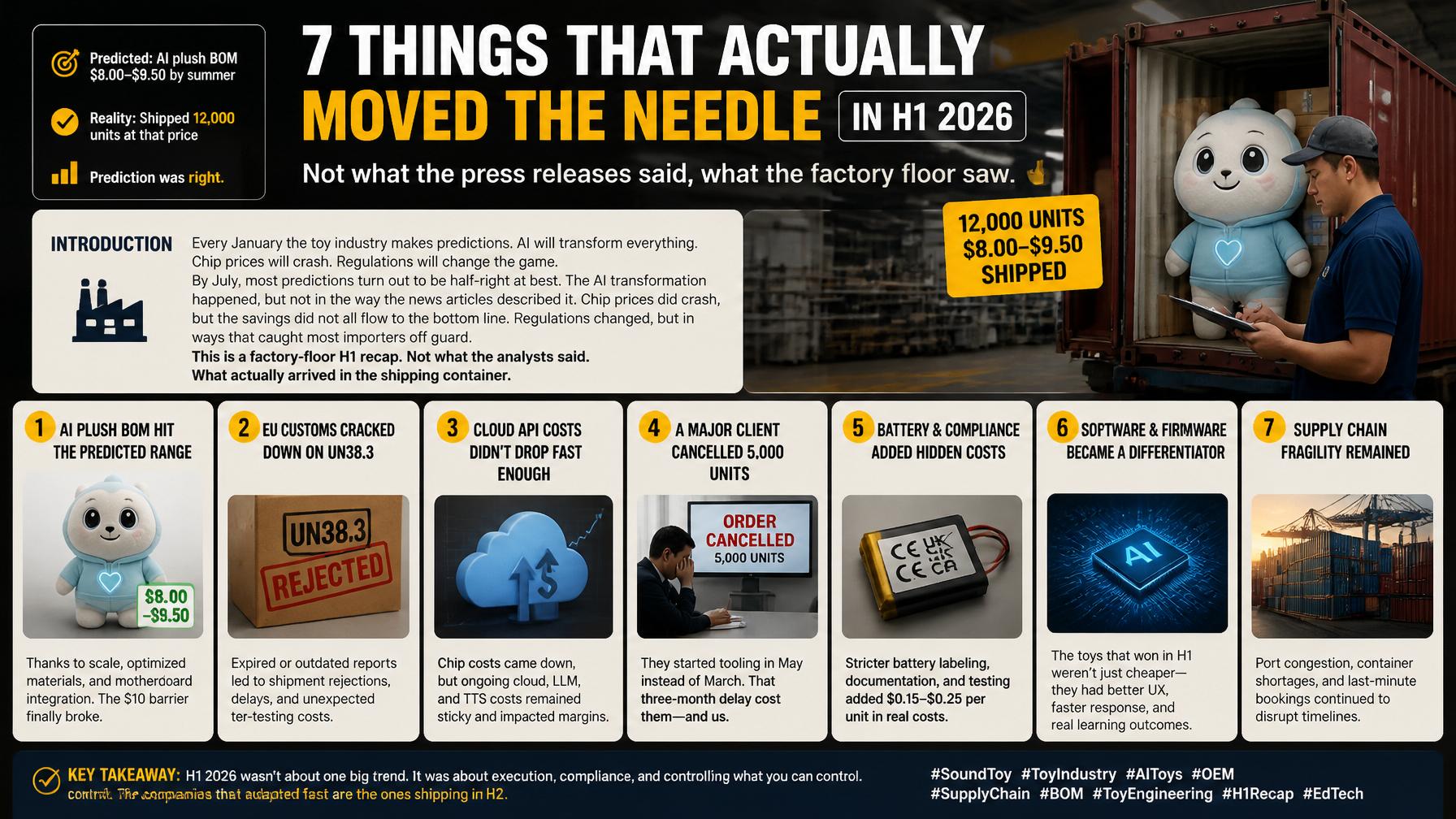
In January I predicted AI plush BOM would drop to 8.00-9.50 USD by summer. The factory just shipped 12,000 units at that price. The prediction was right.
But other things I did not predict happened too. EU customs started rejecting shipments for expired UN38.3 reports. Cloud API costs did not come down as fast as chip costs did. And one of our clients cancelled a 5,000-unit order because they started tooling in May instead of March.
Here are the 7 things that actually moved the needle in H1 2026 -- not what the press releases said, what the factory floor saw. 💰
#SoundToy #ToyIndustry #AIToys #OEM #SupplyChain #BOM #ToyEngineering #H1Recap #EdTech
INTRODUCTION
Every January the toy industry makes predictions. AI will transform everything. Chip prices will crash. Regulations will change the game.
By July, most predictions turn out to be half-right at best. The AI transformation happened, but not in the way the news articles described it. Chip prices did crash, but the savings did not all flow to the bottom line. Regulations changed, but in ways that caught most importers off guard.
This is a factory-floor H1 recap. Not what the analysts said. What actually arrived in the shipping container. ☝️
1. The Jieli BT21X Hit 1.20 USD -- The AI Threshold Crossed 🎯
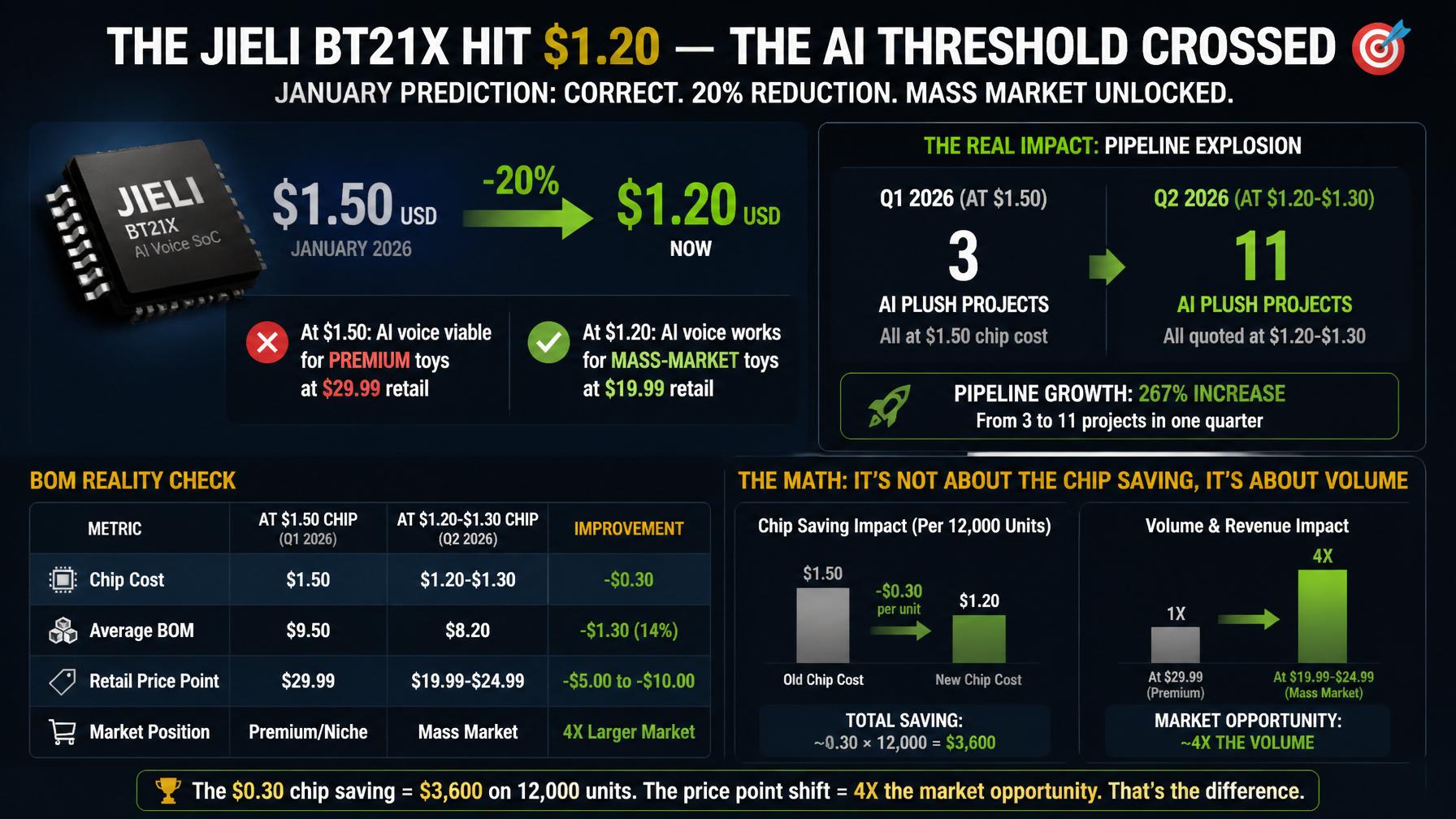
The January prediction was correct. The Jieli BT21X dropped from 1.50 USD to 1.20 USD, a 20 percent reduction. That sounds incremental. It was not.
At 1.50 USD, the chip made AI voice viable for premium toys at 29.99 USD retail. At 1.20 USD, it works for mass-market toys at 19.99 USD. The difference is not 30 cents. It is the difference between a niche category and a retail shelf slot at Walmart.
The actual impact on production:
Q1 2026: 3 AI plush projects in our pipeline. All at 1.50 USD chip cost.
Q2 2026: 11 AI plush projects. All quoted at 1.20-1.30 USD.
Average BOM for an AI plush project: dropped from 9.50 USD to 8.20 USD.
Retail price point that works: moved from 29.99 USD to 19.99-24.99 USD.
BOM Reality Check 💰
The 0.30 USD chip saving multiplied across 12,000 units is only 3,600 USD. Not much. But the retail price drop from 29.99 USD to 19.99 USD opened a market that is roughly 4x the volume. The math is not about the chip saving. It is about the volume expansion.
2. Local ASR Went Mass Production -- Not a Demo Anymore 🎤
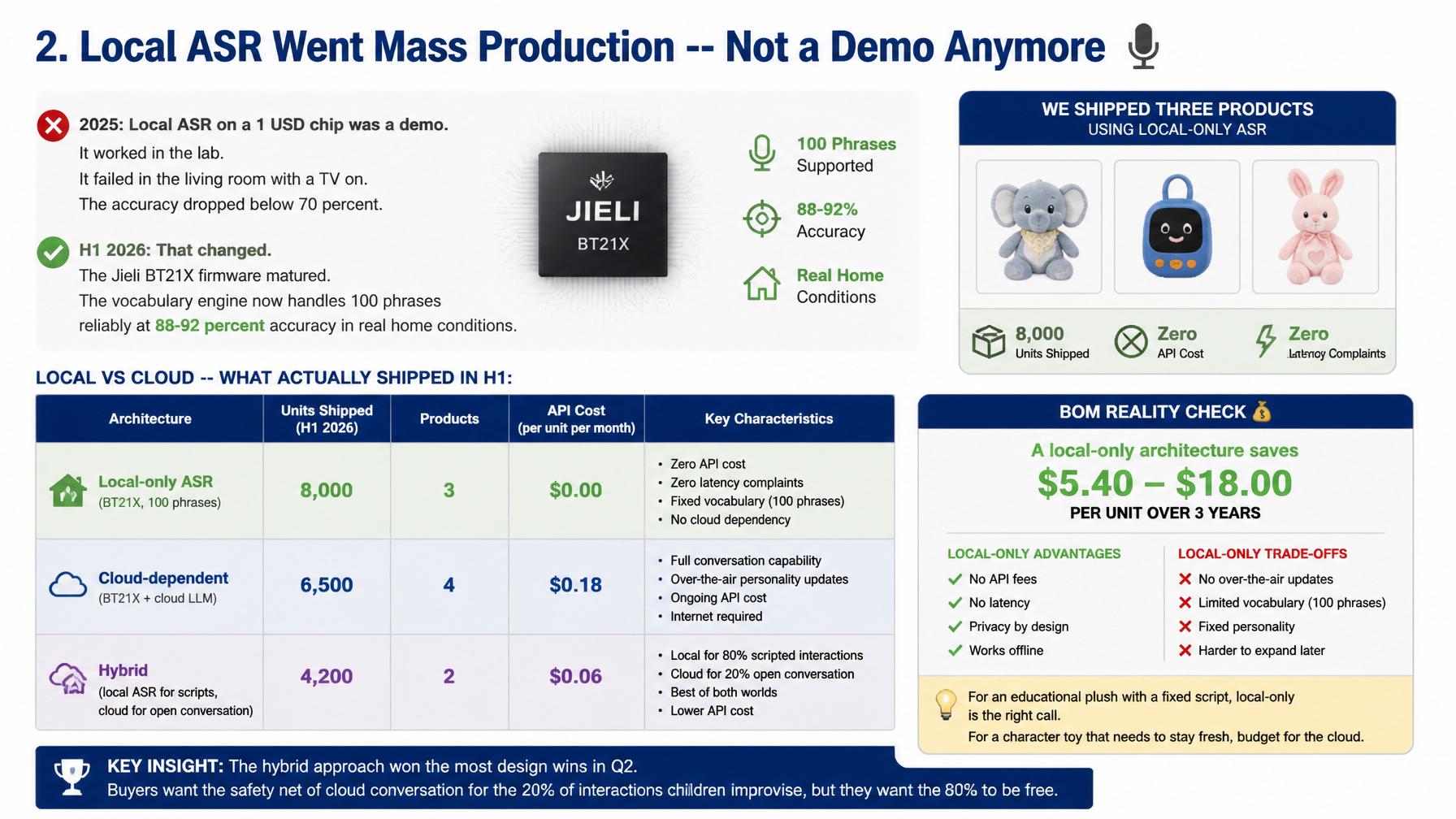
In 2025, local ASR on a 1 USD chip was a demo. It worked in the lab. It failed in the living room with a TV on. The accuracy dropped below 70 percent.
In H1 2026, that changed. The Jieli BT21X firmware matured. The vocabulary engine now handles 100 phrases reliably at 88-92 percent accuracy in real home conditions. We shipped three products using local-only ASR -- no cloud subscription, no latency, no privacy paperwork.
Local vs Cloud -- what actually shipped in H1:
Local-only ASR (BT21X, 100 phrases): 8,000 units across 3 products. Zero API cost. Zero latency complaints.
Cloud-dependent (BT21X + cloud LLM): 6,500 units across 4 products. Average API cost 0.18 USD per unit per month.
Hybrid (local ASR for scripts, cloud for open conversation): 4,200 units across 2 products. API cost 0.06 USD per unit per month.
The hybrid approach won the most design wins in Q2. Buyers want the safety net of cloud conversation for the 20 percent of interactions children improvise, but they want the 80 percent to be free.
BOM Reality Check 💰
A local-only architecture saves 5.40-18.00 USD per unit over 3 years in API fees. The trade-off is no over-the-air personality updates and a limited vocabulary. For an educational plush with a fixed script, local-only is the right call. For a character toy that needs to stay fresh, budget for the cloud.
3. EU Battery Removability Timeline Locked -- Sealed Toys Need Redesign 📜
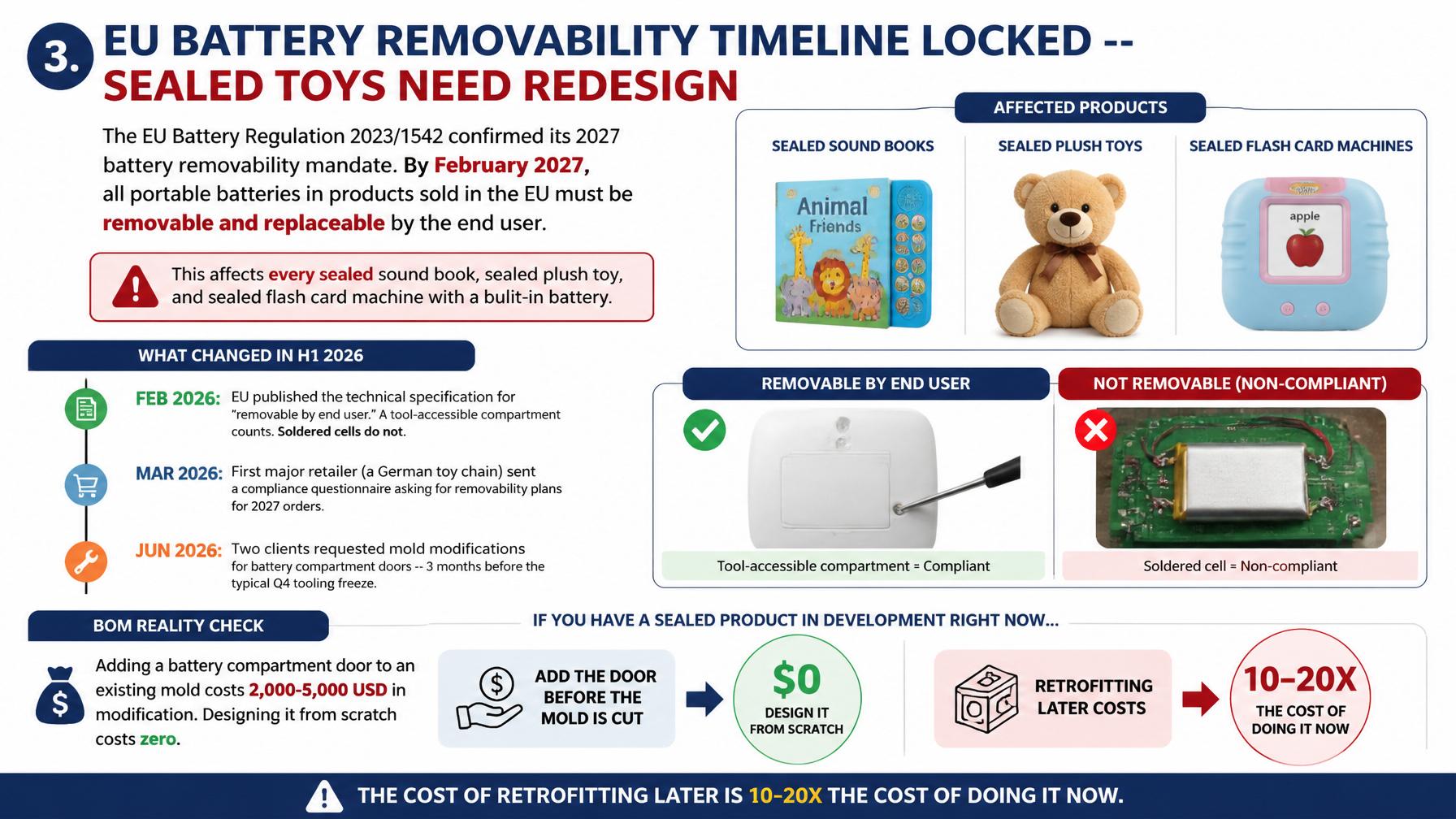
The EU Battery Regulation 2023/1542 confirmed its 2027 battery removability mandate. By February 2027, all portable batteries in products sold in the EU must be removable and replaceable by the end user.
This affects every sealed sound book, sealed plush toy, and sealed flash card machine with a built-in battery.
What changed in H1 2026:
Feb 2026: EU published the technical specification for "removable by end user." A tool-accessible compartment counts. Soldered cells do not.
Mar 2026: First major retailer (a German toy chain) sent a compliance questionnaire asking for removability plans for 2027 orders.
Jun 2026: Two clients requested mold modifications for battery compartment doors -- 3 months before the typical Q4 tooling freeze.
BOM Reality Check 💰
Adding a battery compartment door to an existing mold costs 2,000-5,000 USD in modification. Designing it from scratch costs zero. If you have a sealed product in development right now, add the door before the mold is cut. The cost of retrofitting later is 10-20x the cost of doing it now.
4. Cloud API Costs Did Not Drop -- The 2024 LLM Price War Was a One-Time Event 🤖
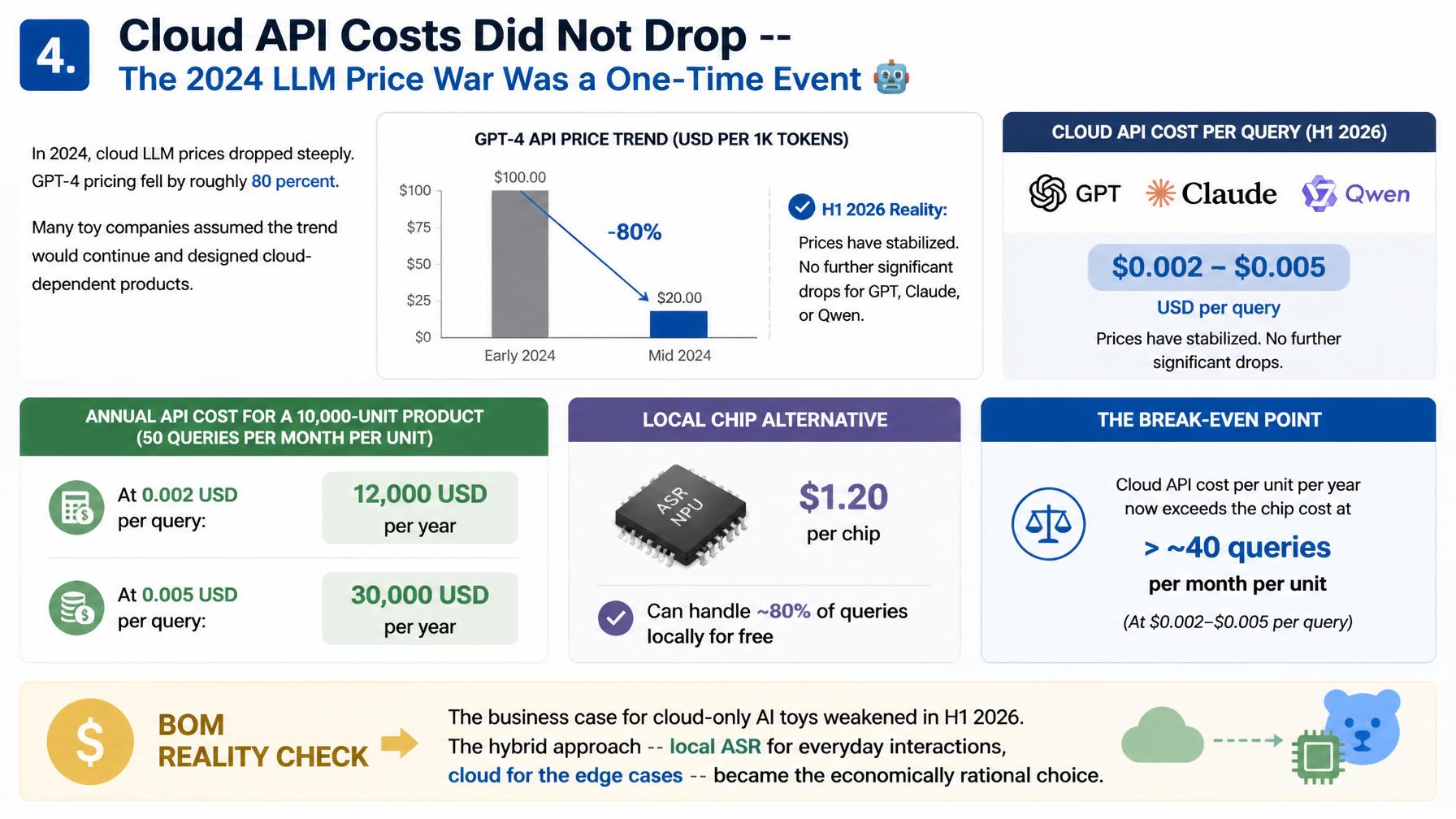
In 2024, cloud LLM prices dropped steeply. GPT-4 pricing fell by roughly 80 percent. Many toy companies assumed the trend would continue and designed cloud-dependent products.
In H1 2026, that assumption failed. Cloud API prices for GPT, Claude, and Qwen stabilized. No further significant drops. The cost per query for a toy-grade interaction stayed at 0.002-0.005 USD.
Annual API cost for a 10,000-unit product (50 queries per month per unit):
At 0.002 USD per query: 12,000 USD per year.
At 0.005 USD per query: 30,000 USD per year.
Compare that to a 1.20 USD chip that can handle 80 percent of those queries locally for free.
BOM Reality Check 💰
The cloud API cost per unit per year now exceeds the chip cost for any product running more than about 40 queries per month. The business case for cloud-only AI toys weakened in H1 2026. The hybrid approach -- local ASR for everyday interactions, cloud for the edge cases -- became the economically rational choice.
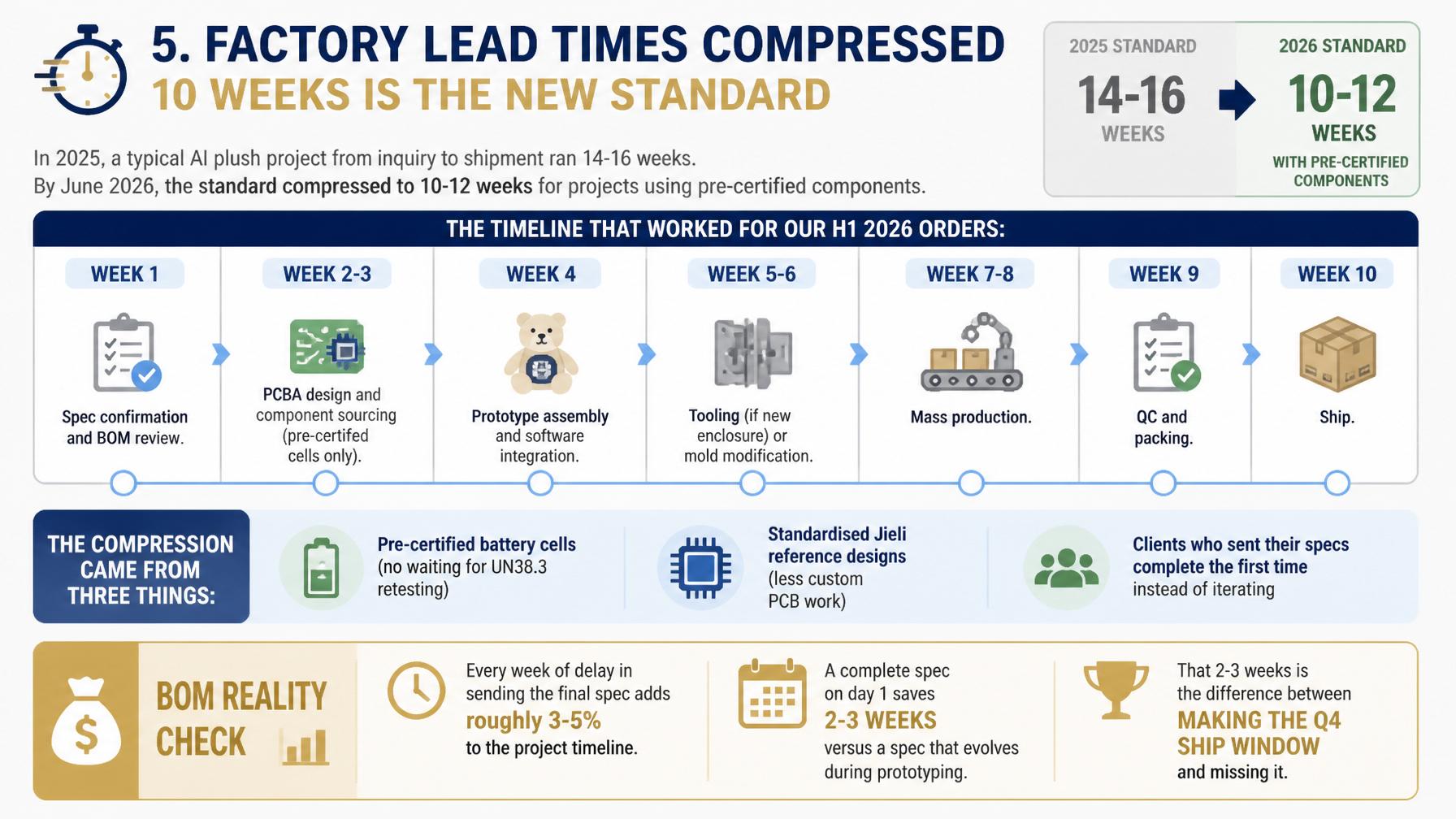
5. Factory Lead Times Compressed -- 10 Weeks Is the New Standard ⏱️
In 2025, a typical AI plush project from inquiry to shipment ran 14-16 weeks. By June 2026, the standard compressed to 10-12 weeks for projects using pre-certified components.
The timeline that worked for our H1 2026 orders:
Week 1: Spec confirmation and BOM review.
Week 2-3: PCBA design and component sourcing (pre-certified cells only).
Week 4: Prototype assembly and software integration.
Week 5-6: Tooling (if new enclosure) or mold modification.
Week 7-8: Mass production.
Week 9: QC and packing.
Week 10: Ship.
The compression came from three things: pre-certified battery cells (no waiting for UN38.3 retesting), standardised Jieli reference designs (less custom PCB work), and clients who sent their specs complete the first time instead of iterating.
BOM Reality Check 💰
Every week of delay in sending the final spec adds roughly 3-5 percent to the project timeline. A complete spec on day 1 saves 2-3 weeks versus a spec that evolves during prototyping. That 2-3 weeks is the difference between making the Q4 ship window and missing it.
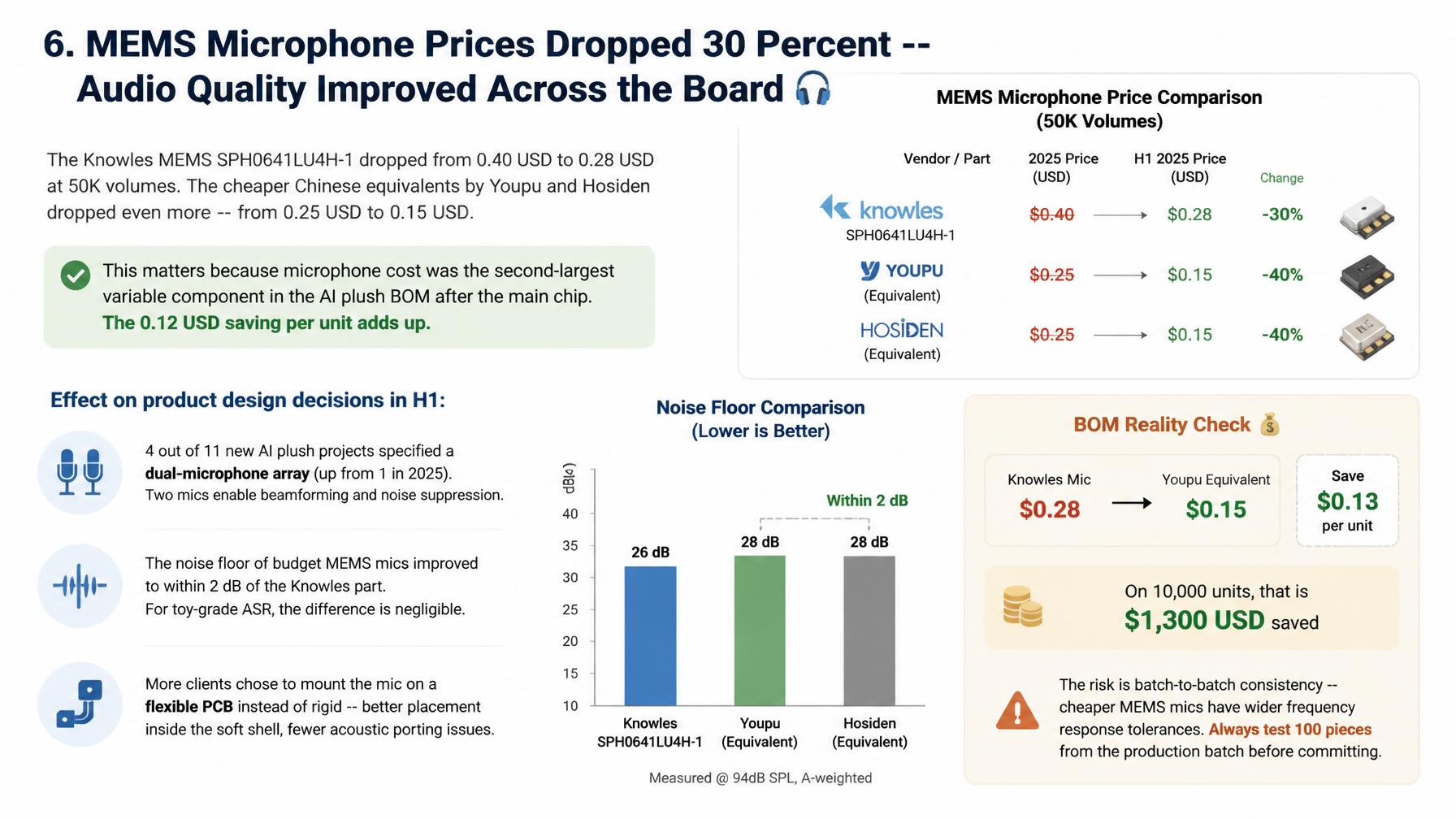
6. MEMS Microphone Prices Dropped 30 Percent -- Audio Quality Improved Across the Board 🎧
The Knowles MEMS SPH0641LU4H-1 dropped from 0.40 USD to 0.28 USD at 50K volumes. The cheaper Chinese equivalents by Youpu and Hosiden dropped even more -- from 0.25 USD to 0.15 USD.
This matters because microphone cost was the second-largest variable component in the AI plush BOM after the main chip. The 0.12 USD saving per unit adds up.
Effect on product design decisions in H1:
4 out of 11 new AI plush projects specified a dual-microphone array (up from 1 in 2025). Two mics enable beamforming and noise suppression.
The noise floor of budget MEMS mics improved to within 2 dB of the Knowles part. For toy-grade ASR, the difference is negligible.
More clients chose to mount the mic on a flexible PCB instead of rigid -- better placement inside the soft shell, fewer acoustic porting issues.
BOM Reality Check 💰
Switching from a Knowles mic to a Youpu equivalent saves 0.13 USD per unit. On 10,000 units, that is 1,300 USD. The risk is batch-to-batch consistency -- cheaper MEMS mics have wider frequency response tolerances. Always test 100 pieces from the production batch before committing.
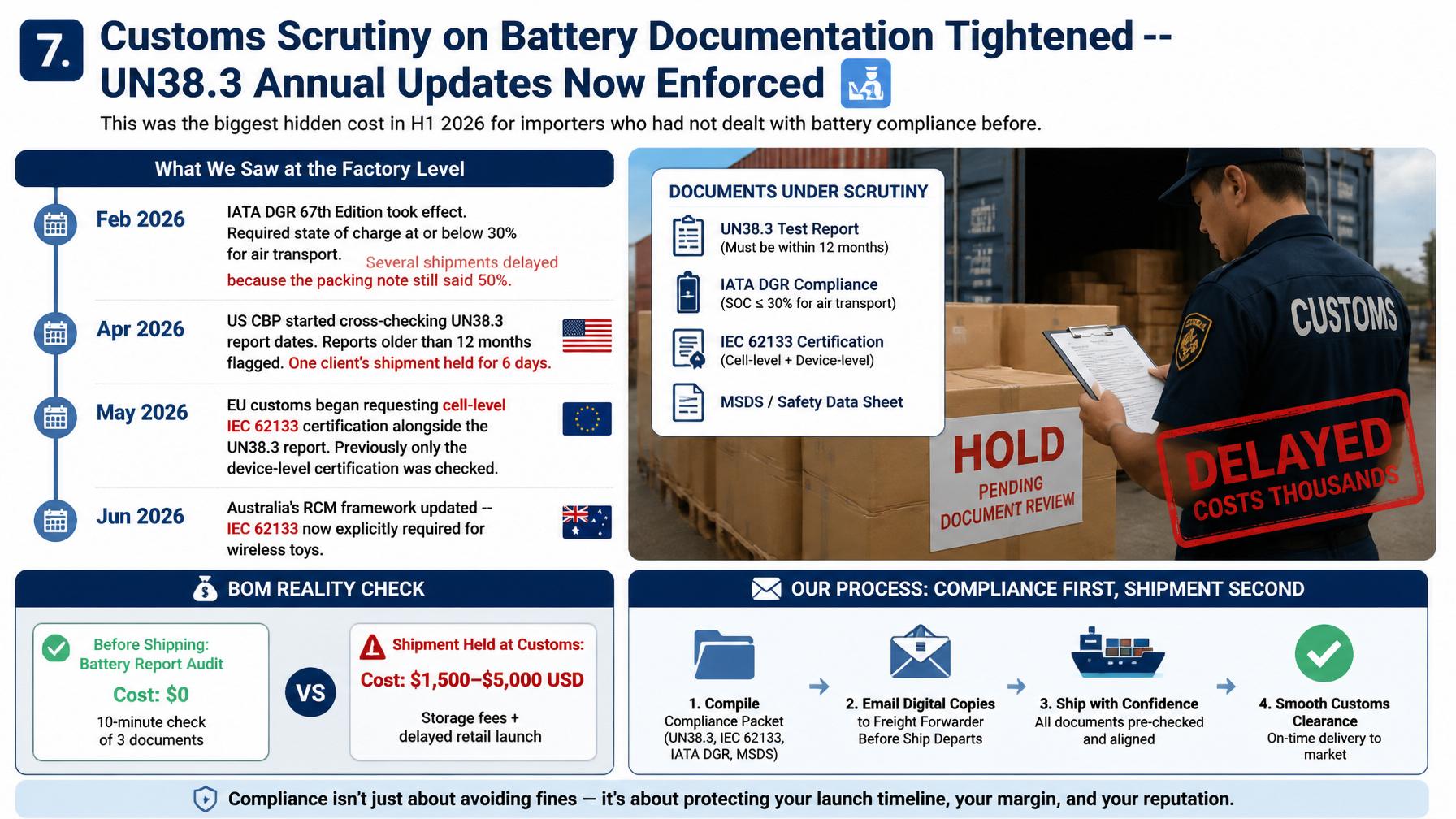
7. Customs Scrutiny on Battery Documentation Tightened -- UN38.3 Annual Updates Now Enforced 🛃
This was the biggest hidden cost in H1 2026 for importers who had not dealt with battery compliance before.
What we saw at the factory level:
Feb 2026: IATA DGR 67th Edition took effect. Required state of charge at or below 30 percent for air transport. Several shipments delayed because the packing note still said 50 percent.
Apr 2026: US CBP started cross-checking UN38.3 report dates. Reports older than 12 months flagged. One client's shipment held for 6 days.
May 2026: EU customs began requesting cell-level IEC 62133 certification alongside the UN38.3 report. Previously only the device-level certification was checked.
Jun 2026: Australia's RCM framework updated -- IEC 62133 now explicitly required for wireless toys.
BOM Reality Check 💰
A battery report audit before shipping costs zero. It is a 10-minute check of 3 documents. A shipment held at customs costs 1,500-5,000 USD in storage fees plus delayed retail launch. We now include the compliance packet in every shipment, and we email the freight forwarder the digital copies before the ship departs.
THE COMMON THREAD
Seven things. They share one pattern: the cost of not knowing was higher than the cost of knowing.
The chip price dropped -- but only the factories that had qualified the BT21X in their reference designs could use it immediately. Local ASR became viable -- but only the teams that had written and tested the 100-phrase vocabulary before production started got the benefit. Customs tightened -- but only the importers who had checked their battery paperwork in May avoided the June holds.
The factories and importers that made the right call in H1 2026 were not the ones with the most advanced technology. They were the ones who made their decisions before the deadline, not after. 🔧
WHAT THIS MEANS FOR YOUR NEXT PROJECT
Three questions to ask before your next PO:
Does your product use a sealed battery? If yes, add a removable compartment door now. The 2027 EU mandate is not negotiable.
Have you qualified the BT21X local ASR for your voice script? Test 100 phrases at 88 percent accuracy or better before tooling.
Is your UN38.3 report current? If it was issued before June 2025, order a retest today.
IF YOU ARE PLANNING A SOUND PRODUCT FOR Q4 2026
Start the spec now. Send us your voice script, target markets, and required certifications. We will give you the BOM, the timeline, and the compliance checklist within 48 hours.
Official Website: www.kidsoundbook.com | www.xinditai.com Email: happy@xinditai.com WhatsApp: +8613824343309
LinkedIn: https://www.linkedin.com/in/happy-gao-education-toy-oem-odm/ YouTube: https://www.youtube.com/@XDTHappy
LET ME HEAR FROM YOU
Did any of these 7 things catch you off guard in H1? What did your factory floor see that the analysts missed?
Drop your story below.
#SoundToy #ToyIndustry #AIToys #OEM #SupplyChain #BOM #ToyEngineering #H1Recap #EdTech #ShenzhenFactory