

Square Children's Phonograph: Card-Reading Story Player Manufacturer & OEM/ODM Sourcing Guide
OEM and ODM production for distributors, publishers, retail groups and brand owners worldwide.
Made by Shenzhen Xinditai Electronic Co., Ltd. - Square-Body Story Phonographs, Card-Reading Players & Screen-Free Children's Audio Toys - OEM/ODM
Quick Navigation
2. What Is the Square Children's Phonograph?
7. Technology, Materials & Build
10. Why Buyers Choose Xinditai
11. Square Children's Phonograph FAQ
1. Introduction
A buyer who already sells a story player runs into a different problem on the second order. The product worked, the household liked it, and the next conversation is not about whether the category sells but about where else the item can sit. A round player that earns its place on a bedside table does not always suit a display counter, a shop window or a shelf that has to be laid out by eye. The follow-up request is almost always about shape, and the cheapest way to answer it is not a new product at all but a body the factory already builds.
The card-reading category keeps widening because it fits several retail settings at once and because the machine and the content can move separately. A platform that reads cards can carry a story library, a language course, a seasonal set or a licensed property by reprinting the deck and reloading the audio. That is a rare property in a toy range: a buyer can broaden the offer without broadening the tooling, and a shape variant can reach the market while the electronics stay exactly where they are.
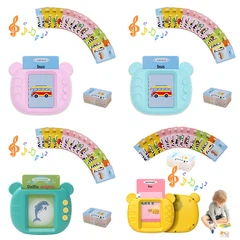
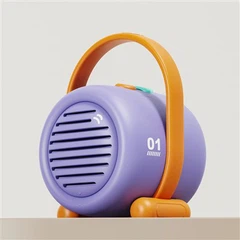
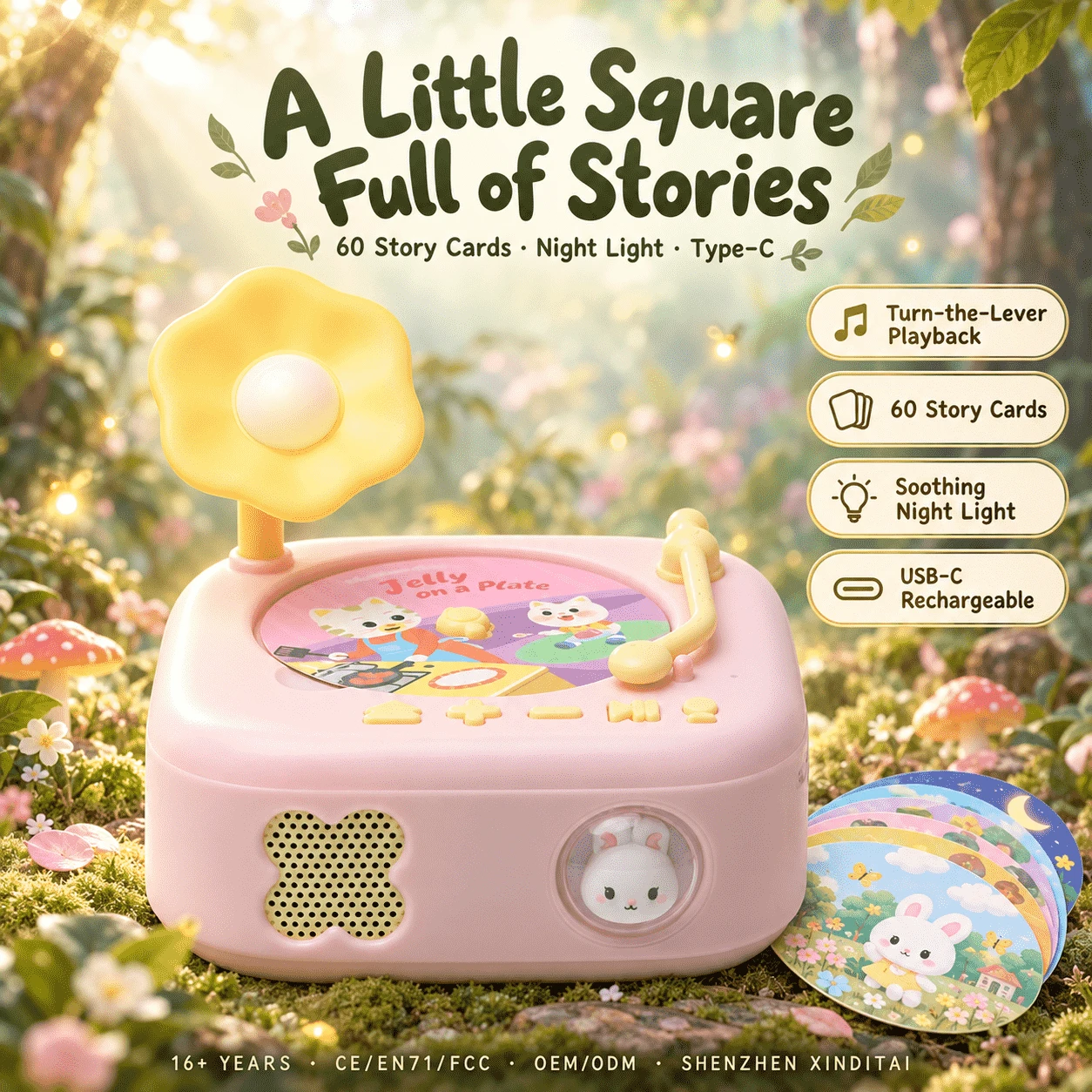
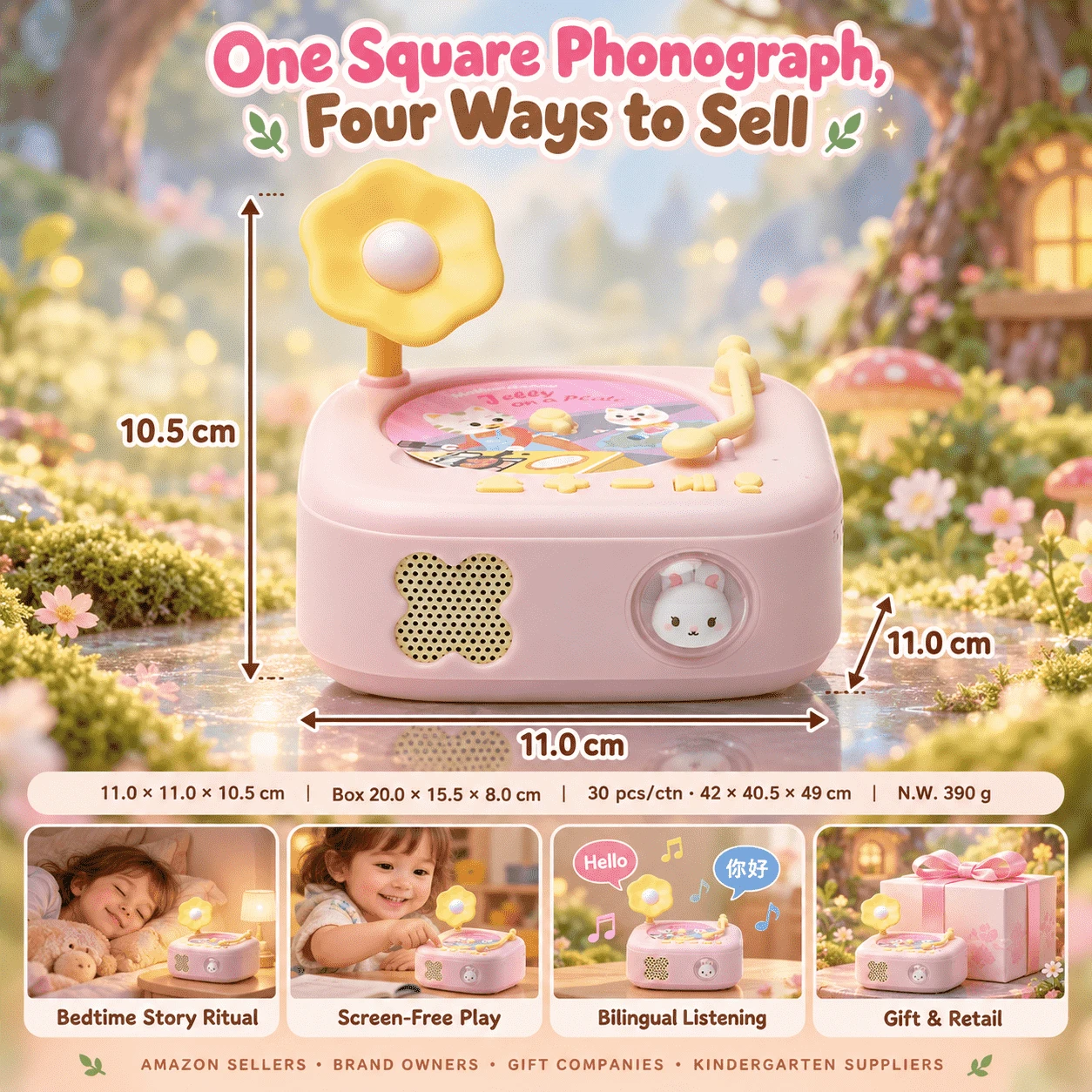
From Shenzhen Xinditai Electronic Co., Ltd., the Square Children's Phonograph is that variant. It keeps the reading mechanism of the family - a card is seated, the side lever is turned, the story starts - and gives it a square 110 x 110 x 105 mm housing that stands on its own base instead of resting on a rounded foot. The standard pack holds sixty story cards, fifty in English and ten in Chinese, and a soft night light sits behind the front face. The unit weighs 390 g, recharges through a Type-C port from a 200 mAh lithium cell, and travels thirty to a carton measuring 42 x 40.5 x 49 cm at 13 kg gross. This guide covers the product, the commercial case for stocking it, the customisation the factory offers and the OEM/ODM process behind a launch.
2. What Is the Square Children's Phonograph?
The Square Children's Phonograph (XDT LMC 002) is a portable, battery-powered audio toy for young children. It carries no display and no controls beyond a lever: a printed story card is seated into the slot on the side of the body, the lever is turned, and the recorded story plays while a gentle light rises behind the front face. Cards, story contents, logo and packaging are all produced to the buyer's brief, so one hardware platform can serve several markets under different titles.
Built by Shenzhen Xinditai Electronic Co., Ltd., the unit brings four capabilities together in a 390 g body:
- Square, Self-Supporting Body: The housing is a 110 x 110 x 105 mm square rather than a rounded shell, so it stands flat on a table and presents a wide face for artwork. On a shelf or a shop display that shape is what lets several units sit in a row without rolling or being propped up.
- Card-Triggered Storytelling: A story card is seated and the side lever is turned to begin. There is nothing to press twice and nothing to navigate, so a child of three or four can run the unit alone - which is the entire point of the category.
- Sixty-Card Story Library: The pack that ships as standard contains sixty cards - fifty English and ten Chinese - and the whole set can be swapped out. Since cards are printed per order, an extra library costs a print run and nothing more.
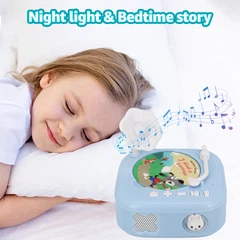
- Soft Night Light and Rechargeable Power: A gentle light behind the front face is designed to help a child settle at the end of a story, and a 200 mAh lithium cell recharged over Type-C keeps the unit running from a cable the household already owns.
Typical B2B buyers include toy and gift importers, children's bookshops, museum and gallery shops, nursery and kindergarten suppliers, publishers who want a hardware edition of their own titles, promotional and gift distributors, and cross-border sellers building a screen-free audio line.

3. How Does It Work?
The Square Children's Phonograph is designed so that a child can operate it on the first attempt, without an adult and without an instruction leaflet.
Step 1 - Choose a Card
The child picks a card from the deck. For a pre-reader the illustration is the label, so choosing is part of the activity rather than a step before it - which is why the artwork has to stay legible at a glance and at a small size.
Step 3 - Listen and Settle
The story plays while the light comes up behind the front face. Because the light belongs to the same object as the story, the unit replaces a separate bedside lamp and earns a place at the edge of the bed instead of in general toy storage.
Step 2 - Seat the Card and Turn the Lever
The card slides into the side slot and the lever is turned. That single action is the whole interface: no menu, no pairing, no sequence to remember, and no state a child can leave the unit in that the next user cannot clear.
Step 4 - Stop, Swap or Simply Stop
When the story ends the child either chooses another card or sets the unit down. Nothing auto-plays, nothing suggests a follow-up and nothing keeps glowing once the session is finished - exactly the behaviour a household is looking for at bedtime.
4. Key Features
| Feature | Description |
|---|---|
| Square Standing Body | A 110 x 110 x 105 mm square housing that rests flat on its base and shows a wide front face, so units line up on a shelf or a display table without being propped against anything. |
| Lever-Started Playback | A card is seated and the side lever is turned to begin. One physical action replaces every button pair, menu and touch target, which is what lets a pre-reader run the device unaided. |
| Sixty Story Cards | The set supplied as standard runs to sixty cards, split fifty English and ten Chinese, and the deck is replaceable. Card artwork, contents and play order are all produced to order. |
| Soft Night Light | A gentle light behind the front face is designed to help a child settle. It works with the story rather than as a separate lamp, so the unit stays within reach after lights-out. |
| No Screen and No App | There is no display, no account and no network dependency. Sessions finish when the child decides they finish - the player never auto-plays and never lines up a following episode. |
| 200 mAh Type-C Battery | A rechargeable lithium cell charged over a Type-C port, so ordinary phone chargers, power banks and car adapters all work. There is no proprietary cable to lose and no supply of disposable cells to buy. |
| Compact and Carryable | 390 g at 110 x 110 x 105 mm - small enough for a bedside table, a book bag or a shelf edge, and heavy enough to stay where it is placed when a card is seated one-handed. |
| Printed Gift Carton | The 200 x 155 x 80 mm outer box is printed for the destination market, so the unit and its deck arrive in packaging that belongs to the buyer's brand rather than a plain shipping box. |
| Export Packing | Thirty units to a carton measuring 42 x 40.5 x 49 cm at 13 kg gross - a comfortable two-person lift and a predictable pallet when a container is shared between accounts. |
| Customisable Content | Cards, story contents, logo and packaging are produced to the buyer's order, so one hardware line can serve several languages, price steps and channels. |
| Certified for Export | CE, UKCA, FCC and RoHS documentation is held alongside CPC, and ASTM F963 and EN71 reports are produced for any market that asks for them. |

- Bedtime Routine at Home: The unit earns its place by finishing a day rather than filling it. A parent hands over the deck, the child chooses a card, and the story closes with the light still on - which is why a square-footed player ends up beside the bed instead of in a toy crate.
- Independent Play for Pre-Readers: Because the entire interaction is one lever turn, a three or four year old can run the device without help. Nothing has to be read and nothing has to be paired, so there is no screen to hand back and no setting an adult has to restore.
- Nurseries, Kindergartens and Libraries: A listening corner works when several children can share one device with no supervision, and a lever-start player asks nothing of the adult in the room. Institutions order by the carton and keep one deck per group, replacing cards rather than machines.
- Language and Story Programmes: Since the deck is printed per order, a single hardware model can carry a first-language library, a bilingual set or a term-length curriculum. A school holds one unit per group and changes the cards instead of the equipment.
- Gift, Occasion and Promotional Gifting: A printed carton, a card deck and a keepsake shape turn the player into a present, and the light gives the gift a second reason to be kept. Sleeve and carton artwork can carry a client's name without touching the tooling.
- Travel, Hotels and Holiday Accommodation: No network, no account and nothing to configure, so the unit behaves the same in a hotel room as in a bedroom. Family accommodation and travel retail buyers stock it as equipment that keeps children occupied at the end of a day.
6. Customized Details
As a dedicated children's audio manufacturer, Xinditai supports complete OEM/ODM customisation. The eight areas below are the ones buyers change most often, and each entry states whether it affects the print, the production batch or the tooling:
Story Library and Themes
Set the sixty-card deck yourself: folk tales, a reading band, a holiday collection or a licensed property. The running order belongs to the brief, because the deck is what a child actually chooses from. This changes the printing and the recording, never the machine.
Voice Talent and Languages
Pick the narrator, the reading pace and the language of the audio, including regional accents where a market expects them. The standard pack ships fifty English cards and ten Chinese cards; any other split is recorded for the order. Voice is the element buyers notice first and the one that is still inexpensive to change while the brief is open.
Card Artwork
Illustration follows the buyer's brand or the studio's house style, and it is drawn to match the words rather than chosen afterwards. Because the picture is what a pre-reader uses to pick a story, artwork and vocabulary are reviewed side by side before anything is printed.
Shell Colour and Front Face
The square body can be moulded in the buyer's palette, and the wide front face designed for a character, a licensed property or a plain decorative pattern. Colour is settled once per batch rather than per unit, which is why it is planned with the run and not added to it.
Logo and Branding
The logo is placed on the unit, the cards and the packaging at the same time, so the product reads as the buyer's own line on a shelf. Carton wording, the leaflet and any importer marking all come from one artwork set.
Packaging and Gift Box
The 200 x 155 x 80 mm carton can be specified as a colour box, a window box or a keepsake box, printed for the destination market. A printed sleeve over the standard carton remains the least expensive way to give one hardware line two price points.
Additional Card Packs
Since the deck is printed per order, a follow-up set - a second language, a seasonal library, a longer edit - can be sold to existing customers with no new hardware. This is the repeat item in the range and the simplest way to refresh a product already on a shelf.
Accessory Bundles
Buyers regularly combine the unit with a carry pouch, an extra deck or a gift insert inside one outer carton. Anything that alters the mould, the electronics or the light behaviour becomes a development project rather than an order option, and it is quoted on its own.
7. Technology, Materials & Build
Card Identification and Story Mapping
Every story card carries an identifier that the unit reads the moment the card is seated in the slot. During production the card-to-audio mapping is written to the buyer's story plan, so stories play in the order the buyer intended rather than the order the files happened to arrive in. Cards are passive and hold no cell and no chip of their own, which is exactly what makes an extra deck cheap to print and simple to extend.
Audio Storage Inside the Unit
The recordings for the deck are loaded in production against the same mapping, so a card and its story are paired before the unit leaves the line. Because the library lives inside the player rather than in the cloud, playback depends on nothing but the card and the lever - no network, no account and no paired phone, the three things most likely to fail in a child's bedroom. Custom libraries are prepared and loaded in house, keeping a language change inside the same factory as the hardware.
The Lever as the Whole Interface
The lever is engineered as a mechanism rather than a decorative part: it is sized for a small hand, travels through a fixed arc, and is assembled so that enthusiastic repeated use does not change the feel from one batch to the next. A reference unit is kept from the approved run, and later batches are checked against that object rather than against a drawing, which is how lever feel stays consistent over the life of a product.
Night Light Behaviour
The light sits behind the front face instead of on a flat panel, so the unit reads as a softly lit object in a dark room rather than as a small screen. It is tuned to come up with the story and to stay gentle, and its level is compared against the reference unit in a darkened room during inspection - because brightness that creeps upward between batches is one of the quietest complaints a children's sleep product can attract.
Power and Charging
A 200 mAh lithium cell powers the unit and is recharged over a Type-C port. The cell suits the way the product is actually used - a story or two at a time, topped up now and then - rather than continuous playback. The charging inlet is checked on the assembled unit rather than on the bare board, because a fault that shows up only once the housing is closed reaches a customer instead of a workbench.
Housing, Edges and Print
The square housing is moulded with rounded transitions and no protruding handle, antenna or stand, so there is nothing in a small hand to snap off. The lever, the card slot and the light aperture belong to the same moulding rather than being glued on, which is why the card loading guide is printed on the body itself. Paper stock, ink lay and box colour are matched against a signed physical proof before every run, so a printed deck and its carton can never drift apart in appearance.
8. OEM/ODM Working Process
01 - Requirements Briefing: Tell us your target market, age range, language mix, story themes, branding assets, packaging preference and expected volume. Xinditai confirms feasibility, the likely minimum and a realistic schedule, and states up front which requests touch the tooling.
02 - Library Planning: The sixty-card structure is designed with the buyer: how many stories, how long each runs, the order they play in and the artwork style. This step fixes everything downstream, because the story list is what the recording session and the card print file are both built from.
03 - Script and Voice Recording: Scripts are written for the target age, and the narration is performed, edited and level-matched to the unit's speaker. A single spoken spread is approved before the full session, which locks voice, pace and pauses while they are still inexpensive to alter.
04 - Card Artwork and Packaging Design: Card illustrations, the front face artwork, the carton dieline and the destination-market wording are produced as one job, so the deck a child chooses from and the box a parent picks up carry the same story.
05 - Sample Production: A working unit is built with the buyer's deck, colourway and carton and sent out for hands-on review. The card feeds cleanly, the lever travels the way it was specified, and the light behaves as it should with the room darkened.
06 - Feedback and Revision: The buyer tests the sample the way a family or a classroom would and returns notes on story order, narration pace, card artwork, lever feel, light level and carton wording. Revisions are made before tooling and printing are locked.
07 - Golden Sample Approval: A final unit assembled from production materials becomes the reference for the run. Here that means a sealed reference piece kept beside a signed sheet, so a later batch is judged against an object rather than against someone's recollection.
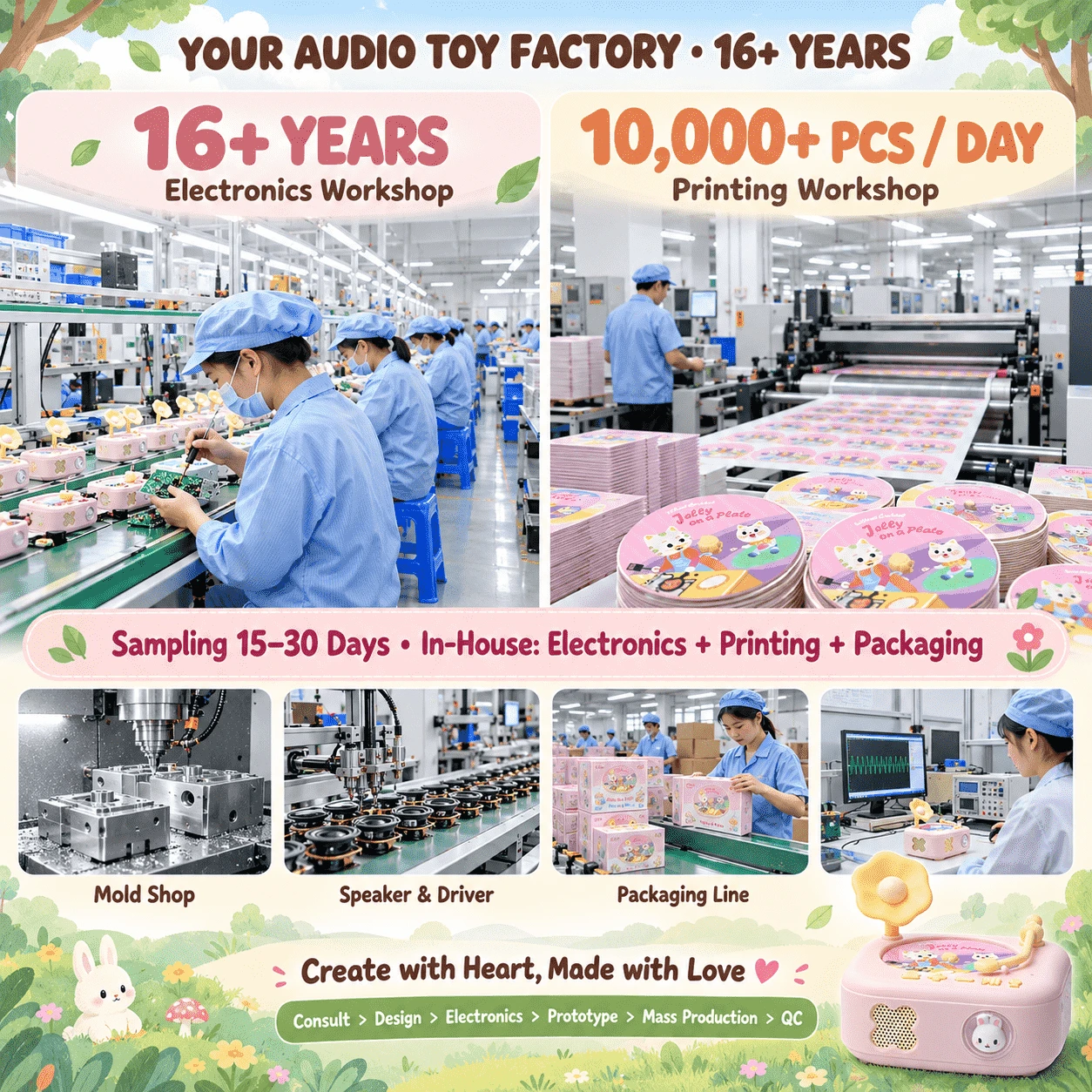
08 - Mass Production: Injection moulding, board assembly, mechanism fitting, card printing, voice loading and final packing are handled at one facility, so a change of deck or language never leaves the building where the hardware is made.
09 - Quality Inspection: Each batch is checked against a signed sheet: card-to-audio match across the whole deck, lever action against the reference unit, light level in a darkened room, charging and cell behaviour, and print quality against the approved proof. The paperwork for the destination is put together before the goods leave.
10 - Shipping and Logistics: Thirty units go to a carton, each shipment is marked for its destination and released with the documents that belong to that batch, using the forwarder the buyer nominates.
9. Quality Control and Safety
Each Square Children's Phonograph unit is inspected at several stages before it is packed:
Inspection starts with incoming materials - the housing polymer, boards, speaker driver, light assembly, cell, charging cable, printed cards and cartons are all checked against specification on arrival. Functional testing then confirms power-on behaviour, card recognition across the entire deck, playback of every story in the edition, lever action measured against the reference unit, light level in a darkened room, and charging behaviour on the assembled article. Deck inspection covers print quality against the approved proof and the make-up of the set, so the right number of cards arrives in the right order. Completed cartons are checked for marking accuracy and packed condition before they are closed.
Certifications
For this product the factory holds CE, UKCA, FCC and RoHS documentation, plus CPC for the children's product route in the United States. ASTM F963 and EN71 reports are produced whenever an importer or a marketplace requires them. The file is tailored to each destination, updated with every batch and sent out with the goods it covers.
Material & Volume Safety
The square housing is moulded with rounded transitions and no sharp edges, and the card slot and lever are built so that no small part can work loose in ordinary use. Output level is calibrated to a child-safe listening figure, because this is a device that ends up close to a face at bedtime. We would rather design that limit into the hardware than trust a parent to notice a volume setting.
Drop & Durability Testing
Production samples are dropped onto hard surfaces and put through repeated lever operation, and the card slot is cycled to confirm that a deck can be loaded and changed without wearing the guide. Copies from each batch are kept as reference units, so a question about batch five is answered by holding it beside batch one rather than by trading impressions. We do not publish a failure rate we cannot substantiate; what we offer instead is a signed inspection record and a carton code that traces back to the batch it came from.
10. Why Buyers Choose Xinditai
Shenzhen Xinditai Electronic Co., Ltd. builds children's audio and interactive products and has done so since 2010, working from a site of roughly 3,000 square metres with a team of more than one hundred engineers and operators. The catalogue spans card-reading phonographs, talking flash cards, story machines, talking books, projection toys and musical items, and every programme is run as OEM or ODM work for distributors, publishers, retail groups and brand owners around the world. Hardware and content are made under one roof: card printing, voice recording, mechanism fitting, acoustic tuning and final packing all happen on the same floor, so a change of deck, language or colourway never turns into a coordination problem between suppliers. Custom runs begin at 1,000 pcs, a first batch of 200 to 500 units is available for a market test, and buyers are welcome to visit the plant or walk the lines over a live video call.
11. Square Children's Phonograph FAQ
Q: What is a square children's phonograph?
A: It is a screen-free audio toy for young children, built as a square body rather than a rounded one. A printed story card is seated into the side slot and the lever is turned, and the recorded story plays while a gentle light rises behind the front face. There is no display and no network, so a pre-reader can use it without help.
Q: How many story cards are included?
A: The standard pack carries sixty cards, split fifty in English and ten in Chinese. The deck is replaceable, and the cards, the story contents, the logo and the packaging are all produced to the buyer's order, so a different library becomes a print run rather than a new product line.
Q: Does it need an app, wi-fi or a subscription?
A: None of them. The library is loaded into the player at the factory against the card mapping, so playback relies on nothing except the card and the lever. That is deliberate - the failures a family remembers are the ones that happen when a phone is on the wrong network at bedtime.
Q: How is the unit charged?
A: A 200 mAh lithium cell is recharged over a Type-C port. Standard phone chargers, power banks and car adapters all work, so the household needs no dedicated cable and no supply of disposable batteries.
Q: What can be customised on an OEM order?
A: The story library and its running order, the narrator and the language mix, the card artwork, the shell colour and front face, the logo and branding, the packaging, additional card packs and the accessory bundle. Anything that changes the mould or the electronics counts as a development project rather than an order option, and it is quoted separately.
Q: What is the minimum order quantity?
A: A custom production run begins at 1,000 pcs. For a market test, a starter batch of 200 to 500 units can be arranged, priced so the unit cost is credited back when the full order follows. Sample quantities of one to five pieces are dispatched five working days after payment clears.
Q: Which certifications do you hold?
A: The product carries CE, UKCA, FCC and RoHS documentation, and CPC is held as well. Where a market calls for ASTM F963 or EN71 reports, those are produced on request, and the paperwork is tailored per destination and travels with the batch it applies to.
Q: How quickly can the language or the stories be changed?
A: It turns on the length of the deck rather than on the hardware, since the artwork, the paper and the tooling stay exactly where they are and only the recording and the printing change. Give us the deck length and the destination and we will come back with a real date instead of an optimistic one.
12. Contact Us
Planning a square-format story player for your own market, or pricing a custom edition against a language split and a volume? Send us the destination, the language mix and the quantity you have in mind.
Send drawings and enquiries to: xdt01@dtdianzi.com
Or message us on WhatsApp: +86 139 2381 3463
Expect a reply within one working day.