



NFC Story Box for Shared Spaces: A Practical Guide for Classrooms, Daycares, and Libraries
A single NFC story box earns its place at home, but the same tap-to-play, screen-free design also solves a quieter problem in shared spaces: how do you give a room full of children calm, independent story time without a tablet, a screen, or an adult reading aloud every minute? If you supply, specify, or buy for those settings, the questions change from "which color" to "how does one device survive a hundred small hands a day." This guide walks through the practical decisions that separate a box that lasts from one that disappears into a lost-and-found bin by week two.

Built for the room, not just the lap
The story box shape matters more in a shared setting than at home. Rounded edges, a wipe-clean surface, and a weight a four-year-old can carry mean the device lives on a low shelf where children reach it themselves, instead of in a closet where an adult has to hand it out.
1. Why the box shape suits shared, high-traffic use
The first thing a teacher or librarian notices about a story box is that it is not a screen. There is no glowing rectangle to argue over, no algorithm deciding what plays next, and no Wi-Fi password to negotiate during circle time. A child picks a card or a character, taps the box, and a voice begins. In a room with six children and one adult, that independence is the whole point: the device does the reading so the grown-up can supervise instead of performing.
The physical form follows the use. A soft, padded, drop-friendly box tolerates the floor in a way a tablet never will, and it reads as a toy rather than a device, which lowers the "I must hold the phone" reflex. Ask the supplier how the enclosure behaves after a one-meter drop onto a hard surface, since a unit that cracks on impact becomes a complaint, not a learning tool.
2. One box, many children: ending the "whose turn" fight
Tap-to-play is quietly radical for group behavior. Because each card is a self-contained choice, a child does not need to scroll, search, or wait for an adult to pick a title. They walk up, tap, and listen. That removes the two friction points that cause most sharing conflicts: the need for adult mediation and the fear that someone else controls the content. In a daycare, this often means one box supports several children in rotation without a queue forming around a single screen.
The practical trick is card access, not the box itself. Keep a small rack or pouch of cards within reach so children choose independently, and reserve a few "calm-down" titles in a separate spot for when the room needs quiet. The box stays neutral; the card layout does the behavior management. Buyers who overlook this end up with a box children fight over, when the real lever was the card system around it.
A rotating card library on the shelf
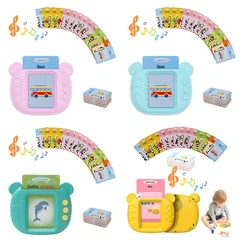
The box is the doorway; the cards are the collection. A shared room works best when the card set rotates by week or theme, so the shelf stays fresh without buying a new device each term. The sorted stack above is the kind of visible, borrowable library that turns one purchase into a year of replay.

3. Building a rotating card library for a shelf or lending desk
A library or classroom does not need fifty titles on day one. It needs a small core that rotates. Start with a dozen cards covering a few moods: a sleepy set, a silly set, a factual set, and a seasonal set. Swap one group out every few weeks so returning children find something new without the institution re-buying hardware. This is where the NFC model pays off: the box is a fixed cost, and the cards are a low-cost, repeatable reason to come back.
For lending desks, treat each card like a short loan. A simple numbered sleeve and a sign-out clipboard keeps the collection intact, and because cards are small and cheap relative to the box, a lost card is an annoyance, not a disaster. Ask suppliers whether blank or authorable cards are available so the room can add local content, a class recording, or a bilingual title without waiting on a factory run.
4. Group listening vs individual calm: choosing the volume approach
Shared spaces split into two listening modes, and the box you specify should match the room. A library corner or a quiet nook wants a gentle, close-to-the-ear level that one child hears without disturbing neighbors. A circle-time rug or a classroom wind-down wants enough projection that a small group catches the story together. These are different acoustic targets, and a device tuned only for one will frustrate in the other.
The safe path is a fixed, tested ceiling near the 85 dB child-safe expectation, with a mode or a simple switch between "quiet" and "room" rather than a free slider a child can max out. Ask the supplier to measure output at the finished product, not at the bare module, because the padded enclosure changes everything. A story box that is either too loud for a shelf or too soft for a circle fails both jobs.


Calm that scales with the room
A fixed, demonstrated volume ceiling lets one child listen close without flooding the space, and lets a small group gather when the mode changes. The cue above is the kind of visible, testable safety signal that reassures both parents and facility managers.
5. Hygiene and durability: what to specify for daily wipe-downs
A device passed between dozens of children a day is a hygiene surface. In daycares and clinics this is not optional: ask whether the outer material tolerates a daily wipe with a standard child-safe disinfectant without cracking, fading, or absorbing odor. Seams, speaker grilles, and card slots are the three places grime collects, so specify smooth, sealed surfaces there and confirm the unit is rated for repeated cleaning rather than just "wipe if needed."
Durability and hygiene overlap in the drop test. A shared box will be dropped, sat on, and left in a cubby overnight. Request the drop-test result at finished-product level and a resistance rating for the surface coating so the unit survives real use instead of a showroom demo.
6. Content for institutions: licensing, languages, and curriculum tie-ins
Schools and libraries care about what is on the card as much as the box. A title that supports a literacy unit, a second language, or a local folk tale earns a permanent spot on the shelf; a random licensed character may not. Before buying, map the card library to the room's actual goals: multilingual learners need parallel-language titles, while a clinic waiting room may want shorter, soothing pieces that reset a restless child.
Licensing is the quiet cost. Confirm who owns the audio and whether institutional or multi-seat use is permitted by the license, because a home license and a classroom license are different animals. If you plan to add your own recordings, ask for authorable cards and the master-file pipeline so the room controls its content instead of renting it title by title.
Power that survives a full day
A shared box is only useful when charged. The charging rack above represents the kind of fleet setup that keeps five or ten units ready between sessions instead of dead in a drawer. Ask whether the box supports a simple multi-unit charger rather than ten loose cables.

7. Power and fleet management: charging many units at once
One box at home charges whenever. Ten boxes in a facility need a system. The first question is battery versus rechargeable: a sealed rechargeable unit avoids the cost and hazard of loose cells across a building, but it demands a charging routine. The second question is the charger itself. A single multi-slot dock beats a tangle of cables for both uptime and safety, and it makes end-of-day cleanup a thirty-second job instead of a hunt.
For larger rollouts, ask the supplier about battery health over cycles and whether the enclosure allows field service or must be returned whole. A fleet lives or dies on the boring details: how fast it charges, how long a full charge lasts in real listening, and whether a dead unit is a five-minute swap or a two-week return.
8. Anti-loss and organization: keeping boxes and cards together
In a shared space, the box and its cards travel separately and get separated. Build the system before you buy the units. A labeled bin per box with its core card set, a wall hook at child height, and a color code per room prevents the most common failure: a box with no cards and a drawer of cards with no box. Some facilities add a simple lanyard or a Velcro loop so the box stays near its shelf.
If the room lends boxes home, a check-out card and a numbered tag turn chaos into a ledger. The goal is not surveillance; it is that the next child finds a working box with a story attached. Specifying a model with a secure card slot that does not eject on a bump protects the content as much as the hardware.

Safety marks that satisfy facilities
Shared and educational settings often face stricter sign-off than a home purchase. The marks above are the public face of test reports that a school district, a clinic, or a library procurement desk will actually ask to see before approval.
9. Safety and certification for group and educational settings
A story box aimed at young users already touches several certification families: toy safety such as ASTM F963 or EN71, electrical safety such as EN62115, and wireless compliance such as FCC for the NFC reader. In institutional buying, those marks are not a formality; a school district or a public library may require the full test report on file before a purchase order clears. Ask for the reports tied to your exact configuration, because adding a battery or changing the enclosure can shift which tests apply.
The quieter requirement is chemical and hygiene compliance for repeated child contact, which matters more in a daycare than in a living room. A supplier who treats certification as a single checkbox is a procurement risk for a facility; one who hands you the configuration-specific matrix is the partner you want when the facilities manager asks the hard question.
10. A sample rollout plan: pilot five boxes before a full cart
You do not need a cart of thirty on day one. A sensible institutional rollout starts with a pilot of five boxes in one room for a term. Watch which cards get tapped most, where units end up at pickup time, and whether the charging routine holds. That small test surfaces the real questions, like "do we need wall hooks" or "is the quiet mode too quiet for our rug," far more cheaply than a building-wide order that guesses wrong.
After the pilot, expand by room rather than by count. A box that earns its shelf in one classroom is a stronger sales case to the next teacher than any catalog photo. Keep the pilot units as the training set for staff, so the second wave arrives with people who already know the system.
11. What to ask a supplier when buying for institutions
Most supplier questions from a home-buyer checklist still apply, but shared use adds a short list. Ask for the finished-product drop-test and surface-disinfectant rating. Ask whether a multi-unit charger exists and what battery cycle life looks like. Ask whether cards are authorable for local or bilingual content and whether the license covers institutional use. Ask how the box and cards stay paired in a lending system. And ask for the configuration-specific safety reports up front, because a facility buyer will need them anyway.
The pattern across all of these is the same: a home buyer optimizes for delight, a shared-space buyer optimizes for uptime, hygiene, and accountability. A supplier who answers the institutional list without blinking is one who has shipped to schools or libraries before, and that experience is worth more than a lower unit price.
Inspect the fleet before you commit
A shared rollout lives or dies on the boring checks: drop results, charge routine, card pairing, and reports on file. The review above is the kind of pre-order inspection that should happen before a pilot, not after a cart of units arrives.

12. Frequently asked questions
Can one NFC story box serve a whole classroom? Not all at once, but it supports rotation and small-group listening well. Most rooms run several boxes plus a shared card library rather than one device for thirty children.
Do the cards get lost easily in a shared setting? They can, which is why the system matters more than the hardware: labeled bins, a checkout card, and authorable spares keep the collection intact.
Is a story box safe for daily child contact? It must meet the same toy and electrical standards as any electronic toy, and for shared use you should also confirm a disinfectant-tolerant surface rating.
Can we add our own bilingual or local content? Ask for authorable cards and the master-file pipeline; some suppliers lock content, while others let the room control its own library.
Does institutional use need a different license? Often yes. A home license and a classroom or library license are different, so confirm usage rights before a public rollout.
How many should we buy for a pilot? Five boxes in one room for a term is usually enough to learn the routine, the popular titles, and the charging reality before expanding.