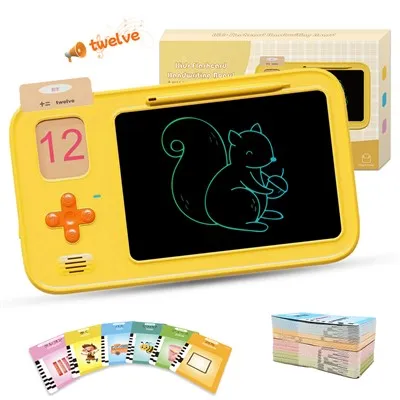

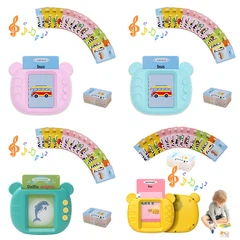






In an increasingly interconnected world, early childhood education faces the exciting challenge of bridging linguistic divides right from the start. Imagine a tool that doesn't just teach letters and sounds but does so across the globe's diverse scripts- from the familiar curves of Latin alphabets to the intricate flows of Arabic, the robust blocks of Cyrillic, the elegant forms of Greek, the sacred symbols of Devanagari, the efficient strokes of Hangul, and the nuanced characters of Japanese kana. This is the heart of the LMB-001, a multi-language alphabet learning pad designed with a singular purpose: to empower young learners everywhere by forging unbreakable links between visual symbols and their auditory counterparts. Unlike apps that flicker on screens and compete for attention, the LMB-001 embodies a hardware-first philosophy, prioritizing tactile engagement and immediate feedback to make literacy feel intuitive and joyful.
From its inception, the LMB-001 was born out of a profound question: How can a straightforward, durable device help children worldwide associate letters with sounds, regardless of their native tongue? This vision guided every decision, steering the development team away from gimmicky add-ons and toward a core experience that resonates universally. Early literacy thrives on simplicity, and the LMB-001 delivers just that-pressing a key triggers a clear, human-voiced pronunciation, embedding the association deep into a child's memory. But beneath this elegant surface lies a symphony of engineering prowess, where precision timing and thoughtful design ensure that learning isn't just possible, but profoundly effective.
At the core of the LMB-001's appeal is its unapologetic embrace of hardware as the foundation for learning. In an era dominated by software solutions, this device stands out by treating the physical interaction as paramount. Picture a compact microcontroller acting as the silent conductor of a meticulously orchestrated performance. It tirelessly scans a robust key matrix, detecting presses with unwavering accuracy even under the enthusiastic barrage of tiny fingers. This isn't mere button-mashing; it's a gateway to phonemic awareness, where each interaction sparks a chain reaction designed for clarity and retention.
The audio system, in particular, exemplifies this hardware-centric ingenuity. When a key is pressed, the signal flows through debounced GPIO pins, consulting an efficient asset lookup table before emerging as crisp, intelligible speech. The focus here is razor-sharp: the 2–4 kHz frequency band, where human speech achieves its peak clarity, takes center stage. This isn't about blasting high-volume effects or bass-heavy tunes that might thrill older audiences but confuse young ears. Instead, the LMB-001 channels output through a dedicated digital-to-analog converter (DAC) and a power amplifier, culminating in a full-range loudspeaker optimized for consonant distinction. Distinguishing between the plosive "b" and the aspirated "p," for instance, becomes effortless, allowing children to build foundational skills without the frustration of muffled or muddled sounds.
Game logic runs in parallel, synchronized with millisecond precision to maintain flow and engagement. Whether it's a single-letter drill or a sequencing challenge, the microcontroller ensures that responses are instantaneous, fostering a sense of mastery that software simulations often struggle to replicate. This hardware-driven reliability means the LMB-001 isn't just a toy-it's a dependable ally in the classroom or at home, capable of withstanding daily use while delivering consistent results. By stripping away digital distractions like notifications or battery-draining animations, the device creates a pure learning environment where focus flourishes.


Microcontroller Magic: The Brain Powering Seamless Interactions
Delving deeper into the microcontroller's role reveals why the LMB-001 punches above its weight in educational tech. Selected for its low power consumption and high I/O capabilities, this tiny powerhouse handles multitasking with grace-scanning keys, managing audio playback, and enforcing game rules all without a hitch. Developers optimized the firmware to minimize latency, ensuring that the gap between a child's press and the auditory reward is imperceptibly short. This immediacy is crucial in early education, where delayed feedback can erode confidence and prolong frustration.
Power management further underscores the device's practicality. Running on rechargeable batteries, the LMB-001 supports extended sessions without frequent interruptions, and its charging circuitry includes safeguards against overvoltage, making it safe for unsupervised use. In essence, the hardware isn't an afterthought; it's the LMB-001's soul, engineered to support diverse languages and learning paces while keeping the experience grounded in the physical world.

Crafting a Layered Content Model: Bridging Symbols and Sounds Across Scripts
One of the LMB-001's most innovative aspects is its content model, envisioned as a dynamic, layered map that navigates the complexities of global orthographies. At the base layer are orthographic units-the tangible symbols children interact with directly. These aren't abstract concepts but physical keys etched or printed with characters from various scripts, allowing learners to "hold" their education in hand. Each unit belongs to a language-specific inventory, encompassing vowels, consonants, diacritical marks, digraphs, or even syllabic constructs, depending on the script's demands.
Building upward, the model incorporates phonological variants, acknowledging that sounds aren't monolithic. In English, this means differentiating short and long vowels, like the crisp "i" in "bit" versus the drawn-out "i" in "bite." Arabic users encounter Fatha, Kasra, and Dhamma-short vowel markers-along with their tanwin extensions for grammatical nuance. Hangul's structure shines through initial, medial, and final jamo forms, reflecting Korean's logical syllable blocks. Japanese learners grapple with clean versus voiced pairs (thanks to dakuten marks) and contracted yōon sounds, blending simplicity with cultural authenticity.
Phonological Precision: Tailoring Audio for Cultural Relevance
This layered approach extends to audio assets, where each orthographic unit links to one or more high-quality recordings. Metadata dictates playback sequences, repetition frequencies, and progressive difficulty levels, creating a scaffolded learning path. Native speakers record these clips in controlled environments, ensuring phonetic accuracy that resonates with local dialects. For instance, a Devanagari "ka" might carry the subtle aspiration of Hindi, while a Greek "chi" captures the fricative edge of modern pronunciation.
The beauty of this model lies in its flexibility-it maintains a unified user experience across languages while respecting pedagogical nuances. Teachers can swap inventories seamlessly, perhaps starting with basic consonants before introducing vowel harmonies in Finnish or tonal distinctions in Mandarin extensions. By decoupling content from hardware, the LMB-001 becomes a chameleon, adapting to curricula without compromising on seamlessness. This isn't just data storage; it's a thoughtfully curated ecosystem that honors linguistic diversity, making alphabet mastery accessible and culturally affirming for children from Tokyo to Tehran.
Engaging Interaction Modes: From Recognition to Mastery
Interaction on the LMB-001 is pared down to essentials, eschewing overwhelming menus for modes that align directly with proven learning principles. The simplest-yet most powerful-is the direct tap mode. Press any key, and the device responds with its corresponding sound, delivered in a warm, human voice. This instant reinforcement builds neural pathways swiftly, turning passive observation into active recall. It's the digital equivalent of a patient tutor whispering encouragements, ideal for those first forays into phonics.
Elevating the experience is "Find Me" mode, where the device vocalizes a target sound at random, challenging the child to hunt down the matching key. Success triggers affirming chimes or cheers, while gentle cues-like a repeated hint-guide without hand-holding. This gamified element introduces auditory discrimination early, helping learners sharpen their ears amid a sea of similar phonemes. As sessions progress, Q&A mode layers on complexity, prompting sequences or contrasts: "Which key makes the 'th' sound?" or "Find the pair that rhymes." These prompts evolve from basic recognition to sophisticated sequencing, mirroring developmental milestones without overwhelming young users.
Pedagogy at Play: Short Bursts, Smart Repetition
Grounded in evidence-based practices, these modes emphasize brevity and relevance. Sessions clock in at 10–15 minutes to match attention spans, with immediate feedback loops that celebrate progress and correct gently. Spaced repetition weaves in subtly-revisiting tricky sounds at expanding intervals to cement long-term retention. Research from cognitive science backs this: children absorb more when practice feels playful rather than punitive. The LMB-001's modes embody that ethos, transforming alphabet drills into delightful discoveries that stick.

Ergonomic Design: Building for Little Hands and Big Adventures
Physical form follows function in the LMB-001, with every curve and contour calibrated for the users who matter most: children aged 3–7. Keys are generously spaced-about 1.5 inches apart-to prevent accidental presses, and topped with tactile domes that deliver a satisfying "click" for kinesthetic confirmation. This feedback reassures users that their action registered, boosting confidence in an otherwise abstract process.
Customization extends to visuals: vowels might glow in soft pastels, consonants in bolder hues, or sets grouped by introductory levels for scaffolded progression. Volume adjusts in discrete steps via a child-locked dial, capping at safe levels while prioritizing speech clarity over sheer decibels. The enclosure, molded from durable ABS plastic, withstands drops and tugs, its rounded edges preventing ouch-worthy mishaps. At roughly 8x10 inches and under a pound, it's portable enough for backpacks yet substantial for desk use, blending portability with presence.
Safety and Sustainability: Materials That Matter
Adhering to educational standards like ASTM and EN71, the LMB-001 incorporates non-toxic finishes and hypoallergenic components, ensuring it's as safe as it is engaging. Battery life stretches to 8–10 hours per charge, with eco-friendly lithium-ion cells that minimize environmental impact. This thoughtful design isn't flashy-it's foundational, creating a tool that invites repeated use without wear or worry.
ODM Customization: From Global Prototype to Local Phenomenon
For educators and organizations seeking a bespoke touch, the LMB-001's original design manufacturing (ODM) pathway opens doors to tailored deployments. Recognizing that one size rarely fits all linguistic landscapes, the process starts with your input: specify the language inventory, pronunciation guidelines, and branding motifs. From there, the team collaborates on panel layouts, sourcing native audio (or integrating yours) and refining logic to align with your teaching framework.
Timelines are brisk yet thorough-a requirements review yields panel and audio prototypes in 2–3 weeks. Engineering samples and a test batch follow in another 3–4 weeks, paving the way for pilot production and scale-up. Minimum orders dip to 1,000 units, democratizing access for startups or nonprofits. Consider the partnership with UK's Quran Cube Ltd., where the LMB-001 morphed into a specialized Arabic learning aid, complete with Fatha-marked keys and Quranic phoneme drills. Such adaptations validate markets swiftly, blending speed with precision.
Streamlining Production: A Collaborative Blueprint
This ODM model thrives on co-creation, with iterative feedback loops ensuring fidelity to your vision. Firmware tweaks might emphasize right-to-left scanning for Arabic scripts, or haptic variances for tonal languages. The result? A device that feels homegrown, amplifying local impact while leveraging proven tech.

Rigorous Quality Assurance: Stability as the Unsung Hero
Behind the LMB-001's reliability lurks a QA regimen as meticulous as the design itself. Firmware undergoes exhaustive stress-testing: key scans endure phantom presses and rapid-fire inputs, audio pipelines are probed for latency spikes, and endurance trials simulate years of use across battery cycles. Interaction stability shines in edge cases-like marathon sessions or multi-user handoffs-yielding a glitch-free experience that builds trust.
Materials and charging align with global safety norms, from UL certifications to RoHS compliance, safeguarding against hazards in diverse settings. This isn't box-ticking; it's a commitment to consistency, ensuring every unit performs like the last, session after session.
Long-Term Durability: Engineering for Lifelong Learning
Beyond initial checks, ongoing validation includes environmental simulations-humidity for tropical classrooms, drops for playground mishaps. The payoff is a device that ages gracefully, its keys retaining snap and speakers their timbre, ready for the next generation of learners.
Ideal Applications: Where the LMB-001 Ignites Literacy Sparks
The LMB-001 finds its sweet spot in environments hungry for focused, low-distraction tools. Preschools integrating it into circle time witness shy beginners blooming into confident readers. Language immersion schools deploy customized batches for beginner cohorts, accelerating proficiency in heritage tongues. Community hubs and faith centers-like synagogues teaching Hebrew aleph-bet or temples guiding Gurmukhi scripts-leverage its cultural adaptability to foster inclusion.
In resource-strapped regions, its ruggedness shines, bridging gaps where tablets falter on spotty power. Libraries and after-school programs stock it for take-home loans, extending reach without complexity. Wherever letters meet eager minds, the LMB-001 amplifies potential.
Classroom Integration: Tips for Maximizing Engagement
Educators report best results pairing it with group activities-rotating "Find Me" challenges or charting progress on shared boards. Its quiet operation suits mixed-ability groups, allowing differentiated pacing without chaos.
The Enduring Value of Dedicated Hardware in Education
Why commit to hardware when apps abound? Because the LMB-001 cuts through the noise, channeling attention solely to the task at hand. No ads, no swipes-just pure, repeatable phonics practice that builds habits for life. It's a compact platform, portable across borders, scalable for cultures, and rooted in rigor.
In a template that balances universality with personalization, the LMB-001 redefines alphabet learning. Panels flex for script-specific layouts, content schemas evolve with updates, and flows adapt to pedagogies. For those eyeing deployment, it's viable at test scales, promising returns on investment through engaged learners and measurable gains.
Small Device, A World of Possibilities
The LMB-001 isn't merely an gadget; it's a catalyst for equitable literacy, proving that thoughtful engineering can transcend languages and ignite curiosity. As global mobility surges, tools like this will define inclusive education-simple, sturdy, and profoundly human. Whether customizing for your locale or adopting the core model, it invites a future where every child deciphers their world's script with ease and delight. Explore its potential, and watch letters come alive.