
When we sat down to make the LMB-001, we didn't think about focusing on one language. From the start, we had a question: how might a simple, rugged appliance assist children everywhere in linking letters to sounds - whether those letters are Latin, Arabic, Cyrillic, Greek, Devanagari, Hangul or Japanese kana? 🌍

LMB-001 language learning board
Everything was shaped by that question. Rather than add a lot of flashy features, we opted for a hardware first approach and consistent, immediate, tactile feedback. Hit a key, hear a sound, form an association. It seems straightforward - because early literacy, simple, is powerful. But there's a lot under the hood.
Think of a little microcontroller quietly conducting a choreographed orchestra: scanning a thick key matrix looking for presses, producing audio - specifically human speech (particularly the 2–4 kHz band where the bulk of intelligibility resides) - and running game logic with timing precision. 🎛️ Each key press produces a clean flow down debounced GPIO, into an asset lookup table, out through a DAC and a power amplifier, then into a full-range loudspeaker who gives a toss about consonant clarity more than bass drops. Children don't need booming sound-they need to be able to tell the difference between "b" and "p." "We designed the content model like a layered map. There are orthographic units, which is the symbols children are exposed to and can hold in their hands. Each is part of a language-specific inventory: vowels, consonants, marks, digraphs or syllabic units. Then come phonological variants: short/long vowels in English, Fatha/Kasra/Dhamma (and tanwin) in Arabic, initial-medial-final derivations in Hangul, and clean/voiced pairs (dakuten) and contracted sounds (yōon) in japanese. 🗺️ Each unit accesses one or more audio files, with metadata specifying playback order, repetition, and difficulty. This division allows us to maintain a seamless, intuitive user experience, and still honor the teaching logic behind each script.

One button for one alphabet
On the interaction side, we didn't cram the device with modes. Just whittle a few that matter. Tap any key, and hear its sound-instant reinforcement. switch to "Find Me," and the device randomly announces a target; the student tries to locate the matching key, while the device immediately offers feedback in the form of gentle auditory cues. In Q&A mode, prompts encourage learners to progress from recognizing to discriminating and sequencing, helping them advance through increasingly challenging steps-but never pushing them too far. 🎯 Playful it may be, but it is grounded in pedagogy: short, frequent sessions; immediate feedback; and spaced repetition that subtly boosts retention.

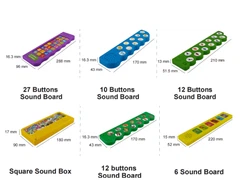
Size information
On the physical side, the options are calculated. Buttons are spaced to accommodate small hands and feature tactile domes that click just enough to let users know they've pressed them. Vowel and consonants can be color-coded, or character sets can be grouped by teaching level. Volume control is multi-step with a child-safe cap; audio tuning prioritizes speech intelligibility rather than loudness for user-friendly classroom application. The body is ABS for strength, rounded for comfort, and good for the rigors of daily learning. 🔧
Then there's customization-the ODM avenue many partners really want. Not everybody needs a global SKU; lot needs a sharp, local tool. That's why we do small-batch ODM from as few as 1000 pcs. You provide the language inventory, pronunciation standards and brand elements; we co-create the panel layout, produce native speaker audio (or incorporate your recordings) and fine-tune the interaction logic to fit your pedagogy. 📦 Typically the path looks like this: requirements intake, panel and audio demo in 2–3 weeks, engineering validation samples plus a small test batch in 3–4 weeks, then a pilot run and mass production. It's enough to be quick for validating the market and detailed for quality.

What we made for QURAN CUBE LTD in UK
Beneath the narrative, stability upholds everything. Firmware QA emphasizes on strip key scan robustness and audio latency, extensively. We check for interaction stability at high rates of input, for endurance across battery cycles, and we match materials and charging protection with educational safety standards. ⚙️ This translates into a consistent feel for the device: no surprises, no glitches if kids hit the same key ten times in a row.
So where? Should LMB-001 be sold? At preschools pioneering literacy, language schools offering beginner modules, community centers and houses of worship bringing local offerings, and any place where a nimble, distraction-free tool can aid kids in linking letters to sounds. 🎓 And why hardware-first? Because a dedicated device removes noise. It changes focus into learning, dependably, session after session.

How is the template looks like
But at the end of the day LMB-001 isn't a "toy." It is a small and compact platform that can be transferred across scripts and cultures with technical rigor and pedagogical clarity. If you are considering a localized deployment, the panel layout, content schema, and interaction flow can be customized for your audience - and at scale sufficient to make market testing viable.🚀