
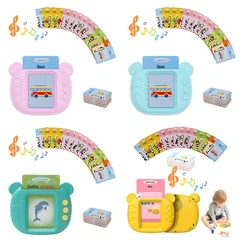
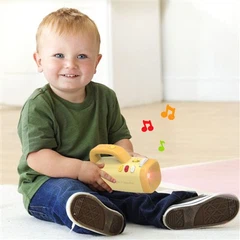
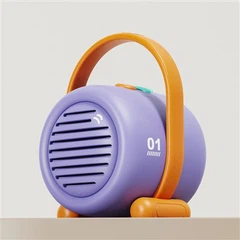
The question buyers ask most often is whether the content can be changed. What actually decides whether this kids gramophone sells, however, is not whether it can be changed - it is how the 60 cards are divided.
Same hardware, same cost. A set organised like a playlist dies on the shelf within a quarter. A set organised around use moments carries a full year of repeat purchase. This article covers the second kind: the content architecture, the three files that customisation really depends on, and three retail moves that work without explanation
.
01 / What this form factor sells is one second of comprehension
Competition in children's audio is thumbnail competition. A parent scrolling a marketplace page gives a product about one second.
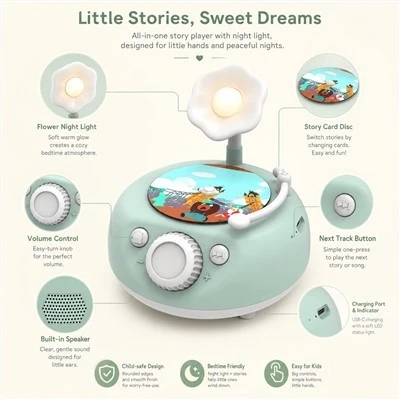
The gramophone shape has a structural advantage here: round platter, tonearm silhouette, card-on-platter playback. One image says "audio for children, no screen." A generic square story box needs copy to explain itself; a gramophone does not. That is why we list the phonograph player as its own product system rather than folding it into story machines - it sells a recognisable form, not only a function.


02 / How the 60 cards should be divided
The standard library splits 60 cards into four groups: nursery rhymes and songs, stories, alphabet and number recognition, and classical music, with every track kept under 90 seconds. The split maps onto four moments:
Familiar melodies (~30%) - an immediate reaction, which is what makes the first switch-on work
Stories (~30%) - bedtime and soothing; the part that drives repeat purchase
Cognitive content (~20%) - letters, numbers, vocabulary; what convinces a parent this is not purely a toy
Quiet music (~20%) - classical pieces and white noise, for night-time and car journeys
The 90-second ceiling deserves its own line. Attention windows are short at this age. If a piece needs three minutes to finish, the child lifts the card halfway through - and the parent concludes the product does not work, rather than that the story was too long.
03 / Customisation really depends on three files
Customisation conversations usually stop at "the content can be changed." Three documents decide whether the project ships on schedule:
Card artwork - 70mm × 70mm, 300dpi, CMYK. Wrong dimensions or colour mode means the printer sends it back.
Audio - MP3 or WAV, at least 192kbps, no track longer than 90 seconds. Low bitrate shows up as hiss through a small speaker.
The mapping table - card number to track number, one to one. This is where projects break: cards printed, audio delivered, and card 23 plays track 24 when the set is assembled. The cost is not money, it is the shipping window.
Freeze all three before tooling and sampling.


04 / Platter and night light: two details that turn a toy into a habit
A real platter. The child places the card; the platter actually turns. That is fine-motor practice - pick up, align, set down. Children who can do it alone are children parents hand the toy back to.
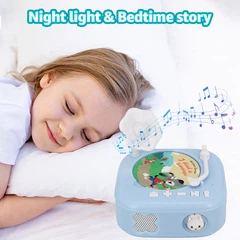
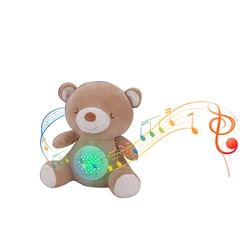
A night light. The star-projector version changes where the product lives: from the toy box to the bedside table. Frequency follows location - nightly rather than weekly. Neither detail adds much cost, but together they decide whether a toy lasts three days or a year.
05 / Hardware and compliance: the right to sell
Published specifications: 110 × 110 × 105mm, ABS housing, 200mAh Type-C rechargeable lithium battery. The small footprint makes it easy for a child to carry; the trade-off is capacity and more frequent charging, which matters if your market is sensitive to runtime.
On compliance, the product can be supplied with FCC, CE and RoHS. At factory level we hold ISO 9001, BSCI and Sedex; product safety covers CE and EN 71; materials meet RoHS and CPSIA; UKCA is available for the UK; other market-specific testing (ASTM F963, for example) is arranged per project. The compliance burden in this category sits in three places: small parts such as cards, child-resistant battery compartment design, and volume limits. None of the three can be fixed by final inspection - they are decided in tooling and circuit design.
The manufacturing side matches: in-house tooling shop (10 injection machines plus 3D printing), in-house laboratory, fully automatic SMT lines with optical inspection (assembly defect rate below 0.3%), IQC → IPQC → FQC → OQC quality control, full function testing on every unit, and final random inspection to AQL standards before container loading.


06 / Three retail moves that need no training
Shelf demonstration. Ship with one card already on the platter and a window that shows it. Staff press once and it plays - a product with zero demonstration cost is a product that earns end-cap space.
Card sets as the repeat engine. The player sells once; cards keep selling - seasonal sets, second-language sets, age-graded sets. One shelf position produces multiple sales.
Gift boxing. 60 cards, storage boxes and a night light is the combination gift channels accept most readily. Gift buyers look for what happens when the box opens, not at a spec sheet.
07 / MOQ, lead time and sampling
Stock platform configurations start at 100 pcs; custom development starts at 1,000 pcs. Lead time is roughly 45–60 days for OEM and 60–90 days for full ODM, with sampling at 15–25 days.
Internal pace markers: STP documents in 3 days, 3D printing in 3 days, PCBA samples in 5 days, tooling in 30 days, mass production in 30 days. Their practical use is calendar planning - once a launch date is fixed, working backwards tells you which file must be frozen today.
Frequently asked questions
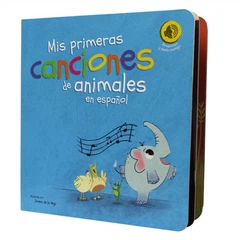
Q: Can all 60 cards be replaced with our own content? A: Yes. Artwork, audio, language and card count can all be rebuilt, or you can change only the language as a light customisation.
Q: Does a language change require new tooling? A: No. Only the audio and card printing change, which makes it the fastest way to test a market.
Q: Can the product carry our brand? A: Yes. Housing colour and finish, logo, packaging, manual and card printing can all be private labelled.
Q: How large should a first order be? A: Small batch on a stock configuration to test a market; move to 1,000 pcs custom development once housing and content changes are confirmed.