
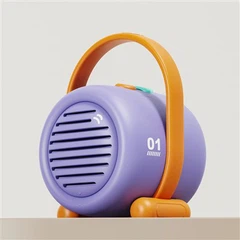
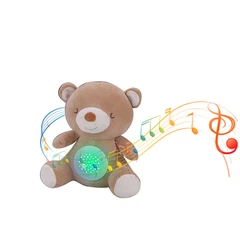

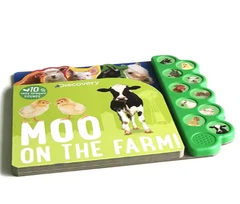
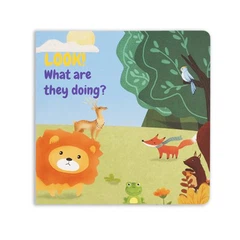

CBME China is the largest baby and children's products trade show in Asia. This year it ran July 15-17 at the National Exhibition and Convention Center in Shanghai. 3,000 exhibitors. 4,500 brands. 270,000 square metres across 8 halls. Over 100,000 professional visitors.
For the first time in its history, CBME dedicated an entire zone to AI toys and education. Hall 8.1. Not a corner booth. Not a shared pavilion. A full hall.
For a factory owner who has been building sound toys since 2001, walking through Hall 8.1 was like watching a category being born in real time. Here is what I saw, what buyers were asking, and what the next 12 months look like. ☝️

Our booth at CBME
1. Smart Storytelling Went Mass Market
The Scenario 🎯
In 2025, an AI plush toy at CBME would have been a demo unit behind a velvet rope. "Coming Q4." "Pre-order now." "Mass production sample available September."
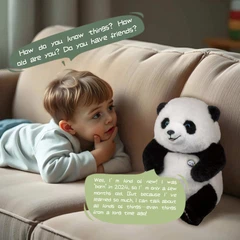
In 2026, the rope was gone. Three booths in Hall 8.1 were showing AI plush toys with working voice interaction. Children were walking up and talking to them. The toys talked back. In Mandarin. In English. In Arabic. No demo script. No handler with a laptop.
What changed between 2025 and 2026:
Chip cost. The Jieli AC7911B at sub-USD 2.00 puts WiFi plus Bluetooth 6.0 plus a local wake-word engine onto a single QFN48 package. In 2025, that combination required two chips and a discrete audio codec. In 2026, it is one chip.
Voice model maturity. The wake word accuracy in a noisy exhibition hall was above 90 per cent. In 2025, it dropped below 70 per cent with background noise. The difference is the firmware. The Jieli SDK now includes pre-trained acoustic models that run on the chip's built-in matrix vector accelerator.
Content integration. The AI plush toys at CBME were connected to live cloud services. DeepSeek. Qwen. Doubao. Children asked "tell me a story about a dragon who is afraid of the dark" and the toy generated an original story in under 3 seconds. This was not a canned response. It was a live LLM call.
What buyers were asking at the booths:
"Can I change the voice personality?"
"What languages does it support out of the box?"
"How do I add my own story library?"
"Do I need a developer to set up the cloud connection?"
These are not hardware questions. These are content and branding questions. Buyers have accepted that the AI technology works. They are now asking how to make it theirs.
The Fix
If you are sourcing AI sound toys for Q4 2026, ask your factory three questions before you ask about price. One: which LLM does the platform connect to? Two: can you swap voice personalities without firmware changes? Three: what is the content update mechanism (OTA, SD card, USB)? The hardware is solved. The differentiation is in the content pipeline.

2. Local AI Without Cloud Dependency Became a Selling Point
The Scenario 🎯
A European distributor stopped at our booth and asked a question I heard five more times that day: "Can this work without an internet connection?"
The answer in 2025 was no. The answer in 2026 is yes, for a defined set of functions.
The Jieli AC7911B has a built-in matrix vector accelerator capable of roughly 300 million 8-bit multiply operations per second. That is enough to run a 100-phrase wake word engine, a basic intent classifier, and a local text-to-speech engine simultaneously. No cloud connection. No API cost. No GDPR paperwork for voice data leaving the device.
What local AI means for sound toys:
Local wake word and command recognition -- The toy understands "play a story," "sing a song," "tell me a joke," and "goodnight" without any internet connection. Accuracy above 90 per cent in quiet rooms, above 85 per cent with background TV noise.
Local TTS for scripted content -- The toy can read a pre-loaded story with natural prosody using a lightweight neural TTS engine. This is not as expressive as a cloud LLM but costs zero per query.
Hybrid architecture -- The toy uses local AI for everyday interactions (80 per cent of usage) and connects to the cloud for open-ended conversation (20 per cent of usage). This cuts cloud API costs by roughly 80 per cent while keeping the "wow" factor of generative AI.
What buyers were asking:
"Does the local mode work in German?"
"How many phrases can the wake word engine handle?"
"Can parents disable the cloud connection?"
"What happens if the WiFi drops mid-conversation?"
The Fix
Specify local-first architecture in your product requirement document. A toy that requires a constant WiFi connection to be useful is a returned product. A toy that works offline for 80 per cent of functions and connects to the cloud only when a child asks an open-ended question is a product that stays in the home. The chip can do both. Make sure your factory configures it that way.

3. Buyers Asked About Integration, Not Hardware Specs
The Scenario 🎯
At CBME 2025, buyers walked up to factory booths and asked: "What chip does this use?" "How many milliamps?" "What is the BOM?"
At CBME 2026, the questions shifted. "Can you connect this to our existing app?" "Do you provide the firmware SDK or just the hardware?" "How do we load our own audio content?" "What is the OTA update process?"
This is a fundamental change. Buyers are no longer evaluating a component. They are evaluating a platform. They want to know how the toy fits into their existing software ecosystem -- their app, their content library, their cloud infrastructure, their user data pipeline.
The three integration questions every factory should be ready to answer:
Firmware SDK availability -- Does the factory provide a software development kit with API documentation, or just a compiled binary? Buyers with in-house development teams want the SDK. Buyers without development teams want the factory to handle firmware customisation. Both are valid. Neither should be a surprise.
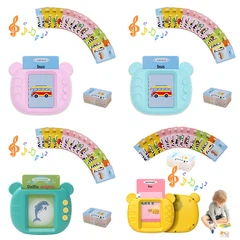
Audio content pipeline -- How does the buyer load their own stories, songs, and sound effects onto the device? USB mass storage drag-and-drop? SD card? OTA push from a cloud server? The answer determines the buyer's content operations workflow. Get it wrong and the buyer's audio team spends weeks re-encoding files.
App integration interface -- If the toy connects to a mobile app via BLE, what is the GATT service profile? What data does the toy expose to the app? Can the app trigger OTA firmware updates? These questions should be answered in a one-page protocol document, not a 10-email thread.
What this means for the industry:
The factories that win in 2027 will be the ones that ship a hardware platform plus an integration document. Not a box of assembled units with a packing slip. A product. A platform. An SDK.
At XDT, we started building this documentation layer six months ago. Every product we ship now comes with a pin mapping spreadsheet, a BLE protocol document, an audio specification guide, and a firmware flashing procedure. The buyers at CBME confirmed we were right to invest there. The ones who only had a price list had shorter conversations.
The Fix
When you request a quote from a factory for an AI sound toy, also request the integration documentation. If the factory cannot provide a pin map and a protocol document, they are selling hardware. You need a platform. The difference is not the chip. It is the paperwork.

THE COMMON THREAD
CBME 2026 was not about new technology. The technology was already here in 2025. What changed is that the technology became a product.
In 2025, AI sound toys were a proof of concept. In 2026, they are a shelf-ready category. The chips are cheap enough. The voice models are accurate enough. The cloud connections are stable enough. The last piece -- the integration documentation, the SDK, the protocol spec -- is what separates a component supplier from an ODM partner.
The buyers who understood this at CBME were not the ones looking at price lists. They were the ones asking questions about SDKs and OTA pipelines and BLE profiles. They were the ones who will be on shelf by Christmas. 🔧
WHAT THIS MEANS FOR YOUR NEXT PROJECT
Three questions to ask any AI sound toy factory before you place an order:
Does this product have a local mode that works without WiFi? If not, every dropped connection is a returned unit.
Do you provide a firmware SDK or just a compiled binary? If you have an in-house development team, you need the SDK. If you do not, confirm that the factory handles all firmware customisation in-house.
What is the content update mechanism? OTA, SD card, USB, or factory-flashed only? This determines your content operations for the entire product lifecycle.
IF YOU ARE SOURCING AI SOUND TOYS FOR Q4 2026
Send me your product concept and your software requirements. I will tell you which of our platforms supports local AI, which LLMs they connect to, and what the integration documentation looks like -- before you place an order.
LET ME HEAR FROM YOU
Did you attend CBME 2026? What trend did you notice that I missed? Or are you planning your first AI toy order and want to know where to start?
Drop your thoughts below.
#CBME2026 #AIToys #SoundToys #EducationalToys #ToyTrends #SmartToys #ChildrensToys #ShenzhenFactory #OEM #ODM #Jieli #EdgeAI #VoiceAI #ToyManufacturing