

A Kids Story Projector for Every Age and Room: An Age-Stage Buyer's Guide
A Story Projector Earns Its Place by Growing With the Child
Most children's electronics are built for one moment and then quietly outgrown. A story projector is different when it is designed as a platform rather than a single toy. The same optical engine that amazes a two-year-old with floating colors can, a year later, carry a three-year-old through a first real narrative, and a year after that, help a five-year-old ask "why is the sky dark" under a projected galaxy. For a brand or importer, that growth path is the product's real value: one SKU that stays relevant across the fastest-changing years of a child's life, with content - not hardware - doing the heavy lifting.
This guide does not re-explain what a story projector is or how the optics work; the basics are well covered elsewhere. Instead, it maps the category to the two questions buyers actually face: which ages should this product target, and which rooms or settings will it actually live in. Answer those, and the specification, the content plan, and the packaging all fall into place.

Ages 2-3: Color, Light, and the First "Story"
The youngest users are not following plots; they are meeting light, scale, and sound for the first time. At two and three, a story projector's job is to make the ceiling a place of wonder - slow-moving shapes, a warm voice, a predictable routine that signals sleep is coming. The content here should be almost wordless: animals, vehicles, simple nature, gentle music. The "story" is the experience of watching something big and soft appear above the crib.
For the buyer, this stage sets the safety and simplicity bar. The device must be intuitive enough that a toddler can start it with one button or one disc, and calm enough that parents trust it at bedtime. Volume limits and eye-safe diffuse light are not features here; they are the entry ticket to the nursery channel.

What Sells at This Age
A toddler does not read the box. They point at the glowing shape, and the parent reads the child's face. The winning unit is the one whose images are recognizable at arm's length on a ceiling and whose voice is soothing on first play - not the one with the longest feature list.
The Routine Hook
At 2-3 the projector is bought for the bedtime ritual as much as the content. A consistent "lights down, disc in, story on" sequence is what turns a purchase into a nightly habit, and a habit is what turns a SKU into a reorder.
Ages 3-4: Characters, Sequence, and "What Happens Next"
By three and four, children want sequence. They begin to expect a beginning, a middle, and an end, and they ask the question that defines this stage: "what happens next?" A story projector earns its place here by pairing the projected image with a narrated arc - a little bear who loses then finds, a seed that becomes a tree. The picture on the ceiling is no longer just pretty; it is a frame the child returns to night after night.
This is also where character attachment forms. A repeated narrator voice and a recurring set of figures become "friends," which is exactly why content libraries matter: the more titles a child can choose between, the more the projector feels personal rather than generic. For a retailer, titles at this age drive the second and third purchase.
Ages 4-5: Themes, Questions, and Early Learning
The oldest preschoolers turn the projector into a small classroom of their own. Space discs prompt "how far is the moon," nature discs prompt "why do leaves fall," and number or alphabet discs turn wind-down into quiet practice. The device does not need to quiz the child; simply hearing themed vocabulary in a calm setting plants the words they will later use at school.
At this stage independence becomes the differentiator. A four- or five-year-old can choose a disc, start playback, and dim the room themselves. Buyers should look for controls simple enough for small hands and content labeled clearly enough that a child can pick "the space one" without adult help - because the product that a child can operate alone is the one that survives sibling rivalry and busy parents.
From Entertainment to Confidence
The quiet win at 4-5 is agency. A child who can run their own story time is practicing decision-making and sequencing every night, with no screen and no algorithm in the way. That is a story a buyer can tell a parent with conviction.
Theming for the Market
Regional interests vary: space and dinosaurs travel well almost everywhere, while local folklore and bilingual narration open specific channels. The hardware stays constant; the discs do the localization.

Why Projecting Upward Beats a Screen at Wind-Down
A tablet faces the child and asks for attention; a projector faces the ceiling and asks for stillness. That single design choice is why the format fits bedtime better than any glowing rectangle. The light lands on a passive surface and reflects softly back, so nothing shines directly into the eyes, and the child looks up and relaxes rather than leans in and wakes up. The darkened room plus a slow image plus a calm voice is a sleep cue, not a stimulant.
For the buyer, "projects upward, not into the face" is a shelf message that needs no explanation. Parents already understand the difference between a screen and a ceiling of stars. The product simply has to deliver it consistently - diffuse optics, capped brightness, and a timer that lets the room go dark on its own.
Scenario - The Nursery Bedtime Ritual
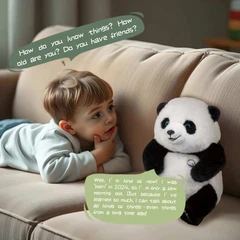
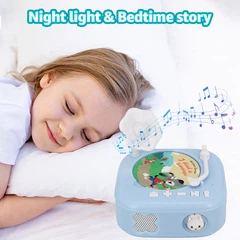
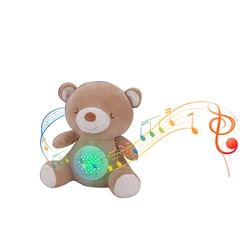
The nursery is the home base of the category, and the strongest use case is the one parents repeat 365 times a year. Here the projector competes not with other toys but with the struggle of getting a child to sleep. The ideal nursery unit is plugged-in friendly or long-battery, sits stably on a dresser or shelf, and offers a sleep timer so the story fades instead of cutting off. Paired with a plush companion, it becomes the "calm corner" of the room.
Buyers specifying for this scenario should prioritize stable placement, a wide-enough throw for a low shelf to reach a standard ceiling, and a disc set themed around sleep, lullabies, and gentle nature. The goal is monotony in the best sense: the same soothing loop, every night, with zero effort from a tired parent.
Scenario - Travel, Car Rides, and Sleepovers
The second home of a story projector is everywhere the child is not at home. A palm-sized, battery-powered unit that throws a story onto a tent ceiling, a hotel wall, or the back of a car seat extends the bedtime ritual past the nursery and keeps a frightened or overstimulated child anchored to something familiar. This is where the category stops being a bedroom gadget and becomes a travel essential.
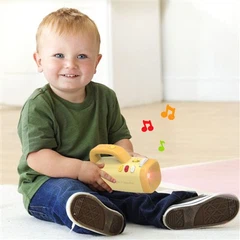
For this scenario, compactness and battery life outweigh optical throw distance. Buyers should look for a unit that survives a backpack, charges on the same cable as everything else, and ships with a couple of universal discs - animals, stars - that need no translation. The flashlight-style variants fit here naturally, doubling as a reassuring night light on the way to the bathroom.

The Familiar in the Unfamiliar
A child away from home will accept a stranger's bed far more easily if the same story appears on the ceiling. For a brand, that emotional job - continuity of routine - is what makes the travel unit a gift parents actually pack.
One Cable, One Language
Travel buyers hate proprietary chargers. A USB-C or Micro-USB rechargeable unit that shares a cable with the phone already in the bag removes the most common reason a travel toy goes dead on day two.
Scenario - Preschool Circle Time and Language Groups
In a classroom or library setting, the projector becomes a shared object rather than a personal one. A teacher dims the lights, projects a story onto the wall, and a circle of children follows the narration together - a low-cost way to add an audio-visual moment without handing a screen to every child. For language groups, discs in the target language turn the same device into repetition practice that does not feel like a lesson.
Buyers serving education channels need brighter, room-scale projection and louder, cleaner audio than the nursery unit, plus disc libraries organized by theme and language rather than by bedtime. Durability and simple teacher controls matter more than cute shell shapes. The pitch is not "a toy" but "a calm group activity tool."
Group-Scale Optics
A wall in a classroom sits farther from the device than a nursery ceiling, so education buyers should specify a longer throw and higher output - while still keeping the light diffuse and the volume classroom-appropriate.
Disc Libraries by Theme
Where the home buyer wants sleep discs, the teacher wants a map of the week: ocean, farm, space, alphabet. Bundling discs by theme, not by character, is the education-channel unlock.

Scenario - Hotel and Branded Kids' Amenity
A newer, higher-margin use case is the projector as a hospitality amenity. Family hotels, airlines, and restaurant chains hand a child a small projector - or place one in the room - as a branded wind-down gift. Because the device is screen-free and calming, it fits a "we thought about your kids" message without the baggage of handing a child a tablet. For the brand behind it, every loaned or gifted unit is a quiet advertisement on a bedroom ceiling.
Buyers in this channel care about branded shells, custom disc content (a hotel's own mascot story), and bulk-ready packaging more than about age staging. The specification is simpler - one universal disc, one friendly shape - but the customization and volume expectations are higher.
The Disc Library as a Growth Engine
If the projector is the platform, the disc library is the subscription that never bills. Each new title is a reason to come back, and because discs are cheap to produce and easy to localize, the same hardware can keep selling for years. The art is in mapping the library to the ages above: sleep and sensory discs for 2-3, character arcs for 3-4, themed learning for 4-5, and universal travel discs that work anywhere.
Buyers should ask suppliers not just "how many discs" but "how is the library organized" - by age, by theme, by language - because a well-structured library is what lets one projector serve a child from toddler to preschooler. A scattered catalog of unrelated titles ages faster than the hardware does.

Content Is the Moat
Any factory can mold a projector shell. Few can ship a coherent, age-mapped disc library with clean narration in the languages your market needs. That content depth is what separates a hero SKU from a me-too gadget.
Localize the Library, Keep the Shell
The efficient path is one physical product and many localized disc sets. A buyer entering three markets does not need three tools; it needs three libraries and one competent audio pipeline.
What to Check When Specifying Per Scenario
The same category serves very different buyers, so the specification checklist should follow the room, not the brochure. For nursery units, confirm stable placement, sleep timer, and eye-safe diffuse optics. For travel, confirm battery life, size, and a shared charging cable. For education, confirm throw distance, output, and theme-organized libraries. For hospitality, confirm branding options and bulk packaging. Across all four, insist on volume limits for young ears and the relevant toy-safety marks for your destination market.
A useful discipline is to write the scenario on the purchase order before the features. "Nursery, EU, sleep-themed, 1000 units" tells a supplier far more than "a story projector," and it prevents the classic mistake of shipping a bright, short-throw gadget to a buyer who needed a dim, long-throw classroom unit.
FAQ - Kids Story Projector by Age and Room
Can one story projector really suit ages 2 through 5? Yes, if it is treated as a platform: the hardware stays constant while the disc library shifts from sensory content at two to themed learning at five. The projector does not outgrow the child; the content does the growing.
Is a ceiling projector better than a screen for bedtime? For winding down, generally yes. Light reflects off the ceiling rather than shining into the eyes, the room stays dark, and a calm voice plus slow images reads as a sleep cue rather than stimulation - which is the opposite of what a tablet does.
What should a travel version prioritize? Size, battery life, and a shared charging cable. Throw distance and optical finesse matter less on a tent or hotel wall than simply being small, charged, and unbreakable in a backpack.
How do education buyers differ from home buyers? They need longer throw, louder clean audio, and disc libraries organized by theme and language for group use, plus teacher-simple controls and tougher build - not cute bedtime shells.
Why does the disc library matter so much? Because it is the repeat-purchase engine and the localization layer. A coherent, age-mapped library lets one projector stay relevant for years and enter new markets without new tooling.
What safety points apply across every scenario? Volume limits appropriate for young ears, diffuse eye-safe optics, and the toy-safety certifications required in your destination market. The room changes; those basics do not.