



AI PaPa Panda – Your Companion Life, From the First Blink to Lights Out
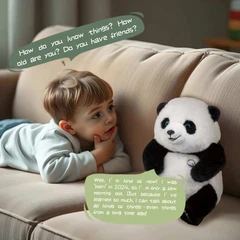
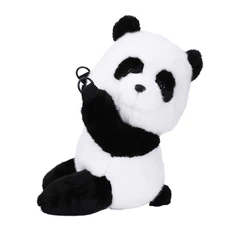
Details: The AI PaPa Panda is a plush panda with a conversation model inside it. It connects over its own 4G link rather than through a paired phone, blinks, answers when its head is touched, plays feeding sounds when the bottle is offered, repeats what it hears, and uses a gyroscope to notice when it is picked up or turned. The body is a 50 by 40 by 15 cm panda in 100% polyester fibre over PP cotton, with the mechanism sealed inside, and it charges over Type-C from a 400 mAh cell. What that adds up to is not a toy that performs a trick once, but an object that is present through a day – waking, answering, being carried, being fed and finally settling. A companion product lives or dies on whether it is picked up on the second day, and the design decisions below are made for that second day. Orders start at 1,000 pcs, and a 200 to 500 unit run is available as a first test of an audience.
Key Product Selling Points
Details: A companion is judged by the small moments, not by a feature list. The seven below are the ones that make the panda feel alive across an ordinary day, and each is a design choice a buyer can specify.
The First Blink
The eyes blink, and that single motion does more for the sense of life than any voice line. A still plush is furniture; a plush that blinks is something a child checks on, and checking on something is the beginning of a relationship. It is also the cheapest form of presence in the whole product, which is why it belongs at the top of the list rather than buried in the specifications.
The Conversation
Ask it something and it answers, because the model runs behind a 4G link rather than a paired phone. That matters in practice: a child, a grandparent or a guest can talk to the panda without anyone setting up an app first. The answers are short and spoken, which suits a companion – the point is the exchange, not a lecture, and a reply that arrives in a sentence keeps the conversation going.
The Touch on the Head
A hand on the head produces a sound, and the sound is chosen to feel like a response rather than a sound effect. That is the physical half of companionship: the panda reacts to being touched, so a child learns to be gentle and learns that gentleness gets an answer. For an older user, the same gesture is a simple, wordless way to make something happen in a room that is otherwise quiet.

The Feeding Ritual
The bottle turns care into a game. Offer it and the panda responds with feeding sounds, so a child practises looking after something rather than only being looked after. That reversal is unexpectedly powerful: it gives a small person a role, and it gives a shy or anxious child a script for interaction that does not depend on finding the right words.
The Repeat Game
It copies what it hears, which is a game children never seem to tire of and adults quietly enjoy too. The repeat mode is the simplest way to make a plush feel responsive without asking it to understand anything, and it works in any language because it is only echoing the room. For a buyer, that is a feature that photographs well, demonstrates instantly and needs no explanation.
The Tilt and the Turn
A gyroscope notices which way the panda is facing and answers with a sound effect, so picking it up, turning it round or laying it down all produce a reaction. That small piece of physical awareness is what stops the object feeling like a speaker in a bag. It turns handling into play, and handling is how a companion ends up in a child's arms rather than on a shelf.
Lights Out
At the end of the day the panda is still blinking softly, which gives a dark room a small, familiar point of life. It is the moment the product stops being an activity and becomes company, and it is the reason a companion plush survives past the first week. A child who says goodnight to something is a child who will pick it up again tomorrow.
In short: it blinks in the morning, answers in the afternoon, gets fed, gets carried, copies a joke and is still there at lights out – and that ordinary day is the whole product.
What Companion Life Actually Means
Companionship is an odd product category because the buyer and the user are rarely the same person. A parent buys for a child who will not articulate what they want; an adult buys for a grandparent who would never ask for a robot; a friend buys for someone living alone. In each case the purchase is really an answer to a quiet worry – that a child is on a screen too much, that an older relative is alone in the afternoon, that a house is quiet in a way nobody talks about. A plush panda is a socially acceptable way to put something warm into that gap.
The object works because it is not a device. Nobody has to learn an interface, charge a second phone or explain an app to a grandparent; the panda is picked up, spoken to and put down. That low threshold is the reason companion plush has become one of the more durable ideas in the AI toy market rather than a novelty: the technology is impressive for a week, but the fur, the blinking and the weight in the arms are what keep it in the room.
For a distributor, the category also has an unusual spread of buyers. The same product is sold as a children's companion, a gift for an older relative, a hospital or care-home comfort object and a retail impulse item, and each of those channels accepts the same panda with a different box and a different story. Few products cross that many shelves without a redesign, which is why a companion plush is worth a line of its own.
How the Panda Hears, Thinks and Answers
The conversation runs on a model reached over the panda's own 4G link, which is the detail that makes it usable by people who are not comfortable with phones. There is no pairing step and no app to open: the plush is switched on, spoken to, and it answers. For a child that is simply how a toy works. For an older user it removes the single barrier that usually stops a connected product from being used at all.
Answer length matters more than raw capability in this format. A companion that delivers a paragraph feels like a lecture, and one that delivers a sentence feels like a reply, so the spoken answers are kept short and conversational. The same principle applies to the delay: a pause of a second or two reads as thinking, while a long silence reads as broken, which is why a companion product is judged on latency as much as on the model behind it.
The third piece is what the buyer controls. The content, the voice and the package can all be produced to order, and a brand that operates the service can set the tone, the language and the boundaries of what the panda will discuss. That last point is not a technical footnote; for a school, a care provider or a brand with a family audience, the ability to define the conversation is the difference between a product that can be sold responsibly and one that cannot.
Product Parameter
| AI PaPa Panda – Specification and Ordering (PT-005) | |
| Item | AI PaPa Panda / PT-005 |
| Conversation | An AI conversation model that answers aloud, kept short and conversational |
| Connectivity | A wireless 4G model that connects on its own, with no phone pairing and no app to open |
| Eyes | Blinking eyes that give the plush a sense of life |
| Touch | Head touch produces a sound response |
| Feeding | A feeding bottle is included and triggers feeding sounds |
| Repeat | A parrot mode that copies what it hears |
| Motion | A gyroscope senses direction and answers with a sound effect |
| Materials | 100% polyester fibre over 100% PP cotton filling, with the mechanism sealed inside |
| Power | 400 mAh cell, recharged over Type-C |
| Body Size | 50 × 40 × 15 cm |
| Gift Box | 40 × 26 × 15 cm |
| Unit Weight | 900 g |
| Export Carton | 12 pcs per carton – 83 × 53 × 48 cm, 13 kg actual (43 kg dimensional) |
| Compliance | CE, UKCA, FCC and RoHS files with CPC; EN71 and ASTM F963 reports issued when a market requires them |
| Minimum Order | 1,000 pcs; a trial run between 200 and 500 units is possible |
Tell us the audience, the voice you want the panda to speak in and the box you want it to arrive in, and we will come back with a content brief, a sample plan and the production slot your launch needs. Send the brief to the export desk by email, or through the enquiry form. Related AI plush and companion models are listed at: https://www.kidsoundbook.com/products
The Design Language of a Companion
Almost every decision that makes the panda feel alive is physical rather than digital. The size is chosen so a child can hug it and an adult can rest it on a lap; the weight is enough to be felt but light enough to carry; the fur is a soft polyester pile that survives being dragged around; and the mechanism is buried deep enough in the PP cotton that the plush still gives when squeezed. None of those things appear in a feature list, and all of them decide whether the object is kept.
The face does the rest of the work. Eyes that blink turn a stuffed shape into something that seems to be looking back, and the effect is strongest in a dim room where the movement is the only thing happening. That is also why the panda works at night: a plush that blinks in the dark is company, whereas a plush that is silent and still is a cushion. A buyer specifying a companion should treat the eyes as a headline feature, not a detail.
The interactive gestures are deliberately small. A touch on the head, a bottle offered, a tilt, a repeated phrase – each is a simple physical act with an immediate, understandable response. That consistency is what teaches a user, of any age, what the panda can do without a manual. A companion that requires instruction is a gadget; one that reveals itself through touch is a friend.
| Who the Panda Is For – Four Buyers and What They Get | ||
| Buyer | What the Panda Does for Them | What Sells It |
| A parent, for a child | Answers questions, plays the feeding and repeat games, blinks at bedtime | A companion that is not another screen in the house |
| An adult, for an older relative | Talks without an app, responds to a touch, keeps a quiet room company | No setup barrier and no phone required to use it |
| A gift buyer | Sits in a colourful box and works the first time it is switched on | An unusual present that photographs and demonstrates well |
| A care home or hospital | Offers a calm, repeatable point of contact in a shared room | A soft, simple object that needs no supervision to operate |
The four rows also show why one product can hold several listings at once: the panda itself never changes, and the box, the voice and the story around it are what make it a child's toy, a family gift or a care-room companion.
Quality Inspection


Production Process
Our Service
A companion product is half plush and half service, so the route from an idea to a box has to cover both. Here is what each stage involves.
Requirement Communication
We agree first on the audience, the character, the voice, the tone of the conversation, the language and the box. Those points are written into a brief both sides sign before a sample is sewn, so the personality is decided on paper rather than discovered at the end.
Character and Voice Development
The plush is sampled in fabric and proportion, and the voice is recorded or generated to the persona agreed with the buyer. The replies are written short, the boundaries of what the panda will discuss are set, and the language is confirmed so the companion sounds right for its market.
Sample Confirmation
You receive a working panda – sewn, connected and talking – so the fur, the blink, the touch response and the conversation can all be judged in the hand. Sign-off is taken in writing first, and nothing is produced until that signature is on file.
Pre-production Sample
The earliest units from the run are kept as the standard for the product. Later batches are checked against them on fur, seam, blink and voice, so a reprint matches the panda that was already approved.
Bulk Production
The plush is cut and sewn, the mechanisms are fitted and tested, and the sets are boxed with the bottle and the cable. Output is logged and can be reported to you, which matters when a companion is tied to a gifting season.
Inspection, Documents and Dispatch
Finished sets clear a last check on fur, blink, voice, contents and carton marking, and the documents for each destination are prepared to match the batch. The line can be inspected in person, or watched on a live call, before the order ships.
Customization Information
A companion is a character as much as a product, so most of what makes one brand's panda different from another's sits in the plush, the voice and the box. The list below can all be made to order, and any change that adds tooling or a certificate is flagged before the order is locked.
FAQ – Frequently Asked Questions
Q1: Does the panda need a phone or an app to work?
No. It is a wireless 4G model, so it connects on its own rather than through a paired phone, and there is no app to install before it can be used. Switch it on and it is ready; that is the point of the format for a grandparent, a guest or a child who does not have a phone. The box and the leaflet are the only setup a buyer has to explain.
Q2: What can the panda actually talk about?
It holds a short spoken conversation: a question in, a conversational answer out. The replies are kept brief on purpose, because a companion that lectures feels like a device and one that answers feels like company. The tone, the language and the boundaries of what it will discuss are set with the buyer, so a family brand and a care provider can each define the personality they are willing to stand behind.
Q3: Is it only for children?
Not at all. The design travels well to older users, because the interaction asks for nothing but a voice and a hand: no app, no account, no menu. A plush that answers when spoken to and responds when touched is a socially acceptable companion for someone living alone in a way that a screen-based assistant is not. The same unit serves a child's play, a family gift and a care-room companion.
Q4: What happens where there is no 4G signal?
The physical responses are built into the unit: the blink, the head touch, the feeding sounds, the repeat mode and the motion effect do not depend on the network. The spoken conversation runs over the 4G link, so in a place without a signal the panda still reacts to touch and play but cannot hold a conversation until the connection returns. A buyer should describe that plainly on the pack rather than leave a customer to discover it.
Q5: Can we control what the panda says?
Yes, within the service the buyer operates. The voice, the tone, the language and the boundaries of the conversation are agreed at the order, and a brand that runs the service can keep the panda inside the character it has promised. For a school, a care provider or a family brand, that control is not a technical extra; it is the condition on which the product can be sold responsibly.
Q6: Can one order cover several characters or markets?
Yes. The plush can be built as a different animal or in a different colour for another brand, and the voice and language can be set per market, so one programme can serve several listings. The editions are kept apart at packing and each carton is marked to match, which lets a distributor receive a mixed programme without opening every box.
Q7: How large a run can we start with, and how do samples work?
Production starts at 1,000 units, and a trial batch of 200 to 500 can be arranged for a first market or a pilot channel. A working panda – sewn, connected and talking – is supplied for judgement first, and the sample cost is credited against the production order. Because the plush carries the mechanism, a new character is a sampling job rather than a long engineering programme.
Q8: Where is the panda made, and can we visit?
The plush, the mechanism and the packaging are produced at a single site in Shenzhen, which matters for a companion because the fur, the blink and the voice have to arrive consistent across a run. Buyers may visit the plant in person or view the line on a video call, and every carton carries a traceable batch record.
Company Introduction
for children
Xinditai Electronics has been making children's audio and companion products in Shenzhen since 2010, largely through OEM and ODM programmes for plush devices, story players, talking cards, sound books and projection toys. Its buyers include toy brands, gift companies, care providers and distributors in many markets. AI plush is a growing part of that work, which is why the plush, the mechanism and the voice are prepared by one team and checked together.
A workshop of about 3,000 square metres covers sewing, moulding, board assembly, voice recording, acoustic testing and packing, staffed by more than a hundred engineers and operators. Each stage signs off before the next one starts, and every batch keeps a record that links it back to the order. A plant visit, or a live walkthrough of the line, can be arranged before a run is committed.

Certifications
Certificates
The plush and the mechanism inside it ship as one product, so the document pack is assembled around the unit in the order and prepared for the destinations named. Certificates stay valid and are issued alongside each batch, and a complete set can be sent with the quotation.

CE

RoHS

FCC

SEMTA

EMC

ISO
Hot Tags: ai papa panda – your companion life, from the first blink to lights out, China, suppliers, manufacturers, factory, customized, wholesale, bulk, quotation, made in China


