




Kid Talking Flash Cards Machine – One Body, Eight Language Markets, One Order Code
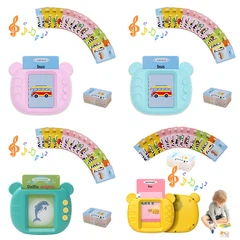
Details: An importer seldom opens a single market at a time. The buyer who lists a product in one country is already looking across the nearest border, and the language a family speaks at home is the first thing that changes between the two. The Kid Talking Flash Cards Machine, model FC 001, is built around that fact: a 99 × 86 × 21 mm reader weighing 285 g, with one card slot, three function buttons for ON/OFF, repeat and volume, a 28 mm speaker, 16M of memory and a 200 mAh cell recharged over USB. The language is not fixed when the tooling is cut; it is chosen when the order is written. Narration, the printed word on each card and the wording on the pack are set per destination, while the shell, the slot and the board stay exactly where they are. Standard runs open at 1,000 pcs, and trial builds of 200 to 500 units are available for a market test.
Why the Language Is a Setting, Not a Second Product
Most talking toys treat a new language as a new product. A change of market means a change of version, a change of packaging line and usually a fresh round of type testing, so the second country costs almost as much to enter as the first. This reader takes the opposite position. Language sits on the configuration sheet rather than on the tooling order, which turns a market decision into a paperwork decision.
The hardware is deliberately market-neutral. The shell a child holds in one capital is the same shell a child holds on another continent, and the card slot accepts the same card stock for every edition. The parts that are customised per destination form a short and predictable list: the voice the machine speaks with, the printed word on the face of each card, and the language printed on the box and its insert. Everything else, from the three function buttons to the 28 mm driver and the rechargeable cell, is settled once and then left alone.
That division is what allows one product code to answer several storefronts. A distributor can commit to a single hardware line and then switch the language pack the way a bookseller switches a title: the same shelf, the same fixture, a different set of words. The purchase order, the freight calculation and the compliance file barely register the change, because all three describe the machine rather than the narration.
It is worth being precise about what a language market actually is, because buyers sometimes confuse it with a country. One country can contain more than one language community, and one language can span many countries. Spanish is sold into Europe and into Latin America, while Arabic reaches across North Africa and the Gulf. Each of those is a configuration this reader can carry, which is why the model is organised around language pairs rather than around national flags.
The practical effect on a range plan is a change of habit. A buyer stops counting product lines and starts counting order codes: one body, several narration builds, and a pack that names the language on the front. From here on, the question is not whether the product can be localised but which handful of decisions actually move between markets.
It is worth separating a language build from a redesign of the whole product, because the two are often confused. Nothing in the electronics, the dimensions or the safety case is tied to a language, so a distributor is not reopening compliance when a new narration is added. The build sheet changes; the type test does not. The same carton measurements and the same 40-unit packing apply from one market to the next, which keeps freight predictable no matter how many languages a range eventually carries.
Kid Talking Flash Cards Machine – Localisation Sheet (FC 001)
| Kid Talking Flash Cards Machine – what is fixed and what is set per market (FC 001) | |
| Item | Kid Talking Flash Cards Machine / FC 001 |
| Fixed Across Markets | The moulded shell, the single card slot, the board, the three function buttons and the rechargeable cell |
| Set Per Destination | The narration language and accent, the printed word on the cards, and the language on the box and insert |
| Language Pairs | English / Chinese, English / Spanish, English / French, English / Arabic, English / German, English / Japanese, English / Korean |
| Card Library | 14 themes, 112 cards, 224 words; the deck is rebuilt around the chosen language |
| Controls | Three buttons – ON/OFF, repeat, volume |
| Speaker | 28 mm driver tuned for single-word clarity |
| Memory | 16M on-board, loaded with the audio for the selected language build |
| Battery & Charging | 200 mAh lithium cell, rechargeable over USB |
| Unit Size | 99 × 86 × 21 mm |
| Gift Box | 130 × 95 × 45 mm |
| Unit Weight | 285 g |
| Carton Configuration | 40 pcs per carton / 29.5 × 27.5 × 40.5 cm |
| Carton Weight | 12.5 kg |
| Compliance | CE, UKCA, FCC, RoHS and CPC; ASTM F963 / EN71 reports available on request |
| Order Quantity | 1,000 pieces per run; trial builds of 200 to 500 units negotiable |
Name the destination, the language pair you intend to open with and the quantity you are planning, and the language pack list, the card artwork template and the carton plan come back together as a single file. Commercial terms, samples and the current build sheet travel with it. The rest of the range is indexed here: https://www.kidsoundbook.com/products
Six Localisation Decisions, Plus the One That Keeps a Market Warm
Details: Localising this reader is not a redesign. It is a series of small, separate choices, each one made before production and each one confined to the content and the pack. These are the six that buyers work through when they prepare a new destination.
The Language Pair as a Line Item
Start with the pairing, because it drives everything downstream. A market that teaches a second language early will want English paired with the local tongue, so one picture is named twice on the same card. A market buying the reader as a first-words toy may want the local language alone. Both are ordinary configurations of the same unit, and both are settled before a single card is printed.
The Narrator and the Accent
A language is not finished until you decide how it is spoken. Two markets that share a written language may still expect different accents, and a child copies the model voice closely, so the recording is cast to match the destination rather than left neutral. The narration can be a single clean voice or a pair, one speaker per language, depending on how the deck is meant to be used.
The Printed Word on the Card
The card carries the word as text as well as audio, so the script and the typeface belong to the localisation. Some languages need more glyphs than others, and some read in a direction the artwork was not drawn for. The card template absorbs those differences without touching the slot, because the card stock and its dimensions are unchanged from one build to the next.
The Language on the Box and Insert
The pack is the part a shopper reads before the product speaks, so it has to be in the market's own language. The 130 × 95 × 45 mm gift carton and its insert can both be re-set per destination, which also gives a distributor the option of adding regulatory text and importer details where local rules require them. The box is a print job, not a new mould.
The Market Test Build
A new language is a hypothesis until it is on a shelf. A trial build of 200 to 500 units lets a distributor prove that the accent is right, that the word list matches how families actually speak, and that the pack copy lands, before committing to a full container. Because only the content changes, the test costs a small print and recording run rather than a new tooling spend.
The Second Market From the Same Code
Once the first destination is running, a second one is a new language build placed against the same hardware line. The distributor keeps one unit code and adds a variant for the narration and the pack, so warehouse staff pick by language rather than by product family. This is the step that makes a regional rollout feel like an extension rather than a launch.

The Build That Answers a Bilingual Home
The configuration that keeps a market warm is the paired build kept in reserve. Households that mix two languages often buy the second pairing after they own the first, because the same reader can be re-voiced to name each picture twice. For a distributor this is a repeat order that needs no new product story, only an additional language pack against a machine the customer already trusts.
Who Orders a Multi-Language Build – Six Buyer Profiles
Several kinds of buyer need the same body to speak more than one language, and each one phrases the request differently. Knowing which profile you are talking to shortens the specification conversation considerably.
When Each Language Build Sells – A Window and Market Table
| Window and market calendar – which language build to have ready | ||
| Window | Market It Serves | Language Build to Have Ready |
| Fourth-quarter gifting | Gift retail and online, several countries | Local-language pack per storefront, plus one paired bilingual edition |
| January intake | Language schools and tutoring chains | One fixed pairing, cast to the local accent, with teacher-facing box copy |
| Back to school | Preschool and primary suppliers | Curriculum-aligned deck in the local language, cartons kept intact |
| Spring gifting | Gift, premium and promotional buyers | Market-language pack with room for a branded insert card |
| Ramadan and Eid | Gulf and North African retail | Arabic paired build, local pack copy, stock landed ahead of the holiday |
| Summer travel | Travel retail and family venues | Two or three narration variants for the languages that pass through |
| LatAm school cycle | Latin American importers | Spanish paired build with a regional accent and local pack wording |
Two habits hold a multi-market range together. First, keep the language list short and deliberate – three or four well-chosen builds keep pack artwork, warehouse picking and listing copy under control. Second, lock the pairing before the pack artwork, because the language on the box has to name the language on the cards. The reader itself asks for nothing in either case, so a market can be added, paused or retired without touching the machine that carries it.
The B2B Case for a Configurable Reader
A reader that speaks one language has one market. Everything below follows from changing that single fact, and each point shows up in the buyer's own numbers rather than in the specification sheet. The argument is about reach per unit of working capital, not about features.
| A configurable-language reader measured against a fixed single-language import | ||
| FC 001 as a configurable build | A fixed single-language import | |
| Markets reachable from one model | Several, chosen at order | One, fixed at tooling |
| Adding a second market | A new narration build and pack artwork | A new product line and a new compliance cycle |
| Warehouse complexity | One unit code, variants by language | One code per language, stocked separately |
| Pack and insert wording | Re-set per destination | Reusable only where the language already fits |
| Carton maths | 40 pcs at 12.5 kg for every build | Varies with the model in the container |
| Trial cost of a new language | A small print and recording run | A mould and a fresh test round |
We keep the claims narrow. This is a card-reading toy that speaks the word printed on each card, across 112 cards and 14 themes, in seven standard language pairs, with three physical buttons and no screen. Its advantage to a distributor is that the destination and the language are decisions rather than fixed features, and that no market depends on a separate copy of the machine.
From Destination to Sealed Carton – How a Language Build Runs
A first order for a new market follows a fixed sequence, and most of it concerns the content rather than the machine. The steps below show where the language is set, where the accent is fixed, and what each stage needs from the buyer.
| Localisation path – from destination to dispatch | ||
| Stage | What Gets Settled | Your Input |
| 1. Destination review | Countries, languages and regulatory expectations are mapped against the standard build | Target countries, age band and intended retail price |
| 2. Language pairing | One or more pairings are fixed and the word list is agreed for each | Language pairs and a vocabulary list, or approval of the default set |
| 3. Accent and voice | The narration is cast and paced to match how the market actually speaks | Dialect preference, narrator tone, single or paired voice |
| 4. Card text and artwork | Script, typeface and illustrations are proofed against the fixed card template | Supplied artwork, or a written brief for the studio |
| 5. Pack wording | Box and insert copy are set in the market language, including any importer details | Box copy, logo file and importer information |
| 6. Working sample | A reader loaded with the new build is assembled and shipped for approval | Sign-off on narration, card text and pack |
| 7. Pilot build | A short run proves the accent and the word list before the full commitment | Confirmation of the trial quantity |
| 8. Mass run and dispatch | The full build is produced, checked and packed 40 to a carton with its documents | Quantity, delivery window and carton markings |
The stage buyers most often rush is the accent. It is tempting to accept a neutral reading and move on, but a model voice that does not match the market is the one detail a parent notices first and a teacher never forgives. Approving the recording early, on the actual 28 mm speaker, avoids a re-record later. The second most common slip is pack wording: a box printed in the wrong language cannot be corrected at the port, so the insert and carton copy deserve the same review as the audio.
Questions Buyers Ask Before Localising a Range
Q1: Can one order serve several language markets at the same time?
Yes, within reason. The reader is the same object for every destination, so the difference between two markets is the narration and the pack rather than the machine. Most buyers split a run into two or three language builds and keep them physically separate from receiving onward, so a warehouse or a fulfilment partner cannot mix the cartons. Keeping the list to a handful of languages is what keeps picking, pack artwork and listing copy manageable.
Q2: What actually changes between one language build and the next?
Three things move, and they are best decided together: the narration language and accent, the printed word on each card, and the language on the box and insert. The illustrations usually survive unchanged, which is why the second market is cheaper to open than the first. In markets where a single picture can carry two everyday meanings, the artwork may be adjusted so that the child is not looking at one thing while hearing another.
Q3: Which language pairs are available, and can you add others?
The standard set pairs English with Chinese, Spanish, French, Arabic, German, Japanese or Korean, and English also stands alone. Further pairs are added as clients arrive, because the work is a recording and a print run rather than a hardware change. Tell us the market and the pairing, and the narration comes back cast to the way that market actually speaks, not to a neutral studio accent.
Q4: Does localising the language change the machine in any way?
No. The shell, the card slot, the board, the three function buttons, the 28 mm speaker and the rechargeable cell are identical across builds, and only the audio loaded into the 16M of memory and the printed content change. That is why one compliance file serves the whole language range and why a buyer never has to re-qualify the hardware when a new market is opened.
Q5: How is a language market tested before a full order?
With a small build. A trial of 200 to 500 units lets you put the accent, the word list and the pack copy in front of real customers before committing to a full container, at a per-unit cost that is credited back against the first full order. Because only the content changes, the test costs a short print and recording run instead of a tooling spend, so a wrong guess is cheap and reversible.
Q6: How large is a minimum run, and how does a sample build work?
A standard run opens at 1,000 pcs, and a market test can be placed from 200 to 500 units. One to five sample readers, loaded with your language build where needed, leave the plant within five working days of payment, and the sample charge is returned once the bulk order is confirmed. For a new destination we would rather you heard the narration on a real unit than judged it from a file.
Q7: Can we supply our own word list, artwork and pack copy?
Both, or either. Send a finished word list, artwork and pack copy and we check them for print legibility, playback and local requirements before anything is produced; or brief the studio and the deck comes back written, illustrated and recorded to your market. You decide how many themes sit in the box, how many cards each theme carries, and whether the deck leans toward vocabulary, phonics or everyday objects.
Q8: Where is the unit built, and is the process open to inspection?
Moulding, board work, card printing, voice loading, assembly, testing and packing all take place at our Shenzhen site, which means a change of language never waits on an outside supplier. Buyers are welcome to visit the plant or walk the lines over a live call, and every carton can be followed back to the batch that produced it. Nothing is subcontracted, and each language build leaves the same floor.
The Workshop Where Every Language Build Is Assembled
for children
The reader in this article is manufactured by Xinditai Electronics in Shenzhen, a factory that has been producing children's audio equipment since 2010. Over those years our work has settled into OEM and ODM programmes for talking flash cards, read-aloud books, story machines and interactive audio toys, built for brands, importers and retail groups on six continents.
Everything runs from a 3,000-square-metre site, where moulding, board assembly, card printing, voice loading, acoustic tuning and final packing share a single floor staffed by more than 100 engineers and operators. Each line follows one rule – Create with heart, ship with pride – and every language build clears its inspection gate before it is boxed, so a delivered reader can be traced back to the batch and the parts it began as.

Compliance Files, Matched to the Destination
Certificates
The document set is assembled for each destination before a shipment is booked and travels with the batch it describes. Ask for it with your quotation and the papers arrive together, ready to hand to an importer, a marketplace or a customs broker without a second exchange of emails.

CE

RoHS

FCC

SEMTA

EMC

ISO
Hot Tags: kid talking flash cards machine – one body, eight language markets, one order code, China, suppliers, manufacturers, factory, customized, wholesale, bulk, quotation, made in China


