


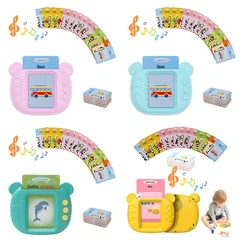





What Is a Flash Card With Drawing Tablet?

A flash card with drawing tablet is a single hand-held unit that carries two functions in one housing: a card slot that reads a printed card and plays the matching audio, and an LCD writing surface where the child traces or copies what the card has just said. There is no app to install, no account to create and no network to connect. A card goes into the slot, the word is spoken, and the writing panel beside the slot is where the answer goes.
The version we build as standard is the Kid Talking Flash Card With Drawing Tablet: 138 preloaded cards with capacity for 200 or more, six or more subject categories, Chinese-English bilingual audio with optional pinyin, an LCD writing board with a stylus, and a housing of roughly 25 x 18 x 3 cm. Cards are printed on 400gsm laminated paper that can be wiped clean. Audio is stored on the board itself, so a new card pack extends the programme without touching the firmware.
We are an OEM/ODM manufacturer of this platform rather than a reseller of it. Housing design, tooling, electronics, voice recording and card printing all sit under one roof in a 5,000 ㎡ factory, so a specification that looks fixed in a catalogue is usually still open for discussion when you place your first order.
How Does a Flash Card With Drawing Tablet Work?

Two questions decide most orders on this platform: what the unit actually does in a child's hands, and what you as the buyer have to approve before anything ships. The first is answered in the function list below; the second in Step A to Step E. The expensive mistakes are almost always approval-gate mistakes rather than feature mistakes.
How the Kid Talking Flash Card With Drawing Tablet Works: Functions in Detail
Function 1 - Card insertion and identification: A printed card is pushed into the slot and identified by an optical or contact route built into the housing. Playback starts from the audio stored on the board, with no pairing step, no network connection and no app. The card is the interface, so a child who can hold a card can run the unit.
Function 2 - Card set and subject coverage: The standard unit ships with 138 preloaded cards and carries capacity for 200 or more. Subject categories run to six or more - nature, everyday objects, animals, colours, numbers and body parts - and the category list is set by you before the print run, not after it.
Function 3 - Voice and language: Audio is bilingual Chinese and English as standard, with optional pinyin support. Voices are recorded by native speakers, and the platform has been produced in six languages: English, Chinese, Spanish, Arabic, French and Japanese. Language is a recording decision, so it is locked at the same gate as the card artwork.
Function 4 - LCD writing surface: The LCD writing board and stylus let a child hear a word and then trace or copy it on the same unit. One control clears the panel. There is no paper, no ink and no consumable to restock, which is the reason this surface survives a school term better than a workbook.
Function 5 - Audio path: A speaker and its rear cavity sit inside the roughly 3 cm-thick housing, so the acoustic volume is decided by the housing geometry and cannot be improved later by changing the speaker alone. Volume is stepped, and playback is local, with no streaming dependency.
Function 6 - Storage and updates: Storage in this product family runs from 4GB to 16GB. Content sits on the board and is extended by adding card packs, so refreshing a programme is a printing decision rather than a firmware project - and a second-season refresh stays out of the engineering queue.
Function 7 - Power: The platform can be specified with AAA dry cells or a rechargeable lithium pack. The compartment uses a screw-secured cover, and the idle-timeout behaviour that switches the unit off is written into the programme white paper rather than left to chance in firmware.
Function 8 - Structure, grading and use scenario: The housing is ABS with rounded edges and a slot geometry sized for 400gsm laminated cards. Age band and subject list are agreed before the card set is printed, because both end up on the cards and the retail box and cannot be corrected by a sticker later.
From a buyer's side, the same unit is delivered in five approval gates. Each gate produces a physical or documented artefact, and each artefact is the cheapest place to discover a problem.
Step A → Send the brief and freeze the card standard: One page is enough to start: target channel, age band, language list, subject categories and card count. We return STP files within 3 days, and the card geometry you approve here becomes the platform your future card packs must fit.
Step B → Approve the housing and the feel of the unit: A 3D printed sample is produced within 3 days. This is where the card slot, the writing surface, the speaker cavity and the stylus storage are judged together, because they compete for the same internal space. A change found on a printed part is a file edit; the same change found after tooling is a tooling amendment.
Step C → Approve behaviour, voice pack and writing flow: A programme white paper is issued within 3 days, describing what triggers what, how many volume steps exist, when the unit powers down and how the writing flow follows the audio. Recording scripts and the language list are signed off in the same document.
Step D → Approve the PCBA sample and the card proof together: A working PCBA sample is delivered within 5 days and is tested with an actual printed card proof rather than a placeholder. Power architecture, storage size and the card set are frozen in one pass, because each of them appears in four documents at once: the colour box copy, the user manual, the transport declaration and the test list.
Step E → Tooling, mass production and the reorder rhythm: A dedicated tool takes 30 days and mass production a further 30 days. Before the first shipment we agree the replenishment logic - how many spare card packs ship with the units, and how fast a reprint turns around when a subject sells out.
Key Features of Flash Card With Drawing Tablet
Six specification decisions do most of the commercial work here. None of them is a marketing line; each one is a gate you pass through once, and each one is cheaper to get right before the print run than after it.

1. Card Capacity Is a Roadmap, Not a Bullet Point
Feature: The board carries capacity for 200 or more cards and ships with 138 preloaded across six or more subject categories.
Advantage: The gap between 138 and 200 is not empty space; it is the room your later card packs plug into without any hardware change.
Benefit: Your first order does not have to carry your full content plan. You can launch with the categories that suit the channel, watch which subjects sell, and print the next pack against real demand instead of a forecast - which is the difference between a reorder and a write-off.
Evidence: The platform is built on our Flashcard System and Writing Board System, two of the ten technology systems we run in-house; card capacity and subject list are set at Step A and frozen with the print proof at Step D.
2. The Writing Surface Is What Extends the Session
Feature: An LCD writing board with a stylus and a one-touch clear control, built into the same housing as the card slot.
Advantage: A listening-only unit is finished when the card is finished. A unit with a writing surface gives the child something to do with what was just heard, and it needs no refills.
Benefit: Longer sessions per unit translate into the two things a retail buyer cares about - fewer "it does nothing" returns and better review content on marketplace listings. It also removes paper and ink from your accessory supply chain entirely.
Evidence: The writing surface and the card slot share the 25 x 18 x 3 cm housing, and both are judged on the same 3D printed sample delivered within 3 days of the brief.
3. Local Playback Removes a Whole Document Set
Feature: Audio is stored on the board and triggered by the card. There is no network path, no camera and no account step in the standard configuration.
Advantage: Connectivity is where most of the onboarding friction in this category comes from - app store listings, privacy text, age gates and update obligations.
Benefit: A flash card with drawing tablet that never connects can be listed, shipped and audited as a straightforward electronic toy. For retail chains and school buyers that means fewer documents to produce, and for you it means a shorter path from sample approval to shelf.
Evidence: The standard configuration carries no network path, no camera and no account step; we hold ISO9001, BSCI, SEDEX, CE (EN71), FCC, RoHS, UKCA and CPSIA documentation for the range, and we claim no privacy certification we do not hold.
4. Card Material Is a Warranty Line Rather Than a Print Detail
Feature: Cards are printed on 400gsm coated paper with a wipe-clean laminate.
Advantage: Cards are the part a child handles most and the part that decides whether the unit still works after a term of use. Thin card stock bends, jams the slot and generates the complaint that costs you the most: "it stopped reading cards."
Benefit: Specifying 400gsm laminated card at the start is one of the cheapest warranty decisions available on this platform, and it also lets the card set survive the transport test with the rest of the pack.
Evidence: Inspection runs to AQL 1.0 with 100% function testing, and every unit is tested with a real printed card from the approved proof rather than a dummy.


5. One Housing Size Decides Freight, Shelf and Fee Tier
Feature: The unit measures roughly 25 x 18 x 3 cm and carries the card slot, speaker cavity, writing board and stylus storage in that volume.
Advantage: A flat 3 cm profile packs differently from a cube of the same screen area, and that difference shows up three times: carton quantity, dimensional weight, and the fee tier a marketplace places it in.
Benefit: Knowing the housing size at Step B lets you plan the carton, the shelf tray and the logistics cost before tooling, which is when packaging decisions are still free.
Evidence: Packaging is specified inside the same 30-day tooling window, and our graphic designers work from the approved STP geometry rather than from a finished sample.
6. Language Is a Recording Gate, Not a Software Update
Feature: Bilingual Chinese-English audio with optional pinyin as standard, native-speaker recording, and a six-language option across English, Chinese, Spanish, Arabic, French and Japanese.
Advantage: Because audio is recorded rather than generated at runtime, adding a language later means a recording session and a new card print, not a firmware release.
Benefit: You can open a new market on the same board and the same tooling, and you can do it with a card pack order instead of a new product introduction - provided the language was listed at Step A.
Evidence: Recording is handled in-house and the language list is frozen at Step C, inside the programme white paper issued within 3 days; the card print proof is approved at Step D.
B2B Applications: Where Flash Card With Drawing Tablet Units Fit

The same unit sells for different reasons in different channels. What changes between them is not the product but the file that has to accompany it, and the specification detail that channel will argue about.
1. Brand owners building a first differentiated product - If you are taking a product from zero to shelf, this SKU gives you a private-tool route without a full platform development. Decide your housing and card standard once at Step A and Step B, then build the brand on card content, where changes are cheap. The risk to manage is sequencing: housing and card geometry must be frozen together, because the card is what your later packs have to fit.
2. Large supermarket and retail chains - This is the channel where the file matters more than the sample. Retail buyers will ask for BSCI or SEDEX social-compliance audit reports, CE (EN71), FCC, RoHS, UKCA and CPSIA documentation, an AQL 1.0 inspection standard with 100% function testing, retail-ready packaging with a scannable barcode, and multilingual manuals in the languages of every market on the carton. Ask for these documents before you approve the sample, not after: certificates are issued to the importer of record, and a missing file blocks a delivery slot even when the product itself is fine.
3. Amazon and marketplace sellers - Here the 25 x 18 x 3 cm profile and the compact pack are the profit levers, because dimensional weight and fee tier follow from them. Run two colourways against the same card set to test conversion, keep the card pack as a separate accessory listing, and put the writing surface in the first image - it reads on a thumbnail and generates review photographs.
4. IP licensors and character owners - A flash card with drawing tablet is a natural series product: the housing stays, the card packs change. Record character voices at Step C, plan the subject categories as a release calendar rather than a single set, and treat the 200-card capacity as the series budget. Note that the licence approval cycle should run in parallel with tooling, not after it.
5. Education distributors and kindergarten chains - This buyer asks about durability and curriculum fit, not novelty. Specify the 400gsm laminated card, an idle-timeout that protects battery life across a class set, and a subject list mapped to your age band. Bulk orders here are won on replacement logic: agree the spare card pack and stylus ratio before the first shipment.
6. B2B importers and distributors - Standard SKUs and a predictable reorder matter more than novelty. The platform runs at 20,000+ units of daily capacity across a 5,000 ㎡ factory, and the two-function housing lets you carry one item instead of a reader plus a writing board. Plan the replenishment rhythm at Step E and keep the language list fixed, so a reprint is a printing decision rather than a re-approval.
OEM/ODM Customization Services for Flash Card With Drawing Tablet

Product Design Customization
Design work starts from your channel, not from our catalogue. Bring a sketch, a sample or a target shelf price; the following can all be specified:
• Housing silhouette, corner radius and grip geometry sized for the age band you serve.
• Card slot position and depth, set against the 400gsm laminated card you will actually print.
• Writing panel size and stylus storage - integrated garage, side clip or tethered stylus.
• Colourway, surface finish and brand marking in mould or by pad print.
• Private tool ownership, with tooling completed in 30 days.
Three structural and design engineers run this stage, and the STP files reach you within 3 days of the brief.
Hardware Customization
Hardware choices are what fix your acoustic result, your battery life and your test list, so they are frozen once, at Step D:
• Identification route for the card slot, specified as an optical or a contact solution.
• Speaker and rear cavity geometry, designed inside the roughly 3 cm housing depth.
• Power architecture: AAA dry cells or a rechargeable lithium pack, with a screw-secured compartment.
• Storage size selected within the 4GB to 16GB range of this product family.
• Housing material and wall thickness in ABS, with the drop and pull behaviour defined before tooling.
Software & Audio Customization
Behaviour and content are specified in the programme white paper, which is issued within 3 days and signed off at Step C:
• Trigger behaviour: what happens on insertion, on re-insertion and on removal.
• Volume steps, maximum output level and the idle-timeout that powers the unit down.
• Voice recording by native speakers, with bilingual Chinese-English and optional pinyin as standard.
• Language list across English, Chinese, Spanish, Arabic, French and Japanese.
• Card-to-audio mapping, including how many words play per card and in what order.
Content is recorded, not generated at runtime, so a language added later is a recording session plus a card print - not a firmware project.
Packaging & Compliance Customization
The last module is the one that decides whether a shipment clears a delivery slot:
• Retail packaging: colour box, window or tray, sized to the 25 x 18 x 3 cm unit.
• Barcode and UPC assignment, carton marking and shelf-ready presentation.
• Multilingual manuals and quick-start cards for every market on the carton.
• Card pack artwork, print proof and the subject list printed on the box.
• Documentation support for CE (EN71), FCC, RoHS, UKCA and CPSIA, with BSCI and SEDEX reports available for retail chain onboarding.
• Inspection against AQL 1.0 with 100% function testing before shipment.

Why Choose XINDITAI as Your Flash Card With Drawing Tablet Partner
Factory-Direct Manufacturing
We have manufactured electronic learning products since 2010 and run the whole chain ourselves - design, tooling, injection, electronics, voice recording and card printing. For a flash card with drawing tablet that matters: the two functions compete for the same internal space, and a supplier who buys the housing from a third party cannot move the speaker cavity to make room for the writing panel.
• 5,000 ㎡ factory with 10 injection machines and our own tooling workshop.
• 20,000+ units of daily capacity and more than 1,000,000 units manufactured to date.
• In-house team: 3 design engineers, 4 electronics engineers, 2 quality engineers and 10 QC inspectors.
• Quality held at AQL 1.0 with 100% function testing, and raw materials meeting RoHS and CPSIA requirements.
Global Export Experience
We ship to more than 120 countries and regions, and roughly half of our business is OEM. That experience is mostly about documents: which files a retail chain asks for, which marks go on the carton, and which specification a market argues about at sample stage.
• Certifications held: ISO9001, BSCI, SEDEX, CE (EN71), FCC, RoHS, UKCA and CPSIA.
• 20,000+ customers served and 100+ manufacturing partners over the years.
• Around 10 new products developed each year across our technology systems.
• 7×24 sales response, with warranty terms fixed in the purchase contract rather than in a brochure.

Frequently Asked Questions About a Flash Card With Drawing Tablet
Q1: What is the minimum order quantity for a custom unit?
Three thresholds sit behind the number, and they are worth separating. The card print run has its own minimum because it is a printing decision; the electronic materials have a separate one set by component purchasing; and a private tool is amortised across roughly 12 months of expected volume rather than over the first order. Send us your channel and annual volume and we will quote each threshold separately.
Q2: Which compliance files will a retail chain ask for?
Expect to be asked for CE (EN71), FCC, RoHS, UKCA and CPSIA documentation for the product, and BSCI or SEDEX social-compliance reports for the factory. Note two things: certificates are issued to the importer of record, which is usually you rather than us, and the file is requested before the sample is approved. Asking for the document pack at Step A rather than Step E is the single change that most often saves a delivery slot.
Q3: Does the unit collect or transmit any data?
In its standard configuration, no. Audio is stored on the board and triggered by the card; there is no network path, no camera and no account creation step. We make no privacy certification claim we do not hold, and if your channel requires a specific assessment we will tell you plainly what we can and cannot support before you commit.
Q4: How long does a programme take from brief to shipment?
The approval gates are fixed: STP files in 3 days, a 3D printed sample in 3 days, the programme white paper in 3 days and a working PCBA sample in 5 days. Dedicated tooling then takes 30 days and mass production a further 30 days. What actually moves the calendar is how quickly each artefact is signed off, not how fast we can produce it.
Q5: Can I have my own housing and packaging instead of the standard platform?
Yes. A private tool is completed in 30 days and you own it. Packaging is specified in the same window, including the colour box, barcode and multilingual manuals. The one thing to plan early is the card standard: if you change the card geometry later, the card packs already in your market will no longer fit the units you have sold.
Q6: What happens if a shipment arrives with defects?
Inspection runs to AQL 1.0 with 100% function testing before shipment, and every unit is tested with a real printed card rather than a dummy. Warranty and defect-handling terms are fixed in the purchase contract rather than in a brochure, and our sales team responds 7×24. For class sets and retail programmes we usually agree a spare card pack and spare stylus ratio before the first shipment, which resolves most field issues locally.
Future Trends in Flash Card With Drawing Tablet
1. Approval artefacts are replacing specification sheets - Buyers are asking for fewer parameters and more proof: a printed sample, a white paper, a test report, a signed card proof. For you this means supplier selection should be judged on what a factory can show at each gate, not on how long its feature list is. It also means a supplier who cannot produce a 3D sample in days will cost you a season.
2. The card standard is becoming a platform decision - Once a unit is in the market, its card geometry is a promise. Changing it orphans every pack your customers already own. Expect more buyers to treat the card standard as a multi-year platform choice and to plan subject releases against the 200-card capacity rather than launching a new housing each season.
3. Compliance files are being requested before samples, not after - Retail onboarding has shifted the document pack earlier in the calendar. The practical effect is that documentation now runs in parallel with tooling, so a programme that starts its compliance work at Step E is already late. Build the file list at Step A.
4. Power architecture is now a channel decision - Rechargeable lithium suits markets where buyers count running cost and expect a charging port; AAA dry cells still win where shelf price decides the sale and where a flat unit can be revived instantly. Choosing at Step D is free; choosing after the packaging is printed means redoing the box copy, the manual, the transport declaration and the test list together.
Conclusion: Start Your Flash Card With Drawing Tablet Project Today
A flash card with drawing tablet is a rare case where the commercially sensible choice is also the simple one: two functions in one housing, content that lives outside the firmware, and a card standard that turns a single product into a series. The decisions that decide your outcome - card geometry, language list, subject categories, power architecture and packaging - are all made before tooling, and all of them are cheaper early.
If you are comparing suppliers, ask each one what artefact it can show at each gate, and how long it takes. Ours are fixed - 3 days to STP, 3 days to a printed sample, 3 days to the white paper, 5 days to a working PCBA, 30 days to tooling and 30 days to mass production. Send us your channel, age band, language list and target volume, and we will return a specification and a costed plan you can compare against anyone else's.
Contact Us
Contact: Zoey
WhatsApp: +86 13342950150
Email: xdt06@dtdianzi.com
Company: SHENZHEN XINDITAI ELECTRONIC CO., LTD | Website: www.kidsoundbook.com
Hot Tags: flash card with drawing tablet, China, suppliers, manufacturers, factory, customized, wholesale, bulk, quotation, made in China


