


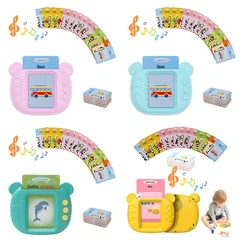


What Is a Flash Card Reader Toy?

A flash card reader toy is a handheld learning device that plays recorded audio the moment a printed card is seated in its slot. The unit identifies the card by optical or contact detection, looks up the matching entry and plays the word, sound effect or short sentence through the onboard speaker. There is no app, no account and no network in the loop. The content is a stack of physical cards and the logic is a lookup table on a board, which is why the category keeps shelf space in channels where tablets have been tried and returned.
For a buyer, the useful definition is a sourcing one rather than a technical one. A flash card reader toy breaks into four independently priced parts: the reading mechanism, the card set, the audio board and the housing. You can reprint the card set for a new language, keep one card standard across three housing tiers, or commission a private mold on the shell while leaving the electronics untouched.
This guide is arranged as a set of choices, not a specification sheet. Delays here are rarely engineering problems; they come from fixing the card standard after the housing is tooled, or finding the voice pack is the long pole after the steel is cut.
We build flash card reader toys as an OEM/ODM manufacturer from a 5,000 square metre Shenzhen facility running since 2010, with 20,000 units of daily capacity, ten injection machines in an in-house mold shop and shipments into more than 120 countries. Two hardware platforms carry most programmes: the card-insert learning machine, a handheld reader at roughly 25 x 18 x 3 cm, and the tracing card machine, a tablet-format unit that adds an LCD screen, a writing board and a stylus. Which of the two fits your channel is the first decision, not the last.
How Does a Flash Card Reader Toy Work?

The mechanism is simple enough for a shelf-talker and specific enough for a sourcing meeting: a card is seated, the unit detects which card it is, and the matching audio plays. Everything you negotiate sits inside those steps. The eight functions below describe what a flash card reader toy does in a child's hands, before we get to how one is built.
How the Flash Card Reader Toy Works: Functions in Detail
Function 1 - Card insertion and recognition: the child seats a card, the unit identifies it by optical or contact detection and the matching audio starts immediately. Card capacity is 200+, so a six-theme starter set leaves headroom for refill packs. The lookup is local, so the unit behaves the same on day one and in year three.
Function 2 - Theme library and preload: a standard programme ships with 138 preloaded cards across six theme categories: nature, everyday objects, animals, colours, numbers and body parts. Themes are a content decision, not a hardware one: adding a seventh theme is a print job on the existing card standard.
Function 3 - Bilingual audio with optional pinyin: standard audio is Chinese-English bilingual with optional pinyin, narrated by native speakers in six languages: English, Chinese, Spanish, Arabic, French and Japanese. Which languages ship on the first run is decided before recording starts.
Function 4 - Onboard storage and update path: the voice bank sits on 4GB to 16GB of onboard storage, and content is extended by adding or swapping cards rather than by reflashing the unit. For a buyer this is the line between a product you extend in year two and one you replace. A refill card pack carries no mold cost, no new electronics, no certification cycle and no firmware change.
Function 5 - Card material and housing: cards are printed on 400gsm coated paper with a wipe-clean laminate, and the housing is ABS non-toxic plastic. Card stock is what a child touches most and what a retail buyer inspects first, so the gsm figure belongs in your written brief.
Function 6 - Writing board and stylus on the tracing card machine: the tablet-format platform pairs the LCD screen with a writing board and a stylus, so a child hears a word, sees it and traces it. That variant moves the product from a listening toy into a writing-readiness product at a higher price band. It also adds a second component set to validate, so the choice belongs at brief stage.
Function 7 - Power architecture: units run either on AAA dry cells or on a rechargeable lithium pack. Dry cells keep the unit out of battery transport documentation and let a retailer shelf it with cells in the pack; a rechargeable pack lifts perceived value and removes the running-cost objection. The two routes change the carton, the manual, the shipping paperwork and the compliance file at once.
Function 8 - Idle behaviour, volume ceiling and age grading: auto-off timing, maximum output volume and the age grade printed on the card set and carton are specified before the white paper is signed. These are firmware and print decisions, not hardware defects, and cannot be corrected after shipment. Bring your channel's volume expectation and age claim to the brief.
Once those functions are agreed, building a flash card reader toy runs in five steps. Each closes a decision and each has a published turnaround.
Step A → Freeze the card standard and the recognition route: optical or contact detection, card size and thickness and the lookup logic come first, because the housing, slot and board footprint are dimensioned around them. Detection route is also the biggest driver of unit cost and field durability. Output: STP files in 3 days.
Step B → Design the housing around the slot and the board: our engineers model the shell outward from the card slot and the PCB rather than dropping electronics into a shape drawn for looks. Slot geometry drives both the feel of insertion and the field failure rate, and it is the one thing a firmware update cannot fix. Output: 3D printed sample in 3 days.
Step C → Write behaviour and the content map into the programme white paper: card-to-audio mapping, language set, volume ceiling, auto-off timing and theme list are approved before any steel is cut. A behaviour that exists as a document can be approved; one that exists as a consensus in a meeting cannot. Output: programme white paper in 3 days.
Step D → Freeze electronics, acoustics and power in one sample: board, speaker cavity, battery architecture and storage size are locked together on one PCBA sample, because changing one after this point re-opens the others. This is also where the compliance test plan is written, since the sample you send to the laboratory has to be the sample you produce. Output: PCBA sample in 5 days.
Step E → Cut the mold and run production: an exclusive mold takes 30 days and mass production a further 30 from mold approval. Those two blocks are why Steps A to D matter: a decision found in month two costs new steel; the same decision found in week one costs a printed file.
Key Features of Flash Card Reader Toys

1. The Recognition Route Is a Durability Decision
Feature: cards are identified by optical or contact detection, with 200+ card capacity on one standard.
Advantage: the two routes price differently and wear differently. Contact detection is cheaper per unit and tolerant of card thickness variation; optical detection reads faster and is less sensitive to a worn contact surface, at a higher component cost.
Benefit: this choice sets your return rate, not your feature list. A reading fault is the one defect a parent notices on day one, and it lands on the review score that decides whether a retail buyer reorders next season.
Evidence: the route is frozen at Step A and validated on the 5-day PCBA sample, with 100% function testing and AQL 1.0 inspection on the production run.
2. The Card Set Is the Repeat-Purchase Engine
Feature: 138 preloaded cards across six themes, 200+ card capacity on the same standard, and cards on 400gsm coated paper with a waterproof laminate.
Advantage: content lives outside the firmware. A new theme, language or licensed character set is a print run on a card standard you already own, not a new board or mold.
Benefit: you get a year-two revenue line without a year-two engineering budget. Shelf space won with the starter set is defended with refill packs, and a language trial that underperforms leaves you with printed cards rather than unsellable electronics.
Evidence: six-language native-speaker narration in English, Chinese, Spanish, Arabic, French and Japanese; theme and language lists are fixed in the 3-day white paper before tooling.
3. Two Platforms Cover Most Channel Briefs
Feature: the handheld card-insert learning machine at roughly 25 x 18 x 3 cm, and the tracing card machine in tablet format. The tracing variant adds:
• an LCD screen plus a writing board, so the child sees the word after hearing it
• a stylus stored in the housing, which removes the most common lost-part complaint
• a trace-then-play sequence that supports a writing-readiness claim instead of a listening claim
• a larger housing, which means a larger carton and a different freight calculation
Advantage: one electronics architecture serves two price bands. You can open with the handheld unit in a promotional channel and add the tracing machine in a specialty channel without re-engineering the reader.
Benefit: the platform decision is a channel decision, and making it early lets you plan one tooling budget across two selling seasons.
Evidence: both platforms run the same reader and card standard, so the second variant reuses the 5-day PCBA sample and the existing card library.
4. The Voice Pack Has Its Own Schedule
Feature: native-speaker narration in six languages, 4GB to 16GB of onboard storage for the voice bank, and Chinese-English bilingual audio with optional pinyin.
Advantage: recording, review and approval run in parallel with tooling rather than after it, provided the language set is fixed at Step C.
Benefit: in practice the voice pack, not the mold, decides whether you hit a back-to-school or Christmas landing date. Treat recording as a scheduled workstream.
Evidence: storage is sized at 4GB to 16GB to the language set you ship, and the language list is frozen in the 3-day white paper before tooling.


5. Power Architecture Changes Four Documents at Once
Feature: AAA dry cells or a rechargeable lithium pack, selected at Step D.
Advantage: the dry-cell route keeps the unit out of battery transport documentation and lets a retailer shelf it with cells included; the lithium route lifts perceived value and removes the replacement-cost objection a parent raises at the shelf.
Benefit: because the choice changes the carton artwork, manual wording, shipping paperwork and compliance test list at once, deciding it at Step D is the cheapest schedule insurance in this category.
Evidence: the power path is frozen on the 5-day PCBA sample together with the board and acoustics, and the documentation is written from that sample.
6. One Platform, Three Tiers
Feature: a shared electronics and card platform offered in good, better and best configurations, distinguished by card count, housing finish and whether the tracing board is fitted.
Advantage: the mix can be changed inside a season without re-certifying the platform, and the private-mold premium is amortised across a forecast rather than one order.
Benefit: slow-moving inventory lands in card stock and printed board rather than in PCBAs, which is the difference between a markdown you absorb and a write-off you cannot.
Evidence: 20,000 units of daily capacity and a shared card standard let you re-mix tiers inside a season, with the mold amortised across a 12-month forecast.
B2B Applications: Where Flash Card Reader Toys Fit

The same flash card reader toy platform is bought for very different reasons. Below is the configuration we recommend for each channel, and the trade-off we would flag before you commit.
1. Brand owners building a differentiated first product - Take the private-mold route on the housing and keep the standard reader. Start with the card-insert learning machine, then extend to the tracing card machine in season two. Trade-off: a private mold wants a 12-month forecast behind it, not one purchase order.
2. Large supermarket and chain retail buyers - Here the file pack, not the product, decides the outcome. We supply a documented pack: ISO9001, BSCI and SEDEX audits, CE built on EN71-1/2/3 with EN 62115 for the electric function, FCC Part 15 where the unit carries an oscillator, RoHS on materials, UKCA, and CPSIA with a Children's Product Certificate for the United States. Add AQL 1.0 inspection, 100% function testing, UPC barcodes, shelf-ready packaging and multilingual manuals, and a category manager can file it. Trade-off: documents are issued to the importer of record, not the factory, so the name on the certificate is agreed before the test plan is written.
3. B2B importers and distributors - Take the platform SKU in good, better and best tiers and let the card set carry differentiation by market. Standard tooling keeps lead time to 30 days mold plus 30 days production, and 20,000 units of daily capacity absorbs a reorder spike. Trade-off: platform units look familiar on shelf; your defence is the card library, not the silhouette.
4. Marketplace and e-commerce sellers - Optimise the carton before the product: a compact pack drops the fulfilment fee per unit, and the 25 x 18 x 3 cm handheld format was designed for it. Ship two colourways against one listing and let the review data pick the winner. Trade-off: listing copy must match the card set and the age grade on the carton must match the listing.
5. IP licensors, gift and hotel programmes - The tracing card machine carries a licensed character better than the handheld unit, because the writing board gives the character something to do. Series planning works here: one housing, several card packs, each with its own artwork approval. Trade-off: artwork approval chains are usually longer than tooling, so start character approval at Step C, not Step E.
6. Education groups and kindergarten chains - Durability and content mapping beat novelty. Specify 400gsm laminated cards, the highest volume ceiling you can accept, and a theme list mapped to your curriculum. Trade-off: institutional buyers ask for replacement cards years later, so commit to the card standard in writing; a discontinued standard cannot be refilled.
OEM/ODM Customization Services for Flash Card Reader Toys

Product Design Customization
Three engineers and two designers work from your brief, so the flash card reader toy you approve is yours alone. Outputs are dated and numbered, so the version you approved is the version that got tooled.
• Housing silhouette, colourway and finish, including a private mold
• Card slot geometry tuned for insertion feel and for field durability
• Card size, corner radius and card standard defined once, reused across every theme pack
• Handheld card-insert learning machine or tablet-format tracing card machine, decided at brief stage
• Button layout, volume control position and stylus storage
Every design output lands in an STP file within 3 days and a 3D sample within 3 days, so you approve a physical part rather than a rendering.
Hardware Customization
Four electronics engineers specify the board, acoustics and power path as one frozen package, because changing one re-opens the others.
• Optical or contact card detection, selected against your cost target and card life
• Speaker and rear-cavity geometry tuned to the housing, not bought as a generic part
• AAA dry cells or a rechargeable lithium pack, with the charging interface to match
• 4GB to 16GB of onboard storage sized to the language set you ship
• ABS non-toxic housing, with incoming materials meeting RoHS and CPSIA requirements
Software & Audio Customization
One AI content creator and the electronics team handle the content map and firmware behaviour. The card-to-audio lookup is the product, so it is specified in writing before anything is recorded.
• Card-to-audio mapping written into the white paper and signed off in 3 days
• Native-speaker narration in English, Chinese, Spanish, Arabic, French and Japanese
• Chinese-English bilingual audio with optional pinyin, and a bilingual-first or local-language-first default
• Volume ceiling, auto-off timing and idle behaviour written as firmware requirements
• Optional content version number and language code burned into firmware and mirrored onto the carton
If you want a language outside the standard six, say so at Step C: the recording schedule, not the engineering, decides your landing date.
Packaging & Compliance
Two quality engineers and a ten-person QC team manage the documents. We treat packaging as part of the compliance file, not a finishing touch.
• Card stock at 400gsm coated paper with waterproof laminate, and carton board matched to your drop-test target
• UPC or EAN barcodes, shelf-ready formats and multilingual manuals for your market list
• Age grading, warning text and traceability codes placed on the card set, carton and manual in one artwork pass
• Test plan written against CE (EN71-1/2/3), EN 62115, FCC Part 15, RoHS, UKCA and CPSIA, with BSCI and SEDEX audit documentation for retail programmes
• AQL 1.0 inspection and 100% function testing on every run, with retained samples tied to the batch code
Which standards apply to your feature set should be confirmed with your own laboratory, notified body or local market authority. We build to what you bring us and document it.

Why Choose XINDITAI as Your Flash Card Reader Toy Partner
Factory-Direct Manufacturing
You are buying from the plant that tools, moulds, assembles and tests the unit, not from a trading desk that re-quotes it. That matters when something has to change, because the people who can change it work beside the mold.
• 5,000 square metre Shenzhen facility operating since 2010, with ten injection machines in an in-house mold shop
• 20,000 units of daily capacity and 1,000,000+ units manufactured cumulatively
• A published schedule: 3 days for STP files, 3 days for 3D samples, 3 days for the white paper, 5 days for the PCBA sample, 30 days for an exclusive mold and 30 days for mass production
• AQL 1.0 inspection with 100% function testing, supported by two quality engineers and ten inspectors
Global Export Experience
OEM and ODM each account for roughly half our business, and we develop around ten new products a year, so the platform behind your flash card reader toy has been through several market entry processes.
• Shipments into more than 120 countries, 20,000 customers served and 100+ manufacturing partners
• Documentation routinely prepared for CE (EN71), FCC, RoHS, UKCA and CPSIA programmes, plus BSCI and SEDEX files for retail buyers
• ISO9001 quality management and national high-tech enterprise recognition
• 7x24 sales response, so a question raised in your afternoon is answered in your afternoon

Frequently Asked Questions About Flash Card Reader Toys
Q1: What is the minimum order quantity?
Three thresholds apply, and they are separate. A platform unit on existing tooling carries the lowest, because there is no mold to amortise. A private-mold housing carries a higher one, quoted against a 12-month forecast rather than a single order, so tooling cost spreads across expected volume. Card sets are quoted separately by print run, which is why refill packs stay viable.
Q2: Can you supply the compliance file a supermarket buyer asks for?
Yes, and it is worth being precise about what that means. We build and test to what you specify and supply the documentation set: ISO9001, BSCI and SEDEX audit files, CE built on EN71-1/2/3 with EN 62115, FCC Part 15 where applicable, RoHS, UKCA and CPSIA with a Children's Product Certificate, alongside AQL 1.0 records and 100% function test results. Certificates are issued to the importer of record, so agree the name on the document before the test plan is written.
Q3: Does the unit collect or transmit any data?
No. Card recognition is local, audio is stored on the device, and there is no camera, no network path and no account step. There is nothing for a parent to configure. We claim no privacy certification we do not hold; what we can give you is a one-page data map describing exactly what the unit stores and what it does not, which is the document your legal reviewer asks for.
Q4: How long does a programme take from brief to shipment?
Design and validation run in days: 3 days for STP files, 3 days for a 3D printed sample, 3 days for the white paper and 5 days for a PCBA sample. Tooling takes 30 days and mass production a further 30. In practice the variable is not our schedule but your approval chain, particularly the voice pack and artwork, so name your approvers early.
Q5: Can I use my own packaging and my own mold?
Both. A private mold gives your flash card reader toy a silhouette nobody else has, amortised across the forecast we agree. Packaging is developed to your board grade, print finish and drop-test target, with UPC or EAN barcodes and multilingual manuals. We ask only that artwork and mold are approved in the same window, because a carton printed before the housing is frozen has to be reprinted.
Q6: What happens if something fails after delivery?
Warranty terms are fixed in the purchase contract rather than in a brochure, and we would rather agree them in writing. What we can commit to operationally: retained samples tied to each batch code, 7x24 sales response, and spare-part packs agreed at ordering so a replacement card set or housing part ships without a new run.
Future Trends in Flash Card Reader Toys
1. Content libraries outgrow hardware cycles - Buyers are shifting spend from new housings to new card packs, because a refill pack has no tooling cost and no certification cycle. The card standard is therefore a long-term asset: freeze it at Step A, because it still earns revenue in year three. A programme that treats cards as a consumable outsells one that treats them as an accessory.
2. Local-language narration becomes a market-entry tool - Six-language narration lets a distributor test a small market without a full electronics programme. If the trial underperforms, what remains is printed cards rather than unsellable boards. Expect buyers to ask for the recording schedule before the unit price.
3. Physical media is being re-read as a compliance advantage - A product with no network path, no camera and no account has a shorter privacy review than a connected one. Retail legal teams are noticing this, and it changes which products clear shelf review first. Build the one-page data map now rather than when a buyer asks.
4. Platform strategies replace single-SKU launches - One flash card reader toy platform in good, better and best tiers lets a buyer change the mix inside a season and keeps slow inventory in card stock rather than in PCBAs. The mold is amortised across a forecast, and the tooling conversation happens once.
Conclusion: Start Your Flash Card Reader Toy Programme
A flash card reader toy rewards the buyer who decides in the right order. Freeze the card standard and the recognition route first, design the housing around the slot, write the behaviour and content map into a white paper, then freeze electronics, acoustics and power on one sample. Do that and the two 30-day blocks are the only dates on your calendar that cannot move. Skip it and the same decisions surface after the steel is cut, when the only answer is new tooling.
The commercial case is equally straightforward. Content lives outside the firmware, so a second season is a print job, not a development programme; the platform carries three price tiers on one amortised mold; the card library keeps a flash card reader toy listing alive after the launch promotion ends. Send us your channel, your language list and target landing date, and we will come back with a configuration, a schedule and a document pack for your buyer.
Contact Us
Contact: Zoey
WhatsApp: +86 13342950150
Email: xdt06@dtdianzi.com
Company: SHENZHEN XINDITAI ELECTRONIC CO., LTD | Website: www.kidsoundbook.com
Hot Tags: flash card reader machine, China, suppliers, manufacturers, factory, customized, wholesale, bulk, quotation, made in China


