













Interactive Plush Cats Put the Play Routine in Focus
Interactive plush cats make an appealing promise: speak or touch, and a familiar animal responds. Current sourcing language often combines speech repetition, fixed audio and connected dialogue under the same smart-toy label. For brands, the immediate challenge is to define which experience they are actually buying. The supplied cat concept illustrates the decisions behind that promise, from its broad white face to the proposed voice system.
The Feature List Has Become Difficult to Compare
A search for an interactive plush cat now brings together ordinary repeating toys, voice-controlled pets and proposed AI companions. Similar phrases appear across products with very different architectures. That creates a practical problem for buyers: an attractive list of functions can hide whether the toy repeats speech, retrieves a fixed recording or generates a new answer.

The consequence is visible at briefing stage. A brand may expect a continuing conversation while a supplier demonstrates a repeat function. Both parties can believe they have agreed on voice interaction. Procurement teams need a description of the actual exchange, including what starts it and how it ends, before price comparisons become meaningful. This analysis examines that problem through the supplied black-and-white cat concept rather than claiming a measured market-wide shift.

A Familiar Animal Raises Specific Expectations
The rounded cat has forward-facing glossy eyes, a small pink nose and a tail that stands above its body. Those visual cues encourage people to approach it like a pet. They may stroke its head, touch its face or expect a response when they speak. A general smart-toy brief can miss those character-specific expectations.
For AI companion toy development, the animal identity should influence interaction design. A response to a gentle head touch is easier to explain than a complicated hidden gesture. The team should watch where people naturally reach and decide whether that action belongs in the design. A familiar form can simplify discovery, but only when the electronics support the promise made by the character.
What Changes for the Buyer
Sourcing teams need a short demonstration script alongside the usual quantity, price and delivery discussion. The script should state the user action, expected response and recovery behavior. It can be filmed using a working sample and shared across purchasing, design and support. This reduces the chance that each department understands the product differently. A clear script also makes revised samples easier to compare because the same interaction can be repeated after a material, audio or firmware change.
Repeat Mode and Dialogue Need Different Explanations
Repeating speech offers a compact, understandable demonstration. The user speaks, the toy plays the sound back, and the result is immediately visible. Connected dialogue introduces a longer chain of listening, processing, response and recovery. Treating both as the same feature makes it harder to write accurate packaging, train sales teams or prepare after-sales support.

Buyers should ask for a demonstration with interruptions. Speak over the playback, pause unexpectedly and try an unfamiliar phrase. Then disconnect the network if the design uses one. The observed behavior reveals far more than a prepared greeting. An OEM talking plush project becomes easier to evaluate when its presentation includes both a normal exchange and an ordinary failure.

The Phone Should Have a Defined Job
A companion phone can manage setup, language or approved audio. It can also become a source of friction when every play session depends on an account or active connection. The useful question is what task the phone performs and whether the family understands that task. Connectivity by itself says little about the quality of the toy experience.
For this cat, a buyer might propose parent-controlled content with a simple child-facing interaction. Another project might require live dialogue. Those are separate routes with separate service responsibilities. Before selecting hardware, write down which actions remain available when the phone is absent. A clear offline behavior gives the product a more understandable boundary and creates a concrete topic for prototype review.
What Changes for the Supplier
Manufacturers need to show how the plush pattern and electronic assembly influence one another. For the cat, the cheek volume, eye spacing and belly shape should remain stable through integration. A change that improves sound may disturb softness; a larger enclosure may change sitting posture. Explaining these relationships gives buyers a basis for choosing between options. It also makes the development discussion more credible than a promise that every proposed function can be added without affecting the product.
Gift Presentation Cannot Explain Everything
The supplied gift-box artwork presents the cat as a soft companion with printed inserts and possible accessories. A gift recipient may never see the original sales demonstration. The package therefore has to explain the first action, power control and adult setup without relying on the person who bought it. This is a content-design task as much as a packaging task.

A useful review asks someone to open a packed sample and start the intended routine using only the included information. Note every hesitation. If the person presses the nose because it appears prominent, the instructions and control location need attention. Private-label plush packaging should match the actual interaction rather than repeat a collection of broad emotional claims.

Softness Is Still Part of the Technology Decision
The exploded concept separates the plush shell from the proposed internal unit. That drawing is helpful because it exposes a trade-off often absent from promotional language: electronics occupy space inside a product chosen partly for its softness. A larger speaker, battery or eye mechanism changes how the cat feels when held.
This issue cannot be resolved by comparing circuit specifications alone. The low body, broad cheeks and small paws leave specific places where a rigid edge might become noticeable. Buyers should evaluate the integrated sample with representative filling and closures. Technology decisions become commercially useful when the team can show that the character remains comfortable, balanced and recognizable after the electronic assembly is installed.
What Changes for the Content Owner
Someone must approve the words the toy speaks and maintain any service that supplies them. Fixed audio requires version control just as firmware does. Connected dialogue requires a defined owner for prompts, settings and updates. Before launch, agree how an approved content package is identified and how the device behaves when an update is interrupted. These are ordinary product responsibilities, even when the outer character remains a simple soft cat.
The Eye Effect Must Communicate a State
Large eyes are central to this cat's appeal, but a glossy fixed surface and a changing electronic expression are different promises. If a design uses illuminated or animated eyes, each expression should tell the user something useful. Additional animations can make the product more confusing when their meaning changes between situations.

A small set of readable signals is a practical starting point: available, listening, responding and asleep. A parent should also recognize a power or connection problem. Review these signals through the final eye construction in ordinary lighting. Smart plush toy design benefits from clear communication at the face because the face is where the user naturally looks for feedback.

Localization Extends Beyond a Language Menu
A multilingual claim can refer to recorded greetings, instructions, speech recognition or generated dialogue. Those layers do not necessarily support the same languages. A buyer planning a regional launch needs to know which layer is being offered and who approves the content. Listing language names without that distinction creates avoidable expectation gaps.
Use representative speech from the intended audience during review. Check names, short responses, quiet voices and common interruptions. For fixed audio, approve actual recordings and pronunciation. For connected responses, evaluate what happens when the system misunderstands. The cat's friendly expression should be supported by understandable behavior; it cannot compensate for a confusing instruction or a response that misses the purpose of the exchange.
A More Useful Sample Meeting
Instead of watching the developer operate the toy, ask a new participant to use it. Give them the packed cat and the draft instructions. Let them discover the power control and attempt one routine. Observe quietly before explaining. The nose, eyes, paws and tail provide natural points of attention, and the participant's choices can reveal a mismatch between visual design and control placement. Record the mismatch as a specific revision rather than a vague request to improve usability.
A Rendering Is Becoming a More Demanding Brief
The source collection contains scenes, internal structures, customization boards and different dimensional references. Taken together, they provide a rich conversation starter. They do not form a consistent production specification automatically. Buyers need to identify which drawing controls size, which functions are required and which scenes simply describe a possible use.
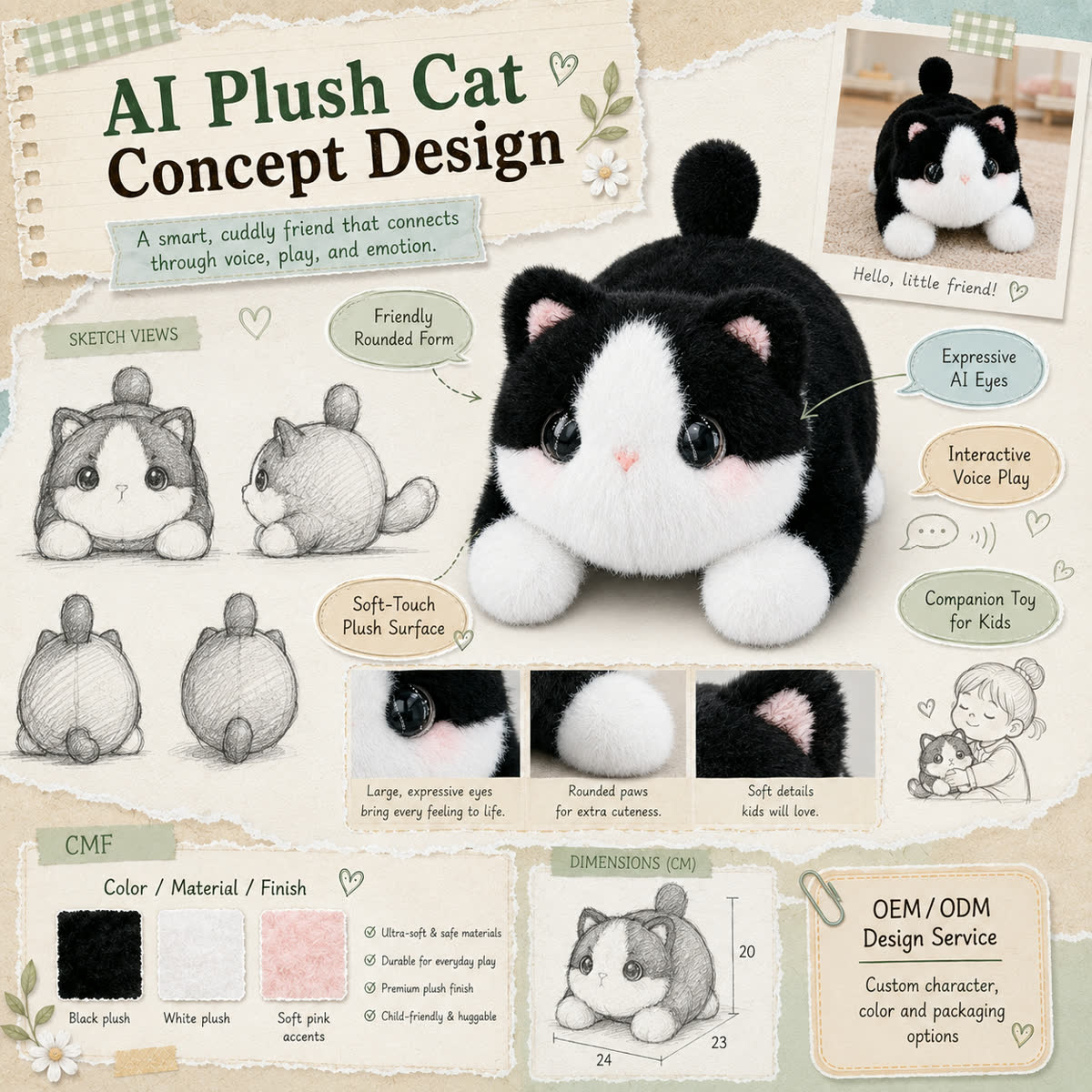
This is especially relevant to AI plush toy sourcing, where detailed concept art can look more finished than the underlying engineering. Mark each visible promise as an appearance requirement, an interaction requirement or an open decision. That modest step turns a presentation into a usable brief and helps a factory explain which parts can be sampled immediately and which require further development.

The Next Commercial Test Is Repeatable Use
A strong first demonstration creates interest; a repeatable routine gives buyers something they can support. For the cat concept, that routine could be a short voice game, a touch response or an approved story exchange. Its value depends on discoverable controls, consistent timing and a clear way to stop. The launch brief should make that routine explicit.
Request evidence across several samples, after packing and under normal room conditions. Compare how users approach the face, whether the upright tail recovers and whether the same input produces the same expected response. Those observations help an interactive toy manufacturer and its buyer discuss readiness in practical terms rather than deciding from artwork or a single carefully managed demonstration.
The Commercial Opportunity Remains Specific
A cat character can fit a focused brand proposition without carrying every available electronic feature. The buyer may prioritize a recognizable pet, a localized voice game or a gift experience. Those are different reasons to purchase. The development plan should preserve the chosen reason while evaluating optional capabilities separately. That approach supports clearer pricing, more accurate packaging and a support team that can explain what the product does in a few sentences.
The Demonstration Should Include an Ordinary Room
A quiet showroom helps a voice product look responsive. Homes contain overlapping speech, soft furnishings and sound from other devices. A useful commercial demonstration should include at least one environment close to the intended use. This is particularly relevant to a low plush cat that may sit on a rug or bed, where fabric can cover an outlet and change the sound. Buyers should ask what placement the prototype was designed for and repeat the routine there.
The result does not need to be flawless to be informative. A documented limitation can guide the brief: perhaps activation should use a physical control, perhaps the recording window should be shorter, or perhaps the instruction should identify a better holding position. The important outcome is a decision supported by observed behavior. A polished video alone rarely provides enough evidence to settle those questions.
From Attractive Character to Honest Product Language
The same discipline should carry into copywriting. A fixed glossy eye can be described through its visible shape and finish. An animated eye needs a working demonstration before the brand promises changing expressions. A picture of a child with the cat can suggest a use scenario without proving learning outcomes or emotional benefits. Specific language gives the buyer room to discuss development while protecting the eventual product description from assumptions introduced by concept art.
For purchasing teams, this means reviewing claims alongside the sample rather than after the package has been designed. Put each proposed claim beside the evidence that supports it. If the evidence is still a drawing, leave the claim open. When engineering confirms a function, record the relevant build and test. The sales story then develops with the product instead of running ahead of it.
A Practical Next Step for Brands
Use the cat artwork to select one use case, then ask for a demonstration that proves that use case inside the finished plush. Keep the product description tied to what the sample can show. Review the experience with purchasing, design, content and customer support before expanding the brief. A shared understanding of the first routine is a stronger launch foundation than an impressive but ambiguous feature list.
For project discussion, contact Joy on WhatsApp: +86 13691793052; E-mail: xdt05@dtdianzi.com. Joy shares broader product presentation references through her visual updates.
Questions Behind the Companion Toy Brief
Is this a report of measured growth in AI cat toy sales?
No. It is a sourcing analysis of ambiguous feature language and its consequences for development. It does not claim sales growth, market share or a completed launch for this concept.
What should a buyer request after seeing a voice demo?
Request the same exchange with an interruption, ordinary background sound and any required connection removed. Confirm the fallback and identify which behavior is actually supported.
Can the gift-box artwork be used as a pack specification?
Only after its contents, dimensions, protection and instructions are agreed against a real sample. The illustration is a presentation direction, not confirmation of included accessories.





