





Why Kids' Story Players Are Recorded in the Destination Language - Not Translated
A story player that ships to eight countries does not ship one English master with eight translated manuals. It ships eight audio libraries, each recorded by a voice the child in that market already knows. That distinction sounds small on a spec sheet and large in a return rate. This article looks at the mechanism behind it - how a physical token is bound to a sound file - and why the language decision is made on the factory floor, before tooling is cut.
 |
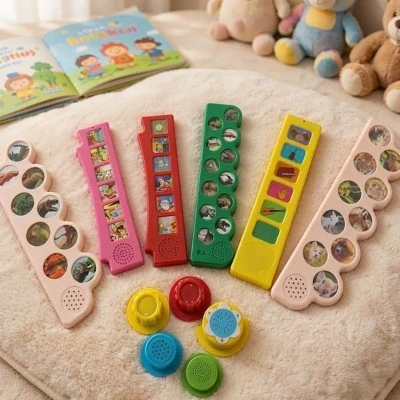
Localization happens before the mouldIn a screen-free player, the content is not a file buried in an app. It is a set of audio tracks, each mapped to a physical token - a card, a figurine, a magnetic tile. Change the market and you change the tracks, not the plastic. That is why a supplier asks for the destination language at the brief stage, alongside the age group and retail price band. Buyers comparing formats can start with the kids story player range, where five trigger mechanisms share the same content-mapping workflow. |
What "localization" actually means in a token-based player
Strip away the packaging and a story player does three things. It reads an identifier from whatever the child places on it, looks that identifier up in a stored table, and plays the audio file the table points to. The reader may be an NFC tag at 13.56 MHz, a low-frequency RFID tag, or a magnetic PIN contact - the mechanism changes, the mapping logic does not.
Because the identifier is separate from the audio, one shell can serve many languages. A German library and a French library can run on identical hardware; only the recorded tracks and the tag-to-track table differ. This is the reason suppliers treat language as a configuration line rather than a fixed product variant. The OEM/ODM workflow freezes those values at sample sign-off, not at concept stage.
Storage is sized to the library, not the other way round. Content memory runs from 128 MB to 128 GB by configuration, on internal flash or a removable TF card. Audio is mastered as MP3 or WAV at 128 kbps and above, 44.1 kHz. A longer native-language story set simply occupies more of that budget - it does not force a new tool.
Why a translated master fails in a child's ear
Translation and recording are different jobs. A translated script keeps the words in order but loses syllables, rhyme and breath. A children's story lives on those things. Read a four-line rhyme aloud in a second language and the metre collapses; the child still hears a voice, but the pattern that made the first line memorable is gone.
The practical complaint is pronunciation. When a factory records one English master and hands the buyer a translated booklet, the child hears names and places pronounced with the wrong accent - and pronunciation is often the first thing a parent notices. Recording in the destination language with a native voice removes that failure before the unit ships. It also allows a regional variant: the same title can be voiced for Spain and for Mexico, or for Portuguese in Brazil and in Portugal, from the same tag table.
The trade-off is real. Native recording means separate voice sessions, separate mastering and a separate approval round per language. That is more upfront work than a single master. But it replaces the far more expensive alternative: a batch that arrives in-market and is rejected for sounding foreign. Buyers who already hold their own recordings can hand over the files; the factory then handles tag mapping and mastering rather than the voice work.
 |
 |
The numbers a language project has to respect
Abstract claims are easy; the following values come from the published platform range for screen-free players. They are the boundaries a buyer plans against, and each one is frozen at sample sign-off rather than quoted as a universal constant.
| Parameter | Published range | Why it matters for language |
| Languages | 60+ on portable NFC formats; bilingual builds available | One platform, several market libraries |
| Content storage | 128 MB – 128 GB, flash or TF card | Sizes the recording library, not the shell |
| Audio | MP3/WAV, 128 kbps+, 44.1 kHz | Native voice mastered once per market |
| Playback | 6–8 hours; 400–1500 mAh cell; USB-C | Longer stories need a realistic battery budget |
| Production gates | 6 signed gates; 100% functional test | Catches a mis-mapped title before the container |
| Lead time | 25–35 days standard; 45–60 days with new tooling | Recording time sits inside the content gate |
Content is the repeat order, not a cost line
A wholesaler buys the player once. The margin that keeps a catalogue alive comes from the next card set, the next figurine, the next seasonal title. That model only works if a new story is a new token, not a new mould. A character family shares one approved shell; adding title twelve to the range means printing a twelfth card or figure, not cutting steel.
This is why screen-free formats travel well across markets with different digital habits. There is no app-store approval, no account creation, no subscription to manage in each country. The RFID story box and the portable NFC player use different triggers but the same commercial logic: the hardware is durable, the content is consumable.
For a publisher or IP owner, the implication is direct. The asset you already own - a book, a character, a curriculum - can become the trigger. An RFID character player reads the figure, not a proprietary cartridge, so the object in the child's hand becomes the play button.
 |
 |
A buyer's checklist for a native-language launch
Before a recording session is booked, five questions usually decide whether the project stays on budget. They are the same questions a factory asks at the first gate.
- Which markets, and how many? Each language adds a voice session and a tag table, even when the shell is shared.
- Who speaks the master? A native voice in the target market avoids the pronunciation complaint that a translated master invites.
- Does the buyer already hold recordings? Supplied files can be mapped and mastered, which shortens the content gate.
- Is the library on flash or TF card? A removable card lets a season change without touching the player firmware.
- Are regional variants needed? Accent differences are a configuration, not a new product - decide before approval.
If the answer to any of these is unclear, a supplier will typically issue a format recommendation and a sample plan rather than a fixed quote. That conversation is easiest through the Contact Us route, where target market and content idea can be sent directly to the factory.
FAQ
Can one player carry more than one language?
Yes. Single-language, bilingual and multi-title builds are all configuration options. The tag table decides which track plays; switching market is a content change, not a hardware change.
Is translation ever enough?
For a printed manual, yes. For the audio a child hears, native recording is the safer choice because rhythm and pronunciation do not survive a literal translation.
How are new titles added after launch?
Through a new card set, a new figurine, or a replacement TF card. The identifier lives on the token, so a growing catalogue does not require new tooling for the player itself.
What file format should supplied recordings use?
MP3 or WAV. Final bitrate and loudness are agreed at mastering; the factory handles mapping to each tag ID and a full tap test of the library.
 |
Recorded in-house, not brokeredSHENZHEN XINDITAI ELECTRONIC CO., LTD (XDT), established in 2010, runs a 5,000 sqm factory with in-house R&D and tooling. Industrial design, 3D tooling, PCBA, firmware, card and figurine printing, voice recording and export cartons are handled by one team - including the native-language voice work described above. Daily capacity exceeds 20,000 units. See the company profile, or Contact Us with your target market and content idea. |
Planning a native-language story player?Send the target market, quantity and content idea. Get a format recommendation, a quotation and a sample plan from the factory - not from a broker. |