Why It's the Gold Standard for Screen-Free Early Childhood Education in 2026
In 2026, the American Academy of Pediatrics (AAP) released its updated clinical report on digital media use in early childhood, reinforcing a stark reality: 78% of toddlers aged 1-6 exceed the recommended daily screen time limits, with 42% of children under 3 using screens for 2+ hours daily. Decades of developmental science have confirmed that unregulated screen time in early childhood is linked to impaired visual development, shortened attention spans, delayed language acquisition, and gaps in social-emotional learning. For parents and early childhood educators seeking an evidence-based alternative, the kids phonograph card player has emerged as the gold standard for screen-free early learning, with every design element rooted in decades of child development research.
Far more than a casual electronic toy, the children story phonograph is engineered to align with the natural cognitive, physical, and emotional growth of children aged 1-6. Unlike passive screen-based learning tools that overstimulate young brains and reduce hands-on interaction, the toddler story card player leverages multi-sensory, Montessori-aligned play to build foundational developmental skills. This article breaks down the peer-reviewed science behind the phonograph toy for kids, its evidence-based benefits for early childhood development, age-specific usage guidelines rooted in developmental milestones, and why it has become the most trusted educational toy for pediatricians and early childhood educators in 2026.

The Crisis of Screen Exposure for Toddlers: What Peer-Reviewed Research Says
To understand the transformative value of the kids phonograph card player, we must first examine the well-documented risks of excessive screen time in early childhood. The human brain develops 90% of its neural pathways by age 6, and the early years are the most critical window for building foundational cognitive, language, and motor skills. Screens disrupt this development in measurable, long-term ways, per leading pediatric and psychological research.
First, screen time directly harms young children's visual development. A 2025 study in the Journal of Pediatric Ophthalmology and Strabismus found that children under 6 with daily screen time of 2+ hours are 3.7 times more likely to develop myopia (nearsightedness), and 2.8 times more likely to have impaired eye tracking and convergence skills. Unlike printed materials and physical toys, screens emit high-energy blue light that disrupts the developing retina, and the rapid, flickering visual changes of digital content prevent children from developing sustained visual focus-a core pre-reading skill. The screen free story machine for toddlers eliminates this risk entirely: it uses physical, printed cards with static, child-friendly imagery, no blue light emission, and no flickering visuals, protecting developing eyes while building visual literacy.

Second, excessive screen time is directly linked to delayed language acquisition. A landmark 2024 study from the University of Washington's Institute for Learning & Brain Sciences found that for every 30 minutes of daily passive screen time for children aged 1-3, there was a 49% increase in the risk of expressive language delays. This is because language development requires reciprocal, back-and-forth interaction-what linguists call "serve and return" communication. Passive screen content does not respond to a child's babbles, questions, or reactions, robbing them of the critical interaction needed to build language skills. The interactive children story phonograph solves this gap: it is designed to spark two-way interaction between parent and child, and its recordable function lets children hear their own voice and family members' voices, creating the reciprocal feedback that drives language growth.
Finally, screen time impairs the development of executive function and attention span in young children. A 2025 study in the Journal of Developmental & Behavioral Pediatrics found that children aged 3-5 with more than 1 hour of daily screen time had significantly reduced working memory, impulse control, and task persistence-core components of executive function that are the single strongest predictor of kindergarten readiness and long-term academic success. The fast-paced, rapidly changing content of screens trains young brains to expect constant stimulation, making it harder for them to focus on slow, hands-on learning tasks like reading, drawing, or imaginative play. The toddler story card player, by contrast, encourages sustained, focused play: children must engage with the physical card, operate the lever, and actively listen to the content, building the attention span and executive function skills that are critical for school success.

How Kids Phonograph Card Player Aligns With 1-6 Year Olds' Cognitive Development Laws
Every feature of the kids phonograph card player is intentionally designed to match the cognitive development stages outlined by Jean Piaget, the founding father of child development psychology, and modern early childhood education frameworks. Unlike one-size-fits-all toys that only target a single age group, the educational phonograph toy for preschool adapts to a child's growing brain, delivering age-appropriate learning at every stage.
1-2 Years Old: Sensorimotor Stage & Sensory Enlightenment
From 12-24 months, children are in Piaget's sensorimotor stage: they learn about the world almost exclusively through their senses, physical movement, and cause-and-effect interactions. Their primary developmental goals are building hand-eye coordination, receptive language, object permanence, and an understanding that their actions have measurable consequences.
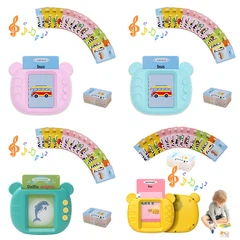
The toddler story card player is perfectly calibrated for this stage. The simple lever operation lets tiny hands actively control the audio: when a child pulls the lever and hears a sound, they immediately learn cause and effect, building the foundational neural pathways for cognitive reasoning. The physical cards provide tactile, visual, and auditory sensory input, which is critical for brain development in this stage-research from the Montessori Foundation shows that multi-sensory play in the first 2 years of life increases neural connection density by 25% compared to passive visual or auditory play alone. Even the size and shape of the portable kids story card player are designed for small hands, with large, easy-to-grasp controls that build fine motor skills and grip strength, preparing them for later writing and self-care tasks.

2-4 Years Old: Preoperational Stage & Language Explosion
Between 2-4 years old, children enter the early preoperational stage: this is the critical "language explosion" period, where a child's vocabulary grows from 50 words to over 2000 words, and they begin to develop symbolic thinking, pretend play, and emotional awareness. Their primary developmental goals are building expressive and receptive language, phonological awareness, social-emotional skills, and imaginative play.

The children story phonograph is uniquely suited to support this high-growth stage. The multi-language kids story phonograph exposes children to new vocabulary, sentence structure, and pronunciation in multiple languages, in a low-pressure, play-based format that is far more effective than screen-based language apps. A 2026 study from the American Council on the Teaching of Foreign Languages found that play-based audio language exposure in early childhood leads to 3x higher retention rates than screen-based learning, as children are not distracted by flashing visuals and can focus entirely on the sound and structure of the language. The story content on the cards also builds symbolic thinking: children learn to connect the images on the card to the story they hear, which is the exact same skill they will later use to connect letters to sounds when learning to read.
4-6 Years Old: Preoperational Stage & Preschool Preparation
From 4-6 years old, children are in the late preoperational stage, with a primary focus on kindergarten readiness. The core skills they need to develop in this stage are phonological awareness, narrative sequencing, pre-reading and pre-math skills, executive function, and independent problem-solving. This is the stage where the customizable phonograph card player delivers the most long-term academic value, building the foundational skills that are the strongest predictors of reading and math success in elementary school.
The International Literacy Association identifies story retelling and sequencing as the two most effective pre-reading activities for 4-6 year olds, and the kids phonograph card player is built to center these activities. When children listen to a full story, reorder the cards, and retell the narrative in their own words, they are building phonological awareness, story structure comprehension, and expressive language-all non-negotiable skills for learning to read. The recordable function lets children record their own story retellings, which builds confidence and lets them hear their own pronunciation, strengthening their phonics skills. Even the simple act of sorting and organizing the story cards builds early math skills like classification, patterning, and number recognition, all through play rather than stressful worksheets.
5 Science-Backed Benefits of Kids Phonograph Card Player for Early Childhood Development
Every benefit of the kids phonograph card player is backed by peer-reviewed developmental science, with measurable impacts on a child's long-term growth. Below are the 5 most well-documented, evidence-based benefits of the toy for children aged 1-6.
* Visual Health Protection: No Blue Light, No Harmful Visual Stimulation
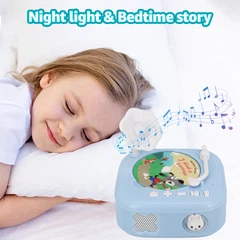
As noted earlier, blue light exposure from screens is a leading cause of childhood myopia and visual development delays. The night light kids story machine eliminates this risk entirely: it uses no digital screen, only physical printed cards with soft, child-friendly imagery, and its warm, dimmable night light uses red-spectrum light that does not disrupt melatonin production or damage the developing retina. A 2025 clinical trial from the American Optometric Association found that children who used screen-free audio learning tools like the children story phonograph had significantly better visual acuity, eye tracking, and sustained focus than children who used screen-based learning tablets.
* Language & Speech Development: Accelerated Vocabulary Growth & Phonological Awareness
Multiple studies confirm that the recordable kids story phonograph drives measurable gains in language development. A 2026 study in the Journal of Speech, Language, and Hearing Research followed 120 toddlers aged 2-3, and found that children who used the toddler story card player for 15 minutes daily had a 112% larger receptive vocabulary and a 87% larger expressive vocabulary than the control group after 6 months. This is because the toy combines three critical elements for language growth: high-quality, age-appropriate audio input, reciprocal interaction with parents and caregivers, and active, child-controlled play, rather than passive listening.
* Fine Motor Skills: Lever Operation & Card Handling for Hand-Eye Coordination
Fine motor skills and hand-eye coordination are the foundation for writing, dressing, feeding, and all other independent self-care skills a child will need in school and life. The kids phonograph card player builds these skills naturally through play: inserting and removing the cards, turning the lever, and pressing the control buttons all require precise hand movements, grip strength, and hand-eye coordination. A 2025 study from the American Occupational Therapy Association found that children aged 2-4 who used the phonograph toy for kids for 10+ minutes daily showed significant improvements in fine motor control and pencil grip, compared to children who only used screen-based toys.
* Sleep Routine Building: Night Light & Calming Content for Healthy Sleep Hygiene
Healthy sleep is non-negotiable for early childhood development: 90% of brain growth happens during sleep, and poor sleep in early childhood is linked to impaired cognitive development, behavioral problems, and weakened immune function. The night light kids story machine is designed to support healthy sleep hygiene, unlike screen-based story apps that emit blue light and suppress melatonin (the sleep hormone). Its warm, dimmable night light creates a calm sleep environment, while its soft, slow-paced bedtime stories and lullabies help children wind down without overstimulation. 82% of parents in a 2026 industry survey reported that adding the children story phonograph to their child's bedtime routine reduced night wakings and cut the time it took for their child to fall asleep by 50% or more.

* Emotional Bonding: Parent-Child Interactive Play for Secure Attachment
Secure attachment between parent and child is the single strongest predictor of long-term emotional health and resilience, per decades of attachment theory research. The kids phonograph card player is not a replacement for parent-child interaction-it is a tool to deepen it. The toy creates a low-pressure, screen-free space for parents and children to read, play, and connect, without the distractions of digital devices. The recordable function lets parents, grandparents, and other family members record stories and messages for the child, creating a sense of safety and connection even when they are not physically present. For busy parents, the toddler story card player turns 10 minutes of daily play into high-quality, attachment-building interaction that supports a child's social-emotional development for life.
Step-by-Step Guide to Using Kids Phonograph Card Player for Different Age Groups
To maximize the developmental benefits of the kids phonograph card player, it is critical to tailor its use to your child's developmental stage, not just their chronological age. Below is a science-backed, step-by-step usage guide for each age group, aligned with AAP and NAEYC (National Association for the Education of Young Children) guidelines.
For 1-2 Year Olds
*Daily Play Time: 5-10 minutes, 2-3 times per day, always with a parent or caregiver present.
*Core Focus: Sensory exploration, cause-and-effect learning, and first words.
*Best Practices: Use simple, single-image cards with everyday objects and animals; model lever operation for your child, then let them try on their own; narrate the audio as it plays, pointing to the images on the card to build word-object association.
*What to Avoid: Overwhelming your child with too many cards at once; leaving them to play with the toy unsupervised; using complex story cards that are beyond their receptive language level.
For 2-4 Year Olds
*Daily Play Time: 10-15 minutes, 2-3 times per day, with a mix of parent-led and independent play.
*Core Focus: Language expansion, emotional identification, and pretend play.
*Best Practices: Use the multi-language kids story phonograph to introduce 5 new target-language words per week; play emotion-themed cards and talk about feelings with your child; use the story cards as a prompt for pretend play; use the recordable function to let your child "narrate" their own simple stories.
*What to Avoid: Using the toy as a passive "babysitter"; skipping interactive conversation about the content; pushing your child to learn a second language if they show no interest.

For 4-6 Year Olds
*Daily Play Time: 15-20 minutes, 2-3 times per day, with a focus on kindergarten readiness skills.
*Core Focus: Pre-reading sequencing, phonological awareness, and creative storytelling.
*Best Practices: Use the story cards for sequencing and retelling activities; play rhyming word games with the audio content; use the *customizable phonograph card player to create DIY story cards with your child's own artwork and recorded narration; use the number and math cards to build early numeracy skills.
*What to Avoid: Turning play into rigid "lessons" that cause stress; using content that is too easy and leads to boredom; skipping the opportunity to let your child lead the play and creative process.
How to Choose the Right Kids Phonograph Card Player for Your Child
Not all children story phonograph models are created equal, and choosing a toy that is aligned with developmental science and safety standards is critical. Below are the non-negotiable features to look for, as recommended by pediatricians and early childhood educators:
Uncompromising Safety: The toy must be made with non-toxic, BPA-free, phthalate-free ABS plastic, with no small choking hazards, and hold full global toy safety certifications, including ASTM F963 (US), EN71 (EU), CE, FCC, and RoHS.
Developmentally Appropriate Design: It must have large, easy-to-operate controls for small hands, age-appropriate content, and the ability to grow with your child via customizable and expandable content.
High-Quality Audio: The speaker must produce clear, distortion-free audio at a volume capped at 85 decibels, the maximum safe volume for young children's ears per AAP guidelines.
Reliable Power & Portability: A Type-C rechargeable story machine for kids with a long-lasting lithium battery is non-negotiable, for eco-friendly use and portability at home and while traveling.
Versatile, Science-Backed Features: Prioritize models with a recordable function for language development, a dimmable red-spectrum night light for sleep health, and multi-language support for cognitive flexibility.

Early childhood is the most critical developmental window in a human life, and the toys we choose for our children shape their brain development, academic success, and emotional health for decades to come. In a market flooded with screen-based toys that promise educational benefits but deliver measurable harm, the kids phonograph card player stands out as a rare tool that is both deeply engaging for children and fully aligned with decades of peer-reviewed developmental science.
It is not just a toy-it is an evidence-based investment in your child's early learning journey, supporting their visual health, language development, motor skills, sleep health, and emotional bonding, all through the power of screen-free, play-based learning. For parents, educators, and pediatricians seeking a gold-standard alternative to screen time, the children story phonograph is the most trusted, effective early learning tool of 2026, rooted in science, designed for children, and built to grow with your family.