


The Story That Turns Its Own Pages – Inside the Big Eye Projector's Automatic Scene Change
Details: The Big Eye Projector is a battery-powered story projector with one feature that changes how it is used: as a story plays, the picture switches to match the scene by itself. There is no remote to press and no slide to advance, because the audio and the image are paired in the file, so the projector effectively turns its own pages. The image is thrown two to three metres onto any pale wall and focused with a wheel, the sound comes from an independent speaker cavity with a 3 W driver, and a sensor cuts the light when anything comes within thirty centimetres of the lens. It carries an 1800 mAh cell for about eight hours of playback, and content sits on a TF card or arrives over Bluetooth. What that means in practice is a story a child can start and then simply watch, without an adult sitting beside the projector to keep the pictures moving. Runs begin at 1,000 pcs, with trial quantities between 200 and 500 units available to test a wall first.
Key Product Selling Points
Details: Automatic scene change sounds like a small convenience and turns out to change the whole experience. The seven effects below are what a buyer gets when the picture no longer needs driving.
The Picture Follows the Voice
The image on the wall changes at the moment the narration reaches the next part of the story, because the two are matched in the file rather than advanced by hand. That synchronisation is what makes the room feel like a book being turned rather than a slideshow being operated. For a child, it is simply how the story works; for a buyer, it is the difference between a projector and a storytelling object.
No Remote, No Adult
Because nothing has to be advanced, the projector can run without a hand on it. A child who has started the story does not need an adult to keep the pages moving, and an adult who is cooking dinner does not have to come back to press a button. Removing that single act of supervision is what turns the product from a shared activity into something a child can own.
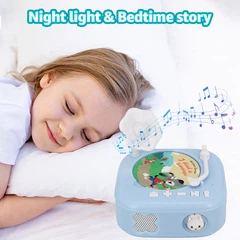
A Bedtime That Ends in Darkness
The story plays, the pictures move with it, and when the story ends the projection stops – so the evening closes without a screen being taken away and without a negotiation. That ending is the point of the feature at bedtime: the child is not interrupted, and the room simply becomes dark. A routine that ends by itself is a routine a parent will repeat.

Read-Along for Early Readers
When the word and the picture arrive together, a child can follow a printed line on the wall while hearing it read. That pairing supports the stage where a child recognises words but still needs the sound to keep going, and it does so without a finger tracing under a page. A read-along edition turns the projector into a reading aid that sits beside a beginner rather than replacing the book.
A Classroom That Keeps Pace
A teacher can begin a story and then talk over it, because the pictures advance without attention. That frees the teacher to watch the class rather than the projector, and it keeps a whole room on the same image at the same moment. For a lesson built on a picture sequence, the automatic change is the difference between demonstrating a story and managing a device.
A Series, Not a Slideshow
Once the pairing is built into the file, a product line becomes a set of stories rather than a set of pictures. A publisher can produce a first title, then a second and a third on the same projector, each with its own scene list, and a buyer who owns the device is already equipped for the next release. That is the commercial shape the feature quietly creates.
A Stage for a Creator's Scene List
A writer or an illustrator can decide exactly which picture belongs to which line, and the projector will honour that decision in the dark. That is a small amount of authorial control that most audio products do not offer, and it is why the format suits a creator who cares about pacing. The scene list becomes part of the work rather than an afterthought left to whoever edits the file.
In short: start the story and stop touching it – the voice moves on, the picture follows, and the room goes dark when the tale is finished.
Why an Automatic Scene Change Changes the Product
A projector with a remote is a device someone operates; a projector that advances itself is a thing that simply runs. That sounds like a minor difference in convenience and behaves like a major difference in category, because every product is judged by how much attention it demands. Remove the act of advancing and the same hardware stops being a gadget on a shelf and becomes something a child can use alone and an adult can leave running.
The second effect is on pacing. A story told with the right picture at the right moment feels authored, and one where the images lag behind the voice feels amateur. When the pairing is fixed in the file, the pacing is decided once, by the person who made the story, and then repeated identically every time the card plays. That consistency is what turns a title into something a family trusts rather than a curiosity they show a guest.
The third effect is commercial. A projector whose content is a paired story-and-image file is a product a publisher can extend without touching the hardware, and a buyer can sell into a series instead of a single item. A second title is a new scene list and a new recording, not a new device, which is exactly the shape a small publisher or a school needs when the budget for one run has to cover several releases.
How a Scene List Is Built
The work begins with the script rather than with the pictures. A title is broken into scenes, each scene is given its line of narration, and only then is an image assigned to it. Doing it in that order matters, because a picture chosen after the recording tends to follow the audio too literally, while a picture chosen with the line in mind can add something the words do not say.
The images are then prepared for projection rather than for print: large shapes, strong contrast and a composition that survives being thrown across a room and viewed from a sofa. Fine detail that reads on paper often disappears on a wall, so the palette and the line weight are adjusted for the distance the audience will actually sit at. A test projection is the moment this is confirmed, and it is worth doing before a full card is loaded.
The final step is the pairing itself. Each audio track is bound to its image so that playback advances the picture at the agreed point, and the sequence is checked end to end on a real wall. Where the story is licensed, the rights holder sees the finished pairing rather than a script, because that is the version the audience will experience and the version that has to be approved.
What to Settle Before You Order a Projection Test
Five decisions are worth making before a single image is prepared, because each one changes the artwork rather than the hardware. The first is the distance the audience will sit at, which sets how large the picture has to be and how much detail can survive. A bedroom wall seen from a bed and a classroom wall seen from the back row are two different briefs, even though they use the same projector.
The second is the scene count. A picture book may translate into a dozen scenes and a short cartoon into far more, and every extra scene is another image to prepare plus another point at which the timing can drift. The count is therefore agreed with the script rather than discovered during assembly. The third is the light in the room: a dim bedroom allows a softer image, while a room with a window needs more contrast, and the artwork is tuned to whichever it is.
The fourth is language, since a bilingual edition doubles the recording work and may change how long a scene stays on the wall. The fifth is the licence, where one is needed, because a rights holder will usually want to see the finished pairing rather than a script. Settling those five answers turns a request into a brief, and a brief is what makes the first projection test useful instead of merely attractive.
Product Parameter
| Big Eye Projector – Specification and Ordering (LMP-004) | |
| Item | Big Eye Projector / LMP-004 |
| Auto Scene Change | The picture switches to match the scene as the story plays, so nothing has to be advanced by hand |
| Projection | A throw of two to three metres onto a pale surface, focused with a wheel |
| Eye Safety | The projection cuts out when an obstacle comes within thirty centimetres of the lens |
| Playback | TF card with 4 GB supplied, plus Bluetooth; previous and next track, volume, play and pause, and mode switch |
| Audio | An independent speaker cavity with a 4Ω 3 W iron-shell driver |
| Battery | 1800 mAh lithium-ion, about eight hours of playback, about two hours to charge |
| Charging | Type-C, with a 50 cm cable supplied |
| Materials | ABS shell with a semi-transparent PE power key, silicone buttons and an anti-slip silicone base |
| Body Size | 111 × 124 × 182 mm |
| Gift Box | 235 × 193 × 135 mm |
| Unit Weight | 850 g |
| Compliance | CE, UKCA, FCC and RoHS files with CPC; EN71 and ASTM F963 reports issued when a market requires them |
| Minimum Order | 1,000 pcs; a trial run between 200 and 500 units is possible |
Send us the story, the scene breakdown and the artwork, and we will come back with a projection test, a pairing plan, sample terms and a production slot for your release. Write to the export desk through the enquiry form, or reach it directly by email. Companion phonograph, story-player and talking-card models are listed at: https://www.kidsoundbook.com/products
Where a Self-Advancing Projector Is Used
The settings below are the ones where "it runs by itself" is not a convenience but the reason the product can be there at all. Each of them has a moment where nobody is free to stand beside a device, and each of them gets a story that plays through without help.
In a bedroom it is the last activity of the day, and the fact that it ends on its own is what lets a parent leave the room. In a classroom it is a picture sequence the teacher can talk over rather than operate. In a children's library it is a story corner that does not need a librarian to keep it moving. In a clinic or a waiting area it gives a child something absorbing while an adult deals with something else, and in a hotel or a holiday let it is a children's amenity that survives being left alone in a room.
| Five Settings – What the Automatic Change Gives Them | ||
| Setting | How It Runs | What the Feature Solves |
| Bedroom | A story at bedtime that finishes and goes dark | No adult needed to end it, and no screen to take away |
| Classroom | A picture sequence the teacher narrates over | The teacher watches the class, not the projector |
| Children's library | A story corner that runs itself between visits | Staff time is not spent advancing a slideshow |
| Clinic or waiting area | A short story during a wait, restarted by the next child | Absorbing without supervision or a screen |
| Hotel or holiday let | A children's amenity left running in the room | Nothing to configure and nothing to hand back |
The common thread is simple: every one of these settings has more children than adults. A product that needs an operator per child cannot work there, and a product that advances itself needs only a wall.
Quality Inspection


Production Process
Our Service
A synchronised edition is decided by its script and its scene list long before it is decided by the lens. The route below is how those decisions become a finished set that turns its own pages.
Requirement Communication
We settle first on the story, the scene count, the artwork, the voice, the language and the box. Those points are written into a brief both sides sign before a scene list is drawn, so the edition is built to a decided plan.
Scene List and Audio Development
The script is broken into scenes, the images are prepared for projection rather than for print, and the narration is recorded and levelled. Each track is then bound to its image, and a test projection confirms the pacing on a real wall.
Sample Confirmation
You receive a working projector with the edition loaded, so the image, the focus, the voice and the moment each picture changes can be judged together. Sign-off is taken in writing before the run is released.
Pre-production Sample
The opening units of the run are held back as the reference for the edition. Later batches are compared with them on image, sync point and sound, so a reprint behaves exactly like the approved version.
Bulk Production
The projectors are assembled, the cards loaded and the sets packed for a retail carton or a classroom order. Output is logged and can be reported to you, which matters when an edition is tied to a launch or a term.
Inspection, Documents and Dispatch
Finished sets clear a last check on image, sync, sound and carton marking, and the documents for each destination are prepared to match the batch. You may inspect the line in person, or see it on a video call, before dispatch.
Customization Information
The body and the lens are the fixed half of the product; the scene list and the recordings are where an edition lives. The list below can all be made to order, and anything that adds tooling or a certificate is flagged before the order is locked.
FAQ – Frequently Asked Questions
Q1: How does the picture know when to change?
The image and the audio are paired in the file, so playback advances the picture at the point agreed when the edition was made. Nothing is pressed and nothing is tracked by a sensor in the room; the sequence simply follows the recording. That is why the pacing repeats the same way on every unit and in every room.
Q2: Can we set our own scene list and timing?
Yes, and that is the point of the format for a publisher or an illustrator. You decide which picture belongs to which line and how long each stays, and the pairing is built to that decision. A story that should linger on one image can linger; a fast sequence can move quickly. The pacing becomes part of the work rather than a setting left at default.
Q3: Can a child use it without an adult?
That is what the automatic change is for. A child starts the story and the pictures keep pace, so nobody has to sit beside the projector and press anything. Most owners find the child watches the story, and the adult is free – which is the difference between a shared activity and a product that can be used on an ordinary evening.
Q4: Is it safe to let a child look at the projection?
The unit is built with eye safety in mind: the light cuts out when an object comes within thirty centimetres of the lens, so a child who leans in cannot stare into the beam, and the image is thrown onto a wall at two to three metres rather than held close to the face. Electrical and materials testing for the destination market is supplied with each shipment.
Q5: How dark does the room need to be?
It works best in a dim room with a pale wall, which is how most bedrooms already are in the evening. A completely dark room is not necessary, but daylight on the wall will wash the image out, so the product is aimed at evening and indoor use. That suits the stories and read-along sequences it was built for.
Q6: Can we bring our own story, or license one?
Both. A buyer can supply an original story and artwork, or license an existing title and bring the rights to the order. Where a title is licensed, the rights holder usually wants to see the finished pairing rather than just the script, since that is the version the audience experiences. That approval step is built into the schedule rather than added at the end.
Q7: How few units can we order, and what does a sample cost?
Runs start at 1,000 units, and a trial batch of 200 to 500 can be arranged for a first title or a pilot classroom. A working projector with the edition loaded is supplied before the run, and the sample cost is credited against the production order. The body needs no tooling; a new edition is a scene list, an artwork and a recording job.
Q8: Where is the projector made, and can we visit?
The projector, its lens assembly and its loaded cards are produced at a single site in Shenzhen, which matters for a synchronised edition because the image, the sound and the scene list have to arrive consistent across a run. Buyers may visit the plant or view the line on a video call, and every carton carries a traceable batch record.
Company Introduction
for children
Xinditai Electronics has been manufacturing children's audio and story products in Shenzhen since 2010, mainly through OEM and ODM programmes for projection story players, story machines, talking cards, sound books and plush devices. Its buyers include publishers, illustrators' agents, schools and distributors in many markets. Synchronised story-and-image editions are a regular part of that work, which is why the artwork, the recordings and the projector are prepared by one team.
A workshop of about 3,000 square metres covers moulding, board assembly, image and audio preparation, voice recording, acoustic testing and packing, staffed by more than a hundred engineers and operators. No stage starts until the one before it is signed off, and each batch keeps a record that can be traced to the order. The factory can be visited, or the line shown on a video call, before an edition is confirmed.

Certifications
Certificates
The projector and its loaded card are shipped as one product, so the document pack is built around the unit and the edition in the order and prepared for the destinations named. The certificates remain valid, accompany the batch they belong to, and a complete folder is available with the quote.

CE

RoHS

FCC

SEMTA

EMC

ISO