






Meta Description: Dive deep into the core technology of AI storytelling devices-intelligent voice interaction. Discover how voice wake-up, continuous dialogue, and personalized responses are transforming children's listening experience.
The Silent Revolution in the Children's Room
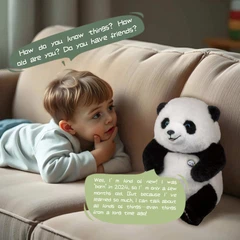
In the quiet of the nursery, a child's voice chirps, "Hello, Little Rabbit, I want to hear a story about a robot puppy." Instead of the expected pre-recorded tale, a warm, responsive voice answers, "Great! Would you like the robot puppy to be brave and adventurous, or kind and helpful?"
This seamless, natural exchange marks a fundamental shift. It's no longer a child operating a machine but initiating a conversation with a companion. At the core of this revolution, transforming AI storytelling devices from simple players into interactive partners, lies one critical technology: Intelligent Voice Interaction.
Beyond the Button: The Three Pillars of Intelligent Dialogue
Moving past simple "play" and "stop" commands, modern intelligent voice systems are built on three key technological pillars that create a truly conversational experience.
1. Voice Wake-up: The Gateway to Instant Connection
The magic begins with voice wake-up technology. This feature eliminates the need for physical buttons, allowing children to interact with the device as naturally as calling a friend.
How it Works: The device is in a low-power "listening" state, constantly scanning for its specific wake-word (e.g., "Hello, Little Genius"). Advanced algorithms filter out background noise to accurately identify the command.
The Impact: This fosters a sense of agency and intimacy. The device becomes an always-available companion that responds not to a press, but to a call.
2. Continuous Dialogue: The Art of Contextual Conversation
This is the true marvel that separates a smart device from a simple one. Continuous dialogue allows the storytelling device to remember the context of the conversation, enabling logical, multi-turn exchanges.
A Practical Example:
Child: "How do bees make honey?"
AI: "Bees collect nectar from flowers... and turn it into honey in their hives."
Child: "What do they use it for then?" (The AI understands "it" refers to honey).
AI: "They store the honey as food to eat during the winter."
The Technology Behind It: Natural Language Processing (NLP) allows the AI to understand pronouns and references, creating a fluid conversation that mimics human interaction and deeply engages a child's cognitive processes.

3. Personalized Responses & AIGC: Crafting Unique Stories
The ultimate expression of intelligent voice is its ability to not just retrieve information, but to create. By integrating AIGC (AI-Generated Content), these devices can craft personalized stories on demand.
The Power of Creation: When a child makes a complex request like, "Tell me a story about a shy dragon who learns to dance," the AI doesn't search a database. It uses the child's input as prompts to generate a completely original narrative with a coherent plot, characters, and a resolution.
The Outcome: This transforms the device from a library into an infinite story fountain. It actively nurtures creativity, showing children that their own ideas can be the seed for wonderful new adventures.
Why It Matters: The Developmental Benefits of a Talking Partner
This leap in technology is not just about convenience; it's about development.
Boosts Language Skills: Regular conversation with a patient, articulate AI model provides immense practice in question-forming, vocabulary acquisition, and sentence structure.
Encourages Critical Thinking: The ability to ask "why" and "how" and receive immediate, thoughtful answers fuels a child's natural curiosity and logical reasoning.
Provides Emotional Fulfillment: The responsive nature of the interaction makes the child feel heard and understood, offering a form of companionship that a passive player never could.

Conclusion: The Voice of a New Generation
Intelligent voice interaction is far more than a feature-it is the soul of the modern AI storytelling device. By giving these devices a "voice" that can listen, understand, and respond, we have given children more than a toy; we have given them a mentor, a playmate, and a storyteller that grows with them. As this technology continues to evolve, the conversations in the children's room will only become richer, more personal, and more full of wonder.