



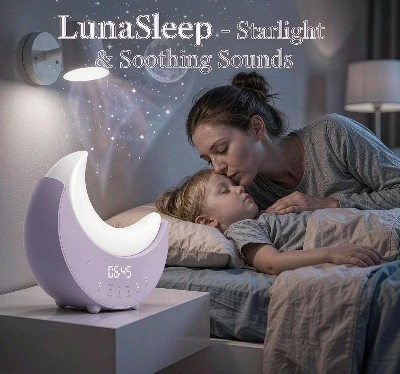




The brief was simple: a pat of butter on a piece of toast, glowing, so a four-year-old can find the toy at 2 a.m. and so a parent can leave it on all night.
The engineering brief was less simple. Six square centimetres of glowing surface, no visible LED, no hotspot, no colour variation between units, no blue light risk at any distance a child can reach, and a battery that has to run the thing for eight hours without becoming the reason the toy dies at 11 p.m.
What follows is the light path, surface by surface, and the numbers that decide whether the result reads as a designed object or as a plastic lump with an LED inside.

The butter block on the front face, edge lit from below the well
A block that glows is a light box, not a lamp 🎛
A lamp throws light at something. A light box makes a surface uniformly bright, and uniformity is a completely different discipline.
The metric is minimum over average luminance, measured on a grid across the emitting face. A backlit sign at U equals 0.5 looks blotchy. At 0.75 it looks intentional. Below 0.4 the eye reads it as a defect, and a child's eye is not more forgiving than yours, only closer.
For a 30 by 22 mm face on a 14 mm block, three arrangements are worth costing.
A single LED behind the block, facing the viewer, gives the cheapest BOM and the worst result: a bright core, a dim rim, U around 0.3, and the LED package visible as a shape through the material unless the block is very heavily frosted, which then costs most of the light.
Four LEDs behind the block even out the face at U around 0.6, but they need a reflector cavity, and the cavity has to be 8 mm deep to spread properly, which does not fit in a 14 mm block that also has to survive being squeezed.
Edge lighting with an extraction pattern gives U of 0.75 to 0.8 in the same volume, at the cost of a laser-etched light guide and a 0.2 mm air gap. That is the arrangement in production. ✅

Light path: die to guide to gap to diffuser to block, and the two uniformity results side by side
One LED is enough, and two is a decision ⚡
The emitter is a 3528 package at 2700 K, 20 mA, 6.8 lm, binned to a 3-step MacAdam ellipse. One of them, coupled into a 2 mm PMMA guide with side-emitting extraction dots at 1.6 mm pitch, delivers about 3.4 lm into the block after guide and coupling losses.
Two emitters are used, not for brightness but for symmetry. With one LED at one end of the guide, the far end of the face is measurably dimmer and the falloff is visible on a flat surface. Two emitters at opposite ends of the same guide cancel that gradient, and the cost is USD 0.09 plus 20 mA of current.
The dot pattern is the part nobody outside the industry expects. Laser dots are spaced at 1.6 mm pitch, with a 4 mm unetched border at the far edge, and the pitch tightens toward the end opposite the emitter. The pattern is calculated, not drawn: etch density is proportional to the local flux deficit, which is why a copied pattern from another product never matches.
The 0.2 mm gap that saves the whole design 🌫
Between the light guide and the diffuser there is an air gap of 0.2 mm, and it is deliberate.
If two optical surfaces touch, light couples across wherever the refractive indices allow it, and the contact points become bright lines. A guide pressed against a diffuser at 300 points shows 300 dots. The gap forces total internal reflection to break down at the extraction pattern instead, where it is supposed to.
The gap is held by three 0.2 mm moulded standoffs on the diffuser frame, not by the housing. Housings warp in ABS, and a 2.2 mm wall over 100 mm will move 0.3 mm through a normal moulding cycle. Standoffs on the optical part hold tolerance to 0.03 mm, which is what the design needs.
Every diffuser is a tax on brightness 💡
The stack from LED to eye has four transmission losses, and a buyer who asks for "brighter" is usually asking to remove one of them.
The guide itself transmits about 88 percent of what it couples. The diffuser, an opal polycarbonate at 0.5 mm with 55 percent transmission and 88 percent haze, takes the largest single bite. The silicone block at 62 percent transmission takes the next. A 4 mm air gap to the block face costs nothing, which is why the block is set proud of the housing rather than recessed.
Multiplying the chain, 6.8 lm in becomes roughly 1.4 lm of emitted flux. That is not a problem, because a night light needs lux on a pillow rather than lumens in a room, and 1.4 lm spread over 6 cm² gives a surface luminance around 400 cd/m², which at 40 cm reads as a soft glow and at 2 m reads as a small warm object in the dark.
The temptation is to buy back brightness with a transparent block. Do not. A clear or lightly frosted block shows the guide, the dots and the shadow of the PCB behind it, and the illusion of butter disappears in one glance. 🚫
Colour is a binning problem, not a design problem 🎨
Ten thousand units have to look like one product. That is a procurement requirement, not an aesthetic one, and it is decided on the LED purchase order.
A 2700 K LED is not a colour, it is a region on the chromaticity diagram, and that region depends on the bin. A 5-step MacAdam ellipse produces visible variation unit to unit when they sit side by side on a shelf. A 3-step ellipse is what this product specifies, and it costs about 12 percent more per emitter for exactly that reason. 🎯
The second colour decision is the block itself. Silicone with a warm pigment shifts the transmitted spectrum toward amber, which is fine at 2700 K and wrong at 4000 K. The specification is written as a transmitted chromaticity target, measured through the assembled stack, not as a pigment code, because the pigment is only half of the result.
What the photobiological limits actually say 🛡
EN 62115 covers electric toys and defers optical radiation to IEC 62471. The relevant question is not "is the light bright" but "how much blue-weighted energy can reach an eye at the closest plausible distance".
For an exempt-group source, the weighted blue light irradiance limit for a long exposure is 0.01 W/m² at the point of evaluation. A 2700 K emitter at 3.4 lm behind a 55 percent diffuser and a 62 percent block is far below that at any distance, and the measurement still has to be made and recorded, because the file needs a number and not a confidence.
Three practical details are worth building in rather than testing for later.
The first is that the block must never be removable. A child who pries the butter pat off has a bare emitter against a palm, and the assessment changes completely. The block is captured by a 0.6 mm lip and cannot be lifted with a fingernail.
The second is that the diffuser must be a diffuser in every unit, not most. A moulding short shot that leaves a thin patch is a local hotspot, and hotspots are what the blue light assessment is actually protecting against.
The third is dimming. Pulse width modulation at 3.2 kHz keeps percent flicker under 1 percent and avoids the banding that phones show at 200 Hz, and it keeps the average current low enough that the thermal design does not change between brightness levels.
Printing a face on a soft curve 🖨
The smiley face on the butter block is pad printed, and pad printing on silicone is a different process from pad printing on ABS.
Silicone has low surface energy, around 20 mN/m, which means ink will not wet it. Two pretreatments are used: a corona or plasma pass to raise surface energy to the high 30s, and a primer layer matched to the ink system. Without both, the face survives about 200 wipe cycles before it starts to fade from the edges.
Registration across a curved 30 mm face is plus or minus 0.15 mm with a soft pad, and the eyes must sit within 0.3 mm of each other or the face reads as broken rather than as cute. That tolerance is why the print is a two-impression job with a locating nest rather than a single stamp.
Yellowing is a clock that starts on day one ⏳
Silicone and polycarbonate both yellow, and both yellow faster with blue light and heat than with time alone.
The specification that keeps this honest is a 1,000 hour ageing test at 60 °C under continuous operation, with the colour shift recorded as a delta u'v' of 0.003 or less on the assembled stack. That number is chosen because it is roughly the threshold at which two units a year apart stop matching on a shelf.
The drive current matters here more than the material. Running the emitters at 20 mA instead of their 30 mA rating costs 30 percent of the light and roughly quadruples the time to reach the same colour shift, because LED depreciation and phosphor degradation both scale with junction temperature.
Two emitters at 20 mA also means 120 mW of heat in a 14 mm block of silicone, which conducts poorly. That is not a thermal problem for the junction, which stays under 62 °C at 26 °C ambient, but it is a reminder that the block is an insulator and the LED has to be given a path to the housing that does not run through it.
What the light is for 🌙
The glow is not decoration, and it is not a night light in the ordinary sense either. It is the state display.
Off means nothing is playing. A dim steady glow means the toy is on and waiting. A slow rise and fall means a story is running, and it is the only indicator a child who cannot read can use to know the machine is still working. A fade over ten minutes at the end of a bedtime story means the product is going to sleep and so is she.
That is four states carried by one emitter pair and no display, which is why the optical design gets the attention: a state display that is blotchy, colour-shifted or flickering is a state display nobody trusts. 🧈
Closing: five numbers behind a pat of butter 📐
Uniformity 0.75 to 0.8, not 0.5. Transmission 55 percent at the diffuser and 62 percent at the block, multiplied honestly. Colour inside a 3-step ellipse. 120 mW of heat with a path that bypasses the silicone. And a weighted blue light irradiance that is measured, printed in a file and available to any buyer who asks.
Butter, in the end, is a lighting problem wearing a very small costume. 🧈
Official Website: www.kidsoundbook.com | www.xinditai.com
Email: happy@xinditai.com WhatsApp: +86 138 2434 3309
LinkedIn: https://www.linkedin.com/in/happy-gao-education-toy-oem-odm/
YouTube: https://www.youtube.com/@XDTHappy
SHENZHEN XINDITAI ELECTRONIC CO., LTD.