

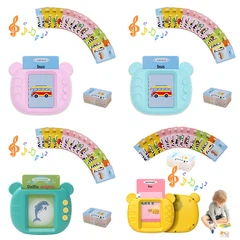








In an era where screen time dominates childhood experiences, a groundbreaking innovation is reshaping early education: the dual-function card-based tracing machine. This hybrid device merges tactile play with digital intelligence, offering a bridge between traditional learning methods and modern technology. By combining optical recognition, electromagnetic sensing, and interactive processing, these devices create a multisensory learning environment that respects developmental needs while preparing children for a tech-driven world.

Core Technology Architecture
The Hardware Symphony
At its heart lies a meticulously engineered hardware ecosystem. The card reader module employs dual-mode detection – using optical scanners to decode visual patterns like animal illustrations while leveraging electromagnetic sensors to read embedded metallic traces. This dual approach allows the system to distinguish between a zebra's stripes and mathematical symbols with 0.1mm precision.
Central to operations is the quantum-core processor that executes 14 trillion operations per second, dynamically matching card patterns to stored educational content. Unlike conventional tablets, this specialized chip prioritizes real-time response over generic computing, enabling instant feedback when children insert alphabet cards or number puzzles.
Storage solutions combine onboard flash memory with expandable microSD slots, housing over 200GB of curated content – from classical nursery rhymes to STEM animation sequences. The output subsystem features a nano-projector capable of casting 4K-resolution templates onto standard A4 paper, paired with directional speakers that create localized sound fields, ensuring audio guidance doesn't disrupt surrounding environments.
Intelligent Software Ecosystem
The machine's neural network-powered recognition engine converts physical card data into interactive experiences through three-layer processing:
- Pattern identification via convolutional neural networks
- Contextual analysis using educational content databases
- Adaptive response generation based on user interaction history
A proprietary algorithm manages the device's screen-free interface, translating physical card manipulations into digital actions. When a child rotates a shape-matching card, gyroscopic sensors trigger corresponding animations in the projection system, maintaining engagement without exposing young eyes to direct LED emissions.

Educational Function Implementation
Cognitive Development Through Structured Play
The tracing function operates through a patented light-guide plate system that projects templates with adjustable opacity. Children progress from basic line tracing to complex pattern replication, with the system automatically increasing difficulty based on success rates. Pressure-sensitive feedback mechanisms in advanced models detect pencil pressure, offering verbal encouragement when strokes match template guidelines.
Card-based learning modules follow a spiral curriculum design. A mathematics set might begin with number recognition cards, evolve into counting exercises using animal illustrations, and then advance to arithmetic operations through interactive problem cards. Each card's magnetic coding tells the system which difficulty level to activate, creating personalized learning paths.
Multisensory Engagement Mechanics
Tactile interaction reaches new heights through haptic response cards. Geography modules, for instance, use textured surfaces that make mountain ranges physically palpable while the projector overlays topographic information. Auditory components employ spatial audio techniques – when a child inserts a jungle animal card, corresponding creature sounds appear to emanate from different directions, enhancing immersive learning.
The system's AI tutor adapts teaching strategies in real-time. If a child struggles with a phonics card, the machine might first repeat the standard pronunciation, then activate a slow-motion articulation mode, and finally project mouth movement diagrams – all while maintaining a playful, pressure-free tone through its voice synthesis engine.

Health-Centric Design Philosophy
Visual Protection Systems
Understanding concerns about digital eye strain, engineers implemented three-layer optical protection:
A 445nm blue light filter in the projector
Automatic brightness adjustment via ambient light sensors
Mandatory 20-minute interval reminders for eye relaxation
The projection system's diffuse reflection principle mimics natural paper viewing, with lux levels strictly maintained below 300 to meet international pediatric ophthalmology standards. Unlike tablets that force fixed focal lengths, the projected images allow natural eye movement between near (drawing hand) and far (projected template) distances.
Ergonomic and Safety Considerations
All interactive components comply with stringent EU toy safety directives. The card slots feature rounded anti-pinch edges, while food-grade silicone coatings make the device drool-resistant for toddlers. Wireless charging eliminates dangerous power ports, and the electromagnetic emission levels measure 60% below WHO-recommended limits.
Durability testing includes 50,000 card insertion cycles and 1-meter drop resistance – crucial for surviving the enthusiastic handling of preschool users. The modular design allows easy part replacement, extending product lifespan through upgradable memory cards and swappable battery packs.
Future Evolution and Market Impact
Emerging technologies promise exciting upgrades. Prototypes testing quantum dot projection can display 16 million colors for art education, while graphene-based pressure sensors in development will detect 1,024 levels of drawing pressure. The next generation may integrate AR compatibility through companion apps, allowing children's paper drawings to come alive in 3D animations when viewed through smartphones.
As these devices gain adoption in Montessori schools and therapeutic settings, they're redefining educational technology paradigms. By preserving the tactile richness of physical play while harnessing digital personalization, card-based learning systems represent not just a product category, but a philosophical shift in early childhood development – proving that technology and tradition can coexist to nurture curious, creative minds.