





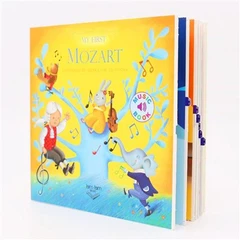
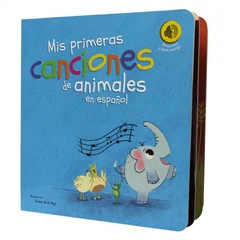
Sound Board Book – A Book With Its Controls Mounted Along the Side
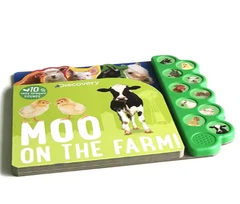
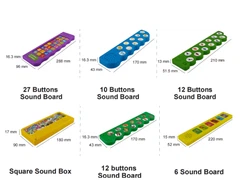
Details: Where the buttons go decides how a child reads. Put them inside the pages and the reading stops each time one is pressed; mount them in a sound board along the side of the book and the child's hand learns a separate rhythm – press at the edge, look at the page, press again. This is the arrangement used here: a customisable sound board carrying up to the button count your edition needs, assembled onto the side of the book rather than into the spreads. Page stock is double 400 g coated paper, binding is hardcover or paper-cover, the cell is AAA or AG13, and book design, book size and audio content are all built to the buyer's brief. A finished unit weighs 350 to 500 g. Minimum order: 1,000 pcs.
The Board Beside the Page
Design a sound book and you make one structural choice before any content exists: is the electronics part of the reading surface, or does it sit beside it? Both answers produce a working product, and they produce entirely different reading experiences. Mounting the board along the side keeps the printed page intact and gives the child a dedicated place to press, which is the choice made here.
The immediate consequence is that every spread stays whole. Nothing has to be designed around a button recessed into the middle of an illustration, and an illustrator is free to compose the page as a page rather than as a layout with holes in it. For a publisher converting an existing title, that is worth a great deal: the artwork that already exists can be used at full size, and the audio attaches to it rather than being built into it.
The second consequence is a ritual the child can learn in a minute. A hand rests at the edge of the book while the eyes stay on the spread, so pressing and reading become two habits that do not interfere with one another. On a book with buttons in the pages, every press interrupts the page; here the control strip is a consistent physical location that stays in the same place from the front cover to the back.
Physical consistency carries further than it sounds. A child who knows where the board lives can find it in the dark, on a car seat or in a lap without looking away from the picture. It also means the board can be built to a single mechanical specification across a whole list of titles, with the number of buttons changing but the position, travel and feel staying the same from one edition to the next.
The page stock supports the arrangement. Double 400 g coated paper per sheet gives each leaf enough stiffness to hold its shape without being held open, which matters when one hand is occupied with the board. Coated stock also resists the repeated wipe-and-turn handling that a sound book collects, and it holds printed colour across a long run, so spread fifty looks like spread one.
Binding is the third variable, and it interacts directly with where the electronics sit. A hardcover stiffens the whole book and protects the board along the spine edge; a paper-cover edition is lighter and cheaper to ship, and it suits titles intended for a single season rather than for handing down. Because the board is a separate assembly, either binding can be produced on the same line without redesigning the electronics.
It is worth naming the trade-off honestly, because a buyer choosing a format should know what is being given up. A separate board means a child has to learn two movements instead of one: press, then look. On a book whose keys sit inside the pages, pressing and seeing are the same act. For an object-naming title aimed at the very youngest readers, that single integrated movement is genuinely better. The side-mounted arrangement earns its place on titles where reading comes first and answering comes afterwards.
What remains constant is the sequence the form creates. A child opens the book, presses the board, hears something, and looks back at the page to connect the two. That loop – act, listen, look – is the reason the product works as a learning object rather than as a novelty, and it exists because of where the buttons were put, not because of what is recorded on them.
The distinction matters when a publisher is choosing between two formats for the same manuscript. The content can be identical in both cases; what changes is the kind of attention the book asks for. A title that expects a press on every page trains recognition, while a title that expects a page to be read before anything is pressed trains sequence. Most successful sound-book lists end up carrying both kinds of book, which means the format decision is properly made per title rather than once for the whole catalogue.
Sound Board Book – Model SB-002 Data Sheet
| Sound Board Book – Specification Summary (SB-002) | |
| Item | Sound Board Book / SB-002 |
| Customisation | Book design, book size and audio content all produced to the buyer's brief |
| Button Layout | Button count set by the buyer; the keys sit in the sound board, assembled along the side of the book |
| Battery | AAA or AG13 |
| Page Material | Double 400 g coated paper per sheet |
| Binding | Hardcover or paper-cover |
| Unit Size | Custom |
| Unit Weight | 350 – 500 g |
| Compliance | CE, CPC, UKCA, FCC, RoHS (ASTM F963 / EN71 testing available on request) |
| Order Quantity | 1,000 pieces (trial orders negotiable) |
Because the format is defined by the order, the fastest route is a short brief rather than a long enquiry. Tell us the trim size, the page count, how many keys the board needs and which languages the audio should be in, and we return tiered quantity bands, sample and trial terms, the paper and print specification, the board and module documentation and the dieline. Post it to the export desk or use the enquiry form, and the reply comes back inside a working day. Full range here: https://www.kidsoundbook.com/products
Seven Layout Choices for the Board and Its Keys
Details: The button count is a buyer's decision rather than a specification, which means the same board assembly can produce quite different reading experiences. These are the layouts that come up most often, and each one changes how a child uses the book rather than merely how it looks.
One Key Per Spread
The simplest arrangement and the one that suits the youngest readers. Every page turn brings a single new sound, so the connection between the picture and the audio is impossible to miss. It also keeps the board short, which leaves more of the book available for artwork.
A Small Cluster Per Spread
A handful of keys grouped for each page, so a spread with several named objects can be explored in any order. This is the layout that turns a book into something closer to a game, and it rewards a child for pressing every key rather than only the obvious one.
A Single Continuous Bar
One long row of keys running the length of the board, matching the sequence of the story. It is the best arrangement for song books and counting books, where the order of the sounds matters as much as the sounds themselves, and it reads as a single instrument rather than a set of buttons.
A Row of Answer Keys
Keys that do not correspond to the page an order, but to possible answers. A question spread is followed by a press, and the sound confirms or denies. Quiz formats and language-learning titles use this layout because it converts reading into a response rather than a narration.
A Different Count Per Edition
Because the key count is set per order, a publisher can produce a twelve-key edition for a full picture book and a four-key edition of the same title for a toddler format. The board assembly changes in length; the position, travel and feel of the keys do not.
One Board Across a Whole Series
The most commercially useful option. Hold the board specification constant and a publisher can release title after title that feels familiar in the hand, so a child who has learned one book can operate the next without instruction. Series consistency is a purchase driver, and this is where the format delivers it.

Your Own Layout
None of the six arrangements above is fixed, and most editions end up combining two of them. Bring a page design and a sound list to the first conversation and the board is laid out around them, rather than the pages being adjusted afterwards to fit a board that already existed.
Six Kinds of Buyer for This Format
The side-mounted board suits buyers whose books already work as books, because it leaves the printed page untouched and adds sound alongside it.
Planning an Edition Through the Year
| Edition Planning Calendar – Sound Board Book | ||
| Window | What to Lock Down | Why It Matters |
| Early in the year | Trim size, page count and key count | Everything downstream, from artwork to board length, follows from the format |
| Spring | Audio scripted and the sound list finalised | Recording is the longest single task in the schedule |
| Late spring | Board layout positioned against the page design | Keys and illustrations have to be composed together, not sequentially |
| Summer | Print sample and working module approved | The last point at which paper or audio can change cheaply |
| Late summer | Testing run for the destination markets | Certification has to complete before the cartons are sealed |
| Autumn, pre-Q4 | Print run, assembly and packing | Retail needs stock in the warehouse, not on the water |
| Post-season | Review what sold and commission the next title on the same board | The second edition is the one that pays for the format work |
Two habits make this calendar easier to keep. Decide the board specification once and treat it as a standard for the list, changing only the key count per title. And bring the sound list to the first meeting rather than the last, because on this format the audio and the page design are a single job with two outputs, not two jobs that happen to meet at the printer.
One further piece of planning advice, learned from editions that ran late. Fix the trim size before the artwork is commissioned rather than afterwards, because a change of format invalidates every page that has been composed and every key position that has been marked on it. Trim size is among the cheapest decisions to make early and among the most expensive to change later, which is why it belongs at the top of the first meeting instead of somewhere in the middle of the project.
The Commercial Case – A Format That Builds a List
Some sound books are single products. This arrangement is better understood as a format, because the second title costs far less to develop than the first.
| What a Buyer Is Choosing Between | ||
| Sound board book (SB-002) | A book plus a separate audio device | |
| Objects the customer manages | One book | A book and a player that must be kept together |
| Artwork freedom | Full page, nothing recessed into it | Full page, but the audio is not attached to it |
| Language editions | A re-recorded module on the same board and pages | A second product to source and hold |
| Series consistency | Same board across the list | None – each title is independent |
| Operation by the child | Press the board, read the page | Depends on the player |
| Paper stock | Double 400 g coated paper per sheet | Often lighter, since the book carries no module |
One clarification is worth making for buyers who are weighing formats. This is not a replacement for a book that places its keys inside the spreads; the two arrangements do different jobs. Where the point of the title is that a child presses the thing being described, buttons in the page are right. Where the point is that a child reads a page and then answers it, the board beside the page is the better structure.
Buyers sometimes ask which arrangement is cheaper to produce. The honest answer is that the difference is small and it lies mostly in where the cost sits. Key-in-page construction carries more moulded parts and more assembly steps in every book; a side-mounted board concentrates the tooling into one reusable assembly and then spreads it across a list. Across a single title the two are close, and across five titles the board is clearly ahead.
Where the Keys Sit – Three Arrangements
The position of the controls is the decision that shapes everything else about a sound book. Read across the rows below and the trade-offs become clear for a specific title rather than in the abstract.
| Control Position – What Each Arrangement Produces | ||
| Arrangement | What the Child Learns | Where It Suits |
| Board along the side of the book | Read first, then respond; the hand finds the same place every time | Story titles, answer formats, series publishing |
| Keys set into the pages | Press the exact object being named | Vocabulary and object-naming titles |
| A single panel on the back cover | Less direct, and the page is out of sight while pressing | Simple sound-effect books with very few keys |
| No controls – page-turn audio | Listening and looking only | Narration-led titles for the youngest readers |
Our own preference, for most titles, is the arrangement used here. Keeping the page whole preserves the reading experience, keeping the controls in one place builds a habit, and keeping the board as a separate assembly makes the next edition cheaper than the last. Those three advantages rarely appear together in any other layout.
For a publisher building a list rather than a single book, there is one further consideration. Series consistency is the asset that makes the second title easier to sell than the first, and it depends on a child recognising the object rather than the cover artwork. Holding the board specification constant while the pages change is the simplest way to build that recognition, and once the first edition has been tooled it costs nothing at all to repeat.
Questions From Publishers and Distributors
Q1: Can the board be added to a title we already publish?
That is the usual starting point. Because the controls sit beside the pages rather than inside them, an existing title can be converted without recomposing a spread or redrawing an illustration. Send the page files as they are and we will lay the board against them, then return a print sample so you can judge the result in the hand before anything is produced at volume.
Q2: How many keys can the sound board carry?
The count is set by the buyer rather than by the platform, so an edition can carry as many keys as its content needs. What stays constant is the key itself: length of travel, resistance and feel are identical whether a board holds four keys or a full row, which is what allows a publisher to hold one standard across a list of titles with different page counts.
Q3: AAA or AG13 – which cell fits our edition?
Both are available. The AG13 keeps the board slim, which matters on a thin side-mounted assembly, but it belongs to the category regulators examine most closely, so the compartment has to be designed properly and documented thoroughly. The AAA option gives a deeper compartment and a simpler file, and it is the safer choice for editions aimed at the youngest readers.
Q4: Can one title be produced in two languages?
Yes, and the board and pages do not change when it is. The module is re-recorded for the second language, so the cost of a new market is a recording session rather than a new edition. Where both languages are needed in the same market, they can also be loaded into a single module and selected on the unit.
Q5: What page stock is used, and does the board change it?
Pages are produced on double 400 g coated paper per sheet, and the binding is hardcover or paper-cover as specified. Heavier stock is deliberate on this format: with one hand resting on the board, the book has to hold itself open, and a leaf that flops shut interrupts the reading every time the child reaches for a key.
Q6: Can the position of the keys change from edition to edition?
The board is specified per order, so its length and key count can differ between editions while the position and feel remain consistent. Most publishers settle on one arrangement for the whole list, because a child who has learned where to press on one book will look in the same place on the next one, and that familiarity is one of the reasons a series sells.
Q7: What do order and sample terms look like for an edition?
Production begins at 1,000 units per edition, with shorter trial quantities available on terms confirmed in the quotation. A physical print sample and a working audio sample are produced before the run, so the stock, the key feel and the sound can all be assessed together. Sample charges are credited against the production order once it is placed.
Q8: Where are the books produced, and can we see the line?
Sheet printing, board assembly, module loading, binding and packing all take place at our own site in Shenzhen, so a title is not handed between unrelated suppliers before it reaches a carton. Publishers and distributors are welcome to visit or to follow a run over a live video call, and each edition is traceable from its paper and components through to the sealed carton.
The Plant Behind the Format
for children
Sound books have been part of our output at Xinditai Electronics since the company began producing children's audio products in Shenzhen in 2010. Together with them we run OEM and ODM programmes for children's audio and interactive products – talking cards, story players, writing tablets, projection toys, sleep aids and musical devices – for publishers, brands and distributors worldwide.
Printing and electronics share the same 3,000-square-metre building, with more than 100 engineers and operators working in one sequence rather than across separate suppliers. The standard is written on the wall and in the process: Create with heart, ship with pride. Checks sit at each stage instead of only at despatch, so an edition can be traced back to the paper and the parts it was made from.

Compliance & Certificates
Certificates
An edition sold in several countries needs paperwork for each one, so the certificate pack is assembled to match the destinations on the order and refreshed when a standard is amended. Everything sent with a quotation relates to the batch being quoted.

CE

RoHS

FCC

SEMTA

EMC

ISO