




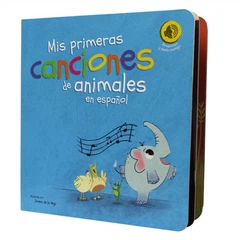
Walk into any toy buyer's showroom in 2026 and the same request comes up: screen-free educational toys that children can use alone, that parents trust, and that survive a retail shelf without an app download. The category has moved beyond a niche. For importers, distributors and brand owners, the hard part is no longer whether to stock educational toys - it is which format to choose, and how many to carry. This guide compares the four formats that dominate learning toys sourcing, explains what each one actually does, and shows how a single factory can supply a mixed educational toy programme under private label.
What Are Screen-Free Educational Toys?
Screen-free educational toys are learning products that deliver content through audio, tactile input or projection rather than a display. A child presses a button, inserts a card, taps a figure or turns a film disc; the toy responds with sound or light. There is no blue light, no account, no Wi-Fi and no advertising channel. That definition covers a surprising range - from a simple talking flash card reader to a conversational AI interactive toy - and the common thread is that the learning happens away from a screen.
Why does this matter commercially? Because the decision driver has shifted from the child to the parent. Parents who already manage screen time at home actively search for early learning toys that feel educational without being digital, and educational toys in this format answer that need directly. Retailers report that educational toys built this way carry a clearer story at the shelf: "no screen, no app" is easy to explain in three seconds. For a buyer building a learning toys assortment, that clarity shortens the path from display to purchase.

How Do Screen-Free Learning Toys Work?
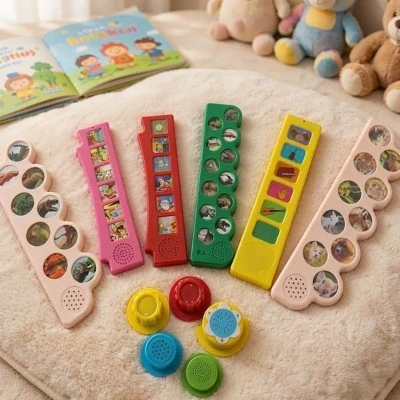
The mechanism differs by format, and the difference is what a buyer is really choosing. Card readers use an optical sensor: the card carries a code, the reader recognises it, and a microcontroller plays the matching file from onboard memory. A RFID story box uses a different trigger - a collectible figure with an embedded tag is set on a reading zone, and its story starts without pairing or a menu. Both are educational toys that work offline, but one scales through printed cards and the other through physical characters.
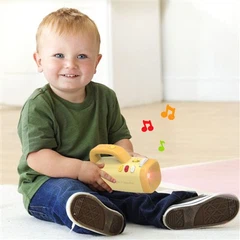
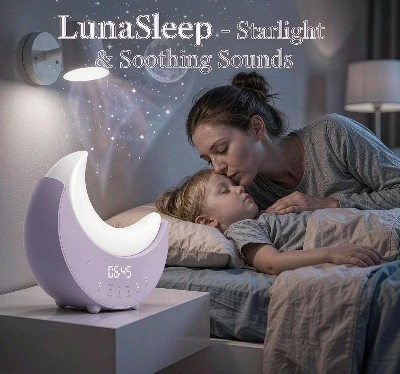
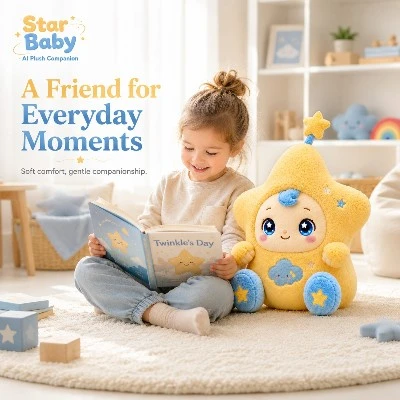
Projectors add a visual layer without adding a screen. A film disc carries images and frame-keyed narration; the unit throws the picture onto a wall or ceiling while the speaker plays the story. Sound plush and AI companions add sensors - touch, feeding, motion, LED eyes - so the toy reacts to a child rather than simply playing a track. Across all four mechanisms the pattern is the same: content is stored locally, interaction is physical, and the product needs no network. That is the technical promise behind early learning toys in 2027, and the reason these formats travel well into markets with strict rules on children's data.
Comparing the Four Formats: Flash Cards, Story Players, Projectors and AI Plush
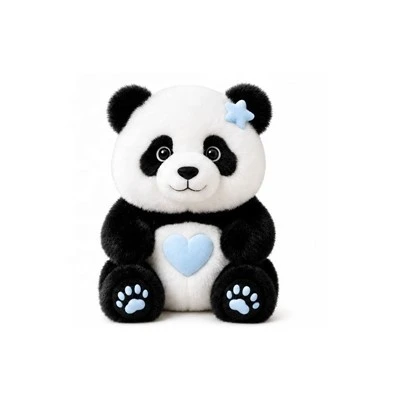
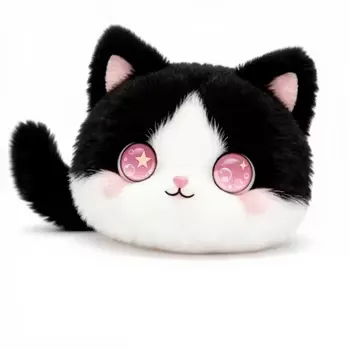
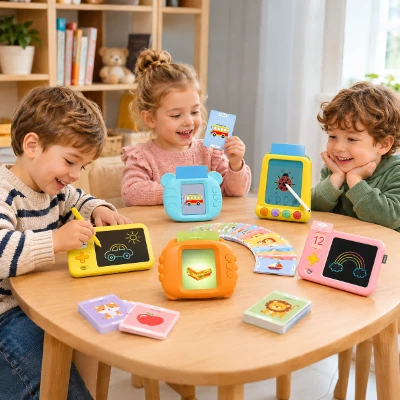
Here is the comparison most buyers actually need. A Kids Story Projector, an RFID Story Box and a card reader are three different answers to the same parental request. The Talking Flash Cards Learning Machine is the entry SKU: 112 cards, 224 words, 14 themes, low unit cost, strong vocabulary value. A Kids Story Player - card, figure or magnetic formats - is the gift SKU: higher perceived value, better shelf presence, deeper content libraries. A Kids Story Projector is the bedtime SKU: projection plus audio, strong in seasonal and nursery channels. AI plush is the premium SKU: conversational interaction, the highest price point, and the most customization surface.
Which one should a learning toys buyer start with? Our honest answer is the card reader, because it teaches the retail channel what the brand stands for before asking them to stock a premium unit. Add a story player for gifting, a projector for the bedtime aisle, and one AI companion to signal that the range is current. That four-step ladder is how a small educational toys assortment grows without betting the season on a single SKU - and it is the question most often omitted from competitors' buying guides.
Card Reader
Best for: vocabulary, entry price, high volume
Content scales with printed cards
Story Player & Projector
Best for: gifting, bedtime, higher margin
Content scales with figures, discs or cards

B2B Applications: Matching Format to Buyer Type
Education brands and publishers generally open with card readers because their own content is the asset. Toy importers and distributors prefer story players and projectors, where character and packaging drive the sale. Gift and seasonal companies lean toward plush and projection formats with strong visual appeal. Premium retailers want AI companions with a story behind the character. In each case the buyer is assembling educational toys around a channel, not around a specification sheet - which is why a supplier who makes all four formats is easier to work with than four specialist vendors.
Consolidation is a real cost saving. A mixed bulk order of educational toys can share carton planning, compliance documentation and a single shipment. Buyers planning wholesale programmes for 2027 should also check language coverage early: native-voice recording and bilingual pairs take lead time, and they are the first thing to be rushed when a season slips.
OEM/ODM Customization and Compliance Planning
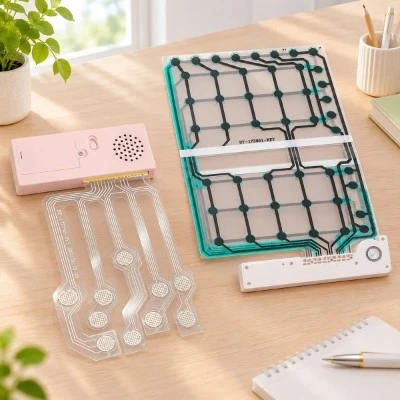
Across the four formats the customizable surface is broad: character design, shell colour, logo, audio files, language pairs, packaging, manuals, labels and barcodes. As a Shenzhen China factory, KidsoundBook coordinates hardware, content, printing and assembly in one workflow rather than handing a project between vendors. For OEM/ODM buyers that means one point of accountability from artwork to inspection.
Compliance is planned per destination market. Existing products reference standards such as CE, EN71, RoHS, FCC, ASTM F963, CPSIA and UKCA; certification documents can be provided upon request, and final compliance status should be confirmed before publishing for any educational toys bound for a regulated market. Category-standard MOQ is 1,000 pcs and standard lead time is 25–35 days, with fully custom tooling at 45–60 days. Ask for a quotation with your format, language pair and target quantity and we will return a line-item breakdown.

Why Source Screen-Free Toys From XDT
KidsoundBook is the brand of Shenzhen Xinditai Electronic Co., Ltd., founded in 2001. Our 5,000 m² facility runs a daily capacity above 20,000 units, has manufactured more than a million units, and ships to 120+ countries. The factory holds ISO9001, BSCI and SEDEX. We are a manufacturer with full in-house development - hardware, software and tooling - so a learning toys concept can move from drawing to sample without leaving the building.
Buyers who compare us against a trading company usually notice two differences: we can change the audio and artwork in-house, and we can put all four educational toys formats into one container. That combination matters more than a headline unit price when a brand is trying to launch a coherent range in one season. It is also why much of our wholesale business is repeat rather than one-off.
2027 Trends in Screen-Free Educational Toys
Three directions are worth planning for. First, multilingual is becoming the default: buyers want English-plus-local pairs in the first order, not as a later upgrade, which makes native-voice recording capacity a supplier-selection criterion for educational toys. Second, content is shifting from fixed sets toward swappable tokens, NFC cards and film discs - a reader becomes a platform with recurring content sales. Third, AI companions are moving down in price and into mid-tier assortments, so an AI interactive toy is no longer only a holiday luxury. For a learning toys buyer, the practical response is to choose one hardware family and build a content ecosystem around it.
Conclusion and CTA: Build Your 2027 Screen-Free Range
Screen-free educational toys are not a single product but a four-format ladder: cards for volume, story players and projectors for gifting, AI plush for the premium tier. The right mix depends on your channel, your content and your launch calendar. Tell us which format you want to start with, your target market and your quantity. Our team will confirm specifications, sample timing and a factory-direct quotation - and reserve production capacity while you finalise the artwork.
Get a Quote · Request a Sample · Ask for OEM/ODM Support · Send Your Requirements (format, quantity, language, destination country, packaging).
Rose Lin | rose@xinditai.com | Tel & WhatsApp: +86 13312972517
XDT Electronic Co., Ltd. / KidsoundBook