

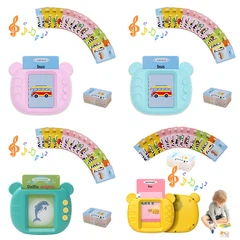


Kid Talking Flash Card With Drawing Tablet – Hear the Word, Then Write It on a Screen That Never Runs Out
Details: Two surfaces sit inside this one 15 mm body, and they do two different jobs. The card slot teaches: seat a card and the machine names the picture in a recorded voice, across 14 themes, 112 cards and 224 words. The LCD writing surface asks for it back: the child picks up the stylus and writes or draws what they just heard, on a panel that erases at the press of one key. Nothing is consumed, nothing is thrown away, and the same sheet of plastic takes a thousand attempts. A 36 mm driver handles the audio, 16 MB of memory holds the deck, and a 200 mAh cell recharges over USB-C. The case measures 245 × 192 × 15 mm and weighs 500 g – an exercise-book footprint that lives on a table rather than in a pocket. Minimum order: 1,000 pcs.
Two Surfaces, One Lesson – Why the Board Sits Beside the Slot
Most talking toys stop halfway. They deliver a word beautifully and then ask for nothing in return. A child listens, nods, and moves on with no way of showing whether anything landed. Listening and speaking are different skills, and the gap between them is where early language work actually happens. That gap is the reason this product carries a second surface: the card supplies the input, and the board collects the output.
Recognising a word and producing it are not the same achievement. A child can pick the right picture out of a spread long before they can say the word, and they can say the word long before they can write it. The card slot handles the first two stages on its own; the writing panel adds the third, which is the stage most toys skip entirely. When a five-year-old hears the word for a farm animal and then writes it across a screen, they have moved the word from something they understand to something they own.
The writing surface itself is the quiet engineering story. An LCD panel responds to pressure from the supplied stylus or from a fingernail, so nothing needs ink, paper or a charged pen. One key wipes it completely clean. A separate lock key freezes the panel so a sleeve or a palm cannot erase work in progress – a small detail that matters enormously to a child who has just finished a drawing they are proud of. Release the lock and the surface is new again.
That loop changes the economics of practice. A workbook lasts one attempt per page. A printed worksheet is finished the moment it is filled. This panel takes unlimited attempts with no consumable at all, which is why the argument lands so easily with parents who have watched a ten-page activity book disappear in an afternoon. Practice stops being a decision about cost and becomes a decision about time.
The physical format supports the same idea. At 245 × 192 × 15 mm the device is roughly the footprint of a school exercise book and thin enough to slide into a bag beside one, and at 500 g it stays put on a table instead of skating around while a child writes. It is a table object by design, used sitting down, which is exactly the posture writing practice needs. The 36 mm driver is sized so narration is clear across a room without being loud enough to pull a child away from the page.
Put the two surfaces together and a session has a shape. A card goes in, the word arrives, the child writes it, the key clears it, the next card goes in. Each cycle takes under a minute and ends in something the child made rather than something they watched. That is a very different half hour from thirty minutes of tapping a glass rectangle, and it is the half hour parents are trying to buy.
There is a practical detail parents notice within a week: a stylus is harder to lose than a pen lid, and a dropped board does not leave a mark on the carpet. The panel makes no sound of its own and needs no sharpener, no eraser and no waste bin. What it does need is a surface that survives being written on a few hundred times a week, which is a materials question rather than a computing one – and it is why the housing is built as a rigid slab with the panel recessed into it, not laid flat over a softer frame.
Kid Talking Flash Card With Drawing Tablet – Model FCB 001 Data Sheet
| Kid Talking Flash Card With Drawing Tablet – Specification Summary (FCB 001) | |
| Item | Kid Talking Flash Card With Drawing Tablet / FCB 001 |
| How It Plays | Seat a card for the spoken word, then write or draw the answer on the LCD surface and clear it with one key |
| Card Library | 14 themes, 112 cards, 224 words; cards and themes replaceable per order |
| Writing Surface | LCD drawing board for free writing and drawing; erasable and reusable with no ink or paper |
| Controls | Function keys: ON/OFF, repeat, volume, lock & clear |
| Speaker | 36 mm driver, tuned for spoken narration clarity |
| Memory | 16 MB on-board, holding the audio for the full card set |
| Battery & Charging | 200 mAh rechargeable lithium cell, USB-C charging |
| Languages | English, English–Chinese, English–Spanish, English–French, English–Arabic, English–German, English–Japanese, English–Korean; further languages on request |
| Customisation | Cards and languages fully customisable; artwork, word list and voice set per order |
| Unit Size | 245 × 192 × 15 mm |
| Gift Box | 288 × 170 × 35 mm |
| Unit Weight | 500 g |
| Carton Configuration | 36 pcs per carton / 52.5 × 48 × 31 cm |
| Carton Weight | 19 kg |
| Compliance | CE, CPC, UKCA, FCC, RoHS (ASTM F963 / EN71 testing available on request) |
| Order Quantity | 1,000 pieces (trial orders negotiable) |
Everything a buyer normally asks for travels as a single package: unit pricing tiers, sample and trial terms, the card artwork template, the voice-recording brief and the 3D files. Send your requirement list through the enquiry form or straight to the export desk, and the material is in your inbox inside one working day. Full range here: https://www.kidsoundbook.com/products
Eight Things a Child Can Do With the Board and the Deck
Details: The hardware is fixed for every order and the deck is rebuilt for each one. What the two surfaces are used for depends entirely on the word list behind them, and the same 112-card set supports eight distinct activities.
Copy the Word
The simplest and most-used loop: hear the word, write the word on the panel, clear it, take the next card. Handwriting practice and vocabulary practice happen in the same thirty seconds, which is rare in early-learning products and the main reason teachers warm to this format.
Draw What You Heard
No writing required. A child hears the word and draws the thing – the animal, the shape, the vehicle. Pre-writers can play this version, which extends the product down to an age group that would otherwise be shut out by a pen.
Listen, Then Answer
An adult seats a card and the child records the answer on the board before looking. Because the machine repeats the word on demand, the child controls how many times they hear it – which turns a small vocabulary drill into an independent task rather than an adult-led test.
Bilingual Copying
The paired language builds name the same picture in two languages. A child writes the word in both, one above the other, and the panel wipes clean for the next attempt. For households and schools running two languages, the board becomes the place where both scripts are practised side by side.
Spelling Under the Lock Key
Write a word on the panel, lock it, and pass the device to the child as a copy task they cannot accidentally wipe. The lock key was designed for exactly this: keeping a model visible while a second person works beside it.
Free Drawing Between Cards
The panel does not need the deck running. Left on a table with the machine switched off, it is simply a reusable drawing board – which is how it earns its place in a car, a restaurant or a waiting room even when nobody wants to practise vocabulary.

Number and Shape Work
Counting, shape tracing and simple sums all belong on a surface that erases. A child can work a sequence of additions without a worksheet, correct a mistake by pressing one key rather than crossing it out, and repeat the whole set as many times as they want.
Your Own Word List
Every run rebuilds the deck: your vocabulary, your illustrations, your narrator, your language. Publishers turn a title into a card set, schools load a term of spelling words, and brands commission an exclusive deck so the same library never appears under a competitor's name.
Who Puts This on a Shelf – Six Buyer Profiles
This product sells through several channels for several different reasons, and the reasons matter when a distributor is deciding where to place it first.
The Calendar – When This Combination Sells Hardest
| Seasonal & Occasion Calendar – Kid Talking Flash Card With Drawing Tablet | ||
| Season / Occasion | Who It Appeals To | Content & Pack to Lead With |
| Back to school | Parents, schools, stationery retail | Spelling and letter deck, classroom bundle pricing |
| Christmas & New Year | Parents, grandparents, gift retail | Gift-box edition, bilingual deck, screen-free message |
| Birthday (year-round) | Parents, party retail | Single-unit gift box, name-personalised card sleeve |
| Easter & spring holidays | Toy and gift retail | Animal and nature deck, window display with live demo |
| Summer travel season | Travel retail, hospitality venues | Carry pack, offline use, USB-C charging, no paper |
| Ramadan & Eid (MENA) | Regional retail | Localised bilingual deck, family gift packaging |
| Grandparents' & family days | Extended family | Classic first-words deck, keepsake box |
Two merchandising moves carry most of the weight here. The first is to demonstrate both surfaces – play a card, then write the answer yourself and hand the stylus to the customer. The second is to stock a second deck beside the device, because a buyer who understands that the deck is replaceable is buying a system rather than a single toy. Starter bundles that pair the tablet with a themed deck outsell the standalone unit almost everywhere we ship.
The Commercial Angle – A Device That Replaces Consumables
There is one argument in this product that retailers understand immediately, and it has nothing to do with audio quality. It is that the writing surface removes a running cost the customer is already paying.
| Kid Talking Flash Card With Drawing Tablet vs. Common Alternatives | ||
| Kid Talking Flash Card With Drawing Tablet (FCB 001) | Printed workbook / tablet with a learning app | |
| Number of attempts | Unlimited – press one key to clear | One per page, or unlimited on a lit screen |
| Consumables | None | Paper, ink and a new book every month |
| Spoken model of the word | Recorded voice, repeated on demand | None, or an app voice |
| Screen and blue light | Reflective LCD, no backlight | Backlit screen |
| Needs internet or an account | No | Usually yes for the app version |
| Work can be protected | Yes – lock key holds the panel | No equivalent |
| Works offline & travelling | Yes – USB-C rechargeable | Paper travels; apps usually do not |
We keep the claims precise. This is a card-reading toy with a spoken word library of 112 cards and 224 words across 14 themes, combined with a reusable LCD writing and drawing surface, function keys for ON/OFF, repeat, volume and lock and clear, and a 36 mm speaker. No backlight, no account, no consumables. That is the whole proposition, and it is a combination few products in the category can match in one body.
Inside the Build – Five Decisions Behind a 15 mm Body
A device this thin only works if several choices are made correctly at the start. These are the five that a buyer can verify on a sample unit.
The panel is reflective, not backlit
The writing surface works with ambient light, the way paper does. A child can work on it in daylight or under a normal lamp, and the surface never lights up on its own. For a product whose whole argument is that it does not behave like a screen, that single choice is what makes the claim true.
The lock key sits apart from the clear key
Erasing is instant, so accidental erasing would be a serious complaint. The two functions are deliberately separated, and the lock freezes the panel until it is released. A child protecting a finished drawing and a teacher protecting a worked example are protected by the same mechanism.
The audio path is sized for speech
A 36 mm driver inside a body only 15 mm thick has almost no room to work with, so the enclosure is arranged to give the driver its own air instead of sharing it with the board. The result is narration that stays intelligible at table distance, which is the only distance that matters when a child is writing while listening.
The footprint is an exercise book, deliberately
At 245 × 192 mm the device matches the proportions of the pads and workbooks it is meant to replace, so it stacks with them, travels with them and sits in the same bag. At 500 g it is heavy enough to stay flat on a desk while a small hand presses down on it.
The card deck is treated as a first-class part
112 cards and 224 words are not an accessory added at the end. The deck defines the age range, the language options and the retail price point, and it is the component that gets re-specified on every order. Buyers who spend their time on the deck, rather than on the colour of the housing, are the ones who reorder.
Buyer Questions – Answered Straight
Q1: Why add a writing surface instead of shipping a plain talking card reader?
Because listening alone leaves the child with nothing to do. The card slot delivers the word; the writing panel asks the child to give it back, and that second step is where the learning is consolidated. It also widens the age range in both directions – pre-writers can draw the answer, and older children can copy and spell it. One device then serves a family with two children of different ages, which is a real selling point at the counter.
Q2: How does the LCD panel behave in normal use?
It responds to pressure rather than to ink, so the supplied stylus or a fingernail will register while a resting palm will not. There is nothing to refill and nothing to replace. The clear key resets the whole surface instantly, and the lock key freezes it so that a sleeve, a bag or a second child cannot erase work in progress. Treat it as you would a rigid book cover and it will outlast any workbook by a wide margin.
Q3: Can the cards, the artwork and the language all be replaced with ours?
All three, and most partners change at least two. Send finished audio and illustrations and we check them against the print and playback specification; or give the studio a brief and we write, illustrate and record the set around your market. Card count, theme split and word order are yours to decide. A second themed deck launched a year after the first is the usual pattern once a market is proven.
Q4: What does the 200 mAh cell cover in practice?
It is sized for the way this product is actually used: short bursts of play, several times a day, rather than continuous playback. A writing-and-listening session lasts minutes, the tablet goes down, and it comes back later. Charging is over USB-C, the same cable a phone uses, so topping up between sessions is simple. The cell choice also keeps the body thin, which matters more to the product than a large battery would.
Q5: How is a 112-card deck organised for a child?
By theme, so a parent or teacher can pull out one group – animals, letters, numbers – instead of dealing with the full library every time. The 14 themes and 224 words are the default arrangement we recommend, and it is deliberately expandable: card size, board weight, finish and the way the set is boxed are all part of the specification you set for your order.
Q6: How small can a first order be, and what do samples cost?
Standard runs begin at 1,000 units. If you want to test a market first, batches between 200 and 500 pieces are possible, at a slightly higher unit cost that is credited back once the full order is placed. Samples of one to five units ship five working days after payment, and the sample charge is returned to you against the bulk order. It is cheaper to prove the product in one store than to guess across a country.
Q7: Can one SKU serve several markets?
The hardware is identical across builds; only the deck and the narration change. That means a distributor can hold a single device SKU with several language decks behind it, keeping warehousing simple while the catalogue speaks to more than one language community. The eight language builds cover English, English–Chinese, English–Spanish, English–French, English–Arabic, English–German, English–Japanese and English–Korean, and others are added on request.
Q8: Where is it made, and can we inspect the line?
The whole build sits in one plant in Shenzhen – card printing, panel assembly, PCB work, speaker tuning, moulding, final assembly, test and packing. Buyers who want to see it are welcome to visit, or to follow the line on a live video call. Nothing is farmed out to a third party, and every unit can be followed from the parts that arrived to the carton that shipped.
The Workshop Behind the Tablet
for children
This tablet comes out of Xinditai Electronics in Shenzhen, a factory that has been making children's audio products since 2010. Our work is OEM and ODM programmes for children's audio and interactive products – sound books, talking cards, drawing tablets, story players, projection toys and musical devices – built for brands, distributors and retailers across six continents.
Production runs across a 3,000-square-metre site, with card printing, panel assembly, injection moulding, PCB layout, acoustic tuning and packing all under one roof, and more than 100 engineers and operators on the floor. The house rule is a short one – Create with heart, ship with pride – and every stage carries its own inspection point, so a finished tablet can be traced back through the components it was built from.

Compliance & Certificates
Certificates
Standards move, so the certificate file is reviewed for every market we ship into and updated as requirements change. The copy that arrives with your quotation always describes the batch it was issued for.

CE

RoHS

FCC

SEMTA

EMC

ISO