









Why Is Understanding Your Child's Emotions So Important?
Research in child psychology shows that ages 0 to 6 are a critical period for emotional development. During this stage, whether a child feels "seen" and "understood" directly impacts their sense of security and emotional intelligence.
Yet parents often face two challenges:
On one hand, busy schedules make it hard to constantly tune into a child's emotional fluctuations.
On the other hand, even when emotions are noticed, parents may not know how to respond effectively-sometimes unintentionally escalating the situation.
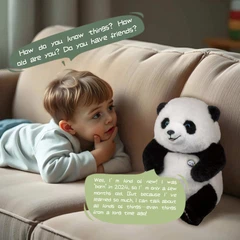
This is where an AI assistant capable of accurately and objectively identifying children's emotions becomes invaluable. It doesn't replace parental love-it serves as a powerful "third eye," helping parents understand their child's emotional state more promptly and scientifically.
Supporting 60 Languages: Breaking Cultural Barriers for Families Worldwide
Children's emotions are often expressed through language. For multilingual families,households, or Chinese families living abroad, language differences can become yet another hurdle in parent-child communication.
XDT AI's "Emotion Eye" supports 60 languages, including Chinese, English, Spanish, Arabic, French, German, Japanese, Korean, and many smaller languages and dialects.
No matter which language your family speaks, the AI can accurately understand your child's expressions.
When children express emotions in their native or mixed language, the AI doesn't "go deaf" due to language barriers.
Feedback and suggestions are delivered in the language the family is most comfortable with, ensuring parents can easily understand and act on them.
With this capability, XDT AI "Emotion Eye" truly becomes a culturally inclusive parenting companion, providing consistent emotional support for families no matter where they are in the world.


Real-World Scenarios: How AI Helps Parents
Scenario 1: Unexplained Crying
A baby suddenly starts crying uncontrollably. The parent is overwhelmed. XDT AI's "Emotion Eye" analyzes facial expressions and vocal cues in real time, identifying a blended state of "hunger + fatigue." It suggests: "Your baby may be hungry and also very tired. Consider a small feeding first, then soothe them to sleep."
Scenario 2: Silent Withdrawal
After school, a child comes home quiet and withdrawn, refusing to talk. AI detects subtle signs of "hidden frustration" through micro-expressions and tone. It advises: "Your child may be experiencing social difficulties at school. Instead of pressing for answers, try offering a hug and quiet companionship. Let them know it's safe to share when they're ready."
Scenario 3: Multilingual Family Communication
A family where one parent is Chinese, the other French, raising a child in both languages. When the child expresses anxiety in French, the AI accurately identifies the emotion and delivers feedback suggestions in Chinese for one parent and French for the other-ensuring both fully understand the child's state.
AI Empowers Parents-It Doesn't Replace Them
It's important to emphasize that XDT AI's "Emotion Eye" is designed not to replace parents, but to empower them.
It helps parents:
Develop emotional sensitivity: With AI's prompts, parents gradually learn to notice subtler emotional signals in their children.
Reduce parenting anxiety: When unsure why a child is upset, AI provides objective clues, reducing the frustration of endless guessing.
Build deeper connections: When children feel truly understood, parent-child bonds grow stronger and more secure.