
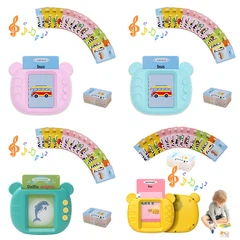
In the ever-evolving world of educational toys, talking flash cards machines stand out as a game-changer for children's learning. These interactive devices combine technology with fun, making education accessible and engaging for young minds. If you're a parent, educator, or toy manufacturer searching for insights on "how talking flash cards machines work," you've come to the right place. In this comprehensive guide, we'll explore the mechanics behind these innovative products, their benefits for child development, and how companies like Shenzhen Xinditai Electronic Co., Ltd. are pushing the boundaries with continuous innovation. Whether you're interested in the core functionality, customization options, or the latest iterations like talking flash cards with drawing tablets, this article covers it all.
As a leading player in the educational electronics industry, Shenzhen Xinditai Electronic Co., Ltd. has been at the forefront of developing talking flash cards that not only teach but also inspire. With a focus on OEM/ODM services, we cater to global clients by tailoring products to specific languages and content needs. But before we dive into the innovations, let's break down the fundamental question: How does a talking flash cards machine recognize and respond to inserted cards?
Understanding the Core Mechanism: Bar Code Recognition in Talking Flash Cards
At the heart of every talking flash cards machine is a sophisticated yet simple recognition system designed for seamless interaction. When a child inserts a flash card into the machine, the device uses an optical sensor to scan a printed bar code on the card. This bar code acts as a unique identifier, much like a fingerprint for each card's content.
The Step-by-Step Process of Card Recognition
The Step-by-Step Process of Card Recognition

1.Insertion and Initial Detection: The process begins when the child slides the card into the designated slot. The machine's internal mechanism gently guides the card into position, ensuring it's aligned for accurate scanning. Built-in sensors detect the insertion, triggering the recognition sequence.
2.Bar Code Scanning: Once positioned, an infrared or LED-based optical reader scans the bar code printed on the card. These bar codes are typically one-dimensional (1D) or quick response (QR) codes, encoded with data that corresponds to specific audio files or educational content. The scanner decodes this information in milliseconds, translating the visual pattern into digital data.
3.Data Matching and Retrieval: The decoded bar code data is cross-referenced with the machine's pre-programmed database. This database is embedded during manufacturing, containing audio clips, sounds, and sometimes visual cues for each card. If the match is successful, the machine retrieves the associated content.
4.Playback Activation: Upon successful recognition, the device plays the corresponding audio through built-in speakers. For example, if the card features an animal like a "lion," the machine might roar and say, "This is a lion. Lions live in the savanna." This instant feedback loop reinforces learning through auditory stimulation.
This recognition technology ensures reliability and speed, making it ideal for young children who may not have the patience for complex interfaces. Unlike traditional flash cards that rely on manual reading, talking flash cards machines automate the process, reducing the need for adult supervision and allowing kids to learn independently.
Why Bar Code Technology? Advantages Over Other Methods
Bar codes were chosen for their cost-effectiveness, durability, and ease of integration. Compared to RFID (Radio-Frequency Identification) chips, which require more expensive hardware, bar codes are printed directly on the cards, keeping production costs low. They're also resistant to wear and tear-essential for toys handled by energetic toddlers.
In terms of accuracy, modern talking flash cards machines boast a recognition success rate of over 99%, thanks to error-correcting algorithms in the firmware. If a card is dirty or slightly damaged, the system can often still decode it, preventing frustration during playtime.
The Birth of Talking Flash Cards: Making Learning Fun and Effortless
The inception of talking flash cards machines stems from a simple yet profound goal: to make learning more enjoyable for children. Traditional educational tools, like paper flash cards, often feel monotonous and require constant parental involvement. Recognizing this gap, innovators developed these machines to blend technology with pedagogy.

Historical Context and Evolution
Educational toys have come a long way since the early 20th century when flash cards were first popularized by psychologists like Maria Montessori. However, it wasn't until the digital age that interactive elements were added. The first talking flash cards emerged in the late 1990s, but advancements in microelectronics have transformed them into the smart devices we see today.
Shenzhen Xinditai Electronic Co., Ltd., established in the heart of China's tech hub, has been instrumental in this evolution. Our team of engineers and educators collaborates to embed pre-written programs into each machine before it leaves the factory. These programs include vast libraries of content-covering alphabets, numbers, animals, colors, and more-designed to align with early childhood curricula.
By pre-programming the content, we ensure consistency and quality. No internet connection is needed, making these devices safe and offline-friendly for kids. The result? A product that turns passive learning into an active, multisensory experience, fostering curiosity and retention.
Benefits for Children's Development
Research from child development experts, such as those at the American Academy of Pediatrics, highlights the importance of interactive play in building cognitive skills. Talking flash cards machines excel here by:
Enhancing Auditory Learning: Hearing words and sounds helps with phonics and language acquisition.
Boosting Memory and Recall: Repetitive playback strengthens neural pathways.
Encouraging Independence: Kids can explore at their own pace, building confidence.
Promoting Fine Motor Skills: Inserting cards refines hand-eye coordination.
For parents searching for "educational toys for toddlers," these machines offer a screen-free alternative to tablets, reducing eye strain while delivering similar engagement.
Innovation at Shenzhen Xinditai: Iterating on Talking Flash Cards
Innovation doesn't stop at basic recognition. At Shenzhen Xinditai Electronic Co., Ltd., we continuously iterate on our talking flash cards products to meet diverse needs. By combining core functions with new features, we create tailored solutions for different age groups.