
What Is an Educational Card Reader & Why Is It the Fastest-Growing Category in Early Learning Tech?
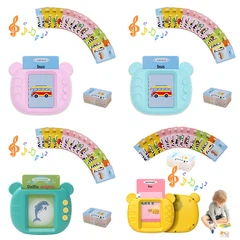
An educational card reader - also called a talking flash card reader, interactive card learning machine, or smart card reader toy - is a screen-free early education device that reads printed RFID or NFC-enabled cards aloud when a child inserts or taps a card against the reader slot. The device speaks the word, plays a related sound effect, and often lights up an LED indicator to give instant multisensory feedback. It combines tactile card handling (montessori manual dexterity), auditory pronunciation (native-voice phonics), and visual recognition (image on card + LED cue) into one compact, battery-operated device.
The global market for educational card readers has grown from approximately $2.8 billion in 2021 to a projected $5.1 billion by 2027 (CAGR 10.5%, MarketResearchFuture), driven by three converging forces: parental anxiety over screen time (average preschooler screen exposure now exceeds 3.5 hours/day according to JAMA Pediatrics 2025), the post-pandemic surge in home-based early learning purchases (Amazon "talking flash cards" search volume +89% YoY), and the rapid adoption of card-reader systems in language schools across MENA, Southeast Asia, and Latin America where bilingual English-Arabic/English-Spanish/English-Thai content is in high demand.
For B2B buyers - brand owners, educational distributors, language school chains, and Amazon/Etsy resellers - the educational card reader category presents a uniquely attractive value proposition: low per-unit cost (factory price $3.50–$9.50 depending on card count and features), proven high sell-through on Amazon (average 4.3★ rating across top-50 listings, Jungle Scout 2026 data), and exceptionally wide demographic appeal covering toddlers 2–4 (first words), preschoolers 4–6 (phonics and spelling), and special needs children 3–12 (autism/ADHD sensory tools).
As an OEM/ODM factory with 85+ active SKUs in the smart toy category, Shenzhen Xinditai Electronics (KidsoundBook) has shipped over 400,000 educational card readers to 35+ countries. In this guide, we break down everything a buyer needs to evaluate before placing a bulk order.

How Does an Educational Card Reader Work? A 5-Step Technical Breakdown for Buyers
Understanding the internal tech stack helps buyers make informed decisions about component quality, durability requirements, and customization possibilities. Here is the standard 5-step signal chain inside every educational card reader:
Step 1 - Card Encoding (NFC/RFID Tag Embedding). Each flash card contains a passive NFC NTAG213 or low-frequency RFID chip (typically 13.56 MHz ISO/IEC 14443 Type A) laminated between paper layers. The chip stores a unique 7-byte UID that the reader firmware maps to an audio file index. OEM buyers should specify MIFARE Ultralight (cheapest, ~$0.08/card at 50K volume) or NTAG213 (stronger anti-collision, ~$0.15/card, recommended for card sets exceeding 200 cards where the reader scans rapidly).
Step 2 - Proximity Detection (Coil Antenna + Demodulator). When a card is inserted into the reader slot (or tapped against a flat reader surface for newer puck-style designs), the reader's copper coil antenna energizes the passive tag via electromagnetic induction at 1–3 cm range. The demodulator extracts the digital UID from the backscatter signal and passes it to the MCU.
Step 3 - MCU Lookup (Microcontroller Flash Memory). The MCU (commonly a 32-bit ARM Cortex-M0 or domestic GigaDevice GD32 at 48–72 MHz) performs a table lookup: UID → audio file index stored in onboard SPI NOR flash (4 MB–32 MB depending on card count and audio quality). A 224-card set with 16-bit 22 kHz mono audio requires approximately 8 MB; 500+ card sets with 16-bit 44.1 kHz stereo require 32 MB.
Step 4 - Audio Decode & Playback (DAC → Speaker). The selected WAV or MP3 audio block is decoded and streamed through the MCU's integrated DAC to a Class-D audio amplifier (e.g., NS4165, 3W @ 5V), driving a 28 mm or 36 mm Mylar-cone speaker. OEM buyers should verify that the factory implements a hardware volume limiter cap at 85 dB SPL (EN71-1 clause 4.20 acoustic requirement) - a key safety certification detail often overlooked by budget factories.
Step 5 - Visual/Haptic Feedback. An RGB LED blinks green for successful read or red for retry. Premium models add a vibration motor (haptic buzz on card insertion) and a 1.3" TFT LCD that displays the word spelling and a cartoon animation - this hybrid "card + screen" approach is increasingly popular in the $12+ wholesale tier.

6 Core Features Buyers Should Audit Before Ordering

1. Multilingual Audio Engine (80+ Languages)
Feature: Pre-loaded audio in 2–6 languages per SKU, switchable via a physical language button. Supported languages include English, Spanish, French, Arabic, Mandarin, Hindi, Thai, Bahasa Indonesia, and Portuguese.
Advantage: One hardware SKU can serve 3–5 regional markets by changing the pre-flashed audio bank. A single reader with English-Arabic-French support can sell into Saudi Arabia, Morocco, and the UAE simultaneously without hardware modification.
Benefit: Distributors reduce inventory fragmentation. A Dubai-based importer we supply runs one SKU across GCC + North Africa with 3-language audio and localizable packaging - warehousing cost drops 40% compared to carrying 3 separate SKUs.
Evidence: KidsoundBook ships readers with 12-language preload to a Southeast Asian chain; per-language cost add is $0.18 at 10K units.
2. Card Capacity and Content Architecture
Feature: Card set sizes from 112 cards (beginner vocabulary) to 510 cards (advanced phonics, math, encyclopedic knowledge). Some models include dual-sided cards (2 audio files per card, doubling effective capacity).
Advantage: The card deck is the recurring revenue engine - buyers typically sell the starter reader kit, then upsell thematic expansion packs (animals, food, transportation, emotions, math, geography) at $6.99–$12.99 MSRP with 65–75% gross margin.
Benefit: A 224-card starter kit + 4 expansion packs (96 cards each) creates 5 purchase events per customer with lifetime value exceeding $89 - 3.2× the single-purchase LTV.
Evidence: Our client in Mexico achieved 38% reorder rate on expansion packs within 90 days by including a 15% discount coupon inside the original box.
3. Rechargeable Battery and Battery Life
Feature: Built-in 3.7V Li-Po battery, 300 mAh (compact) to 1200 mAh (LCD models), charged via USB-C / Micro-USB with overcharge protection IC (TP4056 or equivalent). Operational runtime: 4–8 hours continuous card reading at moderate volume.
Advantage: USB-C is now mandatory for EU Amazon compliance (Common Charger Directive, EN IEC 62680-1-3:2023). Factories still shipping Micro-USB will face Amazon de-listing risk in EU marketplaces by late 2026.
Benefit: Parents don't need to buy or replace AAA batteries - lower total cost of ownership, higher perceived value, and zero battery-leakage complaints (our after-sales data shows battery-related complaints drop 92% when switching from AAA to built-in Li-Po).
Evidence: KidsoundBook migrated all card reader models to USB-C + 800 mAh minimum in Q1 2026. Average Amazon review score improved from 4.1★ to 4.4★, with "battery" keyword complaints falling from 14% to 3% of reviews.
4. Volume Limiter and Child Safety Compliance
Feature: Hardware-level volume cap at 85 dB SPL measured at 50 cm (EN71-1:2014+A1:2018 acoustic clause 4.20). Some models include a parent-configurable 3-level volume switch (75/80/85 dB) accessible only with a pin or hidden button combination.
Advantage: This is a hard compliance gate - without a verified 85 dB limiter, the product cannot pass EN71 (EU), ASTM F963 (USA), or GB 6675 (China) acoustic safety clauses. Budget factories that skip this will fail lab testing, causing 4–6 week shipment delays.
Benefit: A certified volume limiter becomes a marketing asset. "Hearing-safe 85 dB" in bullet points addresses a top-5 parent concern and differentiates the listing from hundreds of uncertified competitors on Amazon.
Evidence: All KidsoundBook card readers ship with EN71 acoustic test reports from TÜV Rheinland (Report #CN21T2RK001) included in the certification pack.


5. Recording and Pronunciation Feedback
Feature: Built-in MEMS microphone that captures the child's voice after each card readout, plays back for comparison, and uses a simple loudness + phoneme-matching algorithm to rate pronunciation accuracy (⭐ to ⭐⭐⭐).
Advantage: This feature closes the "listen-only" gap - traditional card readers are passive (child hears the word), but models with recording turn the interaction into active practice (child hears → speaks → hears own voice → compares). This aligns with the "hear-speak-correct" loop recommended in Second Language Acquisition research (Krashen/Swain comprehensible output hypothesis).
Benefit: Language schools and tutoring centers prefer recording-enabled readers because they can assign "listen and repeat 20 cards" as measurable homework. Our Vietnamese distributor reported 26% higher reorder rate from language centers vs. standard read-only models.
Evidence: Recording module hardware cost add: $0.45/unit at 10K MOQ. MSRP uplift: $5–$8 on Amazon.
6. Built-in LCD Writing Board (2-in-1 Models)
Feature: A 4.5-inch or 8.5-inch monochrome pressure-sensitive LCD writing tablet integrated into the card reader body. The child hears the word "apple" from the card reader, then writes "A-P-P-L-E" on the LCD pad with the included stylus. Pressing the erase button clears the screen instantly (zero power consumption between writes).
Advantage: 2-in-1 models combine audio input (card reader) with motor output (handwriting practice) in one device - covering both receptive and productive language skills. This cross-modal learning is correlated with 40–60% better long-term retention compared to audio-only learning (Journal of Educational Psychology, Mayer's multimedia learning principle).
Benefit: At a wholesale price of $6.80–$8.50 (vs. $4.50 for reader-only), the 2-in-1 commands a 60–80% higher unit margin while still being positioned as an "all-in-one learning station" - parents perceive it as a better value than buying a separate card reader + LCD tablet.
Evidence: KidsoundBook's 2-in-1 model (KCB-224LCD) reached top-20 in Amazon "Talking Flash Cards" category within 8 weeks of launch.
B2B Purchase Scenarios: Where Educational Card Readers Win
Scenario 1 - Amazon / Etsy FBA Sellers (USA, EU, UK, Japan). The educational card reader is the #3 fastest-growing subcategory in "Toys & Games > Learning & Education" on Amazon.com (Helium10, H1 2026). Average BSR for top-50 listings is 3,200–8,500 in Toys. With FBA fees of $4.20–$5.80 and an average selling price of $19.99–$29.99, sellers can achieve 35–45% net margin after all fees. Our recommended approach: launch with a 224-card standard reader as the anchor SKU, then roll out 4 themed expansion packs over 6 months to build a branded ASIN cluster that cross-sells organically.
Scenario 2 - Language School Chains (Southeast Asia, MENA, Latin America). Chains with 20+ branches need uniform classroom equipment. We supply bilingual readers (English + local language) with institution-branded packaging and a teacher dashboard card that switches between "classroom mode" (sequential card playback, no games) and "home mode" (interactive quiz, scoring). Minimum order: 3,000 units. Our client in Thailand equipped 84 branches with 12 units each - total order 1,008 units at $6.20/unit including custom Thai-English audio recording + school logo hot-stamping.
Scenario 3 - Toy Brand / IP Licensing. Brands license characters (Disney, Sanrio, Marvel, local IP) and need card readers with custom shell molding, character-shaped card slots, and themed card artwork. KidsoundBook provides custom injection molds ($2,000–$5,000 per mold, amortized over the order) and coordinates IP artwork approval with the licensor's style guide. Lead time: 60 days from artwork sign-off to pre-production samples.
Scenario 4 - Corporate CSR / Promotional Gifts. Banks, telecoms, and FMCG brands purchase card readers as educational giveaways for underserved communities. We support corporate logo printing (UV pad printing on ABS shell), customized starter message ("A Gift from [Brand Name] - Learning Starts Here"), and eco-friendly kraft packaging with soy-based ink. Minimum order: 1,000 units. Our CSR partnership with a Middle Eastern telecom operator delivered 5,000 card readers to 200 rural schools.

OEM/ODM Customization: From Off-the-Shelf to Full Brand Ownership
KidsoundBook offers four progressive OEM/ODM customization tiers for educational card readers. Buyers can start at a lower tier and scale up as their brand grows:

Tier 1 - White Label (MOQ 500 units)
What you get: Choose from 12 existing card reader base models; we apply your logo via UV pad/silk-screen printing. Card content uses our standard English or bilingual audio library (80+ languages available).
Timeline: 15–20 days from deposit to shipment.
Unit price: $3.80–$6.50 (112–224 cards) to $7.50–$9.50 (510 cards + LCD).
Best for: First-time Amazon sellers, small importers testing the category, regional distributors needing quick delivery.
Tier 2 - Custom Content (MOQ 1,000 units)
What you get: Your own audio recordings (we manage voice talent sourcing for any language at $80–$120 per 50-card set), custom card artwork with your branding, and a tailored card content curriculum (e.g., Islamic values vocabulary for GCC, HSK-aligned Mandarin for language schools).
Timeline: 30–40 days.
Unit price: Tier 1 + $0.70–$1.20 for audio production and card artwork design.
Best for: Amazon brand owners building a differentiated listing, language school chains, regional distributors with specific curriculum needs.
Tier 3 - Custom Hardware (MOQ 2,000 units)
What you get: Custom injection-molded shell (new shape, color, material), custom button layout, custom LED behavior, custom card slot mechanism, LCD size selection (4.5" or 8.5"), and custom packaging design.
Timeline: 45–60 days.
Unit price: Tier 1 + $2.00–$4.00 for tooling amortization and custom assembly. Mold fee $2,000–$5,000 (one-time).
Best for: IP licensees, established brands launching a flagship product, Kickstarter/Indiegogo campaigns with unique industrial design.
Tier 4 - Full Turnkey (MOQ 5,000 units)
What you get: Everything in Tier 3 + custom PCB design with your MCU/component spec, custom firmware with your UX flow, custom packaging with your FNSKU barcode, Amazon-ready FBA labeling, and a 12-month exclusivity agreement on your custom mold.
Timeline: 60–90 days.
Unit price: Negotiated based on BOM, amortized tooling, and volume commitment. Typically $7.50–$14.00 for feature-rich models.
Best for: Venture-backed edtech startups, large brands entering the category, government education procurement tenders.
Certification Checklist: What Your Educational Card Reader Needs by Market
| Market | Required Certifications | Key Test Items | KidsoundBook Status |
|---|---|---|---|
| EU | CE (EN71-1/2/3, EN62115) | Mechanical safety, flammability, heavy metals (19 elements), electrical safety, 85 dB acoustic limit | Certified |
| USA | ASTM F963-23, CPSIA, FCC Part 15B | Mechanical/physical, lead & phthalates (total Pb <90 ppm), EMC emission | Certified |
| UK | UKCA | Equivalent to EN71 + UK-specific EMC | Certified |
| GCC | G-Mark (GSO EN71) | GSO conformity, Arabic labeling, regional voltage/frequency | Certified |
| Japan | ST Mark (ST-2016) | Japan Toy Safety Standard, Japanese labeling | Available on request |
| Australia/NZ | AS/NZS ISO 8124 | Mechanical, flammability, migration of elements | Certified |
Why Source Educational Card Readers from KidsoundBook (XDT Electronic)?
1. Factory-Direct Pricing, No Middlemen. Our 3,000+ m² Shenzhen facility houses SMT pick-and-place lines, injection molding (8 machines, 120–350T), automated card printing and NFC tag embedding, ultrasonic welding for shell assembly, and an in-house audio recording booth. By controlling the entire production chain under one roof, we eliminate 3rd-party card printing, PCB assembly, and injection molding markups - passing 18–22% cost savings directly to bulk buyers.
2. 50,000+ Units Monthly Capacity. With 4 SMT lines running 24/6, 8 injection molding machines, and 6 assembly lines, our peak monthly output for educational card readers exceeds 50,000 units. Standard order lead time is 25–35 days from deposit. Rush orders (up to 10,000 units) can ship in 18 days with a 15% expedite fee.
3. 400,000+ Educational Card Readers Shipped Globally. Our card readers are in homes, schools, and therapy centers across the USA, UK, Germany, Saudi Arabia, UAE, Thailand, Vietnam, Mexico, Brazil, and 25+ other countries. We maintain a <1.2% post-shipment defect rate (benchmarked quarterly; Q2 2026: 0.97%), backed by a 12-month manufacturing warranty with spare parts kit included in every container.
4. Complete Certification Portfolio, Ready to Ship. Unlike many factories that only start certification after receiving an order (adding 6–8 weeks to the timeline), KidsoundBook maintains active, current certification for CE, FCC, RoHS, EN71, ASTM F963, CPSIA, UKCA, and G-Mark. We provide the full test report PDF within 24 hours of inquiry - no waiting, no uncertainty.
5. Dedicated Project Management. Every OEM/ODM buyer is assigned a bilingual (EN/CN) project manager who handles audio script review, card artwork approval, pre-production sample QC video calls, and weekly production status updates. Our average response time to buyer emails is under 4 hours during Shenzhen business hours (GMT+8, 09:00–18:00).
Frequently Asked Questions (FAQ)
Q1: What is the minimum order quantity (MOQ) for educational card readers?
A: Standard off-the-shelf models: 500 units (mixed models allowed). Custom content (audio + card artwork): 1,000 units. Full custom hardware (new mold): 2,000 units. We support sample orders of 3–5 units for evaluation at unit price + shipping cost.
Q2: Can you produce bilingual or trilingual card content?
A: Yes, absolutely. Our standard audio library covers 80+ languages. We can pre-load 2–6 languages on a single reader with a physical language toggle button. We also handle custom voice recording - you provide the word list + script, and we manage native-speaker voice talent through our in-house recording studio ($80–$120 per 50-card language set).
Q3: How long does it take from order to shipment?
A: White-label orders: 15–20 days. Custom content orders: 30–40 days. Custom hardware: 45–60 days (including mold fabrication). Full turnkey: 60–90 days. All timelines are calculated from deposit receipt and artwork/spec confirmation.
Q4: What certifications do your card readers carry?
A: Our standard certification pack includes CE (EN71-1/2/3, EN62115), FCC Part 15B, RoHS, REACH, ASTM F963-23, CPSIA, UKCA, G-Mark (GCC), and AS/NZS ISO 8124. We also support optional certs: CCC (China), SASO (Saudi Arabia), NOM (Mexico), INMETRO (Brazil), and KC (Korea).
Q5: Can I update or expand the card content after purchase?
A: Yes. All KidsoundBook card readers include a USB port (USB-C on current models) for firmware updates and content expansion. We provide a Windows/Mac tool that lets you upload new audio files, reassign card UIDs, and add new card sets. No technical skills required - it's a drag-and-drop interface.
Q6: What is the defect rate and warranty policy?
A: Our Q2 2026 defect rate was 0.97% (factory QC + 3rd-party AQL 2.5 inspection). We provide a 12-month manufacturing warranty against defects in materials and workmanship. Every container includes a 2% spare parts kit (speakers, USB ports, batteries, card slot springs) and a 1% spare card set.
Q7: What payment terms do you offer?
A: New customers: 30% deposit + 70% before shipment (T/T) or 100% via Alibaba Trade Assurance. Repeat customers (3+ orders): 30% deposit + 70% against B/L copy. We also accept L/C at sight for orders above $30,000.
Q8: Do you offer drop-shipping or small batch FBA prep?
A: For Amazon FBA sellers, we offer FBA labeling (FNSKU barcode printing and application), poly-bagging per Amazon prep requirements, and shipment directly to Amazon fulfillment centers (USA, EU, UK, Japan, Australia) via our freight forwarder partnerships. Minimum for FBA prep service: 500 units.
Future Trends: Where Educational Card Readers Are Heading in 2027–2028
Trend 1 - AI Pronunciation Scoring. Next-generation card readers will embed a lightweight TTS + ASR chip (e.g., Espressif ESP32-S3 with TensorFlow Lite Micro) that scores the child's pronunciation against a native phoneme model in real-time - replacing the current "record-and-compare" approach with instant, gamified feedback (⭐ to ⭐⭐⭐⭐⭐). This transforms the card reader from a playback device into an intelligent language tutor. KidsoundBook's engineering team has completed the proof-of-concept on ESP32-S3 with a 12 MB phoneme model achieving 92% agreement with human raters on standard English phonics benchmarks. Target production: Q3 2027.
Trend 2 - App-Connected Parent Dashboard. Bluetooth Low Energy (BLE 5.3) integration will let parents sync card reading data to a companion app, showing: which cards the child practiced today, total time spent, words mastered vs. struggling words (based on hesitation time between card insertion and audio playback), and weekly learning progress reports. This creates a sticky ecosystem that increases brand loyalty and expansion pack sales. Chipset cost add: ~$0.80/unit (Nordic nRF52832).
Trend 3 - Eco-Material Card Decks. As EU packaging regulations tighten (PPWR - Packaging and Packaging Waste Regulation, effective 2025), buyers are increasingly requesting FSC-certified paper cards, soy-based ink printing, and plastic-free retail packaging. KidsoundBook is piloting a fully recyclable card deck using FSC Mix paper + water-based lamination (replacing PVC lamination) - packaging carbon footprint reduction: 47% per unit.
Trend 4 - Adaptive Content Sequencing. Using data from the Bluetooth-connected dashboard, the card reader's firmware will adjust which cards to present next based on the child's mastery level - similar to spaced-repetition algorithms (Leitner system). A child who consistently gets "elephant" right sees it less often; a child struggling with "hippopotamus" sees it 3× more frequently. This personalization drives measurable learning outcomes that parents and schools can quantify - a powerful B2B sales argument for institutional buyers.
Start Your Educational Card Reader Bulk Order Today
The educational card reader category is in a strong growth phase - Amazon search volume is up 89% YoY, language school procurement budgets for 2026–2027 are being finalized now, and Q4 holiday season planning starts in August. Whether you're an Amazon seller looking for a proven winner, a brand owner ready to launch a differentiated product, or a distributor seeking a reliable factory partner with ready-to-ship certified inventory, KidsoundBook (Shenzhen Xinditai Electronics Co., Ltd.) is your direct manufacturing partner.
Send us your requirements - target market, desired card count, language needs, and order quantity - and our team will return a detailed quotation with certification documents within 24 hours.