




Castle Phonograph Card Player – A Product That Explains Itself in Ten Seconds on a Shop Floor
Details: There is one test that decides whether a children's product works at retail, and it has nothing to do with the product's quality. Put it on a shelf and watch a shopper who has never heard of it. If they understand it in ten seconds without help, it will sell; if they need to read a paragraph, it will sit. This castle passes that test for reasons that are worth describing carefully, because the same reasons apply to how a buyer should stock it. It is 117.7 × 117.7 × 116.9 mm and 450 g, with 60 story cards – fifty in English and ten in Chinese – a side lever, warm light behind the windows and a 200 mAh Type-C cell. Minimum order: 1,000 pcs.
The Shelf Is the First Customer
Most of what determines a sale in this category happens before anyone speaks to a member of staff. A shopper walks an aisle at roughly a metre a second, scanning for something that matches a picture already in their head. Products that require reading lose that race. Products whose shape already communicates what they do win it, and this is where the castle silhouette does its commercial work: turrets, windows and a handle read as a story object from several metres away, in any language, before a single word on the carton has been read.
The second advantage is that the demonstration requires no electricity of its own. A card goes into the slot, the lever turns, a voice comes out. No pairing, no app, no login and no salesperson explaining a subscription. In a shop where a member of staff is covering three aisles, that matters more than any specification: the product can complete a demonstration with no one present, which almost nothing else in the audio aisle can do.
Then there is the child. In this purchase the child is frequently the person who decides and the parent is the person who pays, and a product a child can physically operate in the shop has already won the first vote. The lever is sized for a small hand, the card is easy to seat, and the light comes on in front of them. Parents buy the thing that made their child stop walking, which is why floor-level placement beats eye-level placement for this product class.
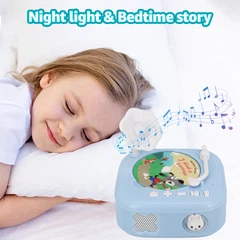
Lighting is the detail buyers underestimate. Most shops are brightly lit, and a night-light product shown under a ceiling of strip lights looks like a plastic model rather than a bedroom object. Move it thirty centimetres into a shadowed corner, or into a fixture with a shelf above it, and the same unit suddenly reads as something that belongs beside a bed. The product does not change; the presentation does, and the difference in conversion is large enough that we now recommend a dimmed demo position as standard.
Packaging carries the last part of the argument. The carton is 200 × 155 × 80 mm, a size that sits comfortably in a gift fixture and stacks without a bespoke display stand. Because the box is small and the shape is distinctive, a buyer can build a shelf block out of it – several units facing out, one opened and running – without commissioning any custom point-of-sale material. That keeps the cost of a first listing low, which is what makes a trial order easy to justify.
One more factor belongs on this list, and it is the one buyers tend to mention only after their first season: the product generates repeat traffic of its own. A household that buys a castle comes back for card sets, so the retailer gains a second visit from a customer who already trusts what the brand does. Products that sell once and are never heard from again occupy the same shelf for none of the follow-on revenue, and over a trading year that arithmetic is what decides whether a line is kept or quietly delisted.
None of this is about being clever in a showroom. It is about the reality of a retail floor: limited staff time, limited attention from the shopper and a limited window in which a decision gets made. A product that needs no explanation has an advantage that no amount of advertising can substitute for, and this one was shaped to keep that advantage intact.
Castle Phonograph Card Player – Model LMC 003 Data Sheet
| Castle Phonograph Card Player – Specification Summary (LMC 003) | |
| Item | Castle Phonograph Card Player / LMC 003 |
| How It Plays | A card is seated and the side lever turned to begin; there is no button to press and no screen to swipe |
| Card Library | Sixty cards ship as standard, fifty in English and ten in Chinese, with language, story content and artwork all open to change |
| Night Light | Warm LEDs sit behind the castle windows, come on with playback and fade away as the story closes |
| Battery & Charging | 200 mAh lithium cell charged through a Type-C port |
| Housing | Rounded ABS shell on a weighted base that resists tipping when the lever is pulled hard |
| Unit Size | 117.7 × 117.7 × 116.9 mm |
| Unit Weight | 450 g net |
| Gift Box | 200 × 155 × 80 mm |
| Carton Configuration | 30 pcs per carton / 49.5 × 37 × 43 cm |
| Carton Weight | 14.5 kg |
| Compliance | CE, CPC, UKCA, FCC, RoHS (ASTM F963 / EN71 testing available on request) |
| Order Quantity | 1,000 pieces (trial orders negotiable) |
For buyers planning a listing, the material we send covers more than the specification: tiered unit pricing, sample and trial terms, the card artwork template, the narration brief, suggested shelf layouts and the 3D data. Request it through the enquiry form or direct to the export desk and it is sent within one working day. Full range here: https://www.kidsoundbook.com/products
Eight Retail Levers This Product Hands a Buyer
Details: The machine is identical in every shipment; what a buyer does with it on a shop floor is not. These are the eight merchandising moves that consistently produce the best results in the markets we ship to, and all of them work with standard fixtures.
Put It Low and Let the Child Reach It
Children in this category decide more sales than adults do. A unit at a child's height, reachable without a parent lifting anything, gets picked up and demonstrated continuously through the day. Raising it to adult eye level removes the only salesperson the product has.
Keep One Unit Open and Running
A sealed box is a photograph. An open unit with a card in the slot and the light on is a demonstration. Buyers who run one demo unit typically report a marked lift in the surrounding stock, and the cost of that unit is recovered by the first extra sale it produces.
Move the Demo Out of the Light
The night light disappears under bright ceiling lighting. A demoted corner of the fixture, or a shelf directly above the unit, restores the effect completely. It is the cheapest change a retailer can make to this product and the one with the largest visible effect.
Stack the Box as Its Own Display
At 200 × 155 × 80 mm the carton faces up neatly and stacks in a block of six or eight without a stand. Because the silhouette is already a recognisable shape, the block reads as a castle shelf rather than a pile of boxes, so no custom point-of-sale material is needed for a first listing.
Sell a Second Deck Beside the Unit
A shopper who can see that the cards are replaceable understands the product as something that lasts. Placing a spare or seasonal deck next to the demo raises the average basket and, more importantly, gives the customer a reason to remember the retailer later.
Rotate the Deck With the Calendar
A festive or seasonal card set lets the same fixture read as new stock without a new product. It costs a print run rather than a container, which makes it the simplest way for a buyer to refresh a display between major selling periods.

Film It Once for the Online Listing
The product films well because the demonstration is physical and short: card in, lever turned, light on. A single fifteen-second clip covers the whole argument and can be reused across every marketplace a seller operates in, with only the subtitles changed.
Take It to Institutional Buyers
A nursery, clinic or library can be shown the whole product in a two-minute meeting because it runs from its own battery with nothing to set up. Products that need a network to demonstrate rarely get shown properly on a site visit; this one can be handed across a desk.
Six Retail Formats Where It Performs
The same unit behaves differently depending on the format it is sold through, and the merchandising notes for each one are worth keeping separate.
The Buyer's Trade Calendar
| Stock & Planning Calendar – Castle Phonograph Card Player | ||
| Window | What the Buyer Should Be Doing | What to Feature |
| January – February | Review the quarter just finished and plan the year's deck content | Best-selling decks reordered; artwork sign-off for spring |
| March – April | Place the Easter and spring order while the line is quiet | Seasonal decks and gift cartons |
| May – June | Build stock for the summer travel season | Compact carry units, offline use, Type-C charging |
| July – August | Confirm Q4 quantities and lock the festive deck | Gift edition packaging and second-language decks |
| September – October | Take delivery of peak-season stock and set the fixtures | Floor-level blocks, running demo unit, dimmed corner |
| November – December | Replenish fast sellers and protect the fixture from clutter | Demo unit plus spare decks beside it |
| Trade fairs (varies) | Bring one unit and three decks rather than a brochure | The live lever demo on a table |
The pattern that emerges from these windows is simple: content decisions need to be made a season ahead, because a deck has to be written, voiced and printed before it can be sold. Buyers who lock their festive deck in the summer, while the factory is quiet, are the ones who avoid the annual scramble for production slots in the autumn.
One scheduling rule is worth repeating because it catches out new buyers every year. The factory can build units quickly; it cannot write, translate, record and print a new deck quickly. Anything that involves new content belongs on the calendar a full season ahead, while a straightforward reorder of an approved specification can be slotted in considerably later. Folding both kinds of work into one late order is the most common reason a peak season is missed.
The Commercial Case – Lower Cost of Selling, Not Just Cost of Goods
Buyers usually evaluate a product on landed cost and margin. There is a third number that matters just as much in this category, and it is the cost of explaining the product to a shopper.
| What the Shopper Is Actually Comparing | ||
| Castle Phonograph Card Player (LMC 003) | Screen-based learning toy / sealed box with no demo | |
| Understood without help | Yes – shape, card and lever say it all | Needs reading, or a member of staff |
| Child can try it in store | Yes – sized for a small hand | Usually not |
| Power or network needed to demo | No – runs from its own cell | Often needs a cable or a Wi-Fi login |
| Display material required | None – the cartons stack as the block | Often a custom stand |
| Night light in shop lighting | Visible in a dimmed position | Not applicable |
| Something to sell next season | A replacement or seasonal deck | Usually nothing |
We keep the claim modest and specific: this is a lever-operated card player with a 60-card library, warm window lighting and a rechargeable cell, and it demonstrates itself without power, staff or explanation. That is a statement about retail behaviour rather than about features, and it is the reason the product is easy to place in a shop.
The Ten-Second Demo – a Script for the Shop Floor
Retailers keep asking for something they can hand to a new member of staff on day one. This is the version that works, step by step, and it comfortably fits inside a shopper's attention span.
| Ten Seconds, Seven Steps – the Demo Sequence | ||
| Step | What Happens | Why It Lands |
| 1. Hand over a card | The card goes to the child, not the parent | It makes the child the operator immediately |
| 2. Thumb the slot | Point at the slot rather than doing it for them | The action is obvious enough to complete alone |
| 3. Let them turn the lever | The story starts on the child's own movement | Cause and effect is the whole product in one motion |
| 4. Stay quiet for a moment | Let the narration play two or three words | The voice does the selling; no pitch is needed |
| 5. Draw attention to the windows | A nod towards the lit windows, nothing more | Signals the bedtime benefit without a speech |
| 6. Show the second deck | Lift the spare or seasonal set off the shelf | Makes the product read as a collection, not a box |
| 7. Mention the charger | Say it charges with the family's Type-C cable | Removes the last reservation about running cost |
Two things are deliberately absent from the script: a feature list and a price. In this category the price should be given when it is asked for, after the child has already reacted to the product, because the demonstration is what justifies the number. Staff who follow the sequence report that the conversation usually ends with the customer asking about the card sets rather than about the machine – which is exactly the outcome a buyer wants.
It is equally worth saying where the script should not be used. Demonstration steps belong on the shop floor rather than in a product description, and staff should be told not to run through them with a customer who has already picked a unit up and is walking to the till. The sequence exists to start a conversation, not to prolong one, and knowing when to stop talking once a child is engaged is what converts a good demonstration into a completed sale.
What Retail Buyers Ask Us
Q1: How much shelf space does the product need to work properly?
Less than most buyers expect. One facing at child height is enough for the stacked cartons, and a single open demo unit needs roughly the space of a shoebox. The only presentation requirement is shading: a shelf directly above the demo, or a corner of the fixture away from the ceiling lights, is what makes the window lighting visible. Nothing else has to be built or bought.
Q2: Does an open demo unit wear out quickly on a shop floor?
It holds up better than most demonstration stock because the mechanism is simple: one lever with no hinge, lid or folding part to fail. The lever assembly is designed and tested for thousands of full turns, which covers far more use than a shop floor delivers. Sensible practice is to charge the demo unit overnight and keep a spare card deck by it, since cards are the part that suffers in public.
Q3: What does a shopper actually get in the box?
A phonograph unit, the story card set and a charging cable, in a 200 × 155 × 80 mm gift carton that is ready to go straight onto a shelf or into a gift fixture. Because the deck ships inside the box rather than being bought separately, the customer can use the product fully on the evening they bring it home – which is what prevents the usual post-purchase confusion.
Q4: How should we handle spare and seasonal decks at the counter?
Keep one set visible beside the demo unit and rotate it with the calendar. The presence of a second deck does two things at once: it signals that the product can grow, and it gives the customer a reason to come back to that retailer rather than to a marketplace. Seasonal decks are also the easiest way to make an unchanged fixture look refreshed between major selling periods.
Q5: Which parts of the product can we change for our market?
Cards, story content, the language mix, the logo and the packaging are all produced to the buyer's brief, including the split between languages in the deck. The mechanism, housing and electronics stay constant, which is what keeps a local edition affordable. Colourway can also be specified if a market wants a version that differs from the standard finish.
Q6: What order terms apply to a first listing?
Production orders normally begin at 1,000 units, and trial quantities of 200 to 500 units are available at a higher unit price with the difference credited against the full order. Sample units are shipped within five working days of payment, and the sample charge is refunded when the bulk order is placed. For a new account, starting with a trial quantity and a small deck is the sensible way to test the shelf.
Q7: How quickly can stock be replenished during a peak season?
Replenishment of an existing specification is the fastest order we run, because the deck, artwork and packaging are already approved and only the units change. What needs lead time is anything new: a different language, a fresh deck or revised packaging. Buyers who separate those two kinds of order – standing replenishment and new-content work – rarely run short in December.
Q8: Where is the product made, and can a buyer visit the plant?
Housing, mechanism, electronics, audio mastering, card printing and packing are all handled at our own site in Shenzhen rather than being spread across subcontractors. Buyers can visit in person or follow a production run on a live video call, and the offer is made to everyone rather than to large accounts only. Units can be traced from their incoming components through to the carton in which they leave.
Behind the Castle
for children
Xinditai Electronics is the Shenzhen manufacturer behind this phonograph, and has been building children's audio products since 2010. Our production year is given over to OEM and ODM programmes for children's audio and interactive products – story players, talking cards, sound books, drawing tablets, projection toys and musical devices – made for brands, publishers, distributors and retailers on six continents.
Everything takes place at a 3,000-square-metre site with more than 100 engineers and operators. Mechanism assembly, injection moulding, electronics, acoustic tuning and packing all sit on the same floor rather than with separate suppliers, which is what allows a run to be traced from incoming parts to the sealed carton. The working standard is short – Create with heart, ship with pride.

Compliance & Certificates
Certificates
The document set is prepared to suit the destination and reviewed as standards are revised, so the file supplied with a quotation belongs to the order being discussed rather than to an earlier shipment.

CE

RoHS

FCC

SEMTA

EMC

ISO