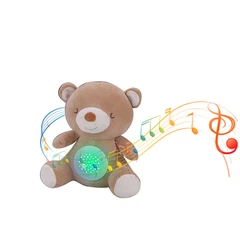
Blinking Panda – A Motorised Plush, and the Rooms It Actually Lives In
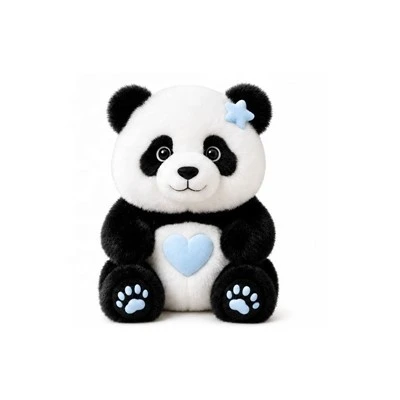
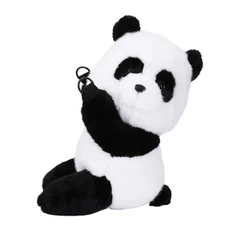
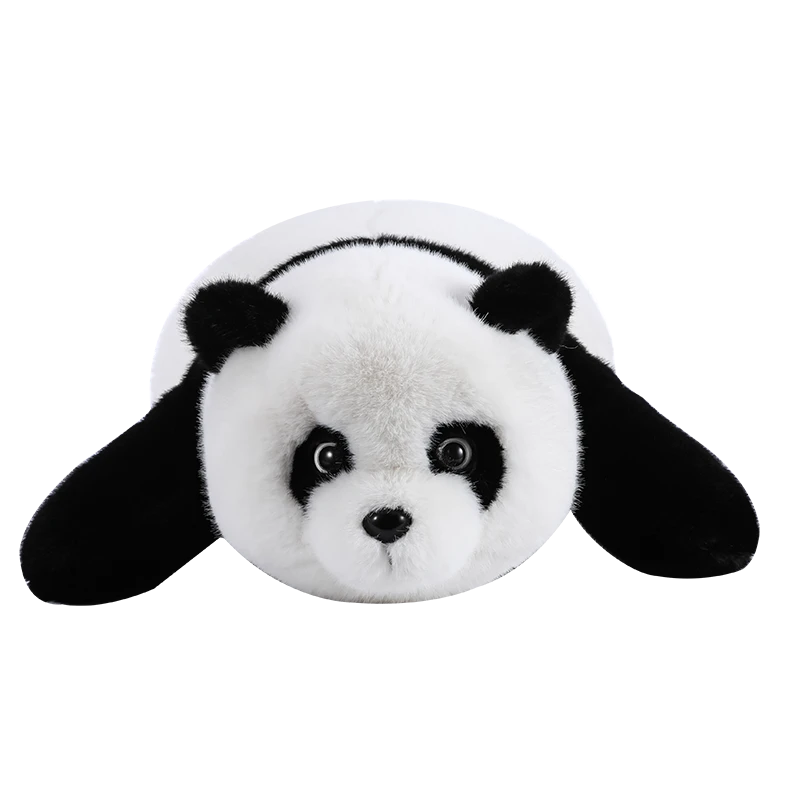
Details: A plush that moves is a different product from a plush that does not, and the difference shows up in the places it can be kept. This panda carries a 130 motor that drives its eyelids, a 29 mm 8 Ω 0.25 W speaker set inside the filling, and three AAA LR03 cells rather than a rechargeable pack. It measures 220 × 400 × 200 mm and weighs 791.5 g, so it is a large, soft object rather than a pocket toy. The sound library holds seventeen clips – eleven panda sounds, three suckling sounds and three burping sounds – and the fabric and filling are both 100% polyester, with the plastic movement living inside the padding. Two colours are available: brown and black. Minimum order: 1,000 pcs.
Where a Motorised Plush Actually Lives
Soft toys are usually discussed in terms of how they look. Their real design problem is where they end up, because a plush is the one children's product that is kept in the most intimate places: against a face, inside a cot, under a sleeping arm. Add a motor and a speaker and those places start imposing requirements that a stuffed animal never had to meet.
The first requirement is that nothing needs plugging in. Three AAA LR03 cells mean the panda can be left in a cot or taken in a pram with no cable following it around, and a parent can renew the power at a kitchen table rather than hunting for a charger at bedtime. For a product used at the point of sleep, the absence of a charging lead is worth more than any capacity figure.
The second is the fluff itself. The speaker sits inside the padding rather than in a hard shell, so the sound has to travel through polyester before it reaches a child. That is genuinely harder than it sounds: low frequencies are absorbed by filling, and a driver that is adequate in a plastic enclosure can arrive muffled in a soft body. The 29 mm driver and its placement are therefore a single decision, and the only reliable test is a finished sample pressed against an ear.
The third is size and weight. At 400 mm long and just under 800 g the panda is substantial enough to be hugged but too large for a shelf of small toys, which places it physically in the room: on a bed, in a corner, or on a floor cushion. That also means it becomes part of the furniture, so the fabric has to hold up to being sat against and dragged around rather than only admired.
Cleaning follows directly from the same fact. A large soft object in a child's room will be washed or at least wiped repeatedly, and the electronics are buried inside the filling rather than sealed in a removable module. Surface cleaning is what the construction supports, and it is worth stating that plainly to a buyer, because a household that expects to submerge it will be disappointed and a retailer that promises it will inherit the complaint.
Colour is the quietest decision but not the least consequential. Brown and black keep the panda looking like a panda, which matters when the product is bought as a recognisable animal rather than as a generic soft shape. It also means the fabric shows less of the everyday handling that a pale plush would reveal within a fortnight.
The sound library is what keeps it in the room after the novelty passes. Seventeen clips is enough for a child to develop favourites, and the mix of animal noises with feeding sounds gives the object a play pattern rather than a single trick. On a soft product, content is the only part that can be updated without touching the fabric, which makes it the most useful thing a buyer can specify.
One further point belongs with the sound design. A clip library is fixed at the factory, so a child will hear the same seventeen sounds for the whole life of the toy. That is a limitation and a virtue at the same time: a toy that surprises a child unsettles them at bedtime, while one that always answers the same way becomes part of the routine. Buyers should therefore choose the library for repetition rather than novelty, and resist adding clips simply because the memory allows it.
Blinking Panda – Model PT-001 Data Sheet
| Blinking Panda – Specification Summary (PT-001) | |
| Item | Blinking Panda / PT-001 |
| Movement | 130 motor driving the eyelid movement |
| Speaker | 29 mm 8 Ω 0.25 W driver set inside the filling |
| Power | Three AAA LR03 cells at 1.5V; no charging required |
| Sound Library | Seventeen clips – eleven panda sounds, three suckling sounds, three burping sounds |
| Fabric | 100% polyester |
| Filling | 100% polyester, with the plastic movement housed inside |
| Colour | Brown and black |
| Unit Size | 220 × 400 × 200 mm |
| Unit Weight | 791.5 g |
| Gift Box | 380 × 200 × 180 mm |
| Carton Configuration | 12 pcs per carton / 77.5 × 41.5 × 56 cm |
| Carton Weight | 9.5 kg |
| Compliance | CE, CPC, UKCA, FCC, RoHS (ASTM F963 / EN71 testing available on request) |
| Order Quantity | 1,000 pieces (trial orders negotiable) |
Because a soft product is judged by touch, the useful first step is a sample rather than a specification. Send the size, the colour and the sound list you have in mind, and we return tiered quantity bands, sample and trial terms, the fabric and filling specification, the sound library format and the packaging dieline. Route it through the enquiry form or straight to the export desk and it arrives inside one working day. Full range here: https://www.kidsoundbook.com/products
Buyers who have never specified a soft interactive product often ask what to send first. A photograph of the room it is intended for, a short description of the child who will use it, and the list of sounds you want are worth more than a written specification, because the fabric, the volume and the movement all follow from those three answers rather than the other way round.
Seven Settings This Panda Fits Into
Details: A plush is bought for a place rather than a purpose, so it is worth reading the product setting by setting. Each one imposes a different requirement on the fabric, the movement and the power arrangement.
The Cot
The most demanding setting, because it is used unsupervised and at close range. Nothing is plugged in, there is no lead near a sleeping child, and the sound has to be quiet enough to soothe rather than startle. This is the setting that justifies the cell choice more than any other.
The Pram and the Car
Both require the same thing: an object that travels without accessories. At just under 800 g the panda is heavy enough to stay where it is put and light enough to be carried by a child, and there is no charger, cable or dock to remember on the way out of the house.
The Play Corner
Here the panda is handled roughly rather than cuddled, and the sound library does the work: seventeen clips let a child build a game around feeding and animal noises instead of pressing the same button repeatedly. Play is what keeps a soft toy out of the cupboard after the first month.
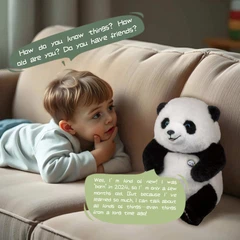
The Sofa
A family room setting means a wide range of users, from toddlers to grandparents, and the panda has to be comfortable in adult hands as well as small ones. Rounded proportions and a soft body do that naturally; a hard interactive toy in the same place feels like equipment.
The Bedtime Routine
Used as a comfort object, the panda has to be quiet, predictable and always available. Repeatability matters more than variety here: a child who knows exactly what the toy will do uses it to settle, and one that surprises them does the opposite.
The Gift
A panda is a recognisable animal, which makes it an easy present for someone who does not know the child well. The 380 × 200 × 180 mm box is a proper gift carton rather than a bag, and brown or black keeps the animal readable on a shelf.
Your Own Setting
The six settings above are the ones buyers describe most often, but a market usually has one that matters more than the rest. Naming it changes the specification usefully: a pram-first product wants a different fabric and a smaller format, while a cot-first product wants the quietest possible sound. Tell us where it will live and the details follow.
Six Buyers for a Soft Interactive Product
Soft toys sell through channels that are organised around rooms rather than around technology, and the buying arguments differ accordingly.
Setting by Setting – Requirement and Answer
| Requirement Mapping – Blinking Panda | ||
| Setting | What It Requires | How the Panda Answers |
| Cot | No cable, quiet sound, predictable behaviour | Three AAA cells; 29 mm driver; seventeen fixed clips |
| Pram or car | Self-contained and light enough to carry | 791.5 g, no charger and no dock |
| Play corner | Something to do beyond a single press | Eleven panda sounds plus six feeding sounds |
| Sofa and family room | Pleasant in adult hands as well as small ones | Soft 100% polyester body, rounded proportions |
| Bedtime | Repeatable rather than surprising | Fixed sound library with the same response every time |
| Gift and display | Reads as a recognisable animal on a shelf | Brown or black panda, proper 380 × 200 × 180 mm gift box |
| Distribution | Compact transport and easy counting | 12 pcs per carton at 9.5 kg |
Two practical notes follow. First, a soft interactive product should be approved as a finished sample against an ear, not on a bench, because the filling is part of the acoustic design. Second, decide the primary setting before the fabric and the sound list are finalised, since a pram-first and a cot-first version of the same panda are genuinely different products sharing a mould and a pattern.
Distribution planning gains from the same clarity. At twelve units per carton and 9.5 kg, a full carton is light enough for one person to move and heavy enough that volumetric space, rather than weight, becomes the real constraint. For an object of this size that is an unusually convenient ratio, and it means a buyer can hold a modest safety stock without a warehouse decision being needed first.
The Commercial Case – A Soft Product With a Reason to Be Kept
Soft toys are bought on impulse and forgotten quickly, which is the problem this product is designed around. Four things give it a longer life on a child's floor.
| What a Shopper Compares in the Soft Toy Aisle | ||
| Blinking Panda (PT-001) | A plain plush, or an electronic toy in a hard shell | |
| Held against a face | Yes – soft throughout, movement inside the filling | Yes for a plush; no for a hard toy |
| Needs charging | No – three AAA cells, replaced at home | Often yes for the electronic option |
| Keeps a child occupied | Seventeen sound clips plus the eyelid movement | Usually one sound effect, or nothing |
| Suitable for a cot | Yes – no lead, quiet driver | The hard-shell option is not meant for a cot |
| Cleaning | Surface cleaning, as the electronics sit inside the padding | Machine washing depends on the plush; hard toys wipe clean |
| Lasting appeal | Personality plus a library to explore | Decoration, or a single novelty effect |
One limitation is worth stating rather than hiding. The electronics live inside the filling, so the panda is a surface-clean product and not a machine-washable one. Telling a buyer that clearly protects the retailer from returns, and it is the sort of detail that separates a supplier who understands their own product from one who repeats a specification sheet.
There is one more commercial argument worth putting to a retailer. Soft toys are often treated as low-consideration purchases, which is precisely why a soft product that keeps working stands out. A panda that moves and answers is remembered where a plain one is forgotten, and that memory is what produces the second purchase – another animal, another colour, or a gift for somebody else's child.
From Pattern to Carton – How a Soft Order Runs
A soft interactive product has a different sequence from a plastic one, because the fabric, the sound and the movement have to be tuned together rather than specified separately. The stages below are the ones that matter.
| Soft Product Flow – Stage by Stage | ||
| Stage | What Happens | What the Buyer Decides |
| 1. Setting brief | The primary place of use is agreed and the format follows from it | Cot, pram, play corner, gift or multi-use |
| 2. Pattern and colour | The pattern is set for the size and the two colourways | Brown or black, plus any branding on the tag |
| 3. Movement tuning | The 130 motor and the eyelid travel are adjusted for a gentle action | Speed and range of the blink |
| 4. Acoustic tuning | The driver is balanced against the filling in a finished body | Volume limits and the sound library |
| 5. Sample round | A complete panda is supplied for handling and listening | Sign-off on softness, sound and movement |
| 6. Testing | The product is assessed for the destination markets | Markets, age grading and labelling |
| 7. Production | Sewing, assembly, testing and packing run to the approved sample | Quantity and the delivery window |
| 8. Packing and export | Twelve units per carton are packed and export documents prepared | Carton markings and shipping instructions |
The stage that most often needs a second attempt is acoustic tuning, because the first sample is the first time the sound meets the filling. Bringing the sound list to the pattern stage rather than after it shortens that work considerably, and it is the difference between one sample round and two.
Finally, a note on the sewing that a buyer should not overlook. Inside a soft interactive product the stitching is doing structural work rather than only decorative work: it holds the movement in place and keeps the filling clear of the moving parts. Stitch density and the position of internal seams are therefore specified rather than inherited from a pattern default, and they are checked on the sample by handling the panda firmly rather than by looking at it.
It is worth repeating one instruction to everyone who will handle the sample. Judge a soft interactive product with your hands and your ears rather than with a checklist. Squeeze the belly where the movement sits, hold the head against your own cheek to hear what a child will actually hear, and check that the eyelids still close completely after the toy has been dropped a few times. None of those three things appears on a specification sheet, and they are exactly the differences a customer notices in the first minute of owning the product.
Questions From Buyers About the Panda
Q1: How is it powered, and what happens when the cells run out?
Three AAA LR03 cells at 1.5V. There is nothing to charge and no lead to route, so the panda can live in a cot or a pram without a cable anywhere near it, and when the cells are flat a parent replaces them at the kitchen table. For a product used at the point of sleep, that simplicity is the point rather than a compromise.
Q2: Can the panda be washed?
It is a surface-clean product. The fabric and filling are both 100% polyester, and the plastic movement and the speaker sit inside the padding rather than in a removable module, so a household should wipe it rather than submerge it. Saying so plainly at the point of sale prevents the returns that follow a promise of machine washing.
Q3: What does the sound library contain?
Seventeen clips in total: eleven panda sounds, three suckling sounds and three burping sounds. The mix is deliberate, because it gives a child more than a single animal noise to play with and supports a feeding-and-nurturing game. The library is also the easiest part of the product to change on a new edition.
Q4: How loud is it, and is it suitable for a cot?
The driver is a 29 mm 8 Ω 0.25 W unit, sized for close-range listening rather than room-filling sound. Combined with the filling that surrounds it, the result is a soft sound appropriate to a child lying beside the toy. It is designed for exactly the setting most soft products are used in, and it is worth confirming levels on a finished sample against an ear.
Q5: Can we change the sounds, the colour or the branding?
The sound library is replaceable per order, and the two colourways are brown and black as standard. A printed tag or label carries the buyer's brand. Because the sound set lives in the electronics rather than in the fabric, a new library can be introduced on a new edition without altering the pattern, the filling or the motor.
Q6: Is the blinking movement a risk for a small child?
The movement is enclosed inside the body of the plush and driven by a 130 motor with a limited travel, so there is no exposed mechanism for a hand to reach. The product is assessed against the toy safety standard for the destination market in the same way as any other interactive soft toy, and the eye assembly is inspected as part of the finished-goods check.
Q7: How do order quantities and samples work for a new edition?
Production begins at 1,000 units, with shorter trial quantities available on terms set out in the quotation. Samples are supplied as finished soft products rather than as bare modules, because the feel and the sound are the two things being approved. Sample charges are credited back against the production order once it is placed.
Q8: Where is the panda produced, and can a buyer visit?
Sewing, electronics assembly, movement fitting, acoustic tuning and packing are all carried out at our own site in Shenzhen, which is what allows a soft product to be tuned and tested in one place. Buyers are welcome to visit or to follow a run over a live video call, and each unit can be traced from its fabric and components to the carton it shipped in.
Who Makes the Panda
for children
Xinditai Electronics has been making children's audio products in Shenzhen since 2010, and soft interactive toys are one of the categories we build. Our programmes cover OEM and ODM development of children's audio and interactive products – sound plush, story players, sound books, talking cards, writing tablets, projection toys and sleep aids – for brands, distributors and retailers in many countries.
Sewing, electronics and acoustic work share a 3,000-square-metre site with more than 100 engineers and operators, which is what makes a soft product practical to develop rather than something to be assembled from two suppliers. The standard is simple and it is written on the wall: Create with heart, ship with pride. Inspection is placed inside each stage, so a finished panda can be traced back to the fabric and the parts it was made from.

Compliance & Certificates
Certificates
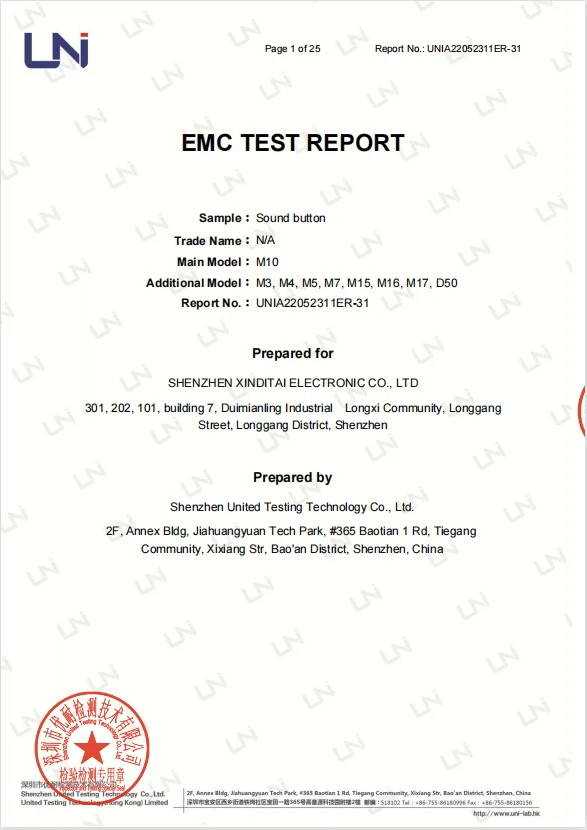
A soft electronic product is assessed on both its fabric and its electronics, so the certificate pack is assembled to cover both and matched to the destinations on the order. It is refreshed whenever a relevant standard is amended.

CE

RoHS

FCC

SEMTA
EMC

ISO