
Most buyers look at the LMP-004 Big Eye Projector and start with the hardware: 1800mAh battery, Type-C charging, 2-3 meter projection range, Bluetooth playback, 4GB TF card, and an 8-hour playback time.
Those specs matter. They tell you whether the product is usable.
But they are not the most interesting part of the business.
The more useful way to look at this product is as a low-cost content delivery device for children. The projector is the entry point. The film discs are where the repeat purchase happens.
The hardware is good enough, and that is the point
The LMP-004 is not trying to compete with a home cinema projector. It does not need to.
A child does not care about 4K resolution. A parent does not need cinema-grade brightness for bedtime storytelling. What they need is a device that is safe, simple, and reliable enough to use every night without becoming another annoying gadget in the house.
This product covers the basics:
- 1800mAh battery with around 8 hours of playback
- About 2 hours of charging time through Type-C
- 2-3 meter projection distance with manual focus
- Bluetooth playback for flexible audio use
- Built-in 4GB TF card for stored content
- 30cm auto shutoff to reduce direct-eye exposure risk
- ABS shell with silicone buttons and non-slip base
- Compact size: 111 x 124 x 102 mm
- Box size: 235 x 197 x 135 mm
- Weight: 850 g
None of this is over-engineered. That is actually a strength. The product is simple enough for parents and children to understand within a minute.
For mass retail, simplicity usually beats feature overload.
The price creates room for a content strategy
The factory pricing tells the story:
| Quantity | Unit price |
|---|---|
| 1,000 units | $12.36 |
| 3,000 units | $12.30 |
| 5,000 units | $12.30 |
| 40,000 units | $11.25 |
| Film disc | $0.24 each |
At first glance, the hardware pricing is not dramatic. Between 1,000 and 5,000 units, there is almost no movement. The real drop happens at 40,000 units.
But the film disc cost is the detail that changes the business model.
At 0.24perdisc,thephysicalmediaischeapenoughtobundle,upsell,andrefresh.Afive−discstorypackhasafactorydisccostofabout
0.24perdisc,thephysicalmediaischeapenoughtobundle,upsell,andrefresh.Afive−discstorypackhasafactorydisccostofabout1.20 before packaging and content cost. That gives distributors room to sell expansion packs, seasonal packs, language-learning packs, or branded story sets.
That is where the product gets more interesting.
If the projector sells once, the business is hardware retail.
If the child keeps asking for new discs, the business becomes content retail.
Parents do not buy projectors. They buy bedtime help.
This is easy to forget when looking at a spec sheet.
The end buyer is not waking up thinking, "I need a 2-3 meter projection device with an independent acoustic cavity." They are thinking:
- I need my child to calm down before sleep.
- I want something better than handing over a phone.
- I am tired of repeating the same bedtime story.
- I want screen-like engagement without a tablet.
- I want a toy that feels educational, not just noisy.
That is the emotional purchase.
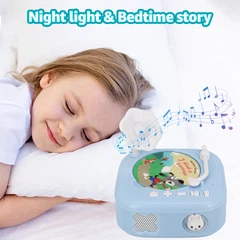
The LMP-004 works best when positioned as a bedtime routine product, not just a toy projector. The story, light, music, and ceiling projection combine into a ritual. Children like rituals. Parents pay for things that make rituals easier.
The 30cm auto-shutoff is a retail advantage
A lot of low-cost toy projectors look similar online. Same cute shape, same colorful shell, same claims about storytelling and sleep.
The LMP-004 has one feature that should be emphasized more clearly: automatic shutoff when the projection distance is less than 30cm.
That means if a child puts their face close to the lens, the unit stops projecting. For a children's optical product, this is not a small detail.
Retailers, marketplace operators, and importers care about this because safety complaints are expensive. Parents care because eye safety is an easy concern to understand. Sales teams should not bury this feature inside a technical bullet list. It belongs near the top of the product page.
A simple product-page line could be:
"Built-in close-range auto shutoff helps reduce direct light exposure when children get too close to the lens."
That is clearer than "anti-eye injury" and sounds more credible.
Bluetooth changes the use case
The built-in story content is useful, but Bluetooth makes the product more flexible.
Parents can play their own audio. Teachers can connect lesson material. Brands can pair the projector with a mobile content library without changing the hardware.
That opens several B2B possibilities:
- Retail edition: projector plus starter film disc pack.
- Education edition: classroom story discs, phonics content, and teacher audio files.
- Language-learning edition: bilingual bedtime stories with matching projection visuals.
- Brand/IP edition: licensed character stories sold as premium disc packs.
- Gift edition: seasonal packaging for Christmas, birthdays, or back-to-school campaigns.
The same hardware can serve multiple channels if the content and packaging are adjusted properly.
Custom color is more valuable than it looks
The spec sheet says the two-tone color effect can be customized according to customer demand.
That sounds minor. It is not.
For B2B buyers, color customization helps separate SKUs by channel. A distributor can give one colorway to Amazon, another to offline retail, and another to a regional partner. This reduces direct price comparison and protects margins.
It also helps with brand positioning. Soft pastel colors work for bedtime and nursery channels. Brighter colors work better for toy retail. A more neutral colorway can be used for education or gift markets.
The product does not need new tooling to feel different. A colorway and packaging change can already create a separate market version.
The biggest risk is not hardware. It is content rights.
The hardware is straightforward. The legal risk sits in the content.
A projector like this becomes much easier to sell when the disc content features familiar characters. That is also where many suppliers get into trouble.
If a factory offers "popular cartoon story discs" without clear license documents, be careful. Western marketplaces are much stricter than many suppliers expect. A product can pass electrical and toy safety tests and still be removed because of copyright or trademark issues.
For importers, the clean options are:
- Use original content created for your brand.
- Use properly licensed IP.
- Use public-domain stories with original artwork and narration.
- Build educational content that does not depend on famous characters.
The content does not need to be famous to work. For bedtime use, calm narration and consistent visuals often matter more than big IP.
How I would package this for B2B sales
If I were preparing this product for a distributor or retail buyer, I would not lead with every specification. I would structure the pitch like this:
Core message: A safe, screen-free bedtime projector that creates repeat sales through low-cost story discs.
Hero features:
- 8-hour playback from a 1800mAh battery
- Type-C charging, about 2 hours to full charge
- Manual focus for 2-3 meter projection
- Bluetooth audio playback
- 30cm close-range auto shutoff
- Customizable two-tone shell color
- Low-cost film discs at $0.24 each
Commercial angle:
- Hardware margin on the first sale
- Recurring margin through expansion disc packs
- Channel differentiation through color and packaging
- Education and language-learning versions using the same base unit
Recommended bundle:
- 1 projector
- 5 starter film discs
- Type-C cable
- Quick-start guide with focus instructions
- Microfiber lens cloth
- Gift-style color box
The microfiber cloth sounds small, but it solves a real problem. Parents will clean the lens. If you do not give them the right tool, they will use tissues or alcohol and damage it.
Suggested retail positioning
For Amazon or DTC product pages, avoid sounding too technical at the top. Lead with the parent benefit, then support it with specs.
A stronger positioning line would be:
"A bedtime story projector that combines soft projection, audio storytelling, and collectible film discs - designed to keep children engaged without handing them a phone."
Then add the hardware proof:
"Built with an 1800mAh rechargeable battery, Type-C charging, Bluetooth playback, manual focus, and close-range auto shutoff for safer use around children."
That sequence works better because it sells the outcome first and the engineering second.
Final take
The LMP-004 is not just a small projector. It is a platform for repeatable children's content.
The hardware cost is low enough for mass retail. The disc cost is low enough for add-on sales. The safety shutoff gives buyers something credible to talk about. The color customization gives distributors room to create channel-specific SKUs.
The companies that treat this as a one-time toy will compete mostly on price.
The companies that build content packs, seasonal bundles, and education versions around it have a better chance of making the product last longer in the market.