

Big Eye Projector – Darken the Room, and Let One Blank Wall Do the Storytelling
Details: Every room already owns the screen. It is the stretch of wall behind the bed, the side of the wardrobe nobody looks at twice, the ceiling above a child waiting for sleep. Ninety per cent of the time it does nothing at all. The Big Eye Projector is built around a single, honest observation: a wall is the largest, cheapest, least damaging display surface in any home, and a small device with a big lens can fill it with light and picture. One 111 × 124 × 182 mm body, an 1800 mAh cell good for roughly eight hours of playback, a focus ring a four-year-old can turn, and a lens that throws a warm image two to three metres onto whatever surface is in front of it. No screen to hold, no glass at arm's length, nothing to swipe. Minimum order: 1,000 pcs.
Why the Lens Comes Before the Software
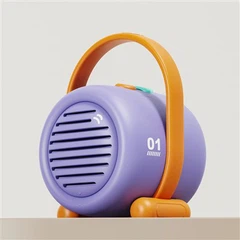
Most children's projectors in this category look like a plastic loaf with a small window in the front, and the projection is treated as an afterthought bolted onto a speaker. The Big Eye starts from the opposite end: the optical path is the product, so the lens sits front and centre, enlarged and domed like an eye, and the whole body is shaped around keeping that lens square to the wall. That single decision changes how the object reads on a shelf – it looks like something that sees, rather than something that plays – and it changes what the picture looks like on the wall, because a larger, well-seated lens produces an edge-to-edge image instead of a bright blob with dark corners.
The dark room is the second half of the idea. A projector only exists at its best when the ambient light drops, and that is exactly the moment parents are trying to engineer anyway. Turn the main light off, switch the Big Eye on, and the ritual assembles itself: the room gets quiet, one wall lights up, a story begins. Nothing about that sequence needs an adult to operate a menu, and nothing about it trains a child to expect a glowing rectangle at arm's length. The image is thrown, reflected and indirect, which is a fundamentally different experience from holding an emissive screen a few centimetres from the face.
The third decision is defensive, and it is the one buyers ask about first. Children do pick projectors up and stare straight into them. On the Big Eye, the moment the lens comes within roughly 30 cm of an obstacle – a face, a pillow, a hand – the light cuts out automatically. The protection is mechanical and immediate rather than buried in a settings page, so it survives a two-year-old's curiosity without anyone having to explain why the light went off. Around that sits a housing in ABS with a semi-transparent PE power key, silicone function buttons along the back and a silicone anti-slip pad underneath, so the unit stays put on a bedside table and keeps its footing when a child grabs it.
Big Eye Projector – Model LMP-004 Data Sheet
| Big Eye Projector – Specification Summary (LMP-004) | |
| Item | Big Eye Projector |
| How It Plays | Power on and the story runs with its matching picture; light up/down keys step through songs, volume and pause sit alongside |
| Optics | Large front lens with manual focus adjustment; projection distance 2–3 m |
| Picture Sync | Each story advances to its own projector cut automatically – audio and image stay locked together |
| Eye Safety | Auto cut-off when the lens comes within about 30 cm of an obstacle |
| Content & Storage | 4 GB TF memory card; story, song and language content fully replaceable per order |
| Wireless | Bluetooth playback with mode switching, so the unit can also act as a speaker |
| Speaker & Audio | Independent sealed cavity with an iron-shell 4Ω 3 W driver, tuned for narration |
| Battery | 1800 mAh; roughly 8 hours continuous playback; about 2 hours to full charge |
| Charging | Type-C, 50 cm cable supplied; works with phone chargers, power banks and car adapters |
| Housing & Controls | ABS body; semi-transparent PE power key; silicone function buttons; silicone anti-slip base |
| Colour | Two-tone colourways customisable; the projected picture uses a two-colour palette |
| Size & Weight | 111 × 124 × 182 mm / 850 g net |
| Packaging | Gift box 235 × 193 × 135 mm; carton configuration confirmed per order |
| Recommended Age | 3–8 years (independent use from age 4+) |
| Compliance | CE, CPC, UKCA, FCC, RoHS (ASTM F963 / EN71 testing available on request) |
| Order Quantity | 1,000 pieces (trial orders negotiable) |
Ask for the full dossier and it arrives in a single package: unit pricing tiers, sample and trial terms, the slide-and-audio content template, word lists for voice recording and the 3D files. Send your requirements through the enquiry form or straight to the export desk, and the material lands in your inbox within one working day. Full range here: https://www.kidsoundbook.com/products
What Travels Through the Lens – Seven Picture-and-Sound Families
Details: The projector body is the same in every order. What changes – and what decides whether a buyer reorders next season – is the content burned into the 4 GB card and printed onto the slides. The default library ships as seven families, each mapped to a different age, occasion or shelf.
Bedtime & Sleep – The Wind-Down Family
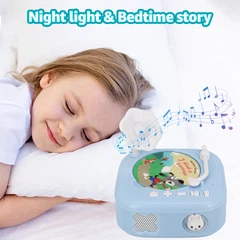
Slow narrated stories with a true end, paired with soft projected scenes that dim as the tale closes. This is the family that defines the product: the room darkens, the wall glows, the voice slows, and the light is gone before the child has to ask for it to be switched off.
Night Sky & Space – The Astronomy Family
Moons, constellations, planets and rockets, projected large enough to turn a bedroom ceiling into a small planetarium. The most photographed family we ship, and the one that works all year round as a gift for children who have outgrown lullabies but not wonder.
Animals & Habitats – The Nature Family
Jungles, oceans, farms and polar ice, each scene introducing the animals that live there and the sounds they make. Animal content travels across borders with almost no translation work, which makes it the safest family for a first order into an unfamiliar market.
First Words, Letters & Numbers – The Early-Learning Family
Picture-and-word cards projected big, with alphabet, counting, colour and shape sets that follow a simple pattern. Oversized projection holds attention longer than a handheld card, and the format is what gets this unit onto preschool shelves and into therapy rooms.
Songs & Sing-Alongs – The Music Family
Nursery rhymes, action songs and simple rhythm games, with picture slides that change on the beat. Buyers bundle this family with the storyteller family so the unit covers both the quiet hour and the energetic one, which raises average basket size without adding a second device.
Festivals & Faith – The Occasion Family
Seasonal stories built around the festivals a market actually celebrates – Christmas, Easter, Ramadan, Lunar New Year, Diwali. Each festival gets its own slide pack and narration, so a retail promotion can launch a themed content set without a new mould, a new tooling cost or a new tool.

Your Market, Your Voice – Editions and Exclusives
Every production run rebuilds the card and the slide pack from scratch: any language, any narrator, any licensed character, any curriculum. Distributors commission seasonal additions, publishers convert their own titles into projection sets, and brands order a locked exclusive so the same content never appears under a competitor's logo.
Who Puts the Big Eye on a Shelf – Six Buyer Profiles
The same unit sells into very different channels, and it sells for different reasons in each one. Worth knowing before deciding which buyers to approach first.
The Merchandising Calendar – When Projectors Move
| Seasonal & Occasion Calendar – Big Eye Projector | ||
| Season / Occasion | Who It Appeals To | Content & Pack to Lead With |
| Christmas & New Year | Parents, grandparents, gift retail | Festival slide pack, gift-box edition, "one wall, no screen" message |
| Birthday (year-round) | Parents, party retail | Night-sky pack, name-personalised slide sleeve |
| Back to school | Parents, preschools | Letters-and-numbers pack, classroom bundle |
| Easter & spring holidays | Toy and gift retail | Animal-and-habitat pack, window display with live demo |
| Ramadan & Eid (MENA) | Regional retail | Localised-language festival set, family gift packaging |
| Summer travel season | Travel retail, hotels, holiday lets | Compact carry pack, offline operation, rechargeable battery |
| Grandparents' & family days | Extended family | Classic story pack, keepsake box |
Two habits do most of the selling in store. First, dim the demo, not the copy – a projector shown under shop lighting looks like a blurred toy; the same unit in a shadowed corner looks like magic. Second, sell the pack, not only the box – display the seasonal slide packs beside the unit so the first purchase reads as the start of a collection. Bundles that pair the projector with a themed pack or a carry case consistently outperform the same unit sold alone.
What You Can Tell Parents – The Projected-Light Case
The strongest reason to buy this product is not on the spec sheet. It is the difference between holding a light source and standing in one. Here is that argument, stated plainly.
| Big Eye Projector vs. Common Alternatives | ||
| Big Eye Projector (LMP-004) | Tablet or handheld player | |
| Where the light goes | Thrown onto a wall, viewed by reflection | Held close, aimed at the eyes |
| Screen size | Determined by the room, up to a full wall | Fixed, palm-sized |
| Number of children watching | A group, sharing one image | Usually one |
| Needs internet or an account | No | Usually yes |
| What ends the session | The story itself | An adult, or another episode |
| Eye protection built in | Auto cut-off within about 30 cm | None |
| Works offline & travelling | Yes, rechargeable anywhere via Type-C | Limited |
We keep the claims precise: the Big Eye is an indirect-light projection toy with a big lens, a focus ring, a built-in auto cut-off and a finite library of picture-and-sound content. That is enough – it is the combination parents are quietly looking for, and it is a combination most of the category cannot offer in one box.
Inside the Build – Five Choices That Decide the Picture
A projector is judged in the dark before anyone reads a spec sheet. These are the five decisions inside the Big Eye that a buyer can actually see, and each one is checkable on a sample unit.
The lens is seated square, not angled
The barrel is centred on the housing and held perpendicular to the front face, so the projected rectangle lands square on the wall instead of keystoning. That matters in real bedrooms, because a tipped image forces the user to prop the unit up on a book – and once a prop enters the routine, the product stops feeling finished.
Focus is a ring, not a menu
Sharpness is set by turning the ring on the lens barrel by hand. Two seconds of adjustment covers the whole 2–3 m working range, and nothing about the process needs a screen or a settings page. Removing the autofocus motor also removes its draw on the battery and one more component that could fail in a child's hands.
The speaker lives in its own sealed cavity
An iron-shell 4Ω 3 W driver sits inside an independent enclosure rather than sharing the housing with the electronics. Narration stays clean at low volume – which is how a bedtime story is actually played – and the shell does not buzz against the plastic when a song track pushes harder.
The light is supervised, not just switched
A proximity check watches the front of the lens. Bring anything within roughly 30 cm and the projection cuts out; move it away and the picture returns. No adult has to intervene, and there is no toggle for a curious child to find and disable.
The base grips and the shell forgives
A silicone pad underneath keeps the unit from sliding on a painted bedside table, the power key is a semi-transparent PE moulding that reads clearly in a dim room, and the ABS body is rounded throughout. Small details individually – together they are the difference between a product that survives a year of nightly use and one that returns to the shelf.
Running a Custom Order – From Brief to Sealed Carton
First-time buyers usually want to know what an order actually looks like week by week, and how much of the content work falls on their side. The honest answer is that the hardware is the easy part; the content and the colourway are where a market is won. Here is the sequence we run.
| Custom Production Path – What Happens and What We Need | ||
| Stage | What Happens | What We Need From You |
| 1. Market & spec review | We map the target country against certifications, age band and retail price point | Destination market, target retail price, target age |
| 2. Colourway & housing | Two-tone colourways confirmed against the mould; artwork placed on the housing | Preferred colourway, logo file, packaging direction |
| 3. Content planning | Slide count, story list, running order and script length agreed scene by scene | Theme list, language and dialect, narration preference |
| 4. Recording & artwork | Either we write, illustrate and record, or your studio delivers finished assets | Finished audio and slides, or a written brief |
| 5. Sample unit | A working projector loaded with your content, shipped for approval | Approval on sound, picture cues and colourway |
| 6. Tooling & pilot run | Moulding, assembly and a pilot batch checked against the approved sample | Sign-off on the pilot unit |
| 7. Mass production | Full run on our own lines with in-line inspection at each stage | Confirmed quantity and delivery window |
| 8. Packing & shipping | Gift cartons, cartons and pallets packed, documents prepared for export | Carton markings, shipping instructions, documents |
Two things shorten this path. Bring a finished audio library, or accept ours as a starting point – both are fine, and the second is usually faster for a first order. And decide the carton early: the gift box is 235 × 193 × 135 mm, so the outer carton quantity affects freight cost more than most buyers expect on a unit this size.
Buyer Questions – Answered Straight
Q1: Why choose a projector over a tablet that already has story apps?
Because the light never points at the face. A tablet is a small, bright, held source; the Big Eye throws its image onto a wall and the child sees only the reflection, at a distance they cannot shorten. On top of that, the story ends by itself – no queue, no autoplay, no next episode – and the whole thing runs without an account, a login or a network. For a parent trying to build a bedtime routine, that combination matters more than a larger content catalogue.
Q2: What exactly stops a child looking straight into the lens?
A proximity cut-off in the optical path. When the lens comes within roughly 30 cm of any obstruction – a hand, a pillow, a face – the light goes out before it can be stared into, then resumes once the obstruction clears. The behaviour is deliberately simple and mechanical: no menu, no setting to disable, nothing for a child to override. It is the first thing we demonstrate to visiting buyers, and the first question most of them ask.
Q3: Does the picture stay sharp, and how is it focused?
Focus is manual, by a ring on the lens barrel, and it takes a second or two to dial in for the distance you are projecting to. Projection is designed for 2–3 m, which covers a bedroom wall from a bedside table or a floor cushion. Once set, the image holds its sharpness for the rest of the session; if you move the unit closer or further away, you simply turn the ring again. No autofocus motor means one less component to fail and nothing drawing on the battery.
Q4: Is the audio and picture always in sync, or does the image lag?
They advance together. Each story on the card is authored with its own projector cuts, so the picture changes at the moment the narration calls for it rather than on a fixed timer. For custom content, we supply the slide-and-audio template used in production, and either your studio or ours lays the cues in. The result is a sequence where the image follows the voice, which is what keeps younger children engaged.
Q5: How long does it run, and is the battery replaceable?
The 1800 mAh cell gives roughly eight hours of continuous playback, and a full top-up takes about two hours over Type-C. A typical household uses the projector for one or two stories a night, so a charge lasts several evenings. Any Type-C cable works, phone chargers and power banks included. The cell is rated for hundreds of charge cycles, and because the housing is a screw-together ABS shell rather than a sealed case, service replacement is straightforward where a market requires it.
Q6: Can we supply our own stories, artwork and language?
Yes, and for most partners it is the reason they order at all. Send finished audio and slide artwork and we check both for projection legibility and playback compatibility; or brief our studio and we write, illustrate and record the pack to your market. You decide the number of scenes, the voice, the dialect and the running order. Many buyers launch a second seasonal pack within a year of the first order, once the base unit is moving.
Q7: What is the minimum order, and how do samples work?
A standard production run starts at 1,000 pieces, and market-testing batches run from 200 to 500 units. Unit price is slightly higher at the low end, and that difference is credited back against your first full order. Sample units – one to five pieces – ship within five working days of payment, and the sample cost returns to you once the bulk order is confirmed. Proving the product in your own market is worth more than ordering blind.
Q8: Where is the unit made, and can we audit the factory?
Everything happens under one roof at our Shenzhen plant: lens and optical assembly, PCB layout and population, speaker tuning, injection moulding, content encoding, final build, testing and packing. We do not sell anything we cannot show, so buyers are welcome to visit the line or walk it live over video call. Nothing is outsourced, and every unit can be traced from incoming component to sealed export carton.
The Workshop Behind the Big Eye
for children
The projector you are reading about is made by Xinditai Electronics in Shenzhen, a manufacturer that has been building children's audio products since 2010. Our working days go into OEM and ODM programmes for children's audio and interactive products – read-aloud picture books, talking flashcards, story machines, projection toys and musical gadgets – for brands, distributors and retailers across six continents.
All of it runs from a 3,000-square-metre site in Shenzhen, where optical assembly, injection moulding, PCB layout, acoustic tuning and final packing share one floor, staffed by more than 100 engineers and operators. One rule carries across every line – Create with heart, ship with pride – and each stage has its own inspection gate, so a finished unit can be traced back to the component it started as.

Compliance & Certificates
Certificates
Certification is reviewed for every destination we ship to, and the file is refreshed whenever a standard moves. The document set you receive always corresponds to the production batch it travels with, never to an older run.

CE

RoHS

FCC

SEMTA
EMC

ISO