

The question parents keep asking
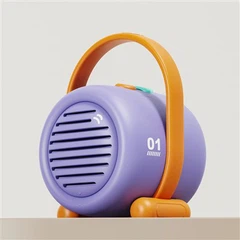
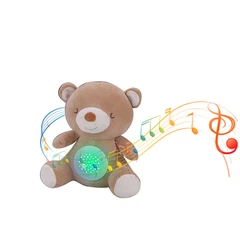
September is literacy month in much of the world, and it brings the same question to every toy fair table and every teacher inbox: if a child listens to stories instead of reading them, is that real learning, or just pleasant background noise? The short answer is that listening is not a shortcut around reading. It is a different road that arrives at the same town, and for children between about three and eight, it is often the wider, faster road. This article explains how audio storytelling supports early literacy, what separates useful children's audio from passive entertainment, and what a brand or publisher should check before putting its name on a story machine, a set of talking cards, or a read-along product.

The listening brain learns to read
Reading is not one skill. Most educators describe it as two engines working together: decoding, which turns letters into sounds, and language comprehension, which turns sentences into meaning. A five-year-old can rarely decode the sentence "the dragon guarded the silver bridge," yet she understands it perfectly when she hears it. Her listening comprehension is running years ahead of her decoding, and that gap is exactly where audio stories do their work.
Feature: while a child listens, she practises the language side of reading vocabulary, sentence structure, story grammar and background knowledge.
Advantage: when she finally meets the same words in print, she is not meeting strangers. The words arrive with voices, feelings and pictures she built herself.
Evidence: reading research consistently points to phonological awareness and oral vocabulary as two of the strongest early predictors of reading success. Both are trained by listening to rich, well-spoken narrative far more effectively than by most worksheet-style apps.
Why comprehension outruns decoding until around age nine
Listening comprehension and decoding grow at different speeds. Decoding is a mechanical skill that accelerates quickly once phonics clicks; comprehension grows slowly and steadily through exposure to language. For most children the two lines cross somewhere around fourth grade. Before that crossing point, audio gives a child access to stories that are genuinely above her reading level, which is precisely the kind of challenge that stretches vocabulary. A child who only ever "reads what she can read" gets vocabulary at her pace. A child who also listens gets vocabulary at her interest's pace.
None of this argues that listening should replace printed books. Books remain the place where children learn that letters carry meaning, that text moves left to right, and that a story can be revisited page by page. The argument is simpler: audio is a complementary lane, and for the preschool years it is often the lane that is actually moving. The families who report the fastest progress tend to be the ones who pair the two, audio at bedtime or in the car, print on the sofa.
Audio teaches without a screen getting in the way
Why not simply let a tablet narrate the same story? The difference is not the words; it is everything else a screen adds. When a story is told with pictures that move, the child's brain receives the images ready-made, and there is little left for the imagination to construct. Audio leaves the picture unfinished, and the child's mind completes it. Teachers sometimes describe this as the difference between watching someone draw and drawing yourself.
Attention behaves differently with sound
Screen content is engineered to hold attention with motion and surprise; audio asks for attention and rewards it with meaning. A child can close her eyes, turn away, or carry the player to another room and the story still works. This matters for children who find sitting still difficult. Many parents report that their most restless child will sit through twenty minutes of a story they would never sit through on a screen, because there is nothing to fight against, no autoplay queue, no recommendation engine pulling toward the next clip.

There is also a quieter benefit that parents notice before educators do: audio stories make children better company for themselves. A child who can reach for a story instead of a screen has learned an early form of self-regulation. She is not being entertained by a device; she is choosing an experience. That distinction shapes how a child relates to technology later, and it is one reason the screen-free category keeps growing inside the toy industry rather than fading as a novelty.

Where audio earns its place: routines and repetition
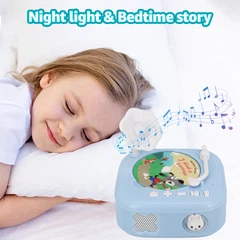
Literacy does not grow in lessons; it grows in minutes. Bedtime, the school run, the hour of independent play while dinner is cooked, these are the slots where audio outperforms every other medium, because audio is the only medium that fits them. A story machine on a nightstand can run for twenty minutes without supervision. A talking card player in the car needs no wifi and no account. The winning products in this category are not the ones with the most features; they are the ones that disappear into a daily routine and stay there for two years.
Repetition is the quiet engine. Adults grow tired of the same story quickly; children do not. Hearing the same tale ten times is how a child moves from following the plot to noticing the words, from noticing the words to predicting them, and from predicting to "reading along" from memory, a behaviour researchers call pretend reading and parents call magic. Products that make repetition easy, one tap, one card, no menu, support this loop better than products that constantly push new content.
Three listening habits that multiply the effect
First, let the child choose the story, even if she chooses the same one for a month. Choice builds ownership. Second, talk about the story afterwards, one question is enough, "why did the fox help the bear?" Conversation after listening is where vocabulary moves from passive to active. Third, follow the audio with the book when one exists. Hearing "the dragon guarded the silver bridge" and then seeing it in print is the fastest route from spoken to written language a toy can offer.
What makes children's audio actually work
Not all audio is equal, and the difference is rarely the recording quality. It is the writing. Audio for young children fails most often when it is adapted from visual media without being rewritten. A story written for a screen relies on the image to carry meaning; stripped of the image, it collapses into "he looked surprised" repeated forty times. Good audio narrative is written for the ear: short sentences, concrete images, dialogue that reveals character, and a narrator who slows down at the moment a word matters. Publishers who convert picture books into audio assets should budget for a genuine adaptation pass, not a voice-over of the printed text.
Length matters more than parents expect. Attention research and classroom observation both point to a sweet spot somewhere between five and fifteen minutes for preschool listeners. Shorter than that and a child never sinks into the story world; longer and the ending is wasted on a sleeping audience. A library of many short, complete stories outperforms a library of a few long ones, because completion is what builds the sense of mastery that brings a child back.
Voice, volume and the safety basics
The narrator is the product. A warm, unhurried voice at a consistent volume beats a famous voice performing at full energy, because young children parse speech best at a measured pace. When brands evaluate audio content, they should listen for articulation, not celebrity. Clarity is also why toy audio hardware sets a firm output ceiling: a child holding a speaker to her ear needs a volume limit that a teenager with headphones does not. A responsible literacy player caps output around 85 dB and gives parents a locked maximum.
Multilingual audio is an underused literacy lever
For bilingual families, audio is one of the few reliable ways to keep the heritage language alive when only one parent speaks it fluently. The same hardware, one card for English, one card for Mandarin, turns a toy into a language bridge. Buyers evaluating content platforms should ask how many languages are truly available per card, and whether switching languages requires new hardware or just a new card. The latter is the architecture that makes a catalog scalable.

The read-along moment: when audio meets the page
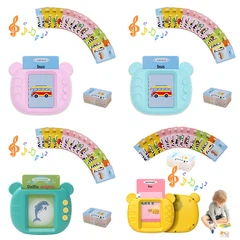
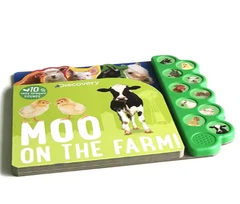
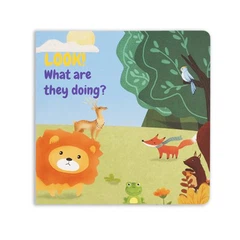
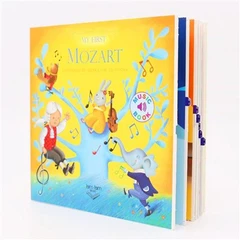
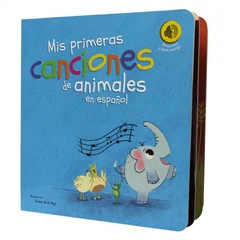
The most powerful literacy products are not audio alone or books alone, but the pairing of the two. Read-along formats let a child hear the page she is looking at, with the audio pausing, highlighting or signalling when to turn the page. For a four-year-old this is the bridge between listening and decoding made physical. She hears the sentence, sees the words, and begins to notice that the sounds she loves live inside those marks on the page. Talking flash cards work on the same principle one step earlier: the card carries a picture and a word, the reader speaks it, and the child connects object, image and sound in a single gesture.
For publishers, this pairing is also a business answer to a hard question. A picture book is sold once; its audio version is an asset that can be produced once and carried across a story machine card, a flash card set, a plush companion and a read-along edition, four products from one recording session. That is the content-ecosystem logic behind the fastest-growing screen-free players, and it is why literacy is where the economics of children's audio look strongest: parents will pay for the same beloved story again if it arrives in a form that fits a new moment of the day.

What to check before you license or buy audio content
Content rights travel with the product. A brand buying a player with preloaded stories should confirm that the license covers the territory of sale, the language of the packaging, and the lifetime of the device, some early deals expired and left players suddenly silent. Ask for a content list in writing before sampling, and check who owns the audio masters if the relationship ends. The cleanest arrangement for a new brand is usually an OEM platform with your own licensed or produced content, rather than a closed catalog owned by the manufacturer.
Encryption is a content question, not a technical one
If your catalog is your business, unencrypted cards are a slow leak. On NFC or RFID card systems, cards that can be freely copied let one purchased card become a shared file. Buyers should ask whether each card carries unique encryption that binds the audio to the card, and whether a copied card plays nothing at all. This matters twice over for literacy products, because the content, stories and songs, is usually the most valuable thing in the box.
Sourcing a literacy audio player: a buyer's checklist
Whether you are a retailer building a literacy assortment, a publisher turning a backlist into audio, or a brand launching its first screen-free player, the same six checks apply. First, listen to the demo with the volume at maximum and your ear at the speaker; if the output does not sit comfortably at a capped level, the hardware is wrong. Second, time the setup from unboxing to first story; if it needs a smartphone or an account, you have lost the preschool parent. Third, test card-switching latency with a four-year-old's hands; slow recognition breaks the flow that makes tap-to-play magical. Fourth, confirm the safety paperwork, EN71 and EN62115 for Europe, ASTM F963 and CPSIA for the United States, plus battery-access rules, before you commit to packaging. Fifth, ask how content updates reach the device, because a player that cannot receive new stories dies when the child exhausts the starter set. Sixth, verify the maker's production reality: MOQ, lead time and certification scope written into a quote, not promised in a brochure.
One factory for cards, players and books
Literacy products are unusual because they ask one supplier to be good at three very different crafts: printed and laminated cards that survive a toddler, audio hardware that sounds warm and stays safe, and content packaging that respects the story. At XDT Electronic (KidsoundBook) the three lines run under one roof in Shenzhen, a 3,000-square-metre facility with SMT, injection molding, automatic card printing and assembly lines, producing more than 50,000 units a month. Talking flash cards scale to 200-plus cards per set with an 85 dB output ceiling, the RFID and NFC story machines support multiple languages and encrypted per-card content, and a children's phonograph line carries 240 cards and over 500 audio tracks. Standard OEM orders start at 500 units with a 25 to 35 day lead time; full custom tooling runs 45 to 60 days. Certifications include CE, EN71, EN62115, FCC Part 15, RoHS, REACH and California Prop 65 as standard, with ASTM F963, CPSIA, UKCA and others available on request.
Where to start if your goal is literacy
Begin smaller than your ambition. Launch one player or one card reader with one language and a tight starter library of five to fifteen genuinely well-adapted stories, measure which stories children replay, then expand the catalog in the direction of the replays. That is how the strongest read-along brands in the market were built, not by launching a hundred titles at once. A manufacturer that can produce the cards and the hardware and advise on the adaptation pass is worth more than one that only assembles the box.

September is a good month to remember why this category exists. Reading is the skill that unlocks every other skill, and for a few precious years, a child's ears are faster than her eyes. The toy that respects that fact, one that speaks clearly, stops at a safe volume, leaves room for her imagination and connects the stories she loves to the words on the page, is not a replacement for a book. It is the reason she will someday pick one up.