

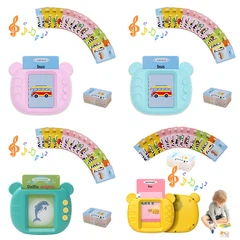
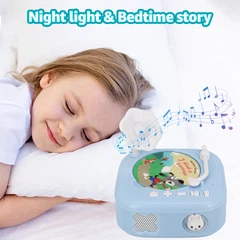
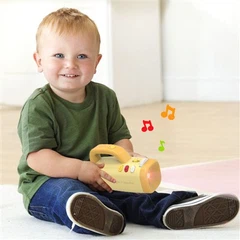
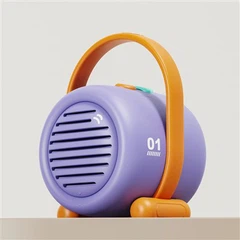

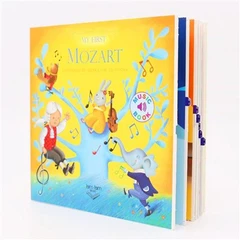

1. Audio Book Chip: Core Structure & Working Principle
The chip serves as the "brain" of audio books, integrating storage, control, and audio decoding functions. Its structure is simplified for child toy scenarios, focusing on stability, low power consumption, and easy operation-critical for long-term use by toddlers and mass production efficiency.
1.1 Core Module Composition
Storage Module: Uses non-volatile memory (commonly flash memory) to store audio files (stories, rhymes, phonics). Capacity ranges from 128MB to 4GB, supporting MP3, WAV and other universal audio formats. The memory is pre-programmed during production, and customizable for B-end buyers to add market-specific content (e.g., bilingual narration).
Control Module: Relies on a low-power microcontroller (MCU) to process user operations (button pressing, page turning triggers). It executes commands such as play/pause, volume adjustment, and track switching, with built-in logic to prevent misoperation (e.g., single-key lock to avoid accidental shutdown).
Audio Decoding Module: Converts stored digital audio signals into analog signals, ensuring clear sound output. It supports adjustable bit rate (128-320kbps) to balance sound quality and memory usage-entry-level models use basic decoding chips for cost control, while high-end versions adopt enhanced decoding for richer sound layers.
Power Management Module: Adapts to 3V-5V power supply (battery or USB), with low-power design to extend battery life (up to 8-12 hours of continuous play). It includes over-current, over-voltage protection to comply with child toy safety regulations.
1.2 Working Logic
When the audio book is activated, the power management module supplies electricity to all components. The control module waits for user input-pressing a button or triggering a page sensor sends a signal to the MCU, which retrieves the corresponding audio file from the storage module. The decoding module converts the digital file into an analog signal, which is then transmitted to the speaker (carbon film or dynamic speaker) to produce sound. The entire process takes 0.1-0.3 seconds, ensuring instant response for children's interaction.
2. Carbon Film Speaker: Working Principle & Advantages for Audio Books
Carbon film speakers are the most widely used audio components in entry-to-middle-range children's audio books, favored for their cost-effectiveness, compact size, and safety-perfect for toddler toys with strict size and budget constraints.
2.1 Working Principle
Carbon film speakers operate based on the "electroacoustic conversion" principle, with a simplified structure consisting of a carbon film diaphragm, voice coil, magnet, and housing:
The analog audio signal from the chip is transmitted to the voice coil, generating a varying electromagnetic field.
The voice coil interacts with the fixed magnet's magnetic field, producing a reciprocating force that drives the carbon film diaphragm to vibrate.
The vibrating carbon film pushes air to form sound waves, which are amplified by the speaker housing to produce the audio heard by users.
The resistance of the carbon film is precisely controlled (8Ω-16Ω) to match the chip's output power, ensuring stable sound without distortion and avoiding excessive volume (capped below 85 decibels to protect children's hearing).
2.2 Core Advantages for Children's Audio Books
Compared to other speaker types, carbon film speakers excel in toy applications: ① Low cost (30-50% cheaper than dynamic speakers), suitable for mass production; ② Lightweight and thin (thickness 2-5mm), easy to embed in book spines or covers; ③ Impact-resistant-carbon film diaphragm is not easily damaged by toddler drops or presses; ④ Low power consumption, extending battery life of portable audio books.
3. Cost-Graded Solutions (FOB Price, MOQ ≥ 1000PCS)
We offer three tiers of audio book solutions, matching B-end buyers' needs for promotional products, mid-range mainstream lines, and high-end customized items. Prices vary based on chip configuration, carbon film speaker quality, and additional functions.
3.1 Entry-Level (Cost-Effective Promotional Grade)
Configuration: 128MB storage chip (pre-loaded 50-80 audio files), basic decoding MCU, 8Ω carbon film speaker (diameter 20-25mm), 2-button control (play/pause, volume), non-replaceable battery.
Unit Price: $1.8-$2.5
Application: Supermarket promotions, free gifts with purchases, low-budget educational kits. Complies with basic safety standards, focusing on cost control.
3.2 Standard Grade (Mainstream Market Grade)
Configuration: 512MB-1GB storage chip (pre-loaded 150-200 audio files), enhanced decoding MCU, 8Ω high-fidelity carbon film speaker (diameter 25-30mm), multi-button control (track switching, repeat, sleep mode), replaceable button batteries, tear-resistant pages.
Unit Price: $2.8-$4.2
Application: Retail mainstream lines, preschool classroom supplies, online platform core products. Balances cost, sound quality, and functionality.
3.3 High-End Custom Grade (Premium & Customized Grade)
Configuration: 2GB-4GB storage chip (supporting bilingual/multilingual content, custom audio), low-power MCU with contactless page-turn sensor, 16Ω high-definition carbon film speaker (diameter 30-35mm), rechargeable battery, waterproof coating, customizable appearance.
Unit Price: $4.5-$7.8
Application: High-end toy stores, brand-customized gifts, premium educational sets. Focuses on customization, user experience, and product differentiation.
4. Supplier Advantages for B-End Cooperation
As a professional manufacturer, we integrate R&D, production, and customization to provide one-stop solutions for European and American buyers: ① In-house engineering team optimizes chip-speaker matching for better sound quality and stability; ② Flexible customization (content, function, appearance) to adapt to regional market needs (e.g., European multilingual demand); ③ Strict quality control, with 100% safety testing before shipment; ④ Fast sampling (7-10 days) and short mass production cycle (25-35 days) to seize market opportunities.
Conclusion
The combination of cost-effective chips and carbon film speakers is the core of high-quality, market-competitive audio books. We tailor solutions based on your target price range and market positioning, ensuring products meet Western families' demand for safety, education, and durability. Whether you need entry-level promotional products or high-end customized lines, we are your reliable long-term partner.
Contact us for sample testing and detailed quotation, and let's jointly develop popular audio book products for the European and American markets.