




I've been running this factory for 14 years, and I still get asked the same question:
"Happy, what do you guys actually do?" 🤷
Last month, I grabbed my phone and took 17 photos on the phonograph line. Not staged. Not cleaned up first. Just what happens every day, 2000 units at a time.
This is that walk. Step by step.

Preparation of shell materials.
It starts quiet. Blue-and-white ABS shells in cardboard - fresh from our injection workshop one floor down.Blue top, white bottom. 🟦⬜ There's a pink version too. Both color-matched under UV light before they ever touch the line. Skip that step, and Batch 3 comes out a visibly different shade than Batch 1. Your buyer notices - even if their QC department doesn't.
Next station: accessories.

Shell accessories prepared.
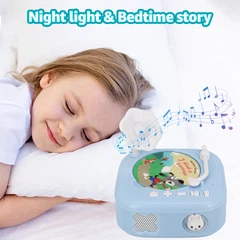
That yellow flower-shaped cover 🌼 - that's the night light lens. It glows warm yellow when the kid presses the light button at bedtime. Buttons, brackets, screw packs - all kitted per unit like a meal-prep tray. Our line supervisor has one rule: if a station has more than what fits in one tray, it's too much.
Then the bench where the magic begins.

Circuit board soldering.
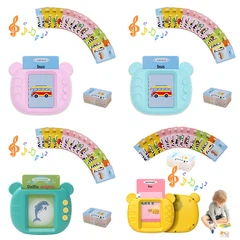
This is where the 5-button layout gets its brain. ⚡ Pause/Play ▶️, Vol+ 🔉, Vol- 🔈, Record 🎙️, Night Light 💡 - all wired here. Plus the optical sensor that reads the black-and-white barcode printed on the bottom of every card. Each card has a unique stripe pattern. The sensor scans it. The PCB plays the matching nursery rhyme.
No NFC chip. No RFID tag. Just optics, good firmware, and a sensor that costs a fraction of a wireless tag. When your toy ships with 120 cards, that difference isn't small.
ESD-grounded gear. ⚠️ No exceptions. I've walked factories where soldering happens on a wooden table. Their boards fail after three months of humidity. Ours don't.
Two stations, side by side - because they're a pair you never separate.

PIN connection

PIN port check
Pin connector. Plug it 🔌, check it under magnification 🔍, check it again. Is this exciting? No. Is it where 80% of field failures trace back to? Absolutely. A pin half a millimeter loose = the unit powers off when a kid drops it off the kitchen table. Fixing that pin at the factory costs seconds. Fixing it in an Amazon return costs a customer.
Now the board meets the body.
PCB drops into the housing. Motor pre-mounted, stylus mechanism aligned. Here's the beautiful part: when a child pushes that tone arm onto a card, the optical sensor fires, reads the barcode, and triggers playback. ✨
It feels like a real record player. Every kid who touches it smiles at that moment. The illusion is simple. Engineering it to survive 2+ years of daily abuse? That took work.

PCBA installation
Motor seated in its bracket with rubber isolation. 🏭 Without it, motor hum trickles into the side speaker and you hear a low-frequency drone under every lullaby. Buyers never notice this. Kids do - they'll say "it sounds funny" and lose interest in ten minutes. Twelve prototype rounds to dial in the mechanism stroke distance. Twelve. For a toy that wholesales under $15.
Then the machine I genuinely love showing visitors.

Motor installation
Automatic screw station. 🔩 Same torque, same depth, every single time. Human hands get tired after 200 units - they don't complain, they just gradually under-tighten or over-tighten. Cracked housings. Stripped threads. Loose speaker frames. This machine paid for itself within 6 months in eliminated returns.
Internal plastics next.

Automatic screw machine.
Yellow clips. Button guides. Stylus bracket. Battery compartment walls. Every piece clicks into exactly one position. 🧩 If it doesn't click, the mold was wrong. This is the moment where 20 years of mold design experience either shows up - or doesn't.

Inner components
Lithium cell goes in. 🔋 This single component decides three things: runtime, weight balance for little hands, and whether you pass UN38.3 transport certification. A phonograph that dies mid-story because someone saved ¥0.80 on the battery is a returned phonograph. Period.

402030 Li-po battery instead of 18650
Side-firing speaker. 🔈 Electric screwdriver with torque control. That X-shaped grille you can see from the outside - that's where sound comes out, left side of the body. Too tight cracks the frame = distortion at any volume. Too loose rattles against the ABS housing = buyer thinks it's broken. This worker has done this 10,000+ times. Her wrist knows the right torque before the tool beeps.
Now the stuff customers actually touch.

Speaker fixed.
Card slot cover. Tone arm. 5-button faceplate. 🎯 Every edge checked for sharpness. EN71 says a 3-year-old's finger shouldn't catch anywhere. We don't check because regulations demand it. We check because a crying toddler is a product returned in tomorrow's mail.

Outside components
Bottom shell seals the unit. 🔒 Type-C charging port visible. Reset hole centered underneath for factory testing. After this, nothing inside is reachable without reopening - which costs 3 minutes per unit × 2,000 units = a morning's output gone. So every internal connection gets one final visual pass before the shell comes down. Not in the SOP. Just muscle memory from 14 years of doing this.
Now the testing zone. 🧪 Two stations, one purpose.

Upper and lower parts assembled.
100% pre-test. Every. Single. Unit.
Stylus down → optical sensor reads barcode → playback triggers → volume knob sweeps → Record button fires mic test → Night Light cycles yellow glow → Type-C charge verified.
This is not final QC. This is screening before QA even sees it. Defects caught here never get counted as "factory rejects." They get counted as "never left my line."
Some factories skip this and go straight to AQL batch sampling. 📊 Their defect rate hovers around 3%. A well-run single-shift line doing 100% pre-screen keeps it under 1%. The math is boring. The difference is your Amazon star rating.

The finished player waiting to be tested.
Bluetooth test rig. 📡 Pairing latency. Connection stability across a 60-second continuous stream. Range check - 8 meters minimum, unobstructed. Audio sync offset measured. This is CE and FCC compliance in practice - not stickers on a catalog page. This station costs more than some entry-level factories spend on their entire QC department.
Last one. The smallest step. The one nobody notices.

BT test station
Four rubber foot pads. One per corner. 🦶 Prevents sliding on hard surfaces. Silences the unit on tables. Nobody thinks about them until one is missing - and then the Amazon review reads: "slides around, 2 stars." Saving ¥0.30 per unit isn't worth that review. We've never skipped this step. We never will.
Seventeen steps.
One blue-and-white phonograph. 🎶
A kid pushes the tone arm onto a card. An optical sensor reads a barcode strip. A speaker plays "Twinkle Twinkle Little Star." Mom records "goodnight sweetheart" through the side mic. The flower-shaped light glows warm yellow in a dark bedroom. Bluetooth streams a playlist from her phone.
It looks so simple. It always does.
And every single unit that leaves this factory carries 17 peoples' fingerprints - from the molded shell to the last rubber foot pad.
I've spent 14 years building a line where every step has a reason. Not because any one of them is clever. Because each one traces back to a specific moment: a failed audit, an angry email, a unit that came back in a return box.
That's what I wish every buyer asked about. 🎤
Not "what's your price." "Walk me through your process."

OEM/ODM inquiries: happy@xinditai.com
Product catalog: www.kidsoundbook.com WhatsApp: +8613824343309
#OEMFactory #PhonographToy #KidsAudio #ToyManufacturing #ScreenFreeKids #EducationalToys #SoundToy #Montessori #ChildrensMusic #ToySupplier #ShenzhenFactory #OEMODM #FactoryTour #QualityControl #NurseryRhyme #ToddlerGift #BedtimeRoutine #BSCI #EN71 #CPSIA #BehindTheProduct