








Custom Square Gramophone Story Player Manufacturer
My first reaction to this custom square gramophone story player was not "add more functions." It was "keep the ritual clear." A child sees a pink cabinet, a story card, a silver control and a flower. Put down the card; hear the story. That promise guides housing, audio, firmware, media and packaging.
I treat the six supplied images as a design brief, not a specification. They do not prove NFC, battery life or lamp brightness. Confirm those details on an engineering sample.
Why did we keep the cabinet square?
The body stands like a small bedside radio: a broad front, rounded corners, a low center of gravity and enough top area for the circular story-card interface. That geometry can make shelf presentation easier than a round player, yet it also concentrates controls and speaker openings on a limited front plane. Buyers need to judge the cabinet as a complete composition rather than enlarging one control at a time.
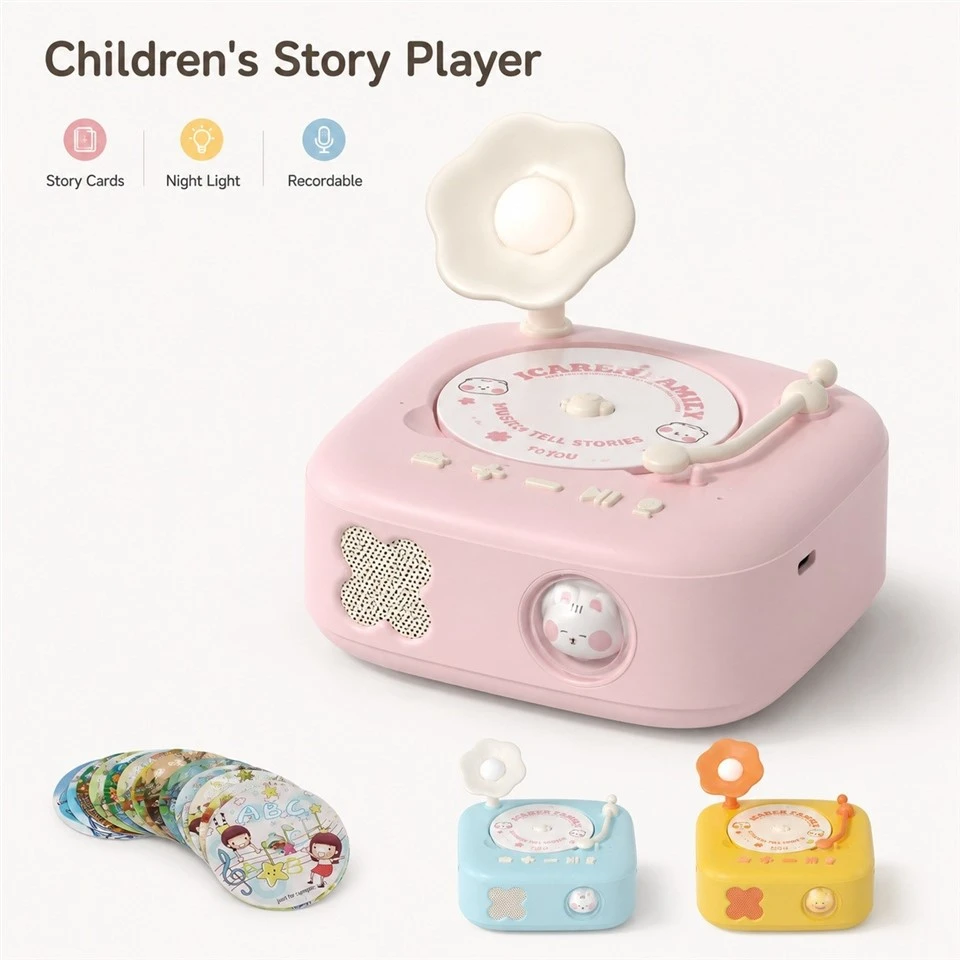
The pink concept uses a perforated speaker area on the left and a silver control on the right. Their visual weight is balanced by the round top platform and the flower-shaped light above it. If a brand changes the grille, dial or lamp, front photographs at the same distance make proportion drift immediately visible.
What is the child expected to do with the top circle?
A child-facing audio product is often remembered through its gesture. Here the round top surface suggests placing or turning a printed story card before playback. That physical step separates the experience from tapping an app icon. It also creates engineering questions around recognition method, card alignment, surface wear and what happens when the wrong media is placed.
The final brief should describe the gesture from the child's point of view, including placement, confirmation, start, pause and removal. Card technology and memory architecture remain project choices. The concept image alone does not prove NFC, RFID, optical reading or another system, so public claims should follow the selected sample.

A clean front reference
The clean pink front view anchors cabinet proportion, speaker position, control spacing and flower height for a custom children's phonograph review.
Would the flower be a lamp, an indicator or simply decoration?
The raised flower form gives this square gramophone story player its strongest vintage cue. If it becomes a night light, brightness, color, diffusion and sleep behavior need to suit a nearby bed. If it is only decorative, the copy should not imply illumination. Either way, the stem and flower must survive handling without making the cabinet easy to tip.
A useful prototype review happens in daylight and in a dim room. The team can see whether the light creates glare, whether the icon or card remains readable, and whether the raised part wobbles after repeated touches. The result is more meaningful than approving a render with an idealized glow.
Can a child start a story before reading the labels?
The front dial, top buttons and possible lever or card action form a small control language. Too many overlapping methods create hesitation; too few can force adults to intervene. The intended age and content model determine whether volume, pause, track change and mode selection belong on the device or behind an adult-only setup step.
During sampling, a new user can be asked to start a story without coaching. Their first touch, pauses and accidental presses reveal more than a feature list. Symbols, resistance and sound feedback can then be adjusted while tooling and firmware remain flexible.
Why does a good bench speaker sometimes sound dull in the cabinet?
The illustrated grille looks generous, but visible perforations do not guarantee clear narration. Speaker diameter, amplifier tuning, cavity volume, internal ribs and the distance to the grille all affect consonants and low-volume listening. A module that sounds fine on a bench may become muffled or cause cabinet buzz once assembled.
Audio approval should therefore use the full housing, final speaker mount and representative story tracks. Listening at bedside distance and in a normal family room exposes different problems. Volume claims, output level and runtime should be written only after the selected hardware and firmware have been measured.
Storytime in its intended setting
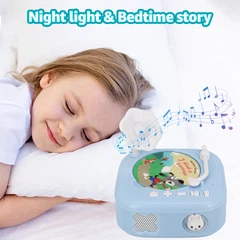
The bedroom scene shows bedside scale and the physical story-card ritual without proving any unconfirmed electronic function.

What can go wrong between a printed card and its audio file?
Illustrated cards can carry stories, songs or learning prompts, but they also have thickness, coatings, corners and print tolerances. A glossy finish may look premium while creating fingerprints; a soft coating can change friction. If recognition depends on a tag or code, artwork and electronics must remain connected through one controlled content map.
A small pilot set should include short and long tracks, quiet speech, music and different visual themes. It can reveal mapping errors, inconsistent loudness and awkward card handling before a large library is produced. Every approved card needs a link between print revision, identifier and audio revision.
How should a bedtime player explain its battery state?
The concept does not confirm battery capacity, charging connector or runtime. Those decisions depend on speaker load, lighting, recognition hardware, standby behavior and the length of typical sessions. A small battery may suit occasional stories but disappoint a retail promise built around all-night ambience.
The product can communicate charging, full, low power and fault states without a screen, but those signals must be deliberate. Repeated playback, idle drain, sleep and recovery after deep discharge belong in the same test plan as the enclosure and content.
Which custom choices belong together-and which do not?
Cabinet color, grille pattern, printed cards, logo and packaging are visible choices. Electronics, firmware, audio mastering and recognition form a second track. Changes meet at prototype gates: a new top graphic may affect alignment, while a larger speaker may change ribs or button space.
A clear OEM square story player quotation separates the confirmed base, optional modules and unresolved decisions. That makes competing proposals easier to compare and prevents every discussed possibility from entering the sample as an accidental requirement.

Visible controls need defined behavior
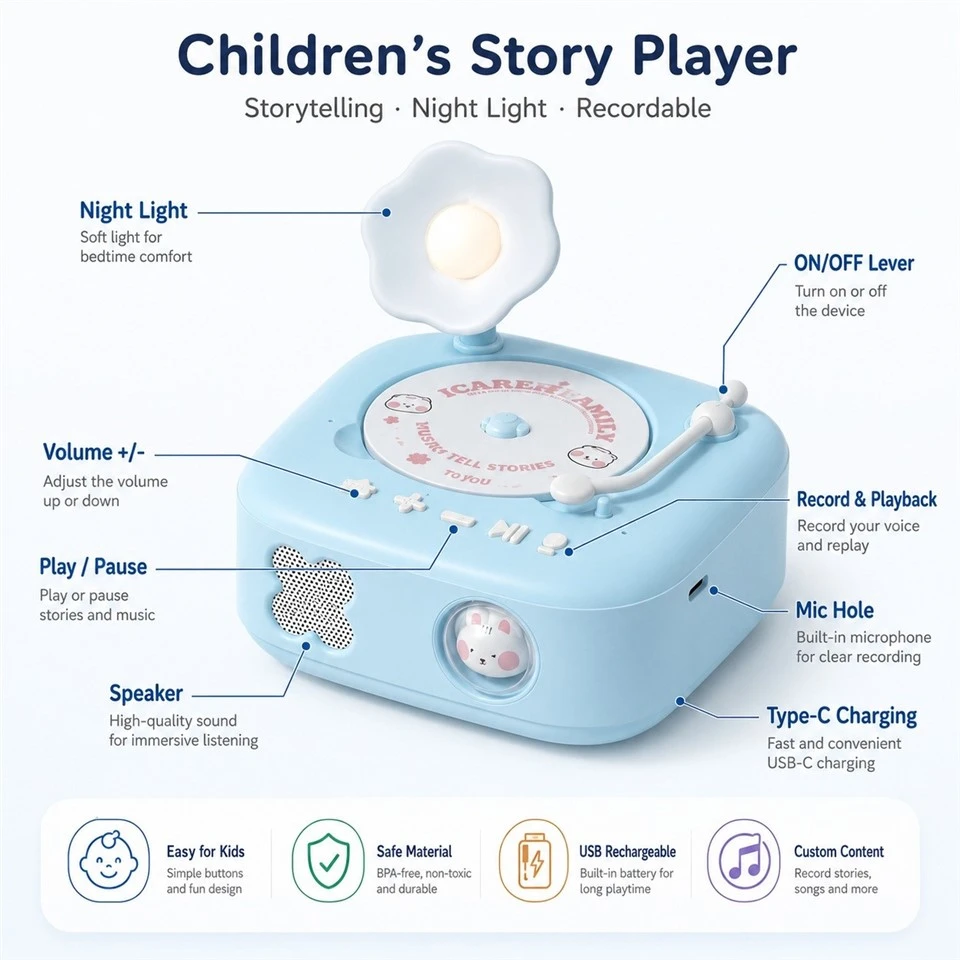
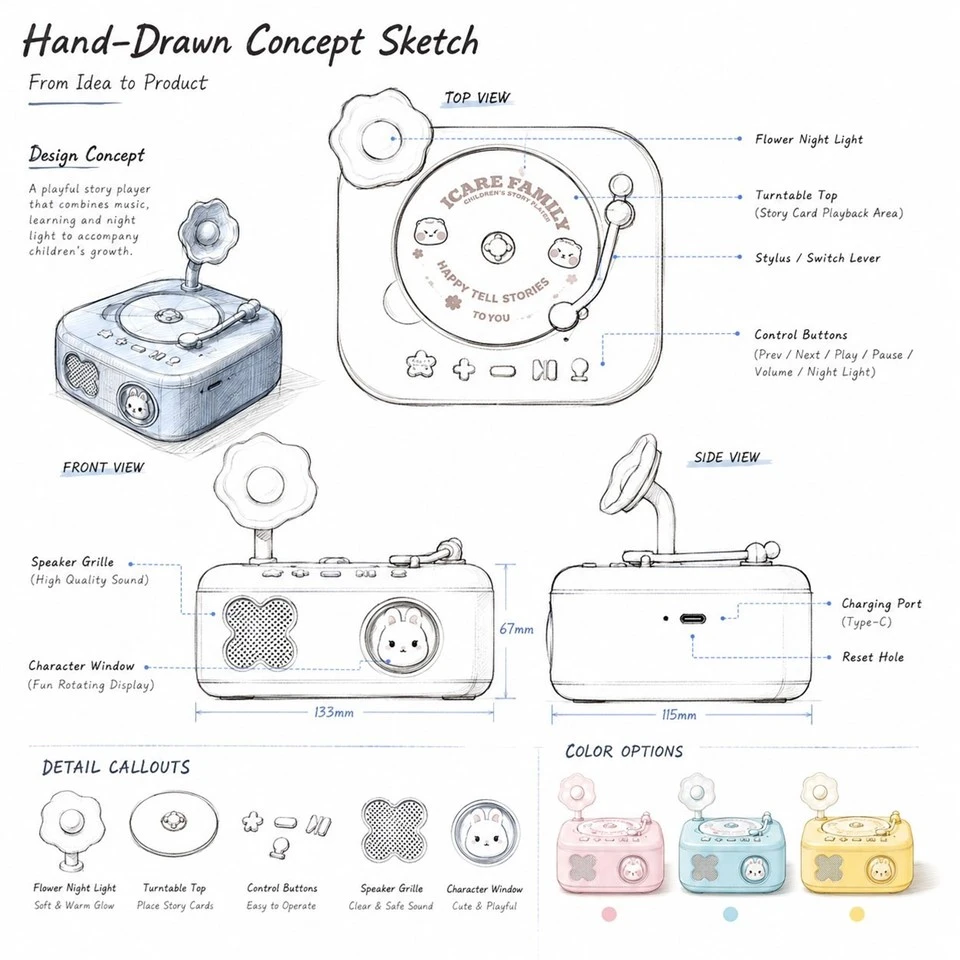
The blue feature board helps convert visible buttons, speaker and light into testable behavior for a kids audio player.
What should buyers mark on the sketch before CAD is frozen?
The hand-drawn board captures front, side and top relationships in a way that invites discussion. Buyers can mark lamp height, top-circle diameter, control spacing and cable access before those choices become fixed in detailed CAD. The sketch is not proof of internal construction; it is a shared surface for questions.
A design review can preserve the gentle square silhouette while locating speaker, battery, PCB and supports. Once the outer form and internal envelope agree, the next prototype has a clearer purpose and fewer cosmetic surprises.
Will the flower and card deck still look right after delivery?
The cabinet is compact, but the flower light adds height and vulnerability. Cards and cables can rub the finish if they move inside the box. A molded or folded insert needs to protect the upper assembly without pressing buttons or leaving a permanent mark around the top interface.
Unpacking by someone outside the project often reveals missing instructions. After transport simulation, the same unit should repeat card recognition, playback, control and charging tests. A gift box is complete only when first use feels as considered as the exterior.
What exactly belongs in the golden sample?
Color chips and photos cannot preserve dial feel, start-up sound, recognition timing or light behavior. The approved unit should be tied to firmware, audio library, card map, labels and packaging artwork. Without that link, later corrections can solve one problem while reintroducing another.
Final inspection can then compare appearance and function against the same baseline. Useful checks include card placement, controls, sound, power states, light, stability, finish and pack completeness. Component or material changes trigger a focused review rather than an assumption that the old approval still applies.
A sketch keeps early choices reversible
The drawing board is useful for discussing geometry and internal envelopes before mold or PCB decisions become expensive.

What should a buyer put in the first inquiry?
The most helpful buyer brief describes where the player sits, who selects the card and what should happen next. It can identify the target market, age direction, language plan, content ownership, preferred controls, colorway and packaging goal while leaving uncertain electronics open for discussion.
This gives the manufacturer enough context to propose a prototype route without inventing commercial numbers. MOQ, schedule, certification and performance depend on the selected configuration and should be confirmed from current project evidence rather than copied from a different model.
Cabinet engineering begins at the split line
If the housing is injection-molded, the team must agree where the front and rear shells meet, where gates and ejector marks can hide, and how ribs and screw bosses stay clear of the loudspeaker and top reader. ABS, PC blends or another resin remain project choices; each affects texture, color, impact behavior and tooling conditions.
A CAD review should flag draft angles, wall-thickness transitions and cosmetic surfaces before steel is cut. The drawing then travels with a finish chip and assembly method-screws, snaps or welding-so a late factory shortcut cannot quietly change service access or cabinet buzz.
The reader needs an RF test, not a perfect demonstration
If the project selects NFC or another radio-frequency card system, antenna size, coil orientation, housing thickness and nearby metal or battery mass can change the reading field. A tag that works over an exposed development board may lose margin under the circular top deck. Stacked cards and off-center placement are practical stress cases.
Engineering can map read positions with production-intent cards, then record response time, missed reads and false repeats. EMI pre-scans matter when charging, amplifier switching and radio functions share the same compact PCB. Optical or mechanical media routes need their own equivalent tolerance study.

Customization belongs in controlled options
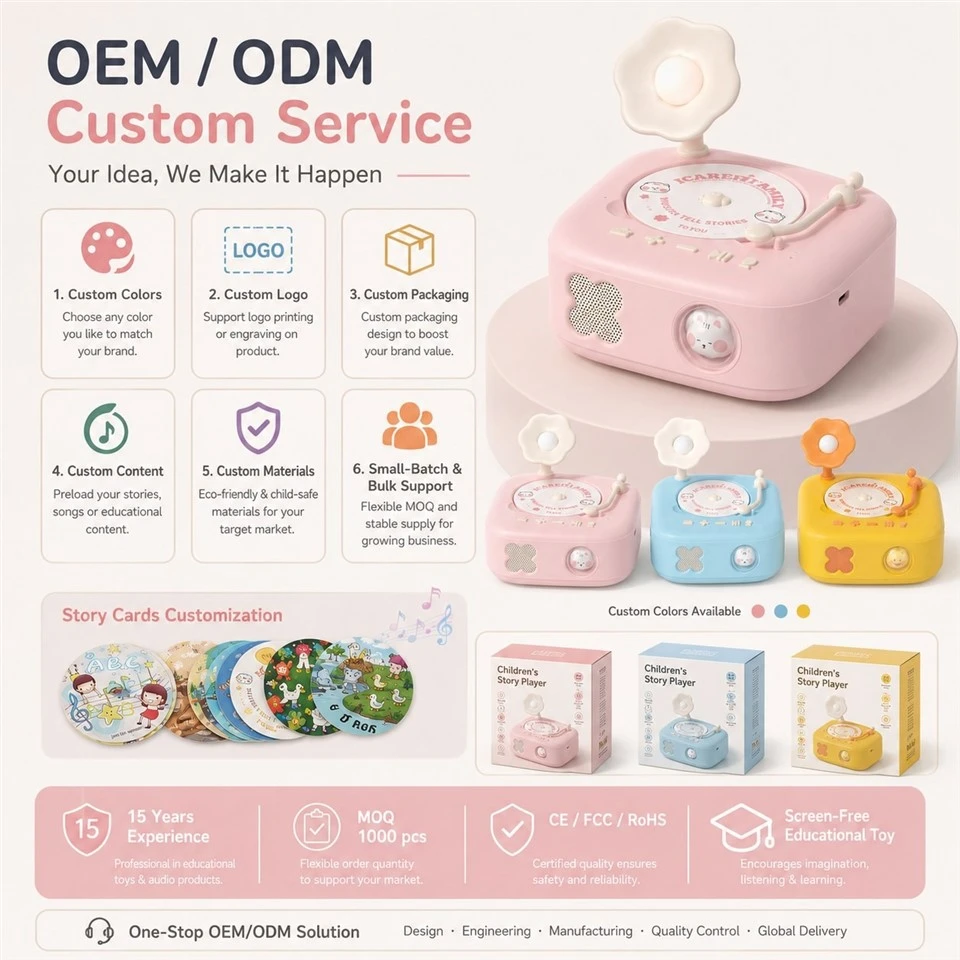
Colors, cards, logo and packaging can vary, while firmware and electronics remain separate approval workstreams.
Speech approval needs acoustic evidence
The front grille open area, speaker gasket, cavity seal, amplifier gain and firmware equalization work as one acoustic path. During a stepped sine sweep, loose ribs or wires may reveal a buzz that ordinary speech masks. Narration samples then show whether consonants remain intelligible at the low volume families use near a bed.
Useful records include the speaker part, enclosure revision, firmware build and test position. SPL or runtime numbers should come from the approved assembly, not from a module supplier's reference board. That distinction keeps marketing claims traceable.
Power architecture changes the compliance file
Battery chemistry and capacity, USB-C implementation, charge IC, protection circuit and sleep current need to be resolved together. The flower light and amplifier can create short peaks that a simple average-current estimate misses. Thermal rise while charging inside the closed cabinet is another sample-level check.
For shipping and target-market review, teams may need documents such as UN 38.3, IEC 62133-2 and the applicable toy, EMC or radio reports. EN 71, ASTM F963, CPSIA, CE or RED relevance depends on market and configuration; the test laboratory should define the final matrix.
Pilot production should exercise the real test fixtures
A pilot is useful when it repeats molding, assembly, programming, card mapping, end-of-line test and packing. Fixtures can check button inputs, speaker output, current draw and media recognition without relying on an operator's memory. Serial or batch records connect failures to firmware and components.
The goal is not a miniature mass run. It is to expose control-force spread, grille buzz, antenna margin, cosmetic variation and programming mistakes while corrections are still manageable. The approved fixes then enter the work instructions, BOM and inspection plan.
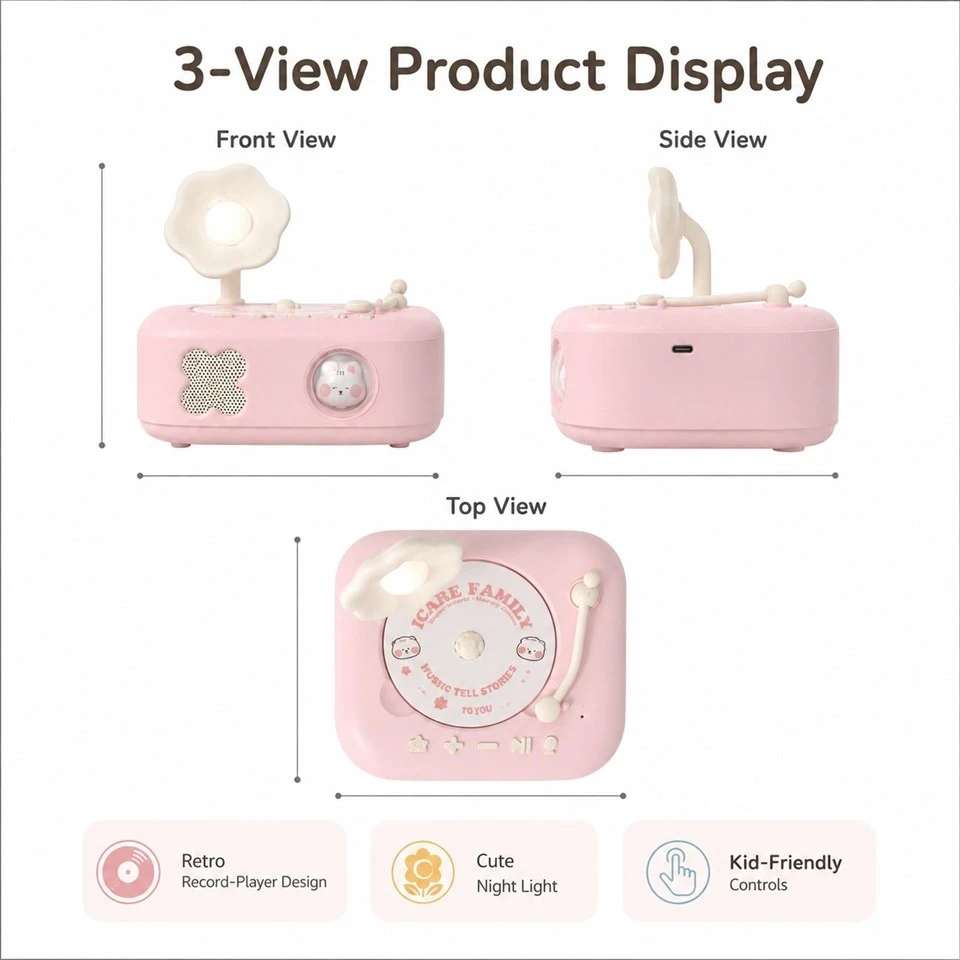
Three views reveal balance and access
Front, side and top views appear last because the board includes engineering angles; it supports stability and access review.

Documentation keeps the approved experience reproducible
A sourcing file should connect exterior drawings, color standards, card artwork, audio masters, firmware and packaging to one revision. That link is especially important for a simple-looking product because a small substitution can change recognition timing, sound quality or control feel without altering the photograph.
Inspection instructions should distinguish visible defects from functional failures and identify the reference sample. Clear records help the factory repeat the approved story ritual across production and give the brand a traceable basis for later language editions or content expansions.
Photographs of approved details can support drawings, but they do not replace measurable specifications or functional checks.
Keep the simple ritual honest
The value of this product direction is not the number of features. It is the clarity of choosing a physical card, starting the intended audio and receiving feedback without navigating a display. A disciplined project protects that moment through every housing, electronics, content and packaging revision.
For related sourcing context, see the published square children's phonograph OEM guide. Joy also shares visual product-development updates for buyers reviewing audio-toy concepts.
FAQ
Q: Does the concept confirm NFC or another card technology?
A: No. The recognition route is a project choice and must be verified with the intended cards, enclosure and firmware.
Q: Can the cabinet color, cards and gift box be customized?
A: Yes. These visible elements can be developed as separate OEM workstreams linked to controlled samples and artwork revisions.
Q: What should be tested before approving audio?
A: Use the final enclosure, speaker mount and representative speech, music and prompt files at realistic listening distances.
Q: What belongs in the first RFQ?
A: Share the market, user age direction, content plan, languages, preferred interaction, colorway, packaging goal and expected order range.
Discuss the square gramophone project with Joy: WhatsApp +86 13691793052 · E-mail: xdt05@dtdianzi.com.
Hot Tags: custom square gramophone story player manufacturer, China, suppliers, manufacturers, factory, customized, wholesale, bulk, quotation, made in China


