




Still Working in 2036 – The Case for a Story Machine You Actually Own
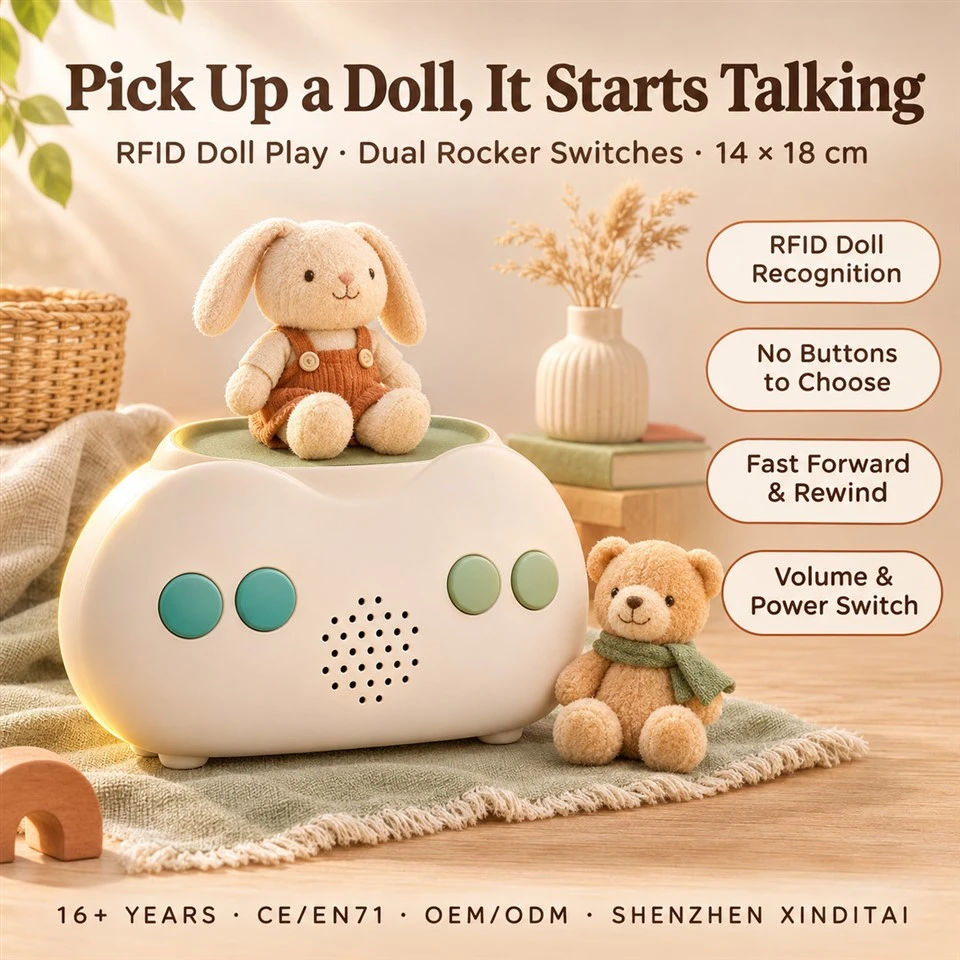
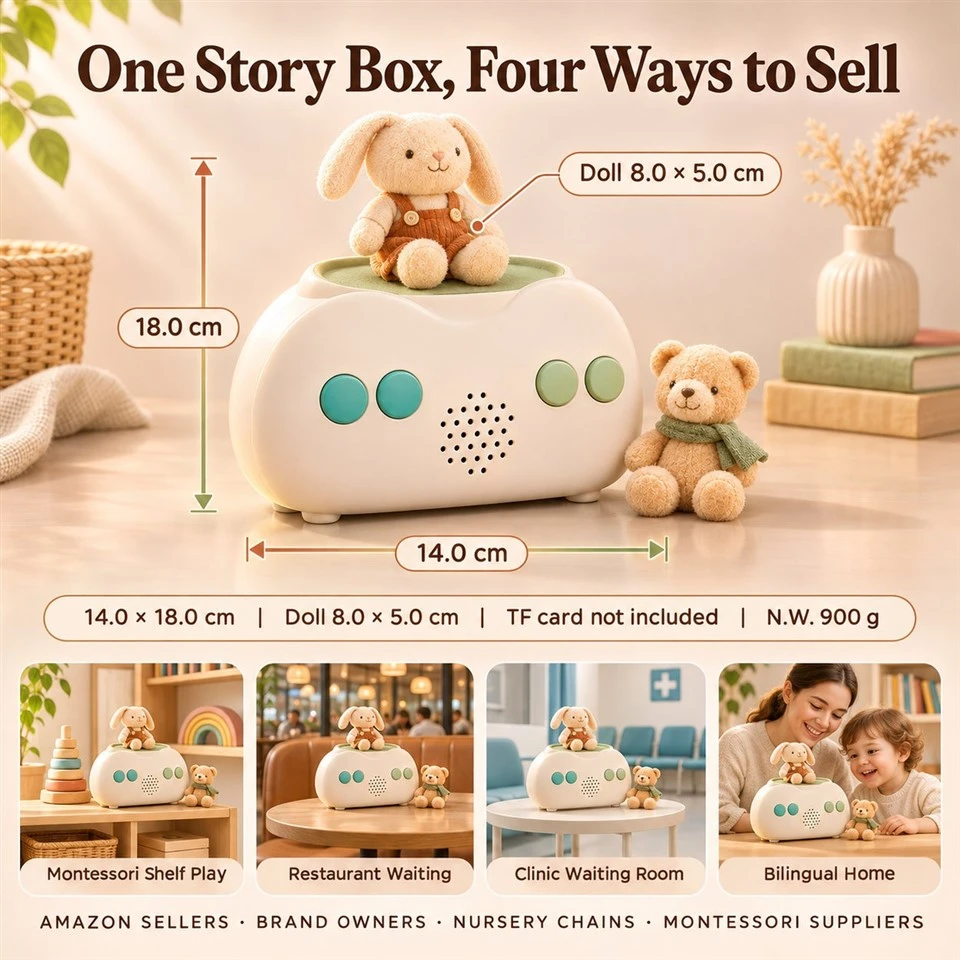
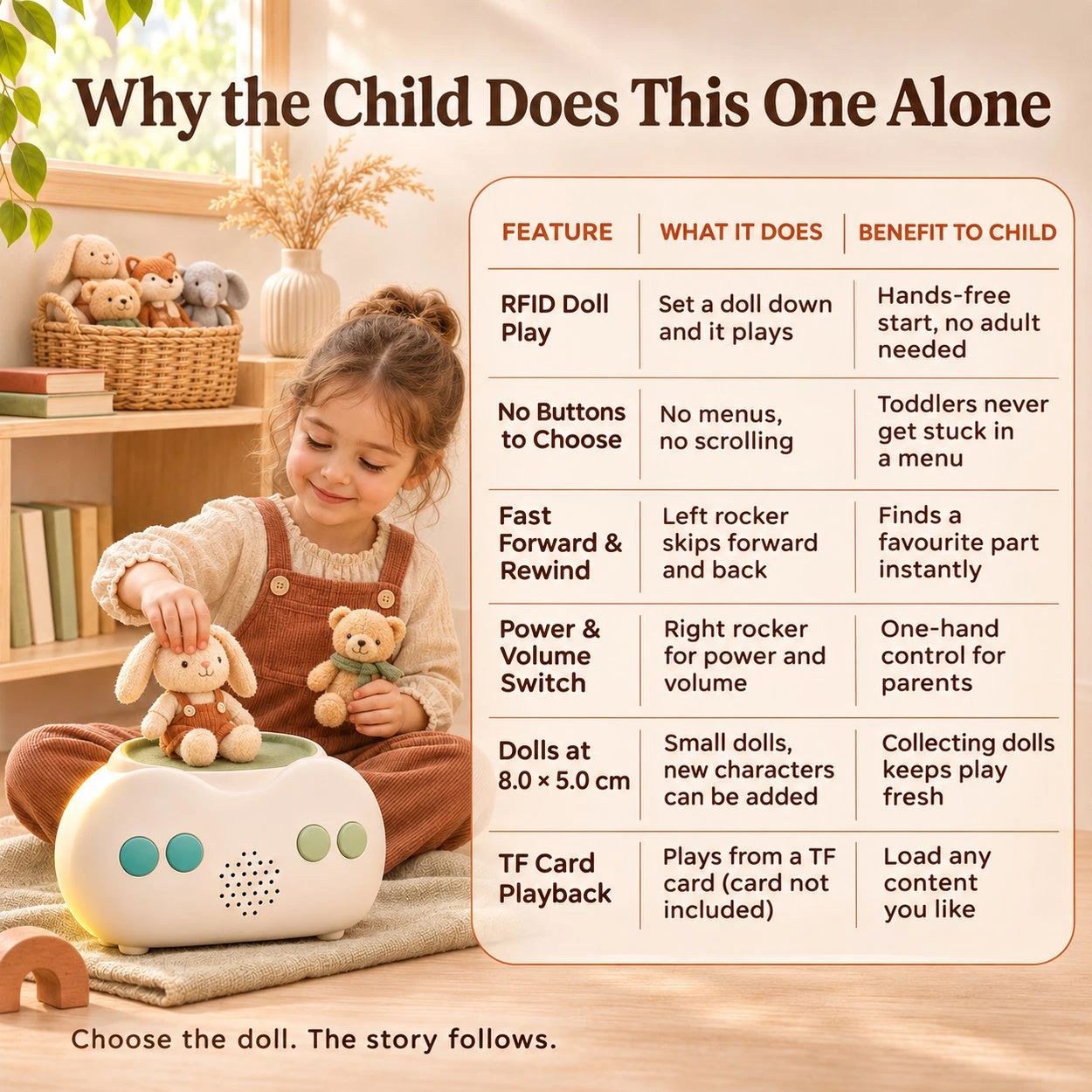
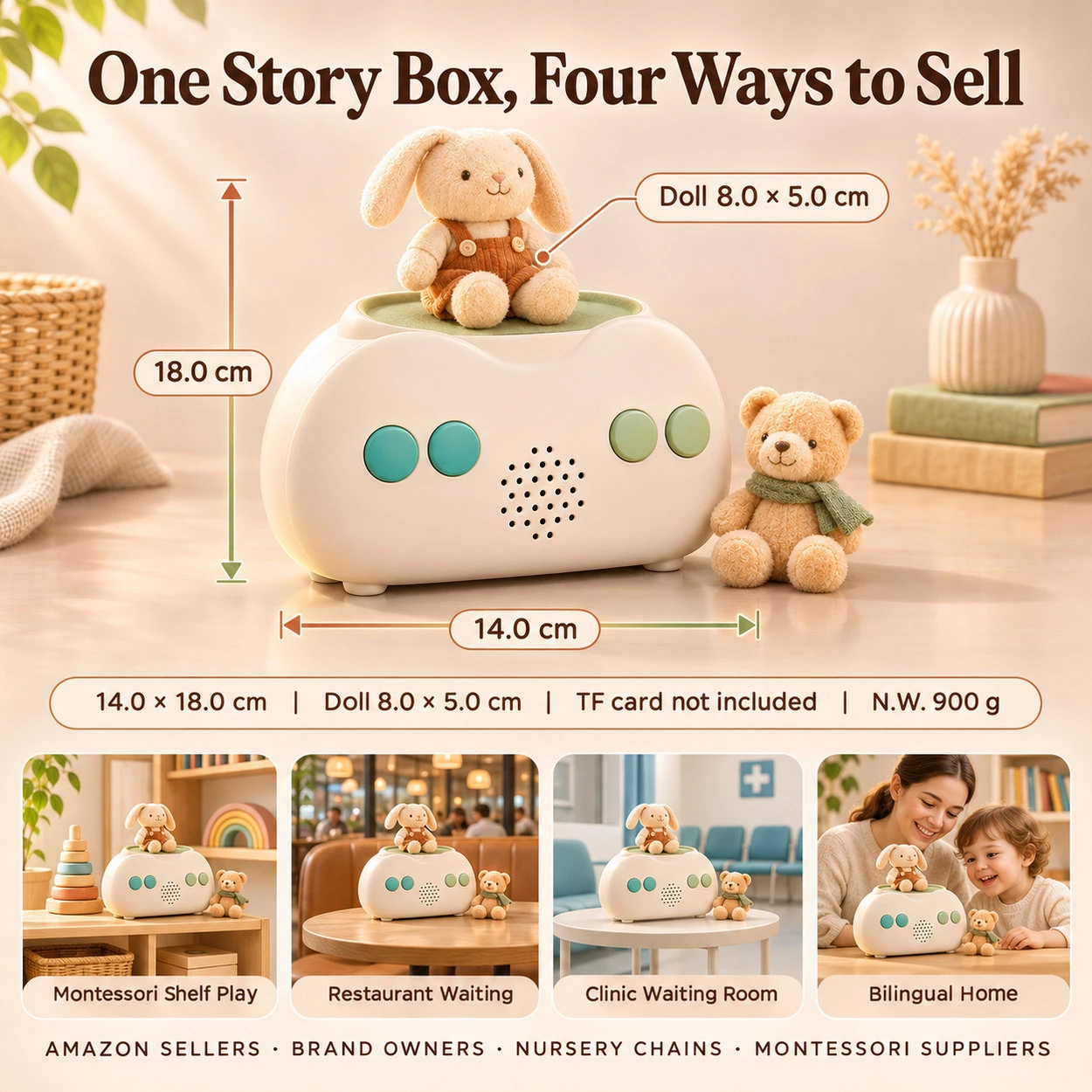
Details: The NFC Story Machine is a small audio player that starts a story when a tagged card or figure is set on its reading pad, and stops when it is lifted. Two raised switches handle everything – fast-forward and rewind on one side, power and volume on the other – and the library lives on the cards rather than in an account. It measures 140 by 180 mm, weighs about 900 g and runs from a TF card inside the body. None of those facts is remarkable on its own. What they add up to is: a toy that cannot be switched off from outside the house. There is no app to be retired, no login to lapse, no plan to cancel and no server that can go dark, which means the product a family buys in 2026 is still a product in 2036. That is a quiet claim, and it is the one this page is about. Volume orders begin at 1,000 pcs; smaller runs of 200 to 500 are possible for a first market.
Key Product Selling Points
Details: Ownership sounds like a legal idea and behaves like a practical one. The seven points below are what a family actually keeps when the product is built this way, and each one is a thing that can be lost.
No App to Be Retired
An app is a promise that has to be renewed every time a phone operating system changes, and most children's apps are renewed for two or three years at most. When the renewal stops, the toy does not break – it simply stops being able to do the thing it was bought for. A product that never had an app cannot lose one.
No Account to Lapse
An account is a small dependency that is easy to forget and annoying to recover: a password, an email address that changed, a child who now has their own login. A card player has no account because it has nothing to authenticate – the card is the credential, and it works whether or not anyone remembers an email from four years ago.
No Subscription to Cancel
A subscription turns a purchase into a standing arrangement, and a standing arrangement can be ended by either side. Families cancel them at the end of a tight month, and companies retire them when a service stops paying. A product sold once, with no plan attached, has no such lever, and that is worth saying plainly on the box.

No Server to Go Dark
Anything that streams depends on a company continuing to pay for a server, and servers outlive their business case far less often than their products. Audio stored on a card and read locally has no such dependency: the story plays because the machine and the card are in the same room, not because a data centre is still running.
A Deck You Can Reprint
A worn card is a worn card, not a lost purchase. Because the deck is printed and encoded rather than licensed per user, a family or a school can order the same set again years later, and a buyer can hold the files and the card mapping for a reprint. That is what stops a product from becoming unusable the moment one piece of it is damaged.
A Unit You Can Open
Repair is the most practical form of ownership, and it begins with a body that can be opened, a battery that can be reached and a module that can be replaced. A product sealed for its own protection is also sealed against its own second life, which is a trade-off worth naming rather than hiding.
A Toy You Can Hand On
The last form of ownership is the ability to give the thing away. A machine that still works and still has cards can go to a younger cousin, a library or a second child, and it arrives with its library intact rather than tied to an account that cannot be transferred. That second life is the strongest evidence a product was really owned.
In short: no app, no login, no plan, no server, a deck that can be reprinted, a body that can be opened and a toy that can be handed on.
What Happens to a Connected Toy When the Company Moves On
Nothing dramatic happens. The toy does not explode and nobody sends a letter. The app stops being updated for the new phone, the voice service quietly changes hands, the subscription page is retired, and one ordinary Tuesday the thing in the child's room simply does less than it did. Parents describe it as the toy "not working any more", which is accurate from the outside and misleading from the inside: every part of the hardware is still fine.
The pattern is old enough to be predictable, and it has three usual endings. The service is retired, and the product becomes a plastic object. The company is acquired, and the product is folded into an ecosystem that requires a new account. Or the product survives but the content does – the toy still turns on, and there is nothing left to play. None of these is a failure of engineering; they are failures of dependency.
For a buyer, that reframes the question. It is less useful to ask what a connected toy can do today than to ask what it will still do when the company has moved on, the phone has been replaced twice and the child who owns it has a younger sibling. The answer is decided almost entirely by where the content lives, which is why the card format is worth a serious look rather than a nostalgic one.
Why the Card Is the Most Durable Part
A card is a piece of printed board with a passive tag inside it, and there is very little in that description that can be retired. It has no firmware to update, no licence that expires and no dependency on a service; the tag holds a code and the machine holds the audio. Ten years from now, a card and a working machine will still do exactly what they did on the first day, because nothing in the chain requires anyone's permission.
That durability has a commercial consequence a buyer should not miss. When the content sits on cards, the product can be extended without touching the platform, and a range can be supported for as long as the buyer keeps printing decks. A brand does not have to choose between retiring a product and maintaining a server; it can simply keep releasing cards, which is a far cheaper way to stay in a market.
The card also survives the ordinary accidents of family life better than a licence does. A scratched card can be replaced, a lost one reordered, a chewed one reprinted from the same files. None of those recoveries requires a customer-service conversation about an account, and none of them depends on a supplier still existing in the same form. The deck is the part of the product that behaves like a book rather than like a subscription.
What a Toy Library Sees
A toy library is the strictest test of ownership, because it lends the same object to dozens of families and expects it back in a state that can be lent again. Most connected toys fail that test before they are unpacked: the library cannot hand over an account, cannot reset somebody else's login and cannot promise that the app will still exist when the item is due back. A card machine passes it almost by accident.
The lending model works because nothing is attached to a person. The machine goes out with a deck, the deck comes back with the machine, and the next borrower starts with a clean library rather than a reset account. A library can keep several decks and match them to the age of the child, which turns one unit into a small collection that serves a whole shelf of borrowers.
Durability stops being a marketing word in that setting and becomes the whole proposition. A shell that wipes clean, two switches rather than a touch panel, and a card that can be reprinted when a borrower loses one are the differences between an item that circulates for years and one that is quietly withdrawn after a term. A library also values the absence of a subscription more than a family does, because a recurring cost per item is a budget line that has to be defended every year.
There is a data point in it for a manufacturer too. A library that reorders cards but not machines is telling you the hardware outlasted its content, which is exactly the shape a well-built card product should have. That pattern is worth watching in the first year of any range, because it predicts which decks deserve a second printing.
The same logic applies to a school. A class set that survives five intakes is a capital item rather than a consumable, and that changes how a head teacher budgets for it. The machine is bought once, the decks are refreshed, and the cost per child falls every year the set stays in service.
Neither a library nor a school will say any of this in a purchasing meeting. They will ask, in different words, whether the thing will still work when the next child borrows it – and a supplier who can answer that without hedging tends to win the order.
Product Parameter
| NFC Story Machine – Specification and Ordering (LM-003) | |
| Item | NFC Story Machine / LM-003 |
| Starting a Story | A tagged card or figure is set on the reading pad; lifting it pauses playback |
| Where the Audio Lives | On a TF card inside the unit, read locally – no account, no app, no subscription and no server in the chain |
| Two Switches | Fast-forward and rewind on the left, power and volume on the right, both raised and tactile |
| Body | 140 × 180 mm, about 900 g |
| Cards and Figures | A passive NFC tag in each, printed and encoded to order, replaceable and reprintable |
| Tooling | A figure needs a one-time mould; a card does not |
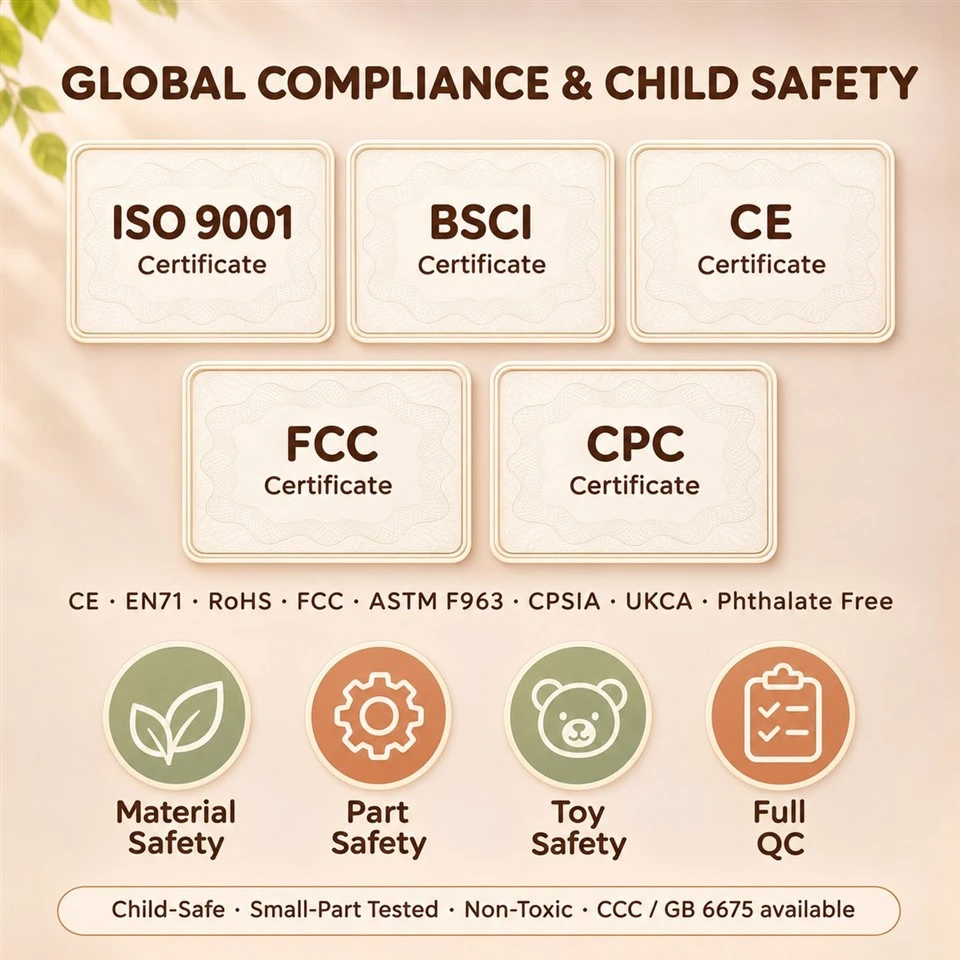
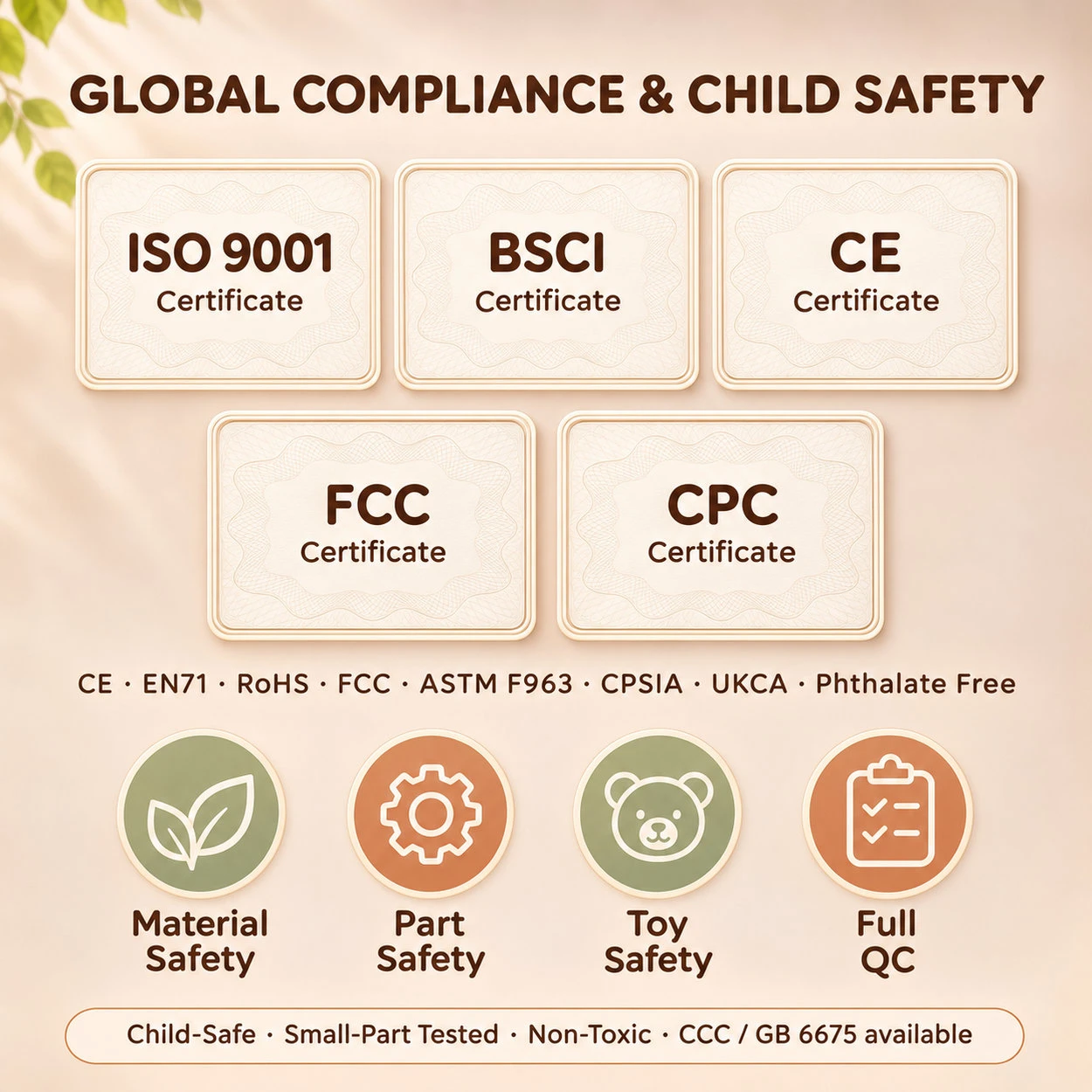
| Compliance | CE, UKCA, FCC and RoHS files with CPC; EN71 and ASTM F963 reports issued when a market requires them |
| Minimum Order | 1,000 pcs; a trial run between 200 and 500 units is possible |
Tell us how long you intend the product to be supported, and we will come back with a build, a deck plan and a reprint arrangement that matches it. Write to the export desk, or set out the plan in the enquiry form. Related story and talking-card models are listed at: https://www.kidsoundbook.com/products
What to Ask Before You Buy a Connected Toy
The questions below are the ones that decide whether a purchase survives its own company. They are not technical questions and they do not need a specification sheet; a supplier should be able to answer each one in a sentence, and the answer should be the same in writing as it is in conversation.
The useful habit is to ask them before the sample rather than before the renewal, because by the time a service is being retired the decision has already been made somewhere else.
| Five Questions, Two Kinds of Answer | ||
| The Question | A Connected Toy | A Card Machine |
| Where does the content live? | On a service the company operates | On cards in the room |
| What happens if the app is retired? | The product loses its main function | Nothing: there was never an app |
| What happens if the company is sold? | The account, the plan and the library may move or close | The cards and the player are unaffected |
| Can a worn part be replaced? | Usually only by a whole replacement unit | A card can be reprinted, a module reached |
| Can it be given to another child? | Often no, because the library is tied to an account | Yes: the deck travels with the machine |
None of this argues that connected toys are bad. It argues that a buyer should know which side of the table a product sits on before promising a family that it will last, because the difference is invisible in a photograph and obvious in year three.
Three Promises That Outlast the Box
Built for a Long Shelf Life
From a Brief to a Reprint
A product meant to last is planned backwards from its tenth year rather than forwards from its launch date, and the route below reflects that.
The Lifespan Comes First
We ask how long the product has to remain usable before we ask what it should say, because a design meant to last a season and one meant to last a decade are different builds.
Parts With Headroom
The cell, the speaker and the switches are chosen with margin rather than at the minimum, and anything that can be reached is placed where it can be reached when the body is opened.
The Sample You Live With
A loaded unit is sent before the run so a buyer can keep it in a room for a week. What a household does with it in seven days tells you more about the tenth year than any bench measurement.
The Reference Nobody Touches
One unit and one deck are sealed as the standard for the product, so a reprint in year four matches the original rather than someone's memory of it.
The Run and the Files
Production follows the approved sample, and the deck files and mapping are handed to the buyer at the end of the run. Those files are what make a third edition possible without a third development cycle.
Reprints and Paperwork
The last stage is not the shipment but the record: a spares allowance, a document pack and a reprint route that survives the original order. The line can be inspected on site, or watched on a live call, before anything leaves.
What Ownership Lets You Decide
If the product is meant to be owned rather than rented, the order should look different from a standard OEM order. The items below are what a buyer can specify to make the ownership claim true rather than rhetorical.
Questions About Keeping It
Q1: Does it need a phone, an app or a network at any point?
No. The audio is on a card inside the unit and the recognition happens on the device, so there is nothing to pair, download, log into or subscribe to. It works on a plane, in a cellar and in a house that has never had Wi-Fi. That is the whole basis of the ownership claim.
Q2: What happens if you stop making the product?
The machines in the field keep working, because nothing in the chain asks the factory for permission. Existing decks keep playing, and if a buyer has held the files a reprint can be arranged through any card printer. A product that depends on no service cannot be switched off by one.
Q3: Can a single damaged card be replaced?
Yes. A card is printed and encoded to order, so replacing one is a small reprint against the same files rather than a lost library. That is the practical difference between content held on cards and content held behind an account: the damaged part is one object, not the whole collection.
Q4: Do we receive the files at the end of a run?
That can be agreed at the order, and for a brand planning a long support life it should be. The audio, the card list and the mapping are the three things needed to reprint a deck, and holding them means a second edition does not depend on anyone's archive.
Q5: Is the unit repairable?
It is designed to be. The body can be opened, the module and the battery can be reached, and a small spares allowance covers most faults. The alternative, a sealed unit replaced whole, is easier to sell and harder to defend once a customer has owned it for three years.
Q6: Can it be handed on to another child or family?
Yes, because nothing is tied to an account. The deck travels with the machine, so a younger sibling inherits a working library rather than an empty toy. A used unit can be sold, lent or donated with its content intact, which is unusual in a category built on logins.
Q7: What is the minimum quantity, and how does sampling work?
Production begins at 1,000 units, with a 200 to 500 unit run available for a first market. A loaded unit is sent before the run so the deck can be lived with for a week, and the sample cost is credited against the order.
Q8: Where is the machine built, and is a factory visit possible?
The unit, the cards and the recordings are made at one site in Shenzhen. The plant is open to visitors, the line can be shown on a video call, and every carton keeps a batch record traceable to a date.
The Workshop That Answers in Year Four
for children
Xinditai Electronics has made children's audio products in Shenzhen since 2010, mostly through OEM and ODM programmes for story machines, phonograph and card players, talking cards, sound books and projection toys. Its buyers include publishers, schools, charities and distributors across many markets. Products built to be supported for years rather than seasons are a growing part of that work, which is why the files, the reference unit and the records stay with the same team.
Moulding, board assembly, card printing, voice recording, acoustic testing and packing run on a site of roughly 3,000 square metres, with more than a hundred engineers and operators. Every stage clears its own check before the next starts, and each batch keeps a record that can be traced back. The factory can be visited, or the line shown over a video call, before an order is confirmed.

Paper That Does Not Expire
Certificates
The unit and its cards leave as one product, so the documents are assembled around the order and prepared for the destinations named. Every certificate is current, ships with its own batch, and a complete set can be sent with the quotation.

CE

RoHS

FCC

SEMTA

EMC

ISO
Hot Tags: still working in 2036 – the case for a story machine you actually own, China, suppliers, manufacturers, factory, customized, wholesale, bulk, quotation, made in China


