

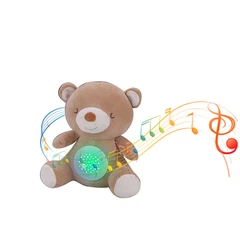



Screen Free Educational Toy Multi Sensory Learning Plush No Screen AI
Why Screen Time Is the Wrong Answer for Early Learning
Most parents have felt the quiet relief of handing a tablet to a restless toddler. The screen lights up, the child goes still, and the room becomes calm. That calm comes at a cost. A screen delivers information through one channel only: the eyes. The child sits, watches, and absorbs passively. For early development, this single-channel approach is the opposite of what the growing brain needs. A screen free educational toy takes a different path. It asks the child to speak, to touch, to move, and to watch all at once. 👶
The Single-Channel Problem of Screens
When a child watches a screen, the visual system works hard while the rest of the body stays still. The voice is silent. The hands are empty. The sense of balance and motion is unused. Neuroscientists describe this as unbalanced sensory input. The brain receives a flood of visual information but lacks the matching signals from touch, movement, and sound that would normally help it build deep, durable memory. This is why a child can watch a lesson on a screen and forget it within hours, but remember a song learned through singing and movement for years.

The Four Senses Working Together
A well-designed multi-sensory learning plush does not rely on one sense. It activates four channels at the same time, and each channel reinforces the others. The diagram below shows how the four channels connect.
👁️ Visual (LED Expressions) │ ▼ 🗣️ Auditory ←──→ 🤲 Tactile (AI Voice) (Touch Sensors) │ ▼ 🔄 Proprioceptive (Gyroscope Motion)
Each channel does a specific job, but the real value appears when they work together. A child hears a question, sees the toy's eyes light up with curiosity, pats the head to answer, and tilts the toy to trigger a response. The brain receives four matching signals at once, and the memory formed is far stronger than any single signal could create.
Visual Channel: LED Expression as a Teaching Tool
The visual channel is not a screen. It is a pair of soft, low-blue-light LED eyes that shift between a small set of clear expressions: happy, curious, sleepy, surprised, and gentle. These expressions act as a visual vocabulary. When the toy speaks in an excited tone and its eyes widen, the child learns what excitement looks like. When the toy speaks softly and its eyes droop, the child learns what comfort looks like. This is visual learning without a screen, and it happens in the context of a real, physical object the child can hold.

Auditory Channel: AI Voice as Language Input
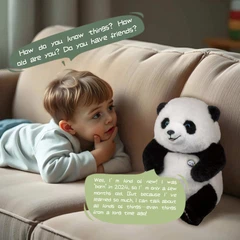
The auditory channel carries the AI voice. Unlike a pre-recorded chip that repeats the same phrases, a no screen AI companion can generate original responses, answer questions, tell stories, and switch between languages. For language development, this matters deeply. A child needs to hear rich, varied, context-appropriate speech to build vocabulary and grammar. A toy that can hold a real conversation provides that input on demand, at any hour, without requiring a parent to be available every minute.
Tactile Channel: Touch as Body-Based Communication
The tactile channel uses flexible touch sensors hidden inside the plush fabric. These sensors detect different kinds of contact: a gentle stroke, a firm pat, a squeeze, a rub. Each contact type triggers a different sound and expression. Touch is the oldest sense humans possess, and for young children it is a primary language. A child who cannot yet say "I am upset" can still squeeze a toy tightly and receive a soft, comforting response. This body-based communication builds emotional confidence that spoken language alone cannot reach.
Proprioceptive Channel: Motion as Spatial Learning
The proprioceptive channel uses a gyroscope to detect how the toy is being moved in space. Lift it up, tilt it sideways, turn it upside down, lay it flat, and each motion produces a matching reaction. Proprioception is the sense that tells the brain where the body is in space. For young children, developing this sense is essential for balance, coordination, and later writing skills. A toy that rewards movement encourages the child to move, reach, lift, and turn, all of which strengthen the proprioceptive system naturally through play.

Multi-Sensory vs Single-Sensory: A Comparison
The difference between the two approaches is not a matter of opinion. It maps directly to how children learn. The reference chart below compares the two models across six developmental dimensions.
| Developmental Dimension | 📺 Single-Sensory Screen Product | 🧸 Four-Sensory AI Plush |
|---|---|---|
| Active senses used | 1 (Vision only) | 4 (Vision + Hearing + Touch + Motion) |
| Child's body position | Sitting still | Moving, reaching, holding |
| Memory retention strength | Low to moderate | High (multi-signal encoding) |
| Language practice opportunity | Passive listening only | Active speaking + listening |
| Emotional expression practice | None observed | LED expressions mirror emotions |
| Physical development benefit | Minimal | Balance, coordination, fine motor |
The chart makes the core point visible. A screen product asks the child to receive. A four-sensory plush asks the child to participate. Participation is where learning actually happens.

The Science Behind Multi-Sensory Learning
The idea that multiple senses together create stronger learning is not new, but modern brain research has given it a clearer mechanism.
How the Brain Builds Connections
When the brain receives information through one sense only, it stores that information in a relatively narrow network of neurons. When the same information arrives through four senses at the same time, the brain connects it across four separate regions: the visual cortex, the auditory cortex, the somatosensory cortex, and the cerebellum. These cross-connected networks are more durable. They are easier to recall because the brain has multiple paths back to the same memory. This is why educators have long known that children learn better when they see, hear, say, and do something all at the same time.
Sensory Integration and Child Development
Sensory integration is the brain's ability to organize information from all the senses and use it to participate in daily life. Children with strong sensory integration can focus, regulate their emotions, coordinate their bodies, and learn new skills efficiently. Children who lack sufficient multi-sensory experience in early years may struggle with attention, balance, or emotional regulation later. A sensory integration stuffed animal provides a safe, fun way to exercise all the major sensory systems during ordinary play. The child does not know they are doing therapeutic work. They simply think they are playing with a friend.

What This Means for Product Design
For manufacturers and brand owners, the lesson is clear. A product that activates only one sense is competing in a crowded, low-margin space. A product that activates four senses and ties them together through AI is offering something a screen cannot replicate. The LED eyes must be soft and expressive, not harsh or flickering. The AI voice must be clear, warm, and age-appropriate. The touch sensors must be reliable enough to respond every time, not just sometimes. The gyroscope must be calibrated so that gentle motions trigger gentle reactions and rough play is gently discouraged. When all four channels work in harmony, the result is not just a toy. It is a developmental tool wrapped in a huggable form.
Contact Us
If you are exploring multi-sensory AI plush products for early education, special needs, or premium gift markets, our team is ready to discuss your concept. We provide full OEM and ODM support for LED expression modules, AI voice systems, multi-point touch sensors, gyroscope motion integration, and complete plush manufacturing.
Judy Shenzhen Xinditai Electronic Co., Ltd. Email: xdt04@dtdianzi.com WhatsApp: +86 136 0263 5993

Hot Tags: screen free educational toy multi sensory learning plush no screen ai, China, suppliers, manufacturers, factory, customized, wholesale, bulk, quotation, made in China


