





Kids Phonograph Card Player: Story Card Audio Toy Manufacturer & OEM/ODM Sourcing Guide
Shenzhen Xinditai Electronic Co., Ltd. - Card-Reading Phonographs, Screen-Free Story Players & Children's Audio Devices - OEM/ODM
Table of Contents
2. What Is the Kids Phonograph Card Player?
5. Applications & Product Uses
7. Technology & Product Knowledge
8. OEM/ODM Development Process
10. Why Partner With Xinditai?
11. Kids Phonograph Card Player FAQ

1. Introduction
Bedtime is the hardest fifteen minutes in most households with small children, and it is also the moment when screen-free products earn their place. Parents are looking for something a child can operate alone, that ends rather than continues, and that does not glow at them in a dark room. The category that answers this is not the tablet and not the plush toy: it is the card-reading audio player, a device where a physical card starts a story and a small light helps a child settle.
The category keeps growing because it solves a problem that a screen does not. A story that finishes is worth more to a household than a story that queues the next episode, and a card that has to be chosen by hand gives a child a decision to make rather than an endless feed to scroll. For B2B buyers the appeal is structural: one piece of hardware serves many content libraries, many languages and several channels, so a range can be widened by re-recording rather than by re-tooling.
From Shenzhen Xinditai Electronic Co., Ltd., the Kids Phonograph Card Player plays a story when a card is seated and the side lever is turned. It carries sixty story cards in its standard pack - fifty in English and ten in Chinese - and adds a soft night light behind the front face. It measures 116 x 103 x 110 mm and weighs 440 g, recharges through a Type-C port from a 200 mAh lithium cell, and ships thirty units to a carton at 15 kg gross. This guide walks B2B partners through the product, its commercial advantages, the customization options, and the OEM/ODM support behind a global launch.
2. What Is the Kids Phonograph Card Player?
The Kids Phonograph Card Player (XDT LMC 001) is a portable, battery-powered audio toy for young children. It contains no display at all: a story card is seated into the slot, the side lever is turned, and the recorded story begins while a soft light comes up behind the front face. Cards, story contents, logo and packaging are all produced to the buyer's order, so the same hardware can carry different libraries in different markets.
Developed by Shenzhen Xinditai Electronic Co., Ltd., the unit combines four capabilities in one 440 g body:
- Card-Triggered Playback: A story card is seated in the slot and the lever is turned to begin. Nothing has to be pressed twice, swiped or navigated, which is what allows a child of three or four to run the device without help.
- Sixty-Card Story Library: The standard pack carries sixty cards, fifty in English and ten in Chinese, and the deck is replaceable. Cards are printed for each production order, so a second library is a print run rather than a new product.
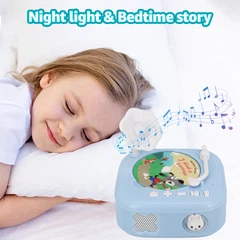
- Comfort Night Light: A soft light behind the front face is designed to help children settle at the end of a story. Because the light belongs to the same object as the story, it replaces a separate bedside lamp instead of adding to the clutter.
- Rechargeable, Cord-Free Operation: A 200 mAh lithium cell recharged over Type-C powers the unit, so an evening of stories needs nothing more than a cable the household already owns.
Typical B2B buyers include toy and gift importers, children's bookshops and museum shops, nursery and kindergarten suppliers, publishers who want a hardware edition of their own titles, gift and promotional distributors, and cross-border sellers building a screen-free early-years line.

3. How Does It Work?
The Kids Phonograph Card Player is built so that a child can use it intuitively, without instructions.
Step 1 - Choose a Card
The child picks a story card from the deck. Choosing is part of the activity: the picture on the card is what a pre-reader uses to decide what to hear, so the illustration does the work a title would do on a screen.
Step 3 - Listen & Settle
The story plays while a soft light rises behind the front face. The light is what turns the device from a toy into part of a routine, and the reason parents keep it on a bedside table rather than in a toy box.
Step 2 - Seat the Card and Turn the Lever
The card goes into the slot and the side lever is turned. That mechanism is the entire interface - one physical action with an audible, visible result - and it is why the product survives contact with small hands that have broken more delicate toys.
Step 4 - Stop, Swap or Simply Stop
The story ends and the child either chooses another card or sets the unit down. Nothing auto-plays, nothing suggests the next item, and nothing keeps glowing once the session is over - which is exactly the behaviour a household is looking for at bedtime.
4. Key Features
| Feature | Description |
|---|---|
| Lever-Started Playback | A card is seated and the side lever is turned to begin the story. One physical action replaces every menu, button pair and touch target, so a pre-reader can operate the unit independently. |
| Sixty Story Cards | The standard pack holds sixty cards - fifty in English and ten in Chinese - and the deck is replaceable. Card artwork, story contents and running order are produced per order. |
| Comfort Night Light | A soft light behind the front face is designed to help a child settle. It works alongside the story rather than as a separate bedside lamp, which is why households keep the unit within arm's reach. |
| No Screen and No App | No display, no account and no network requirement. Nothing auto-plays and nothing queues a next episode, so a session ends when the child decides it ends. |
| 200 mAh Type-C Battery | Rechargeable lithium cell charged over a Type-C port, so ordinary phone chargers, power banks and car adapters all work. No proprietary cable and no disposable cells. |
| Compact Footprint | 116 x 103 x 110 mm and 440 g - small enough for a bedside table or a school bag, heavy enough to stay where it is put when a card is seated one-handed. |
| Gift Carton | A 200 x 155 x 80 mm carton carries the unit and its deck, with artwork and wording produced for the destination market rather than supplied as a generic box. |
| Export Packing | Thirty units to a carton measuring 42.5 x 41.5 x 48.5 cm at 15 kg gross - a two-person lift, and a predictable pallet when a container is split between accounts. |
| Customisable Content | Cards, story contents, logo and packaging are all produced to the buyer's order, so one hardware line can serve several markets, languages and price steps. |
| Globally Certified | CE, UKCA, FCC and RoHS files are held, with CPC; ASTM F963 and EN71 reports are issued where a destination requires them. |

- Bedtime Routine at Home: The unit earns its place by ending a day rather than filling it. A parent hands a child the deck, the child chooses a card, and the story finishes with the light still on - which is why the product ends up on a bedside table instead of in general toy storage.
- Independent Play for Pre-Readers: Because the whole interaction is one physical action, a three or four year old can run the device alone. Nothing has to be read and nothing has to be paired, so there is no state a child can leave the unit in that the next user cannot fix.
- Nurseries, Kindergartens and Libraries: Listening stations work when several children can share one device without supervision, and a lever-start player needs no adult in the loop. Institutions order in multi-carton quantities and keep one deck per room.
- Language and Story Programmes: The deck is produced per order, so one device serves a first-language library, a bilingual library or a curriculum tied to a term. Teachers can hold a single hardware model and change the content per group.
- Gift, Occasion and Promotional Gifting: A gift box, a deck and a keepsake look make the unit a present rather than a purchase, and the light inside gives the gift a second reason to be kept. Printed sleeves and carton artwork carry a client's name without touching the tooling.
- Travel, Hotels and Holiday Accommodation: The unit needs no network, no account and nothing configured, so it behaves identically in a hotel room and a bedroom. Family accommodation and travel retail buyers stock it as equipment rather than as merchandise.
6. Customized Details
As a dedicated children's audio manufacturer, Xinditai supports complete OEM/ODM customization. The eight areas below are the ones buyers change most often, and each entry notes whether it touches the print, the production batch or the tooling:
Story Library and Themes
Define the sixty-card deck yourself: classic tales, a curriculum band, a seasonal set or a licensed property. The running order is part of the brief, because the deck is what a child actually chooses from. This changes the print and the recording, not the machine.
Voice Talent and Languages
Choose the narrator, the pace and the language of the recording, including regional variants where the market expects them. The standard pack ships fifty English cards and ten Chinese cards; other language splits are produced for the order. Voice is the most noticed element of the product and the cheapest to change while the brief is open.
Card Artwork
Illustration follows the buyer's brand or the studio's house style, and the artwork is drawn to match the words rather than chosen separately. Because the picture is what a pre-reader uses to pick a story, artwork and vocabulary are reviewed together.
Shell Colour and Face Design
The body can be produced in the buyer's palette, with the front face designed for a character, a licensed property or a plain decorative pattern. Colour is a batch decision rather than a unit decision, which is why it is planned with the run rather than added to it.
Logo and Branding
The logo is applied to the unit, the cards and the packaging, so the product reads as the buyer's own line on a shelf. Carton wording, the instruction leaflet and any importer marking all come from the same artwork system.
Packaging and Gift Box
The 200 x 155 x 80 mm gift carton can be specified as a colour box, a window box or a keepsake box, with printing matched to the destination market. A printed sleeve over the standard carton is the cheapest way to give one hardware line two price steps.
Additional Card Packs
Because the deck is printed per order, a follow-up set - a holiday library, a second language, a longer edit - can be sold to existing customers without new hardware. This is the repeat-revenue item in the range and the cheapest way to give a listed product new material.
Accessory Bundles
Buyers routinely combine the unit with a carry accessory, a second deck or a gift insert in one outer carton. Anything that changes the mould, the electronics or the light behaviour is a development project rather than an order option, and it is quoted separately.
7. Technology & Product Knowledge
Card Recognition and Audio Mapping
Each story card carries an identifier that the unit reads when the card is seated in the slot. During production the card-to-audio mapping is written according to the customer's story plan, so the order in which stories play follows the order the buyer intended rather than the order the files arrived. Cards are passive and carry no cell, which is what makes an extra deck inexpensive to print and easy to extend.
Audio Library and Storage
The recordings for the deck are loaded in production against the same mapping, so a card and its story are paired before the unit leaves the line. Because the library lives inside the unit rather than in the cloud, playback does not depend on a network, an account or a paired phone - the three things most likely to fail in a child's bedroom. Custom libraries are prepared and loaded in house, which keeps a language change inside the same factory as the hardware.
Lever Mechanism
The lever is the complete user interface, and it is engineered as a mechanism rather than as a decorative part: it is sized for a small hand, travels through a fixed arc, and is assembled so that enthusiastic repeated use does not change the feel between batches. A reference unit is kept from the approved production run, and later runs are checked against that object rather than against a drawing, which is how lever feel stays consistent across the life of a product.
Night Light Behaviour
The light sits behind the front face rather than on a flat panel, so the unit reads as a lit object in a dark room instead of a small screen. It is tuned to come up with the story and to stay gentle, and its level is compared against the reference unit in a darkened room during inspection - because brightness that drifts upward between batches is one of the quietest complaints a children's sleep product can attract.
Power Management
A 200 mAh lithium cell powers the unit and is recharged through a Type-C port. The cell was chosen for the way the product is actually used - a story or two at a time, topped up occasionally - rather than for continuous playback. The charging inlet is checked on the finished unit rather than on the board, because a fault that appears only once the housing is closed reaches a customer instead of a workbench.
Materials and Structure
The housing is moulded with rounded transitions and no protruding handle, antenna or stand, so there is nothing in a small hand to snap off. The lever, the card slot and the light aperture are part of the same moulding rather than glued on, which is why the card loading guide is printed on the body itself. Card stock, ink lay and carton colour are pulled against an approved physical proof before each run, so a deck and its box cannot drift apart in appearance.

8. OEM/ODM Development Process
01 - Requirements Briefing: Share your target market, age range, language mix, story themes, branding assets, packaging preference and estimated volume. Xinditai confirms feasibility, the likely minimum and the realistic schedule, including which requests touch the tooling.
02 - Library Planning: The sixty-card structure is designed with the buyer: how many stories, how long they run, the order they play in and the artwork style. This step decides everything downstream, because the story list is what the recording session and the card print file are both built from.
03 - Script and Voice Recording: Scripts are adapted to the target age, and narration is recorded, edited and level-matched for the unit's speaker. A single spoken spread is approved before the full session, which settles voice, pace and pauses while they are still inexpensive to change.
04 - Card Artwork and Packaging Design: Card illustrations, the front face artwork, the gift carton dieline and the wording for the destination market are produced together, so the deck a child chooses from and the box a parent reads tell the same story.
05 - Sample Production: A working unit is assembled with the buyer's deck, colourway and carton, then shipped for hands-on review. The card slot feeds correctly, the lever travels as intended, and the light reads properly in a darkened room.
06 - Feedback and Revision: The buyer tests the sample the way a family or a classroom would, and returns notes on story order, narration pace, card artwork, lever feel, light level and carton wording. Revisions are made before tooling and printing are finalised.
07 - Golden Sample Approval: A final pre-production unit built from production materials becomes the reference for the run. On this product that means a sealed reference unit as well as a signed sheet, so later batches can be compared with an object rather than with a memory.
08 - Mass Production: Moulding, board assembly, mechanism fitting, card printing, voice loading and final packing are carried out on one site, which keeps a change of deck or language inside the same building as the hardware.
09 - Quality Inspection: Every batch is checked on a signed sheet: card-to-audio match across the deck, lever action against the reference unit, light level in a darkened room, charging and cell behaviour, and print quality against the approved proof. The document set for the destination is assembled before dispatch.
10 - Shipping and Logistics: Units are packed thirty to a carton, marked per destination and dispatched with the paperwork belonging to that batch, through the buyer's preferred forwarder.
9. Quality Control & Safety
Every Kids Phonograph Card Player production unit passes through a multi-stage inspection protocol:
Incoming material inspection covers the housing material, boards, the speaker driver, the light assembly, the cell, the charging cable, the printed cards and the cartons. Functional testing validates power-on behaviour, card recognition across the whole deck, playback of every story in the edition, lever action against the reference unit, light level in a darkened room and charging behaviour on the finished article. Card inspection checks print quality against the approved proof, plus the make-up of the deck - the right number of cards in the right order. Finished cartons are checked for marking accuracy and packed condition.
Certifications
The unit is certified under CE, UKCA, FCC and RoHS, with CPC held for the children's product route in the United States. ASTM F963 and EN71 reports are issued where an importer or a marketplace requires them. The document set is prepared for the destination, refreshed with each batch and dispatched alongside the goods it describes.
Material & Volume Safety
The housing is moulded with rounded transitions and no sharp edges, and the card slot and lever are built so that small parts cannot work loose in normal use. Audio output is calibrated to a child-safe listening level, because this is a product designed to be held close to a face at bedtime. We would rather build that limit into the hardware than rely on a parent noticing a volume setting.
Drop & Durability Testing
Production samples are drop-tested onto hard surfaces and put through repeated lever operation, and the card slot is cycled to confirm that a deck can be loaded and changed without wearing the guide. Copies from each batch are held as reference units, so a question about batch five is answered by comparing it with batch one rather than by discussing impressions. We do not publish a failure rate we cannot substantiate; what we offer is a signed inspection record and a carton code that traces back to the batch.
10. Why Partner With Xinditai?
Shenzhen Xinditai Electronic Co., Ltd. is a manufacturer of children's audio and interactive products, building since 2010 across a site of about 3,000 square metres with more than one hundred engineers and operators. The range covers card-reading phonographs, talking flash cards, story machines, talking books, projection toys and musical items, and every programme runs as OEM or ODM work for distributors, publishers, retail groups and brand owners worldwide. Content and hardware are produced in the same building: card printing, voice recording, mechanism fitting, acoustic tuning and final packing happen on one floor, so a change of deck, language or colourway never becomes a coordination problem between suppliers. Custom orders start at 1,000 pcs, with a first batch of 200 to 500 units available for a market test, and buyers are welcome to visit the plant or walk the lines over a live video call.
11. Kids Phonograph Card Player FAQ
Q: What is a kids phonograph card player?
A: It is a screen-free audio toy for young children. A story card is seated into the slot and a side lever is turned, and the recorded story begins while a soft light comes up behind the front face. There is no display, no account and no network requirement, so a pre-reader can use it unaided.
Q: How many story cards come with the unit?
A: The standard pack carries sixty cards, fifty in English and ten in Chinese. The deck is replaceable, and the cards, the story contents, the logo and the packaging are all produced to the buyer's order, so a different library is a print run rather than a new product.
Q: Does it need an app, a network or a subscription?
A: None of the three. The library is loaded into the unit at the factory against the card mapping, so playback depends on nothing but the card and the lever. That is deliberate - the failures a household remembers are the ones that happen when a phone is on the wrong network.
Q: How is the unit powered?
A: A 200 mAh lithium cell recharged through a Type-C port. Standard phone chargers, power banks and car adapters all work, so the household does not need a dedicated cable or a supply of disposable batteries.
Q: What can we customise on an OEM order?
A: The story library and its running order, the narrator and the language mix, the card artwork, the shell colour and face design, the logo and branding, the packaging, additional card packs, and the accessory bundle. Anything that changes the mould or the electronics is a development project rather than an order option, and it is quoted separately.
Q: What is the minimum order for a custom run?
A: Production runs start at 1,000 pcs. A first batch of 200 to 500 units is available where a buyer wants to test a market, at a unit cost that is credited back against the full order. Samples of one to five pieces leave five working days after payment clears.
Q: Which certifications are held?
A: CE, UKCA, FCC and RoHS files are held, together with CPC. ASTM F963 and EN71 reports are issued for destinations that require them, and the document set is prepared per market and shipped with the batch it describes.
Q: How long does it take to change the language or the stories?
A: It depends on the length of the deck rather than on the hardware, because the artwork, the paper and the tooling stay where they are and only the recording and the print change. Send us the deck length and the destination and we will return a realistic date rather than a hopeful one.
12. Contact Us
Ready to launch your own phonograph line, or to price a custom edition against a language and a volume? Send us your target market, language mix and quantity.
Email: xdt01@dtdianzi.com
WhatsApp / Mobile: +86 139 2381 3463
We reply within 24 hours with a tailored quotation.
Hot Tags: kids phonograph card player: story card audio toy manufacturer & oem/odm sourcing guide, China, suppliers, manufacturers, factory, customized, wholesale, bulk, quotation, made in China


