




Custom Big-Eye Kids Story Projector Manufacturer
A buyer-focused OEM/ODM product page for a friendly yellow projector concept designed around shared storytelling, portable setup and controlled engineering validation.
A custom kids story projector succeeds when its character form, optical system, audio, content and packaging are developed as one verified experience. Contact Joy on WhatsApp: +86 13691793052 · E-mail: xdt05@dtdianzi.com.
Approve the big-eye identity before choosing electronics
The commercial value starts with the friendly yellow body, circular lens surround and high carry handle. Together they read like a small character rather than generic AV equipment. A custom kids story projector brief should freeze these visible cues first, because optical, battery and speaker decisions can otherwise stretch the shell or move the controls.
Ask for aligned front, side and top photographs of the appearance sample. Mark the lens center, handle arc, corner radii and top ring position. When these reference points are recorded, the industrial-design team can evaluate internal revisions without losing the expression buyers selected.
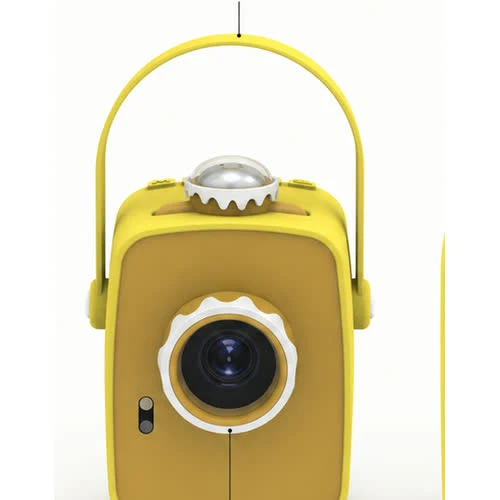
Front profile for a custom kids story projector
The centered lens, rounded yellow enclosure, raised carry handle and top control ring create the product's recognizable "big eye" expression. Buyers should use this clean view to approve proportion, color separation and lens alignment before packaging artwork is frozen.
Define one repeatable story session
Start with a simple sequence: an adult places the unit, prepares the room, selects content, focuses the image, starts playback and ends the session. That sequence reveals the real requirements for controls, content media, sound and power more clearly than a list of features.
The pictured concept does not prove a particular resolution, brightness, runtime or content system. Treat those as engineering choices. A useful specification names the target surface, expected viewing distance, ambient-light condition, session length and responsible operator before suppliers quote an optical platform.
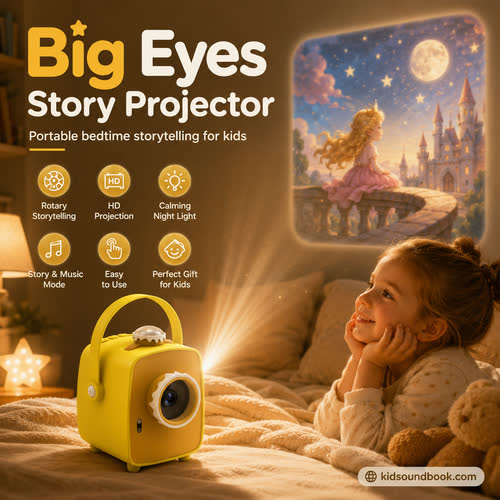
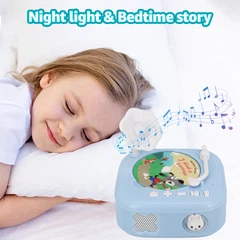
Bedtime projection as a real use condition
A dim bedroom changes how projected color, focus and sound are perceived. This scene is useful for discussing throw distance, wall tone, control visibility and whether the device can be positioned without encouraging a child to look into the lens.
Separate the optical target from marketing language
Projection quality depends on several variables that should be measured together: focus uniformity, color balance, readable detail, image geometry, throw distance and ambient light. A single "HD" label does not show how a sample behaves on a child's bedroom wall.
For prototype review, use the same test image at several distances and photograph the center and four corners. Record the room lighting and wall color. This evidence gives an OEM projector toy manufacturer a concrete correction list and protects the buyer from comparing unrelated claims.
Build the enclosure around the lens path
The round front opening dominates the face, so the optical engine needs firm support without making the surrounding plastic bulky or uneven. Lens position, ventilation and internal cable routes must be planned before tooling. Decorative rings should not interfere with focus movement or service access.
Request a cross-section showing the lens barrel, front bezel, PCB and speaker envelope. During a drop or vibration review, check whether the optical alignment shifts. A visually centered lens can still project unevenly if its internal mount twists under assembly pressure.

Portable family story projector routine
The handle and compact body suggest movement between rooms, but portability must be validated with weight, cable storage, drop resistance and adult setup steps. A family scene helps buyers define who carries, places and operates the finished product.
Make the handle useful rather than decorative
The tall handle suggests portability and is a strong retail cue, but it also creates leverage during carrying and drops. Its hinge, stop angle, clearance and attachment points need their own test plan. Small fingers should not be trapped between the handle and body.
Review the handle in raised, lowered and half-moved positions. Load testing should use the complete product, not an empty housing. Buyers should also check whether the handle blocks controls, packaging closure or ventilation when folded.

Gift-ready packaging concept for projector toys
Packaging must protect the lens, handle, controls and any story media while explaining the first-use sequence. The pictured concept supports discussion of tray retention, accessory counting and multilingual instructions; final claims must match the approved hardware.
Design controls for a dim room
Top controls may be convenient for adults setting up bedtime content, yet shallow icons can disappear in low light. Button spacing, tactile difference and operating force should support use without requiring the operator to stare into the front lens.
Create a control map that identifies power, focus, content selection, volume and any mode change. Run a blind-touch trial with the unit placed at its intended height. If two controls feel identical, change shape or spacing before finalizing the top panel.
Choose content architecture before tooling
Story discs, cards, onboard files and connected libraries create different mechanical and software obligations. Removable media needs orientation, retention and counting; onboard content needs memory and update planning; connected content adds accounts, privacy and ongoing service ownership.
The buyer should select one primary route and document fallback behavior. If no network is available, what still works? If media is inserted incorrectly, what feedback appears? These decisions affect firmware, packaging and customer support as much as the enclosure.

Component access and service planning
An exploded concept helps engineering teams discuss enclosure halves, optical path, PCB position, speaker clearance and battery access. It is not a production drawing, so every internal part, fastening method and electrical specification still needs confirmation during development.
Treat sound as part of the story experience
Narration must remain intelligible at the intended listening distance without harshness or enclosure buzz. Speaker direction, grille area, cavity volume and plastic thickness all affect the result. A loud bare module is not evidence of good performance inside the finished body.
Test spoken passages, music and quiet effects at several volume levels. Listen from the front, side and typical seating position. If a fan or optical system adds noise, measure intelligibility while the product is projecting, not while it is idle.
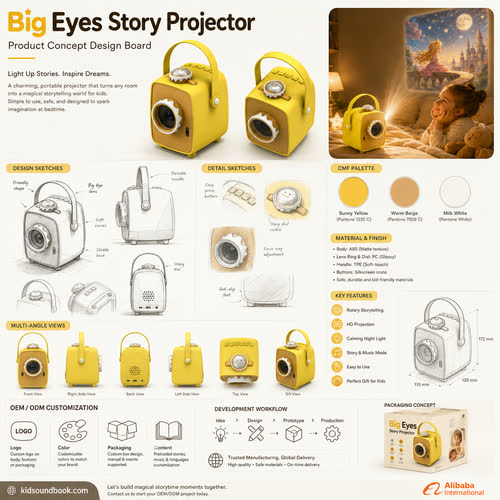
Industrial design review for OEM development
A design board brings silhouette, color direction, handle geometry and control placement into one review. Buyers can mark fixed brand cues separately from negotiable engineering details, reducing the risk that a late module change alters the character unexpectedly.
Plan power, charging and thermal behavior together
Battery type, charging method, session length and heat management are linked. A compact yellow shell leaves limited room for separation between the optical engine, battery, PCB and speaker. Unverified runtime claims should stay out of the listing.
Ask engineering to map heat sources and accessible surfaces during the longest intended session. Confirm cable strain relief, charging-state indication and low-power behavior. The sample should shut down predictably rather than distort the image or audio as voltage falls.
Use staged prototypes to close different risks
An appearance model can confirm shape and color. A bench optical build can compare lenses and light sources. A functional engineering sample combines controls, content and sound, while a production-intent sample tests the selected architecture inside final materials.
Label every sample by purpose and revision. This prevents a beautiful rendering from being treated as proof of electronics and keeps comments focused. OEM/ODM product development moves faster when each review closes named questions instead of reopening the entire brief.

Calm projection experience without a handheld screen
Warm lighting and a simple projected story illustrate the intended emotional outcome rather than a verified brightness level. The scene helps teams discuss ambient light, image size, session duration and audio pacing before they choose an optical or content architecture.
Turn packaging into the first setup guide
A gift box must protect the front lens and handle while making accessories easy to verify. The first visible panel should describe the actual product route, not a future feature list. Inside, the sequence of tray, guide, cable and story media should match first use.
Run a pack-out audit with a numbered checklist. Photograph the box before and after transit testing, then inspect lens protection, handle pressure and accessory migration. A retail concept is useful for alignment, but dielines and claims require final hardware confirmation.

Shared storytelling instead of passive viewing
Projection can become a social prompt when an adult pauses, asks questions and changes the story pace. Product teams should decide whether interaction comes from physical controls, removable media, narrated tracks or a companion experience, then test that exact route.
Control color and surface finish across parts
The mustard-yellow body, cream lens ring, metallic-looking top ring and dark lens create the friendly visual hierarchy. Different plastics, paint or molded finishes can shift under warm bedroom lighting and make the face look mismatched.
Approve physical color chips and textured plaques, then compare them beside the assembled sample. Photograph under neutral and warm light. If the buyer adds seasonal colors, keep the lens surround and key proportions stable so the range remains recognizable.
Test the product in the room it is designed for
Bench measurements matter, but placement reveals usability failures. A bedside surface may be lower than the projection area, a pale wall may sit at an angle and nearby soft furnishings may absorb sound. Cables and controls must remain manageable.
Set up a realistic bedroom mock-up and ask a new operator to complete the first session using only the draft instructions. Record pauses, wrong turns and focus adjustments. These observations often improve industrial design more than another feature discussion.

Gift set presentation and accessory control
A gift presentation should make every included item visible and easy to count. Buyers can use this image to plan inserts, story discs or cards, charging accessories and printed guides without assuming that every pictured item belongs to the final commercial set.
Prepare quality evidence before pilot production
Inspection criteria should cover cosmetics, lens alignment, handle movement, control response, media recognition, audio, charging and stable operation. Each item needs a test method and acceptance example, not only a general instruction to "check function."
During pilot production, compare samples after packing and repeated sessions. Watch for loose lens rings, color drift, control inconsistency, rattles and projection changes. Update work instructions and inspection photos before volume grows.

Controls that can be found in low light
The top ring, handle joints and front lens surround are natural touch points. Prototype reviews should check operating force, icon readability, accidental activation, pinch clearance and focus adjustment while the unit is placed at its intended height.
Keep every public claim tied to the approved build
The artwork suggests portable storytelling, projection, sound and gift packaging, but only the final verified product can support specific performance statements. Resolution, brightness, battery life, content quantity and safety marks must come from controlled evidence.
Maintain a claim sheet linking each listing statement to a test report, specification owner and product revision. When firmware, optics or content changes, review the sheet again. This protects buyers and gives sales teams a reliable story.
Build the quotation around decisions, not assumptions
A useful quotation identifies what is fixed, what remains optional and what evidence is required before each cost becomes firm. Separate appearance development, optical evaluation, electronics, firmware, content preparation, packaging and verification so buyers can see which changes affect tooling or another discipline. If the project begins from a buyer-supplied platform, provide controlled drawings, interface definitions and change notices rather than expecting the enclosure team to infer requirements.
During sample review, maintain one issue list with photographs, owners and target dates. Close appearance comments before changing colors again; close optical questions before promising image performance; close content and user-flow decisions before printing instructions. This sequence does not remove iteration, but it prevents the same uncertainty from moving between teams. It also gives procurement a fair basis for comparing suppliers because every quote responds to the same product definition.
Move from a friendly concept to a controlled commercial build
Freeze the big-eye silhouette and one primary story session, then validate optics, sound, controls, power, handle durability and packaging through staged samples. The strongest program is not the one with the longest feature list; it is the one whose claims, instructions and retail promise match the approved build. Record the approved revision in photography, specifications and packaging so later changes remain visible to every team.
For additional category context, read our 2026 guide to kids story projectors. Joy shares visual product-development updates for buyers reviewing new concepts and samples.
FAQ
Can the yellow body, handle and lens surround be customized?
Yes. Color, surface finish, graphics and packaging can be developed from a buyer brief, subject to mechanical review and physical sample approval.
Does the concept artwork prove HD projection or a specific runtime?
No. Resolution, brightness, focus range, battery life and content capacity must be defined and verified on the selected production-intent hardware.
What should a buyer provide for a quotation?
Share the primary use case, target market, visual requirements, expected content route, operating environment, languages, packaging direction and any required hardware platform.
Why test the projector in a bedroom mock-up?
Room light, wall color, placement, sound absorption and user behavior can reveal problems that are not visible during a bench demonstration.
Discuss your projector-toy brief directly with Joy: WhatsApp +86 13691793052 · E-mail: xdt05@dtdianzi.com.
Hot Tags: custom big-eye kids story projector manufacturer, China, suppliers, manufacturers, factory, customized, wholesale, bulk, quotation, made in China


