





 |
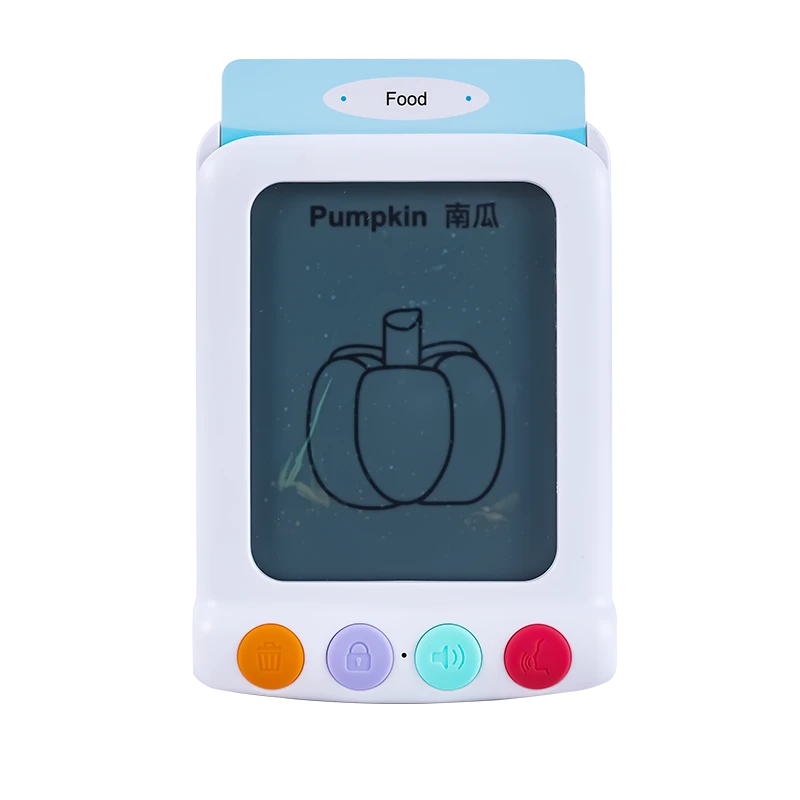
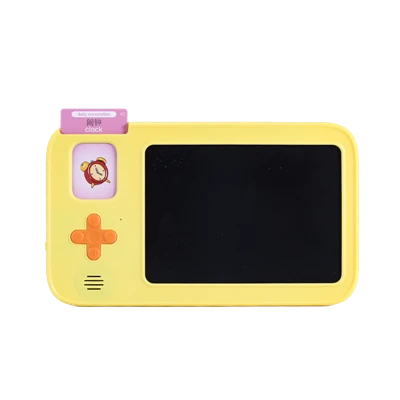
Custom Talking Flash Card With Copying Tablet - Specs, Stroke Prompts and OEM/ODMThe kids copying card learning machine merges a card reader and an LCD writing board in one handheld unit. A card goes in, the word is spoken, and the child copies the line on the screen below. No paper, no app, no account. Built by Shenzhen Xinditai Electronic Co., Ltd (since 2010), the format is sold as an OEM/ODM platform: theme, word list, native voice, shell color and packaging are all opened per project. Discuss a custom configuration with our factory team. |
What a Copying-Tablet Flash Card Actually Does
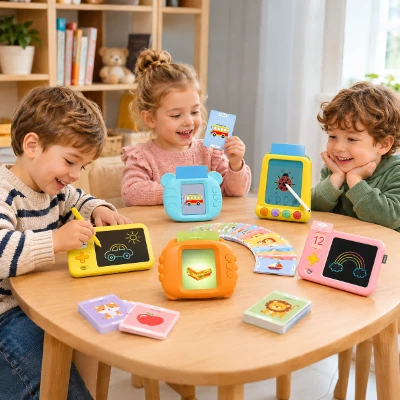
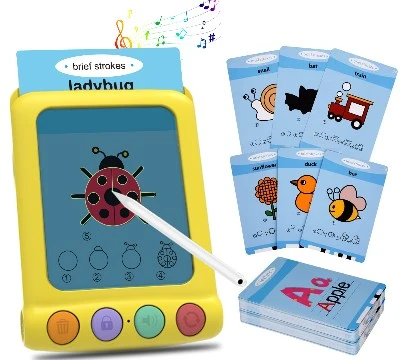
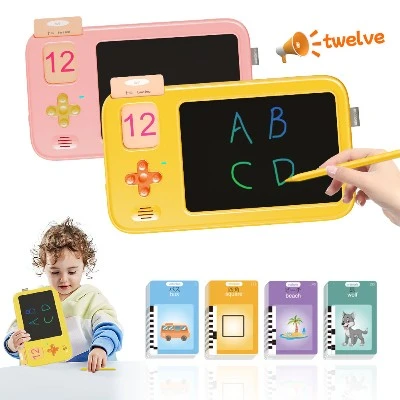
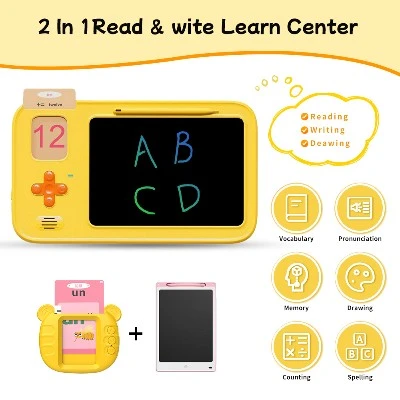
Call it a tracing-card format and the mechanism is easy to picture. The talking flash card machine with copying speaks a step-by-step stroke prompt the moment a card is inserted, then leaves the child to copy that line on the LCD panel. The audio and the writing surface are on the same device, so the prompt and the action stay linked in one interaction.
This is not the same as a plain reader. A talking flash card learning machine stops at vocabulary playback. The copying variant adds a reusable writing layer, which changes both the bill of materials (an LCD panel and stylus) and the use case - from "hear the word" to "practise the word".
The Interaction Flow, Step by Step
What the child experiences is simple. What the device does behind it is why the format is priced and tested the way it is.
- A printed card is seated in the slot; the reader identifies it by its printed code rather than a chip on the card.
- The unit pulls the matching audio from internal memory and plays the word - and, on the copying format, the stroke prompt - locally.
- The child writes the character or letter on the LCD panel with the stylus; one press clears the surface for the next card.
- Repeat, erase, repeat. Nothing is consumed, and there is no paper cost per use.
The engineering decision worth naming: recognition is local, not cloud-based. Audio is stored in the device, so the unit works with no Wi-Fi, no app and no account. The trade-off is that content cannot be pushed over the air - a new theme means new cards or a reloaded audio set, which is why content is frozen early in an OEM program.
 |
 |
Specifications - Confirmed Facts vs. Project-Dependent Values
The figures below describe the documented flash-card platform range. Shell size, card count and storage differ between formats, so the table separates what is published from what is fixed at sample sign-off. Final values belong in the approved quotation and pre-production sample - not in a catalogue promise.
| Item | Documented value |
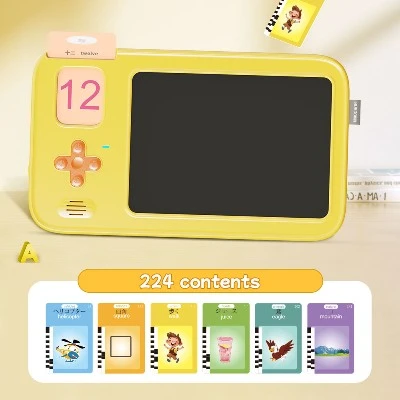
| Card set (leading set) | 112 double-sided cards / 224 words / 14 themes |
| Drawing-tablet unit | 112 preloaded cards, 200+ card capacity, stylus |
| Pocket-shell size | 85.3 × 99 × 20.7 mm patented housing |
| Reference device size | 99 × 86 × 21 mm; 285 g unit weight |
| Export carton | 40 pcs; 29.5 × 27.5 × 40.5 cm; 12.5 kg gross |
| Recommended age | 36 months and up |
| MOQ | 1,000 pcs category standard; project-specific on request |
| Audio / language / shell color | Customized per project - confirm at sample |
Notice what is deliberately absent: no lead-time number and no certification promise. Lead time and export documents depend on the destination market and on whether new tooling is cut, so they are agreed per project. A supplier who quotes them before seeing your content brief is guessing. Our OEM/ODM overview explains how variable items are handled.
Customization Scope - Four Projects in One Order
A private-label copying-tablet program is really four parallel workstreams. Each can stay standard or be opened, which is how a first order stays affordable while a full brand program still gets its own identity.
Content and artwork
Custom word lists, subjects, illustrations, school lessons and licensed content. The card is the media, so artwork and code legibility have to be designed together - a beautiful card that will not read is a return, not a feature.
Language and voice
Languages, accents, bilingual pairings and native-speaker MP3/WAV audio are customized. Recording in the destination language rather than translating an English master is the choice that decides whether a parent hears a natural voice.
Hardware and appearance
Standard readers, LCD writing formats, copying tablets and NFC card readers; logo, shell color, printed cards, labels and manuals follow the same visual system.
Packaging and compliance planning
Color boxes, inserts, barcodes, gift sets and display packaging, with materials and testing planned for the destination market. Buyers also serving audio-led ranges can reuse the workflow behind our projector toys and story players.
 |
 |
From Content Brief to Released Carton - Six Gates
Each gate has a signed output. That is what keeps a large repeat run identical to the sample you approved, and it is more useful than a promise of "strict quality control".
- Requirements - market, language, themes and quantity are written down.
- Design - artwork, audio, logo and packaging are laid out together.
- Prototype - a working sample is built for review.
- Approval - the production standard is confirmed.
- Production - printing, audio loading and assembly run in-house.
- Inspection - function checks and release before shipment.
Inspection is built around how these toys actually fail, not around cosmetics. Incoming card stock, housings, PCBs, speakers and batteries are checked; audio files are verified for completeness, pronunciation, volume and clarity; every unit is tested for power, card recognition, repeat, volume and charging; a final appearance and packaging check precedes release.
An OEM rule that saves rework: the configuration sent for testing must be the configuration that ships. Change the speaker, the card stock or the firmware volume cap after approval and you own a new round of verification - however small the part looks.
 |
Factory-direct since 2010. A 5,000 m² Shenzhen facility runs in-house R&D and tooling with a daily capacity above 20,000 units. Audited systems. ISO9001 quality management and BSCI / SEDEX social compliance; export test reports are prepared for the destination market. Electronics development, audio loading, card printing, assembly and packing are coordinated in one manufacturing system. Meet the company or request a sample plan. |
Who Buys This Format
Home-learning brands use it for independent vocabulary practice and screen-free play. Preschools use theme-based sets for repeatable classroom activity. Speech and language programs value the visual prompt plus repeatable audio. Publishers and IP owners use a private-label reader to turn licensed characters into a line, where a new title is a new card set rather than a new mould.
FAQ - Custom Copying-Tablet Flash Cards
What is the MOQ for a custom copying-tablet set?
The category standard is 1,000 pieces. Samples, stock products and fully customized projects can differ, so the figure is confirmed against your format and content scope.
Can I supply my own words, illustrations and voice files?
Yes. Card content, artwork and audio can be supplied or produced in-house; native-voice recording, bilingual pairings and MP3/WAV mastering are available, and existing recordings can be mapped to the card IDs.
Does the reader need Wi-Fi or an app?
No. Audio is stored inside the unit and playback is offline, which removes app-store approval, account creation and data cost from the model.
Which export documents can be supported?
Requirements depend on the destination market. Common programs include CE, EN71, RoHS, FCC, ASTM F963 and CPSIA, with final clauses confirmed project by project. Tell us your market for adocument checklist.
Build Your Custom Copying-Tablet Flash Card Range
Send your target market, language, card themes, product format and estimated quantity. Get a format recommendation, a quotation and a sample plan from the factory - not from a broker.
Get a Custom QuoteHot Tags: custom talking flash card with copying tablet — specs, stroke prompts and oem/odm, China, suppliers, manufacturers, factory, customized, wholesale, bulk, quotation, made in China


