


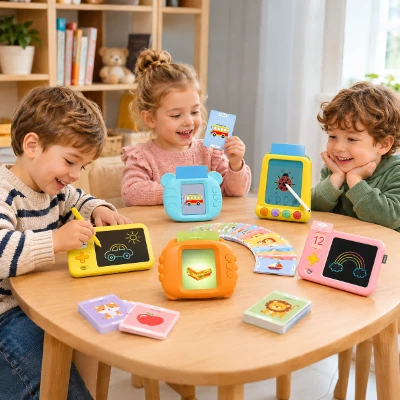

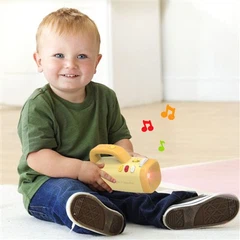


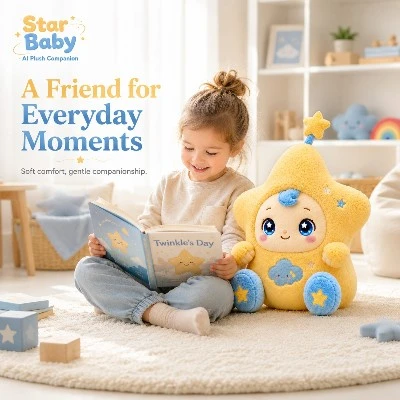
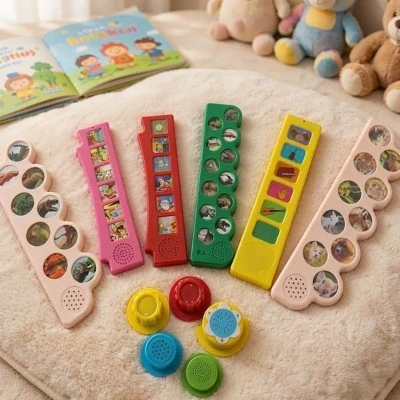




Each story disc in the toast-shaped player prints its own title and cover illustration behind the front window, so a four-year-old who cannot read a word can still identify which story is loaded. The unit holds one disc at a time, and the window becomes a shelf label the child reads in pictures. That single design decision turns a set of cards into a first library, because a library is defined by the ability to find a title rather than by the number of titles owned. A collected stack that a child can navigate alone is what separates a library from a pile.

The Printed Title Solves a Pre-Reader Problem
Conventional card-based players ask a child to recognise a story by its card, and cards stored loose lose their identity the moment they are shuffled into a drawer. A child who cannot read cannot restore order to a collection, so the collection quietly stops being a collection.
The toast player closes that gap by placing the identifier where the child looks.
The artwork is the primary cue. A cottage in a flower meadow, a bear with an open book, a girl and a bear under a leaf canopy: each disc announces its content in one image, and the image sits at eye level because the unit is short enough to stand on a low shelf.
The printed title is the secondary cue. A title in large type becomes a word a child learns to recognise before learning to read, which is the same mechanism that turns a favourite book cover into a sight word.
The third cue is the disc itself. A disc that the child loads and unloads is an object with a front and a back, and physical ownership of a story is what a streamed file never offers.
How a Disc Library Works
The mechanics are simple by design, and each step returns control to the person listening.
A disc seats behind the window, and the arm is swung inward to begin. The window keeps the cover visible for the whole session, which means the child looks at the title while hearing the story. Repetition pairs the printed word with the spoken word, and that pairing is the earliest form of reading readiness.
The top slot accepts a card that carries the same story for a player without a disc, so one content library can serve two hardware formats. A brand that owns its audio can move it between formats without re-recording anything, which lowers the cost of testing a new body shape.
Storage is the part most programs neglect. Loose discs scratch, cards bend, and an adult forced to hunt for a story stops beginning sessions. A supplied sleeve or a shallow tray that holds a dozen discs keeps the library legible. The container is not packaging, it is the catalogue, and a catalogue that lives in a drawer is a catalogue nobody consults.

Building a Collection Rather Than a Playlist
A collection has rules that a playlist does not, and the rules are what make it commercially durable.
Series logic. Discs grouped by world rather than by length give a child a reason to want the next one. Three stories set in the same meadow accumulate meaning, while three unrelated stories sit side by side without accumulating anything.
Visible progress. A numbered spine or a dot on the cover lets a child see that four of eight exist. A visible gap is the oldest and most reliable driver of a second purchase, and it works on the child as effectively as it works on the collector.
A named protagonist. A returning character converts a purchase into a habit, because a child asks for the character rather than for the product.
Age grading. A disc built for a two-year-old will not hold a five-year-old, and a printed age mark lets a gift buyer choose without asking.
The commercial consequence is straightforward. A single unit sold with four discs creates a customer, while a unit sold with one disc creates a transaction, and the difference shows up in the reorder rather than in the first invoice.

What a Buyer Should Stock
|
Library Layer |
What Ships |
What It Adds |
Retail Role |
|
Starter disc |
One illustrated story with a printed cover |
A working product on day one |
Opening price point |
|
Theme set |
Three stories in a shared world |
Familiarity and repeat listening |
Mid-price bundle |
|
Character series |
Six discs around one protagonist |
A reason to return for the next |
Ongoing replenishment |
|
Bedtime selection |
Calm stories with a warm-light cue |
Predictable wind-down use |
Gift pairing |
|
Language set |
The same stories voiced in another language |
Access to bilingual households |
Market extension |
|
Storage sleeve |
A printed wallet for a dozen discs |
Order that a child can maintain |
Add-on sale |
The table is also a stocking plan, because a shelf that carries only the starter disc cannot sell the second purchase. Retailers who stock one SKU and expect library behaviour are buying a product and refusing the category.
Naming, Recall, and the Pleasure of Choosing
The behavioural payoff of a navigable library is larger than it looks.
Choosing is the part of the session a child owns. An adult sets the time, the room, and the end; the child sets the story. That division gives a small person a decision inside a routine that is otherwise decided for them, and a routine with one owned decision produces less resistance than a routine with none.
Recall grows alongside the collection. A child who has heard six stories begins to link a cover to a plot, then a plot to a feeling, and eventually asks for a specific story by describing the character. That request is the earliest form of literary preference, and it needs a shelf to point at.
Repeated listening does the remaining work. A story heard often enough becomes predictable, and prediction is where comprehension starts, because a child who can guess the coming line is testing memory rather than receiving a feed.
The object also survives use in a way that a screen does not. A flocked crust absorbs the knocks of daily handling, the window protects the cover from fingers, and the discs are swapped rather than bent. A library that still looks intact after a year is a library a family keeps rather than clears.

Frequently Asked Points
Content format - One illustrated disc behind the front window at a time, with a card option on the top edge for the same story in card form.
Cover visibility - The window keeps the cover and title in view while the story plays.
Library size - A supplied sleeve holds around a dozen discs, and the range expands by theme and character rather than by single titles.
Identification - Every disc carries its own title and illustration, so a pre-reader can find a story without help.
Language - One build plays discs voiced in different languages, which lets a household mix two.
Age grading - Discs carry a printed age mark so a gift buyer can match a story to a child.
Starting playback - The arm is swung inward to begin a story and lifted to end it.
Order volume - Initial volume is 480 units per set, and a prototype can be ordered as a billed single unit.
Contact
For OEM and ODM programs covering story libraries, language versions, series design, and printed sleeves, contact SHENZHEN XINDITAI ELECTRONIC CO., LTD at happy@xinditai.com, +86-138-2434-3309 (WhatsApp and WeChat), or visit www.kidsoundbook.com.
Hot Tags: a child's first library fits in a bread slice, China, suppliers, manufacturers, factory, customized, wholesale, bulk, quotation, made in China


